Receptor
Historical document, translated for reference. It reflects medical knowledge of the 1920s–30s and is not medical advice.
Summary
The article explains the receptor theory introduced by Ehrlich in 1907, describing how receptors on cells bind with substances including nutrients and toxins, and how this relates to antibody formation. It also discusses bacterial receptors used for serological differentiation of bacteria.
Encyclopedia article (1928–1936)
RECEPTOR, a term introduced into immunology by Ehrlich in 1907 when he presented his theory of side chains (see Immunity). According to this theory, a cell by analogy with a benzene nucleus consists of a neutral chemical nucleus (Leistungskern) and a large number of atomic groups, side chains (Seiten-kette) or R., which carry out the functions of assimilating various nutrients (nutri-receptors). According to Ehrlich's theory, the nutritional material depending on its chemical composition binds with certain cellular R. with the help of a haptophoric group (see). With the help of R., substances not only nutritional but also poisonous to the organism, for example toxins, can bind with cells. If R. combine with substances not assimilable by cells, then in place of these R. becoming disabled, the cell produces new ones and in greater quantity according to the law of excessive regeneration by Weigert; the newly produced R. are cast off into the bloodstream and play the role of antibodies. According to the mechanism of action, Ehrlich divides R. into several types: R. of the first, second, and third order (see Immunity). Ehrlich called the freely circulating receptors in the blood haptenes (see figure). In addition to the listed receptors, Ehrlich also proposes another type—chemo-receptors, which differ from nutri-receptors in their inability to be cast off from cells. Various chemical substances, when fixed by chemo-receptors, can penetrate into the cell and cause its death. If, however, the fixation of poisonous substances occurs gradually, chemo-receptors lose their affinity for them, which leads to the formation of drug-resistant strains of microorganisms. Ehrlich's theory is highly conditional and is rejected by most researchers due to its lack of substantiation. The term R. is also used to denote several types of agglutinogens found in bacteria and causing the formation of corresponding antibodies-agglutinins during immunization. For the first time, R.-agglutinogens of the double type were discovered by Weil and Felix in Bact. Proteus X19. These two receptors O and H according to the terminology of the authors cause the appearance of fine-grained (O) and coarse-grained (H) agglutinins. In Bact. Proteus X19 the O-receptor is thermostable and carries specificity, whereas the H-receptor is thermolabile and non-specific (Sachs). In the typhoid-paratyphoid group, during the study of the receptor apparatus, two receptors have also been identified (Weil, Felix and others), and in contrast to the proteus group, the thermolabile H-receptors are carriers of specificity, while the thermostable O-receptors are non-specific. - The work of a number of authors (de Rossi, Seitz, Jotten, Braun and Lowenstein) has shown that H-receptors are connected with the flagellar apparatus, while O-receptors are connected with the endoplasm of the bacterial cell. Cultivation for the formation of flagella under unfavorable conditions (addition of carbolic acid, sublimate, alcohol, etc. to nutrient media) leads to the loss of corresponding agglutinogens.
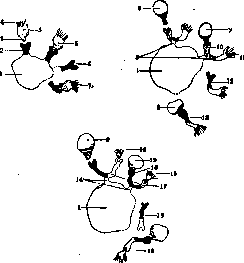
Ehrlich's receptor theory: 1-body cells; 2-receptor of the first order; 3-haptophoric group of toxin; 4-toxophoric group; 5-toxin; 6-cast off receptor (free antitoxin); 7-toxin neutralized by antitoxin; 8-receptor of the second order; 9-bacterial cell; 10-haptophoric group; 11-zymophoric group; 12-free agglutinin; 13-agglutinin bound with bacterial cell; 14-receptor of the third order (amboceptor); 15-complement; 16-cytophilic group; 17-complementophilic group; 18-free immune body (amboceptor); 19-immune body (amboceptor) with bacterial cell and complement. (According to Kolle and Getch.)
The discovery by Weil and Felix of the double type of R. formed the basis of modern serological differentiation of bacteria. The nature of the receptor apparatus is in close connection with the variability of colony form. The work of a number of authors (Andrewes, Aoki and his school) has shown that in the typhoid-paratyphoid group there occur 'specific' and 'non-specific' forms of bacteria. By using agglutinating sera from specific and non-specific strains, Aoki and Kaufman made a fine serological differentiation in the paratyphoid group.
e. Bunin.
Related articles
Mentioned in
Cite this page
“Receptor.” Soviet Medical Encyclopedia. English translation of Bolshaya Meditsinskaya Entsiklopediya, 1st ed. (Moscow, 1928–1936), ed. N. A. Semashko. https://sovietmedicalencyclopedia.pages.dev/article/receptor/