Human Motorics
Historical document, translated for reference. It reflects medical knowledge of the 1920s–30s and is not medical advice.
Summary
Human motorics refers to the anatomical and physiological mechanisms that implement motor functions, where each movement is a reaction to external stimulation expressed through muscle contraction. While muscles can contract autonomously without nervous system involvement, in physiological conditions, muscle contractions are primarily mediated through the nervous system.
Encyclopedia article (1928–1936)
HUMAN MOTORICS (from Latin motus - movement), the aggregate of anatomophysiological mechanisms that carry out motor functions. Each motor manifestation of the organism represents a reaction to external stimulation and is expressed through muscle contraction. Thus, the final organ for implementing motor function is the muscle. The latter is an organ specially adapted to the contractile function. As some individual examples observed in the lowest animals show, muscle contraction can be caused directly by external stimulation, i.e., without the participation of the nervous system. This autonomous muscular contractility also exists in higher animals. The clinical method for detecting this muscular contractility independent of the nervous system ('idiomuscular contractility') is the stimulation of muscles by direct mechanical impact (a short strike with a percussion hammer). But this autonomous excitability of muscles has no essential significance in human motorics, since under physiological conditions, muscle contractions are not caused by direct stimulation of the muscles but with the participation of the nervous system. So1 ?
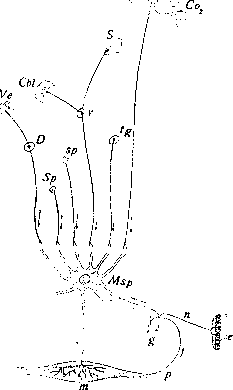
Diagram of the main apparatuses of human motorics: m-muscle; Msp-motor cell of the spinal cord; r-proprioceptive fiber (tendon); e-exteroceptive fiber (skin); p-periphery, sensory nerve; d-intervertebral node; g-red nucleus. Other designations are explained in the text.
The closest element of the nervous system directly connected to a muscle is the motor cell of the anterior horn of the spinal cord (Msp in the figure); it is also the intermediate stage for all impulses, no matter from which parts of the nervous system they are directed to the muscle. The simplest and shortest way for the spread of irritation from the external environment to a muscle is the segmental reflex act, the essence of which consists in the spread of irritation arising in the peripheral apparatus of deep or superficial sensitivity along the sensory nerve through the gray matter of the spinal cord and the motor nerve to the muscle (r, e-p-Msp-t). This form of motor act, carried out within the limits of one segment, represents the most primitive way of carrying out a motor reaction, already existing at the lowest stages of phylogenetic development.--With the formation of the metameric type of structure (see Metamerism), there arises a need for the combined action of a series of segments. In the overwhelming majority of cases, motor reactions are based on the combined action of a series of muscles, i.e., irritation of motor cells of several segments. For this purpose, a connection between individual segments of the spinal cord is necessary. The anatomical substrate of this intersegmental connection is fasciculus proprius, or the main bundle—a part of the white matter directly adjacent to the gray matter along its entire circumference and representing a collection of fibers establishing the connecting link between neighboring segments; thanks to intersegmental connections, irritation affecting the receptor apparatus of one segment can cause a combined motor reaction from a number of neighboring segments (Sp in the figure). Development in the anterior part of the cephalic section, which directs the activity of the spinal cord segments and carries out reactions of the organism as a whole, led to the creation in the corresponding nervous apparatus, i.e., in the brain, of such anatomical-physiological mechanisms by means of which combined motor reactions of a series of segments could be carried out. The simplest of such mechanisms is the so-called formatio reticularis, the rudiments of which are already present in the upper parts of the spinal cord and which reaches its greatest development in the medulla oblongata and higher parts of the brain stem. Anatomically, formatio reticularis is a collection of cells and fibers by means of which a connection is established between various nuclei of cranial nerves and segments of the spinal cord. Among the motor reactions carried out with the help of formatio reticularis, an important place belongs to those automatic complex movements for the carrying out of which the joint participation of muscles innervated by cranial (vagus) and spinal nerves is necessary: vomiting, coughing, etc. The system of fibers connecting formatio reticularis with the spinal cord is designated by the term tractus reticulo-spi-nalis (sp in the figure).--Some of the cranial nerves have very important significance for general motorics and accordingly can be considered as special motor mechanisms; anatomically this is expressed in the presence of independent connections between the nuclei of certain cranial nerves and motor cells of the anterior horns of the spinal cord. Among such nuclei belongs the nucleus of the vestibular nerve (D in the figure), which has an independent connection with spinal motor cells in the form of the so-called tractus vestibulo-spinalis; the function of the vestibulo-spinal system consists in regulating the movements of the trunk and limbs under the influence of irritation of the semicircular canals; as a result of this regulation, balance is maintained.--The tectum of the midbrain also has an independent connection with the spinal cord: from the anterior, to a lesser extent from the posterior hillocks of the quadrigemina, a complex of fibers (tractus tecto-spinalis, s. fasciculus praedorsalis, Ig in the figure) begins, ending in the medulla oblongata and in the upper parts of the spinal cord; the function of tr. tecto-spinalis consists of reflex movements (mainly turns of the head and eyes) under the influence of light and sound irritations.--A very important role in motorics belongs to the cerebellum, which is the main reflex center for impulses arising in connection with changes in the position of the body (vestibular apparatus) and its individual parts (reflex proprioceptive impulses). The role of the cerebellum in human motorics consists in the automatic regulation of the correctness of movements: not being an organ of conscious initiative of motor acts, the cerebellum, under the influence of proprioceptive impulses, regulates the correctness of movements, giving them precision, planning, regulating the size, force, and direction of movements. This regulatory activity of the cerebellum is designated by the term 'coordination of movements.' The next important mechanism of motorics are the large ganglia of the base or subcortical nodes, the main representative of which is the striated body, corpus striatum (S in the figure). Being the most anterior part of the trunk of the central nervous system, the large ganglia of the base already at early stages of phylogenetic development acquired the significance of guiding apparatuses, subordinating all other lower parts of the nervous system to their influence. In relation to the motor function, this guiding role belongs to the striated body. In all lower vertebrates, corpus striatum has an independent complex of fibers (fasciculus basalis) directed to all levels of the lower trunk of the central nervous system. The essence of the motor function of the striated body at these lower stages of evolution consists in the constant maintenance of the tone of the entire musculature of the body; under the influence of irritations which flow to the striated body from various receptor organs (olfactory area, optic thalamus, etc.), this static state of a certain degree of tension of the musculature passes into the dynamic state of muscle contractions.--At those stages of evolution where the movement of the body is carried out by the sequential contraction of the entire musculature of the body (swimming of fish), corpus striatum is the main central organ of movement; as in the further course of evolution the dominant role in the initiative of motor acts passes to the cortex of the brain, corpus striatum finds itself in ever greater and greater subordination to this phylogenetically new part of the nervous system. However, even in man, corpus striatum essentially retains the same function which was inherent to it at the lower stages of evolution: innervation of the general tone of the musculature and the carrying out of amorphous diffuse contractions, against which the cerebral cortex by means of inhibitory and stimulating influences creates fine movements limited to a certain group of muscles. Completely subordinate to the cortex, the subcortical motor centers in man come into action only when cortical motor innervations arise; the function of autonomous motor initiative of the striated body in the adult human is almost completely lost, and its role in motorics is limited almost exclusively to the miostatic function, i.e., innervation of the tone of the musculature necessary for the preparation of muscles for contractions under the influence of cortical innervations. On the contrary, in infancy, until the complete development of cortical motor conductors, subcortical innervations predominate in motorics, and the expression of which are the diffuse movements of the entire musculature of the body observed in children. The main guiding mechanism of human motorics, the organ of voluntary movements, is the cerebral cortex, gradually superimposed in the course of evolution over the primitive trunk of the central nervous system (segmental apparatus). The role of the cerebral cortex in motorics can be clarified from the general properties and peculiarities of cortical innervations. The human cerebral cortex represents the final stage of evolution of the central nervous system, beginning with the segmental apparatus of the spinal cord. In general, this evolution can be characterized as a gradual transition from simpler, more automatic, innate forms of reactions to more complex, more conscious, acquired forms during individual life.--One of the essential anatomical peculiarities of the cerebral cortex is the absence of direct connection with peripheral sensory and motor apparatuses. The cerebral cortex communicates with peripheral organs through the spinal cord. The basis of cortical reactions is the spread of impulses along a series of neurons. Due to such remoteness of cortical centers from the periphery and the need to switch impulses along a series of neurons, cortical motor reactions do not have the character of that directness and unconditional predetermination which are inherent in spinal reflex acts; cortical reactions are not automatic, but have the character of 'choice,' i.e., they appear conditional, in the sense of a certain dependence of them on the past experience of a given individual.
This conventionality of cortical reactions, the absence in them of properties of innate predetermination, constitutes the essence of the so-called voluntary, or arbitrary, movements. All those motor manifestations that we experience in our subjective experience as 'voluntary actions' represent a product of cortical innervation. It goes without saying that the motor function of the cortex is carried out not by any one limited area of it, but by the combined activity of its various sections. The pyramidal tract is the conductor of cortical motor innervation to the segmental apparatus, i.e., a complex of fibers beginning in the anterior central gyrus and directed to various levels of the spinal cord (Soh in the figure). The anterior central gyrus and the corresponding pyramidal tract are designated by the term 'projection motor system,' since with the help of this system the projection to the periphery of all motor impulses originating from the cortex is carried out. The motor projection area, i.e., the anterior central gyrus, is connected with other areas of the cortex. These areas of the brain (So2 in the figure), which do not have a direct connection with the segmental apparatus but are connected with it through the motor projection area, are designated by the term 'association areas.' Thus, every voluntary motor act is the result of an impulse directed from various parts of the brain through the anterior central gyrus and the pyramidal tract to the segmental apparatus, and from there to a specific group of muscles; in other words, the participation of the cerebral cortex in motorics is carried out through the motor projection area. This determines the dependence between associative activity and the projection area in motor function. However, associative activity, at least in humans, possesses a certain autonomy in some of its motor manifestations, which is particularly clearly revealed in pathological conditions, when, as for example in speech disorders, associative disorders can be observed while the projection system is preserved (motor aphasia), and conversely, the associative speech function can be preserved while the projection system is impaired (anarthria). In human motorics, the associative activity, which constitutes the basis of the function of consciousness, plays the leading role; the associative function of the cortex is the source of initiative, the so-called conscious, or voluntary, movements. On the other hand, some motor functions serve as mechanisms of intellectual activity. In this respect, the speech motor function has particular importance (see Thinking). It should, however, be borne in mind that in regard to the mechanism of intellectual activity there are some individual fluctuations in the sense of predominance in the process of intellectual work of motor or sensory elements. Attempts have been made to divide people according to the predominance in intellectual activity of one or other elements into motor, visual, auditory 'types.' Unusual development of intellectual abilities with predominance in the activity of the intellect of motor mechanisms and ability to significant functional perfection of motorics in general constitutes the essence of the concept of motor giftedness.
M. Astvatsaturov. Psychomotorics. Individual motor mechanisms, joining together, give the general motor appearance of the subject as a whole, closely connected with the peculiarities of his psyche. Schematically, one can distinguish simpler mechanisms-reflexes in the narrow sense of the word-and complex higher mechanisms, more or less closely connected with psychological processes and therefore united under a special name 'psychomotorics.' While reflex mechanisms do not give significant phylogenetic, and even less individual, changes, psychomotorics reveals very great differences depending on the species of animal, on its age and even individuality and (most importantly) reaches particular complexity and differentiation in humans. Schematically, in vertebrate animals, 4 stages of development of the motor apparatus can be established: 1) with the predominant significance in psychomotorics of the globi pallidi, the old subcortical nucleus (fish); 2) with the predominant significance of neostriati, the newer subcortical formation (reptiles and especially birds); 3) with the predominant significance of the motor pyramidal cortex (mammals); 4) with the predominance of the frontal system (primates), especially clearly predominant in humans. Thus, along the path of phylogenetic development, the leading role in psychomotorics gradually passes to newer, more highly organized centers of the forebrain ('progressive cerebration'). However, the complication of the motor apparatus occurs not only due to the appearance of cortical centers; the extrapyramidal system (subcortical nuclei and cerebellum) also complicates, which is enriched by a number of new formations, more or less closely connected with cortical motor centers. With the appearance of newer, more highly organized motor systems, the activity of phylogenetically older mechanisms changes, the functions of which undergo a shift. Thus-in the morphological sense, the same centers are not the same in their functions in different species of animals, since they do not occupy the same place in the general system of motor mechanisms. For example, when the functions predominant in psychomotorics pass from neostriatum to the cortex, neostriatum begins to play a more subordinate role as a center of automatic movements. The development of human psychomotorics by age schematically occurs in the same order of progressive cerebration as in phylogenesis. In infancy, there are only massive undifferentiated movements of an automatic and protective character, with pallidal functions predominating in the first months, and striatal functions later. Cortical mechanisms develop later; a sharp predominance of subcortical mechanisms is still observed in preschool children with their grace, rhythm, great mobility, but at the same time with inability to endure prolonged strains and to precise coordination of movements due to underdevelopment of cortical, especially frontal, mechanisms. The anatomical substrate of the underdevelopment of cortical motor mechanisms in children is the absence of myelin sheathing of the strio-pallidal and pyramidal paths in the first months of life, and then insufficient development of fibers in the motor (especially frontal) cortex, which gradually reaches full development no earlier than the age of ten, and may be even later. The most complex frontal psychomotorics apparently only reaches full development in adulthood. In old age, weakening of motorics first of all affects the striatal apparatus (impoverishment of automatic movements). With the gradual age-related complication of psychomotorics and the transfer of the leading role in the order of progressive cerebration to frontal mechanisms, a shift of functions of older systems occurs, with the developing higher centers exerting an inhibitory influence on the old mechanisms. Movements of an atavistic character, however, under pathological conditions can be disinhibited and revealed even at a later age (for example, the 'quadrupedal' syndrome-atavistic for humans the skill of a four-legged animal). Violation of the correct age development of psychomotorics can lead to persistent phenomena of motor insufficiency, manifesting in various forms depending on the predominant retardation in the development of one or another system (hence extrapyramidal, cerebellar, pyramidal, and frontal forms of motor insufficiency). In addition to congenital forms of motor underdevelopment, various pathological processes can cause diverse disorders of psychomotorics. In cases of gross focal lesions (for example, in arteriosclerosis, syphilis of the brain, etc.), phenomena of loss (paralyses) are sometimes observed, sometimes of irritation (hyperkineses), and in diffuse inflammatory and degenerative processes (epidemic encephalitis, schizophrenia, etc.), more subtle changes in psychomotorics with partial disturbances of the motor act (tonus, tempo, rhythm, coordination, correct alternation of innervation and denervation, automatisms, etc.) are observed. Lesion of a specific motor center leads not only to disturbance of functions related to this center, but also to disinhibition or shift of functions of other motor centers and systems, more or less connected with the affected center. For example, with lesions of frontal motor centers, cerebellar symptoms can be observed-due to disinhibition of cerebellar mechanisms connected with the frontal system; the results of lesions of individual centers are so extremely complex that they greatly complicate the possibility
MOTORICS
of topical diagnosis of motor disorders; nevertheless, by comparing clinical and patho-anatomical data, extremely important material on the localization of individual components of motor functions has been obtained. The psychomotorics of a healthy person represents various variations, which within certain limits can be considered normal and which are connected both with congenital features of the organism and with acquired skills conditioned by profession, lifestyle, etc. The study of psychomotorics is based on the evaluation of its components, connected with a certain anat.-physiol. substrate, which determines their role in the structure of motorics. The following components are distinguished schematically and to some extent provisionally: 1) extrapyramidal - muscle tone, automatic movements (expressive, protective, auxiliary), tempo, rhythm, smile of innervation and denervation; 2) pyramidal - strength, clarity of execution (absence of synkinesias); 3) cerebellar and cortico-cerebellar - static and dynamic coordination, balance, proportionality of movements in space (direction); 4) fronto-extrapyramidal - motor activity; 5) frontal - ability to develop motor formulas and their preservation (engrams), secondary automatizations, ability to simultaneously produce different series of movements. The given grouping of psychomotoric components cannot be considered exhaustive; however, it is a prerequisite for the analysis of motor functions, without which it would be impossible to develop a scientifically grounded methodology for research for the detailed study of motor abilities and shortcomings, i.e., motor giftedness and its variations. The synthesis of the indicated components forms certain types of motor characters, in which the subject's motor response ability manifests itself. These motor characters, like psychic ones, are characterized by polar fluctuations, the presence of which makes it possible to establish a series of motor proportions connected with constitutional properties of the organism. The study of the relationships between the features of motorics on the one hand and physique and character on the other has shown that pure types, i.e., those with affinitive physique and character (for example, pyknic-cyclothymic, leptosome-schizothymic), are characterized by certain types of motorics. The establishment of relationships between psychomotorics and other properties of the organism supplements Kretschmer's doctrine of the affinity of types of physique and character (the term 'affinity' indicates not the absolute belonging of a certain physique to a certain type of character, but their tendency, for insufficiently studied reasons, to often accompany each other). Thus, one can distinguish four types of psychomotorics, namely: 1. Cyclothymic-pyknichic type, observing- HUMAN
is observed in picnic-cyclothymics, and is characterized by high general motor giftedness, very good development of extrapyramidal, cortico-cerebellar and fronto-extrapyramidal components, medium development of frontal and pyramidal components, and insufficient manual dexterity. This type is characterized by a motor proportion expressed in polar fluctuations between increased mobility and psychomotor inhibition; associated with the vegetative-endocrine state of the body, an increase and decrease in motor activity acts as a stimulant or inhibitor on the entire motor apparatus. The above-mentioned basic properties of psychomotorics of picnic-cyclothymics are expressed in the entire external appearance and behavior of the subjects: their gait is distinguished by smoothness, rhythm, elasticity with an excess of associated movements (swinging arms, etc.), posture is natural and free, speech is expressive, facial expressions and gestures are lively, handwriting is uniform and smooth; such people work quickly, are capable of long-term stresses, but manual dexterity is insufficient due to poor differentiation of innervation of small muscle groups. 2. Schizothymic-leptosomic type, characteristic of leptosom-schizothymics, is characterized by high development of frontal components and manual dexterity, medium development of cortico-cerebellar and pyramidal components, and weak development of extrapyramidal and fronto-extrapyramidal components. This type is characterized by a motor proportion depending on changes in intra-psychic excitations, and there is either irritation of motor centers in the form of a desire for movements rather than activities, i.e., without appropriate adaptation to the situation, or blockade of motor manifestations, which leads to distortion of motor formulas, disruption of movement rhythm, to episodic predominance of automatisms and synkinesias due to incorrectly distributed and unevenly acting psychological influences. This type is characterized by uneven, insufficiently rhythmic gait, unnatural posture, sometimes tense sometimes relaxed, inexpressive speech, sluggish facial expressions, as well as some features of handwriting (unevenness, fragmentation, sometimes micrography). In work, such people tire more quickly, their movements are angular, uneven; at the same time, they have very good manual dexterity due to high differentiation of fine movements. 3. Epithymic-athletic type, characteristic of epithymics-athletes, differs by medium development of almost all components except for very good strength. This type is characterized by a proportion characterized by fluctuations between slowness of movements and their explosiveness, which depends on phenomena of tension, replaced by sharp explosions associated with spastic fluctuations in the vasomotorium. People of this type are distinguished by a firm gait, a collected posture, good performance, and most of their motor abilities turn out to be, as it were, average between the properties of the two previous types (except for great strength, which partly depends on good muscle development). 4. Labile-infantile type is characterized by high development of extrapyramidal, fronto-extrapyramidal and cortico-cerebellar components, low development of frontal components, and of pyramidal ones - poor development of strength and medium development of distinctness; manual dexterity is medium. This type is characterized by a motor proportion characterized by fluctuations between infantile mobility and rapid exhaustion, inability to withstand long-term stresses. In general, the motor manifestations of this type are distinguished by childishness, very lively facial expressions and gestures, great mobility and inability to achieve accuracy and purposeful overcoming of resistance, which is especially evident in work. 5. Displastics are characterized by various forms of motor insufficiency mentioned above, which already belong to pathology. The listed motor types are observed in both men and women, but in the latter, with all types, there is a certain inclination towards cyclothymic-picnic motorics due to the relatively better developed extrapyramidal and weaker developed frontal components; at the same time, in women, manual dexterity is almost always better developed. Impure types, i.e., those in which there is no correspondence between body build and character, are characterized by certain deviations in psychomotorics: for example, leptosom-cyclothymics are characterized by motorics average between pure types - cyclothymic-picnic and schizothymic-leptosomic. In general, there is a somewhat closer connection between M. and character than between M. and body build. Along with the above constitutional relationships, profession, lifestyle, exercises, etc., have an enormous influence on psychomotorics. These external factors, the significance of which for psychomotorics is still little studied, without significantly changing the basic motor tendencies of a certain type, essentially influence the development and shaping of individual motor abilities and skills of the personality. Such variability of psychomotorics depending on external factors of a social nature, as well as the important role of motor peculiarities of a person for the process of his education, for his professional suitability, etc., determines the great importance of studying psychomotorics for applied fields of knowledge - pedagogy, physical education, psychotechnology, etc. Methodology for studying psychomotorics. The basis of the methodology for studying psychomotorics lies primarily in those methods for studying motor functions that are used in neuropathology and whose main advantage is their relatively precise adaptation to the study of certain anat.-physiol. mechanisms. However, these methods, intended for establishing pathological motor deviations, are too crude and therefore insufficient for determining variations of psychomotorics within the norm. The huge number of diverse research methods developed in experimental psychology and psychotechnology, for the most part, have the same basic defect that they are not connected with specific anat.-physiological motor mechanisms and therefore, while giving valuable results for solving certain special tasks, are not fully suitable for the scientific study of psychomotorics. Such a study is possible only by developing a methodology for studying specific components of psychomotorics in an anat.-physiol. sense, a methodology that is essentially a refinement and improvement of neurological research methods. Undoubtedly, for this purpose, some methods used in psychotechnology and experimental psychology can be adapted by selecting them according to their suitability for studying one or another component of movement. The methodology for studying psychomotorics is divided into: 1) motoscopy, based on the description of external signs obtained by observing motor manifestations; 2) motometry, based on the measurement of movements, and 3) motography, based on obtaining images characterizing the motor act. Motoscopy, despite its inaccuracy and subjectivity of assessment, nevertheless gives much valuable data in determining the general motor appearance and in particular of facial expressions, pantomime, speech and other motor manifestations that are difficult to study by more precise methods. Motometric methods should be considered basic and giving the most objective results, in most cases available in numerical form. These methods are based on the application of tests and special equipment. Very valuable and objectively accurate data are given by motographic methods, but they are often complex and require special expensive equipment; special importance in motography is given to photography, cinematography and cyclography. Individual methods for studying psychomotorics are combined in various ways depending on the tasks set for the research. To assess giftedness in childhood, a metric scale is used, which makes it possible to take into account the correspondence of the psychomotorics of the subject to a given age; repeated studies register the course of development of psychomotorics. To study variations of psychomotorics in adults, belonging to a certain motor type is established by studying certain motor components, and basic data are obtained to determine professional suitability (details of course require the application of special psychotechnical methods). In mild pathological deviations, insufficiency of certain motor mechanisms is established, and the study of components of psychomotorics makes it possible to supplement and clarify the main neurological research. In general, it is undoubtedly that the methodology for studying psychomotorics should be applied both for theoretical purposes (for studying normal and pathological variations of motorics and its relationships with other properties of the body) and for practical purposes (in applied fields of knowledge - pedagogy, physical education, psychotechnology). However, at present, the methodology for studying psychomotorics is still far from sufficiently developed.
Related articles
Mentioned in
Cite this page
“Human Motorics.” Soviet Medical Encyclopedia. English translation of Bolshaya Meditsinskaya Entsiklopediya, 1st ed. (Moscow, 1928–1936), ed. N. A. Semashko. https://sovietmedicalencyclopedia.pages.dev/article/human-motorics/