Memory
Historical document, translated for reference. It reflects medical knowledge of the 1920s–30s and is not medical advice.
Summary
This article from the 1928-1936 Soviet Medical Encyclopedia examines the psychological aspects of memory, distinguishing between different forms of reproduction and the conditions affecting memory processes.
Encyclopedia article (1928–1936)
MEMORY. In the activity of memory, three moments are usually distinguished: memorization, retention in memory, and reproduction. Reproduction has several forms. 1. Recollection - the most frequently occurring form of reproduction. An example can be the recollection of previously learned facts, for instance, the number of factories and machine-tractor stations put into operation in the third year of the five-year plan. For recollection to occur, it is necessary to have a sufficiently vivid imprint in memory of the phenomenon being recalled. Recollection is accompanied by a feeling of certainty. 2. Reminiscence is characterized primarily by the absence of a feeling of certainty. It is usually associated with numerous attempts at reminiscence in different directions. An example can be Chekhov's story "The Horse Family." 3. Spontaneous recollection differs from ordinary recollection and reminiscence in that it is accompanied by a feeling of some surprise regarding how the recollection occurred, since its path was not consciously realized. 4. Recognition differs from recollection and reminiscence. An example of recognition can be the selection from a whole series of offered books of those that have already been read. In such a case, it is characteristic of us to recognize the offered objects rather than recall them. What is typical of recognition is that it is broader in scope than reminiscence and recollection. In this example, the number of books indicated always turns out to be greater than the number of books that can be recalled without having these books as objects of recognition. Recognition is based on weaker "imprints" than reminiscence or recollection. 5. The feeling of familiarity stands very close to recognition, being its initial stage, not yet leading to a complete act of recollection. The feeling of familiarity - a well-known experience to everyone when he looks at an approaching person, knows perfectly well that this person is familiar to him, but who he is, when and where he was met - all this remains completely unclear. The characterization of the feeling of familiarity as a special kind of memory indicates that complete recollection differs from recognition and expectation in that it occurs not only on the basis of receptor similarity between the representation and the object, but also on the basis of relating the latter to a known place, time, and the relationship established with the subject. 6. Expectation is also one of the specific types of memory. It is based on memorizing the sequence of events. Expectation most frequently and vividly manifests itself in early childhood. The activity of memory is determined by a number of objective and subjective conditions. I. Among the objective conditions are: A. Time conditions, which determine both memorization and forgetting. In a series of experimental studies, it has been found that subjects memorize differently, depending on the period for which memorization is carried out. Three forms of memorization periods are distinguished: immediate memorization, memorization for a period, and indefinite memorization, with the latter two forms often combined under the general name of long-term memorization. All these types of memorization vary depending on age, sex, and other differential characteristics of a person. 1. Immediate memorization in many respects differs from long-term memorization. Immediate memorization is determined primarily by concentration of attention, and in such cases, recollection relies on the not yet faded echo of what was perceived, on the not yet extinguished image of what was retained. Long-term memorization depends primarily on the number of repetitions. Reproduction in memorization for a period is determined by the strength of the imprint. Long-term imprinting is determined not so much by concentration of attention as by the number and type of repetitions of impressions, as well as the degree of mastery, assimilation of the material being memorized. A number of authors point out that immediate memorization improves with age, reaching its limit in this regard by 22-25 years. Immediate memorization grows especially rapidly between the ages of 8 and 14. Immediate memorization is one of the most exercised functions of memory. It does not always coincide in quality with long-term memorization in the same subject. Some persons with very good immediate memorization have very poor long-term memorization and vice versa. From a pedagogical and medico-pedagogical point of view, the distinction between immediate and long-term memorization has great practical significance, as it indicates two different paths in regard to the cultivation of memory. The cultivation of immediate memory is possible mainly through the cultivation of concentration of attention. For long-term retention in memory, it is necessary to accustom students to the most rational repetition of individual impressions. 2. Long-term memorization. Is long-term memorization really a function of repetition? In the experimental-psychological literature, this question was posed somewhat differently: what is the significance of individual repetitions and how should they be distributed in time to achieve the best results? The works of the overwhelming majority of authors converge in answering the question posed in this way. It is indicated that the distribution of repetitions in time is more advantageous than their simultaneous use. For example, having 100 hours for learning to type, it is more expedient to distribute the learning process over, say, 50 days than over 20, or even more so over 10 days. Sometimes this law is formulated as follows: the distribution of repetitions in time is the more economical, the more times it is divided, of course, without prejudice to the integrity and organization of the material. At the same time, it has been found that each new repetition brings the greater benefit, the further it stands from the beginning of skill formation or memorization. B. Dependence of memorization on material and formal characteristics. Here three groups of questions are usually distinguished: 1) dependence of memorization on the correspondence of the logical structure of the material to the development of the subject; 2) dependence on which sense organs the material to be memorized affects, and 3) dependence on the formal characteristics of the material - its rhythm and tempo, its clarity, degree of organization, and belonging to a whole, etc. 1. Correspondence of the logical structure of the material to the development of the subject. Mechanical and logical memorization. Logical memorization takes place when the material is fully understood by the subject, when the logic of its construction and its content, meaning are fully accessible to the person performing the memorization. Memorization without understanding what is being memorized is mechanical. It is erroneous to think that any memorization of any meaningful material will be logical, and any meaningless material requires mechanical memorization. The concepts of meaningless and meaningful material often coincide with the concepts of mechanical and logical memorization, but by no means cover them. For example, we can use some logical scheme when memorizing meaningless syllables, and our memorization will be logical. Similarly, some meaningful material can be completely incomprehensible to a schoolchild, in which case he will begin to memorize it purely mechanically. Consequently, one cannot speak of mechanical and logical memorization in general. The material that for one stage of cultural development would necessitate mechanical memorization is fully memorized logically at the next stage. The concepts of mechanical and logical memorization are relative concepts. In experimental works with complete unanimity, it has been found that logical memorization is many times more economical than mechanical. Some authors indicate that this advantage is expressed in a tenfold increase in the volume of material memorized with logical memorization. Other authors assert that logical memorization is more economical than mechanical by more than twenty times. At the same time, in experimental works, it has been discovered that the economy of memorizing meaningful material itself is directly dependent on its degree of organization and the subject's understanding of this organization. Along with this, it is indicated that the type of logical operation contained in the material to be memorized greatly affects the economy of memorization. For example, it has been found that first in terms of memorization economy come concrete nouns, then in sequential order come adjectives, verbs, and abstract nouns. At the same time, when forgetting, we have the opposite relationship. Those concepts that are most easily retained are forgotten faster, i.e., concrete nouns are forgotten faster than adjectives, adjectives faster than verbs and abstract nouns. It has also been found that logical memorization, being more economical, ensures better reproduction and longer retention in memory. 2. Significance of belonging to a whole. The belonging of individual parts or members of a series of memorized material to a whole ensures their significantly better memorization.
More accurately, memorization always occurs in the plane of holistic form-formation of the material being memorized. It has been established that the subject strives for holistic form-formation of the memorized material, even if the latter is meaningless. For example, the subject memorizes the letters b n k m s b by incorporating them into the following geometric form |~!~-!~| as something that brings unrelated letters into a holistic system. Another example can be the memorization of word series, both united by meaning into a single whole and not united. It always turns out that subjects memorize word series that are united by meaning into a holistic form-formation incomparably better. Practically, the question of belonging to a single whole is related to the indication that it is better to memorize material as a whole if it is not fragmented into separate, unrelated pieces. This rule should not be understood as requiring everything to be memorized as a whole, even if the material to be memorized is of very large volume. This rule indicates that the fragmentation of material into parts should always be limited to self-contained holistic parts. For example, one cannot memorize a poem by individual lines; it is necessary to memorize several lines at once, united by a common meaning in one passage or another of the poem. In modern psychological theory, the question of belonging to a single whole finds its illumination in a number of works related to the concept of holistic form-formation. 3. The question of dependence on the quality of material and specifically in the sense of which sense organs' activity it arouses is most closely related to the question of types of M., i.e., to the question relating to the subjective conditions of M. activity. However, regardless of the type of M., one or another type of material, by the nature of the sense organs it affects, itself exerts a certain influence on various aspects of memorization and reproduction. It has been found that for an adult cultured person, the visual method of presenting material ensures the most accurate memorization. The auditory method, on the contrary, is associated with various types of errors, especially distortions. Silent reading of material to oneself also facilitates correct memorization and reproduction. Loud reading leads to errors. At the same time, it has been found that for long-term memorization, the visual method of learning is most favorable, while for immediate reproduction, the auditory method is more favorable. However, one should not forget that the activity of each individual sense organ in the act of memorization affects memorization, retention, and reproduction not so much by itself as as a component part of a whole system of sense organ activities forming one or another method of presenting material. 4. Rhythm and pace of memorization. The rhythmic presentation of material as a rule facilitates memorization, which explains the great ease of memorizing poetry by heart compared to prose. A number of experimental works indicate that the introduction of any rhythm into the process of presenting material or its corresponding construction has a favorable effect on both memorization and retention in memory and reproduction. It should be thought that here we are dealing with successive (sequential in time) form-formation of material, and rhythm serves as a formal support for this form-formation. As for the pace of memorization, experimental works indicate the existence of a certain pace of memorization for each subject depending on their habit of working. In this respect, it has been found that both excessive acceleration and excessive slowing down of the sequence of individual elements of the memorized series are equally unfavorable for memorization. 5. Localization. Complete recollection requires assigning the remembered to a specific place and time, requires localization of the remembered. As a number of experimental studies have shown, localization has its own regularities. It has been found that memorization material arranged in a temporal or spatial series is determined in its memorization by this arrangement. All authors indicate that the beginning and especially the end of the series are memorized better than the middle. At the same time, with visual presentation of material, sometimes the beginning of the series is memorized best, while with auditory presentation, its end is best remembered. The latter is obviously explained by the fact that auditory images have the property of vividly echoing in consciousness immediately after the exposure ends. The nature of localization varies and depends on the general type of M. of the subject. It has been found that in addition to visual localization, there is also motor localization. At the same time, localization moments in the broad sense of the word include all so-called auxiliary memorization techniques. These include: the use of various spatial and temporal schemes, systematic classification and organization of material, incorporation of material into a single whole, establishing contrasts, similarities with already known material, etc. 6. The influence of the amount of material on memorization. Regarding the influence of the amount of material on the process of its memorization, three cases should be distinguished: 1) the amount of material does not exceed the maximum possibility for the subject to retain it without error after a single impression; 2) the amount of material exceeds this maximum of errorless reproduction but does not exceed the maximum of retention with errors; 3) the amount of material exceeds this last maximum and is beyond the possible limit for the subject, beyond which the amount of material completely disrupts the memorization process. In the first case, a single act of impression is sufficient. In the second case, the number of repetitions will depend on the individual qualities of the subject. In the third case, there will be a sharp increase in the number of repetitions required for memorization, and sometimes a complete disruption of memorization. Within the period of memorizing a normal amount of material, the time required for memorization grows in proportion to the square of the length of the series. 7. The influence of time on retention in M. and forgetting. With the passage of time, what has been learned is forgotten. In experimental psychology, this proposition is usually verified by measuring the time required to restore the original strength of impression in subsequent repetitions. It has not yet been established with complete accuracy in what relationship time and forgetting of memorized material stand. It was previously indicated that memorization and forgetting are related to each other as inverse logarithms of time. This law can hardly be formulated in such a general form. Obviously, with the passage of time, the percentage of forgetting decreases, but both the volume and accuracy of memorization also decrease. At the same time, one should not lose sight of the fact that the process of forgetting depends to a large extent on the period of human life in which memorization occurred. As a rule, everything learned in childhood, despite the distant separation of childhood from adult age, is remembered better than what is learned in mature or especially in old age. This position is expressed in the most general formula as follows: 'of two connections of equal strength but different ages, the older one is forgotten more slowly.' 8. Dependence of memorization on time of day. The speed and accuracy of memorization depend on the time of day, although one should not forget that in this respect there are large individual differences. As a rule, morning time most facilitates the process of memorization itself. However, what is learned in the morning is relatively easily forgotten later. At the same time, evening gives quite favorable conditions for memorization for most people and ensures longer retention in M. Here there are both individual and typological differences. II. Subjective conditions of M. activity. 1. Types of M. The type of M. is usually understood as some predisposition to better memorize material of a certain sensory character. One better memorizes everything that one sees—one has a predominantly visual type of M.; persons with a predominantly auditory type of M. best memorize moments of reality that they perceive by the auditory path, etc., in relation to all other moments of perception—in relation to the motor moment, taste, smell, and touch. In the experimental literature, it was usually indicated that so-called pure types of M. are observed very rarely. It almost never happens that a given subject has a purely visual or purely auditory, etc., type of M. Usually, the overwhelming majority of people have a mixed type of M., for example auditory-motor, visual-motor, etc. As a rule, one of the moments associated with the perception of the memorized material predominates over all others. At the same time, it has been found that in the same person, the type of M. varies depending on different conditions of memorization, for example, on the quality of the memorized material.
An adult person with respect to objects in the surrounding environment predominantly has a visual-motor type of M., and with respect to abstract objects predominantly an auditory-motor type. All this is completely understandable if we keep in mind that our experience with respect to the objects around us is formed predominantly in a visual-motor direction, and with respect to abstract concepts in an auditory-motor one. Consequently, the type of memory varies depending on the nature of the material being memorized and the subject's previous experience. Along with this, it should be noted that the concept of the type of M. should be expanded in the direction of other conditions of memorization. It is undoubtedly true that the participation of this or that moment of sensation in the act of memorization can serve as a basis for the typology of M. However, the concept of the type of M. is incomparably more complex. It is quite obvious that typical differences in the activity of M. manifest themselves in many other respects, for example, whether subjects predominantly use a logical or mechanical method when memorizing, whether they approach the material to be memorized synthetically or analytically, how feelings and moods affect its memorization, where age-related features manifest themselves, etc. The concept of the type of M. should also include all possible abnormalities of memorization and reproduction. The question of eidetic images (see Eidetism) stands very close to the problem of the type of memory. 2. Influence of age. In a number of works, it has been established that the activity of M. develops in parallel with age, having certain qualitative features at each stage of age development. It has been found that the functions of M., taken as a whole, reach their greatest perfection at the age of 25-30 years. At the age of 30-40 years, the activity of M. decreases somewhat and gradually, like the activity of many other psych. functions. At the same time, it has been found that children surpass adults in terms of retention in M. of what has been learned. For example, it has been established that if children forget more than adults within the first hour, then in the subsequent retention of what has been learned they significantly surpass adults. This fact is connected with the fact that adults generally have a more immediate M. than children. Obviously, in adults the ability to learn is more developed than retention in M. For children, it is more difficult to learn than to retain in M., for adults it is the opposite. If we take into account that logical memorization is more economical than mechanical and that children, due to their small development and experience, learn predominantly mechanically, then it will be understandable why immediate memorization in adults is higher than in children. Regarding the general curve of development of the activity of M., it should be noted that it does not have the character of a gradual increase or gradual decrease. At certain of its moments, we have nodes (jumps or falls) in the development of M. For example, the period of puberty in both girls and boys is associated with a certain decrease in the activity of M., followed by a sharp increase. 3. Influence of interest and feelings. In a number of experimental studies, it has been established that the activity of M. depends on emotions and interest, and this dependence occurs both in relation to memorization and reproduction. In relation to the determinability of M. by emotions, the following has been found. 1) Positive emotions promote the activity of M. at all stages of the memorization-reproduction process. Emotions that negatively, suppressively affect the overall life activity of the organism have the opposite effect. 2) Both positive and negative emotions in their most intense manifestations (affects) promote the memorization of facts associated with them. 3) As a rule, with the passage of time and in proportion to this time, facts and experiences associated with negative emotions, with displeasure, are forgotten more strongly. Interest, generally speaking, has the same effect on memorization and reproduction as emotions. At the same time, a long-expressed interest contributes to bringing the studied, memorized material into a system, which also promotes memorization-reproduction.--Here only the most important of the subjective conditions of the activity of M. have been considered--the type of M., the influence of age features, emotions and interest. However, the number of subjective conditions includes a whole series of although less significant but still very essential moments. Memorability and retention in M. are also largely determined by the desires and aspirations of the person memorizing, his current psych.-phys. condition, whether he is in a fresh or tired state, general health, etc. p. Mnemotechnics. One of the practical conclusions from the teachings on memory is the question of mnemotechnics as the doctrine of improving and rationalizing methods of memorization and reproduction. It should be kept in mind that mnemotechnics has often been and is being developed in a completely unscientific manner. Therefore, this question has in its history much that is unhealthy, connected with advertising and the material interest of the 'masters' of mnemotechnics. If we speak of improving and rationalizing methods of memorization and reproduction from a scientific point of view, then first of all the question of rationalizing the objective and subjective conditions of the activity of memory should be raised. This includes questions 1) about the correspondence of the logical structure of the material to be memorized to the development of the subject, 2) about the advantage of logical memorization over mechanical, 3) about the significance of organizing the material into a single integral system, 4) about the correspondence of the method of presenting the material to the type of memory, 5) about the rhythm and pace of learning, 6) about the use of various auxiliary methods of memorization (which sometimes mistakenly limit mnemotechnics), 7) about the influence of the amount of material on learning, 8) about the influence of the time of day on memorization and reproduction, 9) about the influence of time on retention in M. and forgetting, 10) about the influence of age conditions, 11) about the influence of emotions and interests, etc. The rationalization of memory work in connection with the hygiene of mental labor acquires great importance under the conditions of the expanded construction of socialism and the mass involvement of workers in the organization of the economic and political life of our Country.
V. Artemov. Theories of Memory. The question of the anatomical-physiological substrate of mental processes of memorization, recollection, recognition, etc. constitutes part of the more general question about the nature of nervous-brain activity taking into account its specifically human peculiarities. The classics of the localization problem were inclined to seek in the cerebral cortex a strictly defined center of Memory, assigning it to one of the so-called associative (frontal, parietal) areas of the cortex. This attempt, however, is devoid of foundation already by the fact that the concept of Memory actually encompasses a number of processes, heterogeneous not only in functional relation, but also by the predominance in one or another of them of different sensory material. Taking into account this last circumstance led many neurologists to an equally mechanistic assertion about the supposed existence of multiple centers of Memory, each of which is located either in the projection fields of the brain or near them (e.g., motor Memory of words-in the center of Broca, visual Memory-near area stria-ta, etc.). However, this view also did not withstand the test of clinical-anatomical practice, which gave rise to militant idealism to put forward renewed attempts to detach memory from brain activity, considering it as one of the manifestations of the "élan vital" (Bergson). Meanwhile, the totality of neurological data accumulated to the present time with sufficient clarity leads to the conclusion that the phenomena of Memory, as very complex in their genesis and functional structure, represent the product of the activity of the entire brain (in its unity with the organism as a whole), and the brain appears here not as a homogeneous, but as a differentiated whole-with different specific significance of different cellular systems for each specific variety of Memory. The leading role in this process is apparently played by the fields of the frontal and lower parietal lobes. There was no lack of attempts to resolve the question of the substrate of Memory by the exclusive application of neurodynamic theories of excitation, inhibition, path formation, etc., e.g., to represent memorization as the formation of a more or less firm conditioned-reflex connection, temporary forgetting-as inhibition of this connection, and recollection-as its disinhibition. The unsatisfactoriness of these mechanistic views is evident both from their unsuitability for discovering the specific neuro-physiological mechanisms of human Memory as distinct from animal Memory, and from the discrepancy with all the richness of the phenomena of Memory-Semon's mneme theory (Semon), which considers the result of each impression as the formation of a dynamic fading trace (engram) in previously indifferent matter (primary indifferenceness), traceing subject to subsequent revival (the process of "ecphory"), does not essentially introduce anything new into the problem of Memory compared with the indicated views, and in its neuro-physiological content is even more meager than the latter. On the other hand, it must be emphasized with all determination that Semon's theory, being a certain step forward compared with the naively materialistic teachings about Memory as a collection of mirror-dead imprints of the external world in the human brain, became an instrument for all sorts of idealistic tricks, e.g., for attributing "mneme" to the most elementary biological processes. The processes of excitation, inhibition, establishment of neurodynamic connections are the first and necessary prerequisite for any act of Memory, as well as for any other manifestation of nervous system activity; the essence of the question of neuro-physiology of Memory lies in discovering how the entire brain is organized with its private "mechanisms and functions" in the process of active recollection, recognition, etc., how this neuro-physiological organization develops in the process of development of man as a concrete historical social being. It is at this very point that the problem of human memory goes beyond the limits of neuro-physiology, and the question of the substrate of Memory turns out to be in essence subordinated to the question of the content and forms of Memory of man as a "collection of social relations", subject to study on the basis of the theory of historical materialism. This position is organically alien to all bourgeois psychology, including Gestalt psychology, which was uncritically accepted by a number of psychologists of the USSR, "captivated" by the principle of wholeness of mental processes it put forward. Lenin wrote: "We do not need rote learning, but we need to develop and improve the Memory of each learner with knowledge of the basic facts." Knowledge of the basic, i.e., really urgent, really important for the theory and practice of successful class struggle of the proletariat facts not only enriches, but also develops and perfects Memory. On the other hand, Memory, organized by rote learning in the old bourgeois school, is not the Memory that is organized on the basis of knowledge of "basic facts", on the basis of assimilation of these facts in the conditions of victorious socialist construction and persistent Marxist-Leninian processing of "the most valuable achievements of the bourgeois era", of all that "was valuable in the more than two-thousand-year development of human thought and culture". In these positions of Lenin are contained the most important indications about the specific theoretical content of the socio-historical approach to the problem of Memory, as well as about the ways of the best organization of Memory of learners, builders of socialism in a certain historical epoch-in the epoch of the struggle for a classless socialist society.
i. Sapir. Methods, apparatuses and materials used in the study of Memory. M e t h o d s. Like any other form of mental activity, Memory is studied by the most diverse methods, starting from everyday observation and ending with laboratory experiments. In the latter case, primary and secondary research methods are usually distinguished. The primary methods include the learning method, which breaks down into a) the method of direct learning, b) the method of saving, and c) the method of successful responses. The secondary methods contain: 1) the method of retained members of a series (most frequently used at present), 2) the method of possible strain of Memory, 3) the method of assistance, 4) the method of reconstruction, otherwise called the method of arrangement, 5) the method of recognition, 6) the method of identical series, and 7) the method of description or narration (Aussage-methode). Material. Until recently, in the study of Memory, the so-called meaningless material was most widely used, which includes: 1) meaningless syllables, 2) letters, 3) numbers, 4) geometric drawings, and 5) various visual materials that do not in themselves have a definite meaning-lines, dots, punctuation marks, etc. Meaningless material was and is used because, as many authors point out, for the study of Memory, especially for its comparison among different individuals, it is necessary to have completely unambiguous material, i.e., material that would be equally unfamiliar to all subjects. For memorization this plays an enormous role, since it is obvious to all that any more familiar material is memorized much better, more accurately, it is already somewhat learned in the preceding experience. However, in recent times, the so-called meaningful material is increasingly being used. Most common for these purposes are 1) words, 2) sentences, 3) real objects, 4) images of objects, 5) sounds and their combinations (e.g., whistling, tearing of paper, stamping of feet, ringing of a bell, etc.), 6) actions in their complete and incomplete form from everyday life, domestic and school routine. Apparatuses. In the study of Memory, the determining role technically is played by the time of presentation of material for memorization. Completely identical material will be learned and retained in Memory differently in direct dependence on the time allotted for memorization. On the other hand, with serial
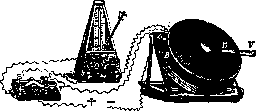
Figure 1.
presentation of material, the intervals of time between individual moments of exposure also play a very essential role. These two requirements form the basis of the construction of modern apparatuses for the study of Memory, called mnemometers. They allow regulation and maintenance of the exact magnitude of time both for exposure of a single member of a series and for the intervals between these exposures. The most established, typical and simple is the Ranschburg apparatus, shown in Fig. 1. The apparatus consists of a metal box, inside of which by means of two electromagnets an axis V moves in jerks. A circle (Fig. 2) is placed on the axis, divided into 60 divisions, coinciding with the divisions of the axis. On each division a word or some other material is written. A cover B is placed on the box, having a window D, through which only the next word is visible. The apparatus, as shown in the figure, is connected
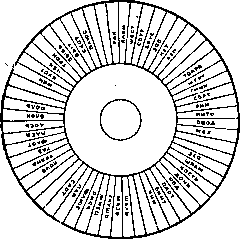
Figure 2.
with a metronome. With each beat of the metronome, the current in the electromagnets is closed, and the axis moves one division, as a result of which the next word appears in the window. The pauses between words are regulated by the metronome and by leaving the corresponding divisions of the circle empty. The key-closer T serves to start the apparatus and to stop it. By means of a slider it is possible to vary the size of the opening in the window.
V. Artemov. Pathology of memory. Disorders of M. can affect all three of its sides: memorization, retention, and reproduction. Disorders of memorization capacity (in the direction of its reduction to complete loss) are usually associated primarily with pathophysiological factors. One cannot overlook the psychological factors of memorization—attention, interest, connection with other representations, etc. Thus, deficiencies in memorization capacity are not univocal and cannot be reduced to homogeneous causes: the symptomatic nature of memorization disorders, indicated by Kraepelin, is currently denied. On the one hand, they can be of organic origin—arteriosclerosis of the brain, lues cerebri, tumors, infections and intoxications (see Korsakoff's psychosis), and on the other hand, they can depend on pathopsychological factors ('neurotic attitude'). Memorization capacity is usually investigated by a simple method—offering the subject a series of numbers, syllables, words, images, objects for direct memorization; on average, under normal conditions, 6-8 objects are memorized. Disorders of reproduction are more diverse; to the present time, they have no generally accepted classification, and in their nomenclature there are many ambiguities, parallel designations, etc. Since the time of Ribot, an increase (hypermnesia), decrease (hypomnesia), and perversions of M. (false memories, paramnesias) are distinguished. Liepmann divides defects of memory into negative (what was actually experienced is not remembered) and positive (what was not experienced is colored by memory); the former include lapses from memory (amnesias), the latter—false memories. Wernicke distinguishes additive and subtractive disorders of M., almost corresponding to Liepmann's positive and negative: in the former, false memories are formed and added, in the latter, part of what was actually experienced is erased from memory (amnesia). All these attempts to delineate memory disorders are insufficient, and the designations are very conditional, since in these disorders we usually have a mixed picture. What distinguishes defects of reproduction from defects of memorization is their much greater pathopsychological conditioning. In the physiological sense, traces of memorizations are considered indestructible, merely obscured (Bleuler, Schilder), and the question concerns the difficulty of revealing these traces in consciousness [defects in the process of ecphoria, not of retention (engrams)]; the latter depends on the state of consciousness, on its content at a given moment, and on the attitude toward what is being remembered (in particular, on emotional attitudes). For convenience of consideration, one can use the old division of defects of M. into hypermnesias, hypomnesias, and paramnesias. As for hypermnesia, they are theoretically unclear (the matter may reduce to a simple weakening of other, inhibitory factors of memory, not to 'sharpening' of M.) and practically unimportant (they usually lead to infrequent cases of sharpening of memories in infections and intoxications); cases of 'phenomenal memory' sometimes attributed here are psychologically more complex; they have no pathological significance. Hypomnesias can be diffuse, general ('weak memory'—mnemasthenia of Ranschburg) or they can concern specific contents of consciousness (individual objects, segments of time, etc.); in the latter case, when sharply expressed, they are called amnesias (see). Hypomnesias are connected either with general somatic weakening of the organism (state of exhaustion) or with the psychological factor of 'repression from memory', forgetting (Freud) depending, for example, on emotional inhibitions (hysterical, neurotic forgettings). Often amnesias in relation to a specific period of time are connected with a disorder of consciousness and perception in that period (see Consciousness). In this case, it is difficult to differentiate the defect of memorization from the defect of memory, since we can only establish the fact of absence. Sometimes what is lost from M. is not the fact itself that took place in the past, but only its coloring of memory. Then one speaks of 'negative false memories', of cryptomnesias: a person reports something known to others as something new or even as something invented (this circumstance explains some 'involuntary' plagiarisms). Cryptomnesias represent a transition to proper false memories of M. (paramnesias). These false memories or errors can be divided, similarly to errors of perception, into illusions and hallucinations of M. (Schneider suggests the terms 'allomnesias' and 'pseudomnesias'). Illusions of M. (like perceptions) cannot be sharply delimited from errors that also occur in normal life. The mechanism here is twofold: on the one hand, indistinctness of memorization, on the other—the factor of forgetting under the influence of repression, embellishment of unpleasant details, addition of desirable supplements, etc. In contrast to this, hallucinations of M. represent the creation of new contents of consciousness, which were never perceived before, but which have the coloring of memory. This includes above all the error of recognition, or identifying error of M. (Kraepelin), consisting in the fact that some event is experienced as having happened before, although in reality it did not (the complete opposite of cryptomnesia), the symptom of deja vu (error of identification—Osipov). It occurs in healthy people too (sometimes in states of fatigue); it is pronounced in epilepsy, hysteria, schizophrenia. Previously this state was designated by the name 'double memories' (Sander, Wildermuth). Close to this is the reduplicative error of M. (Pick), in which the patient feels that he has already experienced once a situation similar to the present one, but under other conditions, so that he is sure of the existence of two completely identical settings or objects in different places; this error of M. is observed in organic lesions of the brain. Finally, a particular case of hallucinations of memory are confabulations (see), consisting in the fact that the patient fills the existing gaps and defects of memory with inventions. In confabulations we have the reaction of the patient to the violation of the integrity of his personality in memories, an attempt to restore this integrity. All the mentioned disorders of M. denote only fragmentary, conditionally delineated phenomena, depending on individual pathological factors of physiological or psychological order. However, one must remember that in M. and its functioning the entire personality of the given subject is manifested, and disorders of its integrity can also manifest in disorders of M. (this is partly seen in confabulations). A disorder of M. can consist not in its individual sides, but in the general active-adaptive character of its work. Thus, in the absence of formal disorders of it, we can see a defect of memory in its reintegrating type—reproduction of everything perceived with the smallest details, in which the essence of the perceived situation dissolves, reproduction 'according to photographic contiguity' of phenomena; it occurs in persons little accustomed to the active use of M. (primitive people, children). Thus, the pathology of M. represents a complex field embracing the most general questions of psychopathology, and each individual case is first of all difficult to determine in a classificatory respect, and secondly requires accounting for both pathophysiological and pathopsychological factors.
Related articles
Cite this page
“Memory.” Soviet Medical Encyclopedia. English translation of Bolshaya Meditsinskaya Entsiklopediya, 1st ed. (Moscow, 1928–1936), ed. N. A. Semashko. https://sovietmedicalencyclopedia.pages.dev/article/memory/