Visual Method (The term 'visual method' should be understood)
Historical document, translated for reference. It reflects medical knowledge of the 1920s–30s and is not medical advice.
Summary
The Visual Method in Soviet pedagogy encompasses a broad approach to education using visual aids, real objects, and experiential learning rather than passive observation. This article traces the historical development of the method from ancient times through Soviet educational reforms, emphasizing its proper application in medical and sanitary education.
Encyclopedia article (1928–1936)
Visual Method. The term 'visual method' should be understood much more broadly, not merely in the sense of sensory perception, but as the development of skills for independent work. For this reason, the term 'visuality' itself can be considered inadequate to express the actual content of this concept. Finally, mention must be made of visuality as applied to verbal perception, when this verbal material is presented in a vivid form that creates visual images in the listener's mind. Thus, in its broad interpretation, the Visual Method includes both the use of visual aids in the proper sense of the word—such as drawings, tables, slides, models, specimens, and preparations—as well as the utilization of objects and things surrounding us in nature and daily life for educational purposes. In this direction, the excursion method assumes great importance, which is essentially one form of the Visual Method in its broad interpretation. Its complete expression is found in museum work, where extensive collections of visual aids are available. The research method, in which students deal not only with books in the sense of independent study, but also with specific labor processes (in particular, the independent creation of visual aids—collecting and processing plants, gathering data and compiling charts, etc.), is also based on the wide application of the visual method. The history of the Visual Method is quite ancient. It was used in education in ancient Greece and even earlier in Egypt. Heraclitus, one of the founders of dialectics, said: 'Eyes are better witnesses than ears.' Quintilian (2nd century AD) also advocated for visuality. The era of feudalism, marked by the oppression of the church, replaced visuality with dead scholasticism. The word became superior to real concepts and knowledge of things. With the birth of commercial capitalism, reflected in the era of the Renaissance and humanism, shifts occurred in pedagogy. Rabelais, in his famous novel 'Gargantua and Pantagruel,' in the system of new pedagogical views, assigned an important place to visuality, and in particular to the excursion method. Following Bacon, who with his inductive philosophy placed observation in the first place, came the greatest educator of this transitional period, Jan Amos Comenius (1592-1670). In his 'Great Didactic,' which laid the foundation for bourgeois pedagogy, he placed visuality in the first place; in this book he gives examples of the application of the Visual Method. Not limiting himself to theoretical propositions about the Visual Method, he created the book 'Orbis Pictus' (The World in Pictures), in which he gave the first example of the application of the Visual Method in textbooks. After him, proponents of the Visual Method included the English philosopher Locke (who said: 'It would be completely useless and uninteresting for children to talk to them about things of which they have no concept; knowledge of concrete things is acquired not from sounds and words, but from the things themselves and their images') and Jean-Jacques Rousseau in his famous novel 'Emile, or On Education,' where he appears as the ideologist of the petty bourgeoisie of the prerevolutionary era. Rousseau goes further and raises the question not about images, but about objectivity; the study of living nature comes to the forefront (Rousseau even protested against the globe and map in teaching geography). The next stage in the history of the question of the Visual Method is connected with the names of Pestalozzi, Froebel, and other German educators. In his book 'How Gertruda Teaches Her Children' (1801), Pestalozzi said: 'Visuality is the foundation of all knowledge; all teaching is based on observation and experience.' Froebel added to the elements of contemplation the element of activity, thus expanding the concept of visuality from exercise of the visual organ also to muscular feeling; every visual aid must be made by the student himself. Among other active proponents of the Visual Method, one should also mention Basedow (from the group of so-called 'philanthropists') and Herbert. The Russian school, remaining under the yoke of classicism up to the last years of the tsarist regime, far from life and nature, applied the Visual Method in extremely limited dimensions. The group of educators of the 1860s, actively developing questions of the Visual Method (in particular for the lower school, Ushinsky), could do relatively little under the existing regime conditions. Before the revolution, the application of the Visual Method had predominantly a purely demonstrative character and was expressed in visual illustrative aids, whereby sensory perception, although expanded compared to verbal perception, nevertheless remains passive. This explains the reaction that arose among modern educators regarding the use of visual aids. As early as the First All-Russian Congress of Natural Science Teachers in Petrograd in 1921, a sharp protest was sounded against visual aids. 'The question is not about propaganda of visuality and expansion of the use of visual aids, but about moderating the enthusiasm in this direction, so as not to distort and diminish the importance of excursion and laboratory-research teaching methods, not to replace nature, with its immense educational value, with dead junk and aids.' 'The use of visual aids is most closely connected with demonstrative teaching methods. They are intended only for looking at them; by their very nature, they are corrections to verbal teaching. They ignore other sense organs and do not provide an opportunity to exercise motor abilities.' Therefore, 'out of school with all models, diagrams, schematic tables, and drawings.' 'The principle of visuality has lived its time and must give way to independent, creative work in the study of the surrounding nature' (report by V. F. Natali). However, this excess was undoubtedly caused by the one-sided application of the Visual Method in the old school and, consequently, by a misunderstanding of its essence. In the old school, when the excursion method was hardly used at all and the study of living nature was replaced by contemplation of flowers in drawings or in a herbarium, and of insects in a box under glass, such a Visual Method, of course, was useless. But the Visual Method by no means amounts to the demonstration of drawings. Even in research work, elements of visuality play a major role. Along with this, the nature of the use of visual aids is of great importance. The view that 'First of all, such aids should become necessary material, a supplement to what cannot be given by the direct study of natural objects. Secondly, many aids can illuminate and resolve those details which, for one reason or another, may be insufficiently clear and understandable on natural objects' (Ulyaninsky) seems completely correct. Thus, the requirements for the Visual Method can be formulated as follows: 1) the Visual Method must be based on objectivity, i.e., the study of natural things, not their images. Only in cases where familiarization with the subject of study is impossible, its image is quite appropriate (for example, in zoology, images of tropical animals, etc., in medicine— anatomical tables, etc.); 2) the application of the Visual Method should not have a passive-contemplative character, but should serve as material for independent activity. In this respect, it should be recognized as correct that 'at present we have to speak not of visual aids, but of working material for the independent knowledge and research of students' (Konors). However, we must recognize that this is nothing other than the highest form of the Visual Method, which has gone beyond the narrow formal understanding of this method. All these provisions retain their full force also in relation to the application of the Visual Method in sanitary education, not to mention the teaching of hygiene in school, where anatomical tables, skeleton, models of various sanitary installations, anatomical microscope, preparations—in short, various forms of visual aids—will find the widest application; the Visual Method is of particularly great importance in mass sanitary educational work.
89
Visual Method
90 Having as its ultimate goal the activation of the initiative of the broad masses in the struggle for the improvement of labor and living conditions, mass work itself, compared to the school where there is stability of audience and a large amount of time, offers fewer opportunities for the active method in the very process of health education work. Therefore, in mass work, contrary to the opinions of opponents of the Visual Method, presented above, purely illustrative aids are of great importance. The significance of visual aids can be reduced to the following: they facilitate the perception of new information, reduce the time for explanations, improve assimilation, and contribute to the creation of visual representations. However, the growth of the initiative of the masses, the fundamental restructuring of all mass work, places the task of applying the Visual Method in a completely different way, since, involving the broadest masses in the work of improving health—in the work of health sections, health groups, sanitary commissions, labor protection commissions, etc.—we conduct sanitary education for millions of masses visually, not on artificially created visual aids, but directly in life, in practical daily work, an example of which is the implementation of the sanitary minimum. New forms of labor—socialist emulation and shock work—in an even greater degree visually educate the masses in the struggle for a new life. The period of reconstruction—of the entire national economy, of building the foundation of socialism in our country—has also presented completely different requirements to the cause of public health. The fundamental restructuring of the entire public health system also requires new approaches and a vast scale in the dissemination of mass sanitary culture. All this places the question of the Visual Method and visual aids in a completely different way at the current stage. The resolution of the Central Committee of the All-Union Communist Party (Bolsheviks) of August 5, 1931, on technical propaganda, opening a new stage in the cause of health education, focusing the attention of all Soviet public opinion on this most important task, directly emphasizes the significance of visual aids. In the school, where visual aids have particularly great application in connection with active forms of work and the growth of initiative, the Visual Method also takes on a different character and is conducted directly on real objects. The polytechnicalization of the school undoubtedly further increases the significance of visual instruction, conducting it not on pictures and images, but directly on labor processes, at the machine, in the field, etc., giving it the character of the greatest life-like clarity. In this way, visual aids by no means are erased from the arsenal of health education methodology, but are assigned a purely auxiliary significance as an important methodological moment. The content of visual aids can serve any questions of medicine and public health, but the relevance of the topic, its correspondence to the needs of socialist construction, are among the most important requirements for visual aids. The basic requirements for visual aids are reduced to the following: scientific competence (not only in the sense of formal accuracy, but especially in regard to the interpretation of various processes on the basis of Marxist-Leninist methodology and the exclusion of vitalistic and mechanistic illumination, examples of which can be found in the German Hygiene Museum in Dresden in the 'Man' department, where in visual aids a position of neutrality between both ideological directions, equally hostile to consistent dialectical materialism, on the basis of which alone health education can be built; as a similar example, one can name the table 'The Human Body' placed in Kahn's book: 'Das Leben des Menschen' and published several years ago by the publishers 'Gudok' and 'Naukaia Mysl'; it is the worst example of vulgarly mechanistic simplification: the entire human body is represented as a series of machines). In each visual aid, political clarity and sharpness, along with the struggle against the aforementioned perversions, must find their expression in the political saturation of each visual aid, which should not serve the goals of mere culturalism, but be a weapon in the struggle for socialist advance, should awaken the activity of the working masses for the improvement of labor and living conditions, for the implementation of the sanitary minimum, for the reduction of morbidity, thereby accelerating the pace of our construction. Only under these conditions can visual aids at the present time be considered suitable; any neutrality in visual aids, as in other areas, must be considered harmful and intolerable. The third requirement for visual aids is the artistic quality of execution. From individual types of visual aids, one can name in sequence: the use of the surrounding nature and living conditions, natural objects taken in their usual setting, the same objects taken in isolation and transferred to a learning environment in nature or in preparations, their images as both fully documentary (photographs) and creative (drawing, table, poster), and one can speak of both pre-printed images and those improvised on the spot before the audience with the help of a blackboard and chalk. Along with these flat images, three-dimensional aids of great importance should be mentioned, to which should be assigned models, mannequins, mock-ups. The last group consists of instruments and experiments. First place in the visual method should be given to the use of the nature and living conditions surrounding us for the purposes of visual instruction, to the use of natural objects. At the same time, it should be borne in mind that the most familiar objects in the process of daily life precisely because of their familiarity are usually not subjected to analysis by us and are perceived almost unconsciously. Therefore, the analysis of the most familiar object as a visual aid can have great methodological interest. As an example, one can name two vivid ones for 91
Visual Method
92 examples of the time, given in Nikitsky's 'A Glass of Water' and 'A Crust of Bread', where the use of such simplest objects as those mentioned is shown for the purpose of visual and comprehensive development of the topic. In the application of such objectivity, sanitary inspections (examinations) of this dormitory, school, club, collective farm, etc., can be used, a stove or radiator of central heating in a room, ventilation* and a number of other things. In an anatomy class, before moving to the corresponding chart, one should become familiar with a number of features of the structure of the human body on one of the listeners, show them a natural cow's heart, brain, and kidney, which can always be obtained in advance by arranging with the nearest meat market or slaughterhouse; only for a pathologically altered organ (alcoholic's liver, tuberculous lung, etc.) can a specimen, mannequin, or model be used. For nutrition classes, such readily available objects as a piece of meat, fat, egg, milk can be used for visualization, showing corresponding experiments with them (e.g., precipitation of protein in milk under the influence of acetic acid or formation of sugar from starch in bread under the influence of the action of ptyalin in saliva). In first aid classes, listeners should be familiarized in nature with bandaging material, its properties, shown and taught how to make improvised splints from straw, twigs, etc., shown what not to apply to a wound (leaf, earth, manure), after which technical skills should be developed, and of course the entire lesson will have both visual-demonstrative and at the same time active character. When teaching care for an infant, which naturally should be entirely visual in character, along with demonstration and exercise in processes such as wrapping the child, how to hold it, one can show a homemade collection of objects with which an infant should not be fed, toys that should not be given to the child (tin, painted with harmful paints, etc.). A similar collection can also be made for the topic 'What should and should not be eaten by a pregnant woman'. Local material should be widely used, which is especially important in rural work. For example, a clean spoon and a dirty one, obtained during a sanitary inspection of a worker's dormitory, found somewhere under a pillow or behind the boot top, dirty dishes, a cigarette butt, dirty rags from under oil, etc.—all this can serve as an excellent visual aid for sanitary-educational work. Many such examples could be proposed and undoubtedly every doctor will find enough of them in his daily practical work. This extensive use of objectivity is especially important in the work of a district doctor, who due to lack of funds cannot purchase expensive teaching aids. Moving to illustrative visual aids, special mention should be made of the importance of aids created right before the audience, together with it or by the audience itself. That is why the use of a blackboard and chalk in lecture work with small groups of a school or club nature is so important. This ABC of methodology has exceptional importance. It is especially valuable if the teacher (lecturer) knows how to sketch not only a scheme or diagram, but also a drawing. Photography as a visual aid has received exceptional popularity in recent years. The International Hygiene Exhibition in Dresden in 1930 showed this particularly clearly; photography in the most diverse combinations was at the center there. Undoubtedly this success is related to the documentary nature of photography, its persuasiveness in terms of reliability compared to a deliberate drawing and the ease of giving it the required dimensions (at the mentioned exhibition there were photographs measuring 4x8 arshins). Objects of photography should be mentioned. Often they prefer formal shots (dead, without people, non-working laboratories, groups, meetings, etc.). Meanwhile, each photograph should be dynamic, life itself should speak from it; each shot made for the purpose of subsequent visual propaganda should teach specific actions, call for practical work on health improvement. This basic requirement determines the choice of objects and moments of shooting. The so-called photomontage has become widely used in recent years, in which several photographs (often several dozen) through various combinations give a coherent and dynamic illustration of a particular topic or process (we do not mean the old-fashioned dead montages, which amounted only to a general framing of several unrelated photographs, and not to their reworking in content into something new). Photomontage has taken root not only in mass magazines but also in visual aids. It is often abused to the detriment of clarity and understandability, but in essence this technique can achieve great dynamism. One technical technique for using photography in museum-exhibition work should be mentioned—the stereoscope, which can give a good effect, enlivening the photograph, while at the same time it allows saving exhibition space, although on the other hand it requires close and more in-depth attention. The main type of flat visual aids are drawing, chart, diagram. The division between all these terms is quite arbitrary. We refer to drawing a one-moment image of small size. The poster (see), which has received exceptionally wide distribution during the years of the revolution, is predominantly of an agitational character and usually does not serve as a teaching aid, although we often encounter propagandistic posters as well. The diagram (see) is a graphical representation of numerical values. Graphical representations should also include schemes, which have great importance due to their simplicity, which has determined their popularity. Schemes can be organizational as well as scientific, for example anatomical and others. By table we conventionally understand a visual aid serving purely educational purposes and often consisting of numerous drawings with considerable explanatory text. We will dwell on these last ones, since the other types (poster, diagram) are described in separate articles. Of the sanitary-educational tables, most often published in series or albums, should be mentioned: anatomy tables, published by Dr. Kaney in the 3rd edition as early as 1920, weak in artistic execution and containing a number of scientific errors; incomparably higher are the anatomical tables published in 1929-30 by Gosmedizdat under the editorship of Prof. Karuzin; their execution is as good as their scientific side. The best in artistic terms were published by Gosmedizdat on venereal diseases (an artistic album containing up to 40 tables both on the clinical aspects of venereal diseases and on social prevention), on tuberculosis (a similar type of publication), on alcoholism, protection of motherhood and infancy. A number of series were published during these years on individual infectious diseases (childhood infections, anthrax, malaria—Rostov edition, and others). In addition to them, several series of tables on first aid, on professional hygiene, a series of educational tables on military hygiene and a number of others should be mentioned. Along with the center (Moscow—publishing of People's Commissariat of Health, Gosmedizdat, Moscow Health Department, Kharkiv—publishing 'Scientific Thought'), localities also published aids, printing tables due to lack of polygraphic capabilities from linoleum and painting them by hand. Along with series consisting of individual tables suitable for hanging, a number of albums were published, valuable as visual aids but not intended for hanging, but more suitable for library use. Among them can be mentioned albums on care for the sick, on first aid (published by ROKK) and others. All these aids (posters, tables, albums) can be used per se, as they are, and in the form of montage, when individual parts of the table are cut out and mounted completely differently in accordance with the task assigned to this aid (health board, etc.). This reworking makes it possible to supplement the coverage of the topic with local material, to enliven it. Often drawings are pasted on plywood and cut out (in this way homemade models are prepared). In general, it should be said that despite continuous complaints about the lack of visual aids, their absence from the market (indeed, their publication is constantly lagging far behind the huge growing need), the center of gravity is not in this lack of ready-made visual aids, but in the underestimation of the importance of local visual aids. Meanwhile, a number of aids (first of all diagrams, photomontages, as well as more complex ones, for example models) can be easily prepared locally up to the district clinic, which in its sanitary-educational work should first of all use its own, local material (morbidity, sanitary condition of the collective farm, etc.). In school practice, such homemade visual aids can and should be made by children as part of their educational work. The use of children's drawings for the purpose of visualization in health education is very important.
Along with the specially developed visual aids, mention should be made of the use of portraits of great scientists and leaders (Marx, Engels, Lenin, Stalin) as visual aids, accompanied by appropriate quotations about the health of the proletariat, the education of the new person, and so on. Not to mention exhibitions where, in the appropriate sections, portraits of the creators of this discipline or those who made an epoch in one field or another are mandatory, but also in lectures, the demonstration of slides with portraits is highly desirable. Portraits should be included in corners and exhibitions arranged in the waiting rooms of medical institutions. Among the portraits of scientists, one can name Leeuwenhoek, Pasteur, Koch, Mechnikov, Lister, Pirogov, and many others. Of even greater importance is the use of artistic painting for the purposes of visual sanitary propaganda. Starting with classical painting (Rembrandt, Rubens, Murillo, Holbein, and others) and ending with modern artists, one can name a large number of paintings, reproductions of which could be used for the purpose of sanitary education. These paintings have the most diverse content: anatomy (there are a number of paintings depicting autopsies), diseases (skin-various rashes, surgical-performance of operations, mental-views of the mentally ill, the setting of 'asylums'), treatment-or rather the healing of patients, hygienic procedures (many paintings depicting baths), protection of motherhood, physical education, etc. Of the relief, spatial visual aids, models should be mentioned first, by which we mean an exact three-dimensional representation, reduced or enlarged to scale or in natural size, of one object or another, building, installation, organism, etc. An example can be anatomical models, which, unlike the corresponding tables, which give a flat image, give a three-dimensional representation. Among them, one can name the common torso models and others. In addition to anatomical models, hygienic models are made-filters, ventilation, heating, and other installations. Models are most often made of papier-mâché and plywood (Figs. 1-6). Moulages represent an image that accurately conveys the shape of the corresponding object, the details of the structure of the surface, and its natural color. With this 'photographic' quality, a moulage differs from a model, which allows for a certain conventionality and schematization (for details, see Moulages). A model is a conventional three-dimensional artistic representation of a certain scene, process, conveying not in plan but in perspective. Models can be made either by sculptural means or by cutting out individual figures from posters and gluing them onto cardboard or plywood (Figs. 7-11 and 16). Mention should also be made of the so-called 'diarama,' which we understand as a light poster, on the front side of which one drawing is placed, and on the back another; when the rear light is turned on, the front drawing disappears, and the rear one appears (Fig. 13 - 'manifestations of syphilis'; in the foreground, the human body is visible, when the bulb enclosed in a box behind the drawing is turned on, the manifestations of syphilis appear). Ready-made printed diaramas on first aid are available for sale, where on the front drawing a scene of bathing is depicted and one of the bathers is drowning; when the rear light is turned on, the viewer sees the scene of artificial respiration; in the diarama 'air-chemical attack on a city,' first the viewer sees a calm street, and then the same street at the moment of attack and organization of chemical defense. (It should not be confused with 'diorama,' which abroad means ordinary models.) If all these aids are static, recently various mobile mechanical aids are becoming more widespread. They can be divided into 3 groups: the first, where movement occurs within a given exhibit, which itself remains stationary and is enclosed in a box or case; the second, where the viewer himself puts the exhibit into motion by performing one experiment or another; the third, where the entire exhibit is mechanically put into motion. From the first group, one can name the blood circulation diagram (in a large wooden box, on a normal diagram of blood circulation, the movement of blood is shown with the help of light effects), the reflex diagram, etc. Built on a similar principle of electrical contacts are: routine clocks (Fig. 12), points of pressure on vessels to stop bleeding, light question and answer boards, similar boards with a bell, which already belong to the second group, since they become exhibitable with the help of the viewer themselves (turning on the contact, pressing the button). All sorts of devices like a dynamometer, automatons, etc., which are offered to the viewer to try, should also be included here. To the third group can be attributed all sorts of machines and working mechanisms. The so-called moving diagrams stand apart, for example, life expectancy, where the bars are turned into rails, along which figures move, showing the limits of life expectancy. Models can also be enlivened by movement. Thus, by sequentially illuminating one theme in several models and arranging them on a small rotating stage, something like a silent theater can be obtained. As an example, one can name the theme of charlatanism in 5 acts (models), exhibited at the international hygiene exhibition. The use of natural preparations is of great importance. The skeleton has the widest distribution, an indispensable aid in school work, in first aid circles. Close to it is the rather complex to make so-called 'transparent man' ('Durchsichtiger Mensch'), made by the German hygiene museum and representing not only the bony skeleton but also the entire circulatory system, nervous system, and internal organs (all this is enclosed in a celluloid frame). Among the preparations, preparations in glycerin (Schor's method), formalin, and other preserving solutions (brain, liver, heart, embryos, etc.), in paraffin or agar-agar (sections of various organs-Talaev's method) are common. For details, see Preparations. An important visual aid is all sorts of instruments, among which the microscope occupies first place, an indispensable aid with which no tables can compare. The demonstration of a drop of water with the organisms inhabiting it, dental plaque, etc., always arouses great interest. Along with this stands the conducting of experiments, for example, experiments with a frog-demonstration of the simplest reflex, blood circulation in a frog, experiment with a bone-softening under the influence of hydrochloric acid and removal in this way of the mineral substance, and the reverse-removal of the organic substance by burning, investigation of exhaled carbon dioxide, demonstration of the work of the lungs, and a number of other experiments. The projection ('magic') lantern occupies a large place among visual aids, making it possible to obtain enlarged images on the screen from drawings applied to glass (so-called slides). Projection of enlarged images on the screen directly from a book's drawing or object is possible with the epidiascope. Both of these devices have the widest distribution and are very valuable aids that allow illustrating and enlivening oral presentations, especially in a large audience (for a detailed description of the projection lantern and epidiascope, see Projection apparatus). Slides ('tum pictures') are pieces of glass 8 1/2 x 8 1/2 cm in size (abroad the size 10 x 8 1/2 cm is accepted), on which one or another image, drawing is applied. Usually slides are made in the same way as photographs-by applying a positive plate to a negative (instead of photographic paper) and passing light rays through. For durability, the slide is covered with a simple cover glass and edged with black paper. The black slides obtained in this way can be painted with aniline transparent paints; since the painting of small drawings is usually done by hand, it doubles (and sometimes more) the cost of the slides. Along with the most common production of slides photographically, their production is also possible by painting ordinary glass with ink (black or colored); in this way, cartoons, slogans on glass can be made. To make such homemade slides, cut glasses are poured with
Figures 1-4. Anatomical models. Figures 5 and 6. Making models.
To the article Visual Method.
Figures 7-10. Hygienic models. Figure 11. Model. To the article Visual Method.
south laarnhn l! 1Ш
].>
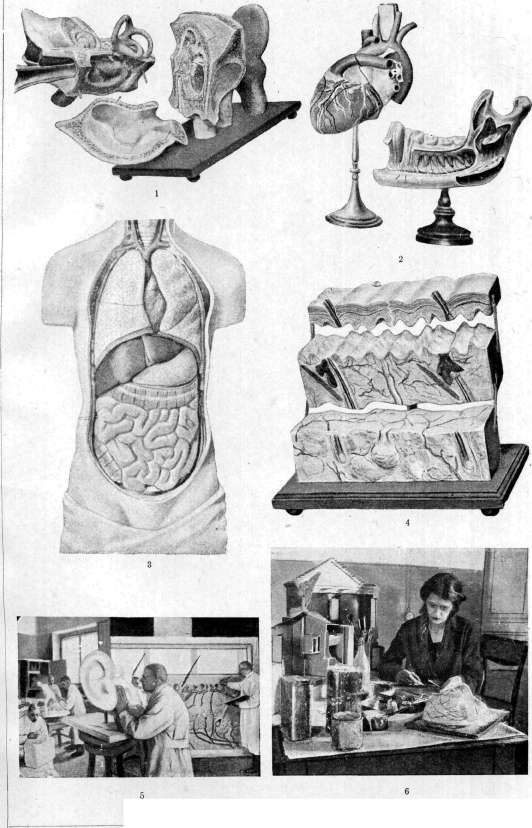
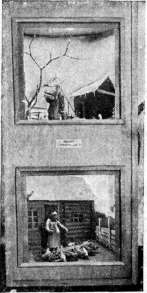
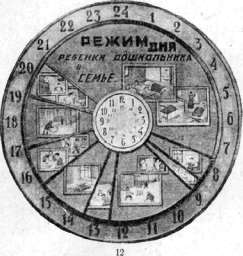
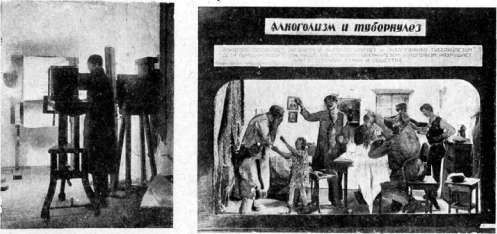
Figure 12. Electric "clocks." Fig. 113. Diorama. Figure 14. Diapositive display case. Figure 15. Making diapositives. Figure 16. Model. For the article Visual Method, drawings can be easily applied to glass covered with gelatin, which has acquired a slightly rough surface. For safe transport of diapositives, special boxes with compartments are made. However, a set of 50 glasses weighs quite a lot and is bulky. Therefore, in recent years, the production of diapositives on film has become widespread, where on a small reel, convenient for carrying in a pocket, 30-40 diapositives can be placed. A significant saving is obtained in price, since a glass diapositive costs 40-50 kopecks, while a reel with 40 film diapositives costs only 80 kopecks, i.e. 20-25 times cheaper. Unfortunately, these film diapositives cannot be projected by an ordinary lantern and require either changing the lens or a special apparatus, which is now produced under the name "filmoscope" (fig. 14 and 15). Diapositives can be used for the so-called "light newspaper," where a certain topic is presented on diapositives in sufficient sequence with connecting inscriptions, special caricatures, etc. The significance of the projection lantern, which had wide distribution at the beginning of the 20th century, is now declining in connection with the development of cinematography, which, due to its dynamism, has exceptional advantages over static projection, making it possible to show much more clearly various physiological or pathological processes (for example, blood circulation, movement, digestion), as well as production processes from the point of view of labor hygiene, first aid training (application of bandages), etc. Thanks to its enormous pedagogical significance, cinematography is now widely used as the most important means of visual instruction. In America, the cinematization of schools for the purpose of using film in the pedagogical process has reached large dimensions; in our country, this task is only now being set. In particular, in the field of sanitary education, our film production has mostly followed the line of artistic-popular films, and little attention has been paid to creating scientific-popular films, and therefore the possibilities of using film as a visual aid in sanitary educational work are still quite limited. The task of creating a sanitary film library suitable for the purposes of visual instruction still fully retains its significance. (For more details on cinematography in medicine and sanitary education-see Cinematography.) The excursion method is the most complete and methodically perfect expression of the Visual Method, in which instead of illustrative aids, corresponding objects are studied not only in their natural form, which is possible to some extent even without the excursion method (e.g. studying a flower in school), but-which is much more important-in their natural environment and usual surroundings, i.e. not tearing out the object of study in isolation, but taking it comprehensively. If one proceeds from the value of the Visual Method as a factor affecting our emotional sphere and thereby increasing our interest, fixing our attention, strengthening memory, facilitating better assimilation, then all these aspects find even greater expression in the excursion method. That is why the wide development of excursion work is one of the most important tasks of sanitary education. (For more details-see Excursions.) The use of visual aids in sanitary education can have a dual character-subsidiary-illustrative (to methods of living speech) and independent (in visual agitation and museum-exhibition work). The selection of visual aids for a lecture (see), conversation, club session is an essential methodological moment. Each lecturer, speaking on this or that lecture before any audience (permanent-organized, where cyclical work is conducted; occasional; working, peasant, women's, children's, etc.) should strive to enliven, illustrate his speech as much as possible. The question of whether he will use diagrams, tables, models, experiments, diapositives or in extreme case a chalkboard is less important-this depends on the nature of the lecture, the topic, the availability of aids and a number of other reasons. It is only important that in addition to the main sensory irritant in the methods of living speech-speech-the sense of sight is also involved, and if possible other senses as well. The number of visual aids (this especially applies to diapositives) is determined by the task which the lecturer sets for himself. However, one should never give in to the desire to show as many as possible, since an excess of visual aids has the opposite effect, tiring the audience. To illustrate a lecture lasting 1½ hours on average 25-30 diapositives or 10-15 tables are sufficient (diagrams should be taken in half as many, otherwise all numbers in the listeners' minds get mixed up). Often lecturers bring 50-60 diapositives, then the entire lecture turns into nothing more than an explanation of the diapositives being shown, since there is no time left for the coherent development of the main idea, and the entire lecture becomes disjointed. From this point of view, it is better to group the aids so as to concentrate them on certain key points, rather than scatter them evenly throughout the lecture, breaking up the main presentation of the question. Regarding the type of visual aids, it should be noted that ordinary tables, posters can be used in small audiences of 25-30 people (maximum 50), since with a larger number of listeners-viewers the aids are visible only to the front row, while for those in the back they disappear. This especially applies to models and conducting experiments. The projection lantern or epidiascope makes it possible in a large audience to make relatively small aids visible to all through large magnification. Among the drawbacks should be kept in mind the immersion of the audience in darkness, as a result of which the lecturer loses direct contact with the audience, which is provided by observation in the light of the listeners, their reactions, the possibility of conducting a conversation is excluded, the lecture turns into a monologue. The listeners, in turn, are deprived of the opportunity to take notes and record various data. Independent use of visual aids takes place in visual agitation (posting tables in public places-clubs, reading huts, waiting rooms of medical institutions, health corners, demonstrating diapositives on the streets, light newspaper), but its most complete expression is found in museum-exhibition work, where we have extensive collections of the most diverse types of visual aids, collected according to a certain system in accordance with the main thematic task. (On the use of visual aids as exhibits-see Exhibitions, Museums.) The production of visual aids is mass-industrial-and homemade. Before the revolution, the production of visual aids was the subject of activity of a number of private firms. The largest of these was "Grossman and Knebel," which created a large number of types of visual aids. In the field of sanitary education, large (by the standards of that time) activity was developed by the commission for the dissemination of hygienic knowledge under the Pirogov Society (see Pirogov Society, congresses), whose works should be mentioned the "album on infectious diseases," tables on school hygiene, numerous series of diapositives on various topics. Anatomical models (torsos, etc.) were made by toy craftsmen, mainly in Sergiev, as well as by workshops of visual aids of the Vyatka provincial zemstvo. Abroad and to this day, the production of visual aids is the subject of activity of private firms pursuing purely commercial goals and therefore often producing not only unscientific aids but even harmful ones. Among public organizations, the German Hygiene Museum should be placed in first place, at which there are workshops for making models, mannequins, etc., and a publishing house for producing instructional visual aids. The museum's products are distributed throughout the world, since most countries do not have their own more or less developed mass production of visual aids. Some aids, mainly of the printed type, are produced by some public organizations in Germany, France, England, USA, such as: leagues against tuberculosis, against alcoholism, for the protection of motherhood and infancy, Red Cross societies, insurance societies, but all this does not have a systematic mass character. In the USSR after the revolution, the production of visual aids received great development corresponding to the general scale of public education, political-educational and sanitary-educational work in the country. True, it has still not (as in the West) moved to factory production, but has a semi-craft character, nevertheless one can speak of a large quantitative and qualitative growth. In the field of production of general school aids, the largest production center is the Cult-prom association of the Supreme Economic Council (former AONAPO), which in the line of sanitary education has been producing anatomical models up to the present time. Large-scale production of visual aids is carried out by the industrial cooperative.
A number of artels, mainly in Moscow, Leningrad, Vyatka, and other cities, united by the Kul'turpo-promsoyuz of the All-Union Council of Production Cooperatives, produce various school aids (physical instruments, globuses, etc.) worth up to 10 million rubles per year. In the field of producing visual aids for medicine and sanitary education, until recently, a number of small workshops operated, which had more experimental than productive significance. Thus, mention should be made of the oldest organization in this field, the 'museum-exhibition bureau' at the State Institute of Social Hygiene in Moscow. There are visual aid workshops at the Sanitary Culture Institute, at the Museum for Labor Protection in Moscow, in Kiev, Odessa, and Ashkhabad. Over the past years, in connection with the great development of sanitary education, the production of homemade visual aids has become widespread. Thus, by a number of sanitary education houses, exhibitions, and individual sanitary educators, various aids are produced, up to models and mock-ups. For the technique of their production, see the relevant literature (collection 'Sanitary Education', Moscow, 1928). The resolution of the Central Committee of the All-Union Communist Party (Bolsheviks) on technical propaganda gives a powerful impetus to the development of visual aids. In the very recent past (in September 1931), the People's Commissariat of Health established a special Central Scientific Research Institute of Visual and Teaching Aids for Medicine, Biology, and Sanitary Culture (TSINUPMED), created on the basis of the aforementioned museum-exhibition bureau of the GISG and the Institute of Visual Aids at the 1st Moscow Medical Institute (the latter, in its short existence of R/2-2 years, has already taken a dominant position in the market of anatomical aids and created a new branch of export). The new institute will be the guiding center for both the scientific-methodological work on developing methods and forms of visual propaganda, new types of visual aids, standards, etc., and the largest production base, which will concentrate in its hands almost the monopoly production of visual aids for medicine and sanitary education, since all other organizations (production cooperatives and state industry) are ceasing this type of production. The institute produces anatomical aids (skeletons, models), zoological, microscopic aids, models and mock-ups for sanitation and hygiene, museum-exhibition equipment, etc. In connection with the party decisions on technical propaganda, the Institute of Visual and Teaching Aids acquires particularly great importance. A very important moment is the examination and evaluation of visual aids. In pre-revolutionary years, such examination was carried out by the Moscow Pedagogical Museum, which annually published lists of visual aids in its reports, and the Pirogov Commission. There existed for a short time even a special journal 'Visual Instruction', published by Knebel. This journal, as well as those published abroad 'Zeitschrift fur Lehrmittel' and others, had rather a commercial character, primarily listing aids from the firms publishing them. After the revolution, an expert chamber for visual aids was created in Leningrad, which existed for a short time under the leadership of Prof. Khvolson. In the field of sanitary education, evaluation was carried out all these years by the Institute of Social Hygiene and the sanitary education department of the People's Commissariat of Health. The evaluation of visual aids should be based on their compliance with the basic requirements noted at the beginning of the article: clarity and consistency of the political orientation, scientific correctness, artistic execution, cheapness, and mass production. The immediate tasks in the production and distribution of visual aids are the creation of a planning center, concentration of production (which ensures the possibility of factory work and strict scientific and political control), cheapening and mass production, creation of an authoritative expert body, and regular publication of recommended lists. The organization of a central institute creates all possibilities for carrying out the planned measures, which will ensure the further growth of visual instruction and propaganda in the field of public health.
Related articles
Cite this page
“Visual Method (The term 'visual method' should be understood).” Soviet Medical Encyclopedia. English translation of Bolshaya Meditsinskaya Entsiklopediya, 1st ed. (Moscow, 1928–1936), ed. N. A. Semashko. https://sovietmedicalencyclopedia.pages.dev/article/visual-method/