HEARING
Historical document, translated for reference. It reflects medical knowledge of the 1920s–30s and is not medical advice.
Summary
This article explains the anatomy and physiology of the hearing organ, including the outer, middle, and inner ear, and the organ of Corti. It describes the transmission of sound vibrations through the ear and Helmholtz's theory of how different frequencies are perceived.
Encyclopedia article (1928–1936)
HEARING. The structure and function of the hearing organ-see Ear, Middle Ear, Inner Ear, Organ of Corti. For the conducting pathways and centers, see Auditory pathways, centers. Sound vibrations from the environment reach the peripheral auditory receptor mainly through the external auditory canal, at the bottom of which they encounter the eardrum (a "telephone membrane" with a specific period of its own vibrations-approx. 800-900 per 1 sec.), though sounds also penetrate the ear even when the ear openings are closed; this is the basis for the Luce-Dennert method for detecting concealed hearing; further, the vibrations are transmitted through the chain of auditory ossicles (with a decrease in amplitude and a gain in force) to the labyrinthine fluid, in which the Organ of Corti is located (see). According to Helmholtz's hypothesis, the fibers of its basilar membrane can resonate, like piano strings, to vibrations of different periods, i.e., sounds of different pitches, and thus in the inner ear the decomposition of complex sound images into elementary sensations (simple sinusoidal waves) takes place. If this hypothesis is accepted, then the further course of sound perception should be understood as follows: the elementary stimuli reach the brain centers of hearing via nerve pathways, where the reverse process takes place-the synthesis of complex sound images (Fig. 1).
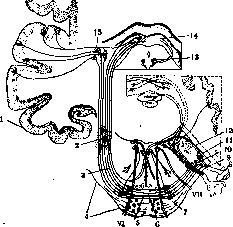
Figure 1. Diagram of the conducting auditory nerve pathways (according to Astvatsaturov): 1-temporal lobe of the cerebrum; 2-nuclei of the lateral lemniscus; 3-lateral lemniscus; 4-medulla oblongata; 5-trapezoid body; 6-bundle of Held; 7-superior olive; 8-cochlea; 9-cochlear branch of the auditory nerve; 10-ventral and 11-dorsal nucleus of this branch; 12-corpus trapezoideum; 13-nuclei of the oculomotor nerve; 14-posterior quadrigeminal body; 15-medial geniculate body.
How mechanical irritation of the hairy cells of the Corti organ is transformed into a nerve process remains a mystery. P. P. Lazarev explains this by changed concentration of potassium and calcium ions (see Ion theory of excitation). Witmaak attaches great importance to changes in hydrostatic pressure and observed under the action of irritants the swelling and deswelling of individual cells and fibers (theory of labyrinthine hypo- and hypertonus). According to the hypothesis of E. Küpper, longitudinal waves in the labyrinth fluid are accompanied by electrical phenomena on the hairs of the auditory cells of the Corti organ. The second incomprehensible circumstance is the colossal difference, of a million times or more, in the sensitivity of the ear to different sounds, e.g. if one compares the threshold of sensation for a sound of low frequency (50 vibrations per sec.) and medium frequency (2,000 vibrations per sec.). According to Lazarev, this should be explained by the similarity of the auditory process to the explosiveness of certain chemical substances, for example nitrogen iodide, which detonates selectively only at a certain number of mechanical vibrations imparted to it. All the mentioned properties give the Corti organ a certain similarity to a microphone and cathode relay. A healthy human ear begins to react with auditory sensations to sound vibrations when their number is not less than 10 per second, and ceases to perceive sound at a frequency of approximately 15,000-20,000 per second. Besides the sensation of pitch and intensity of sound, one also distinguishes the timbre of complex sound patterns, i.e. there is the ability to distinguish sounds of complex composition, to distinguish not only the fundamental but also the additional overtones, in particular those characterizing the timbre—overtones. In this case, the phases of vibrations are apparently not distinguished, at least if we speak about listening with one ear. But with binaural listening, the property of perceiving the non-simultaneous arrival of the same phase of sound in the right and left ear is discovered (the threshold of this property is measured in absolute units of negligible magnitude—0.00003 sec.). The phenomenon of mutual masking of sounds to a large extent disrupts the similarity between the objective irritant and its subjective reflection in our perception. Masking can be binaural (Stenger's experiment) and monaural, when even in the same ear it is possible to detect the obscuring of some sounds by others. Besides perceiving the peculiarities of external sounds, the ear also shows the ability: 1) to perceive their derivatives, e.g. so-called difference and summation tones, which, it is thought, owe their origin to the asymmetric elasticity of the tympanic membrane, 2) to extract from harmonic combinations (chords) their constituent tones, 3) to guess the size of the interval between two tones and even 4) the absolute pitch of a given sound (see Absolute pitch). All these qualities of H. are not inherent in all people and are characteristic of so-called musical hearing. Another of its characteristic properties is sensitivity to dissonances (see). For a sound to be perceived as definite in pitch, it must not go beyond the so-called zone of musical sounds, within approximately from 32 to 5,000 vibrations per second, and besides it must not be too short in duration. If a weak sound becomes very short, it escapes perception altogether; this is the basis of the experiment with 'chronaxy,' by which is conventionally meant the minimum time (usually of the order of tenths of a sigma) at which the subject begins to hear a sound if a current with voltage twice that which would be sufficient to cause the first auditory sensation at all acts on his ear. Besides chronaxy from the action of current, one can determine the same chronaxy directly from sound stimulation—the minimum time of action of sound sufficient to cause the first sensation. Bone conduction, osteoacusis, is the ability of the auditory organ to perceive vibrations transmitted directly through the solid formations of the body (e.g. if the stem of a tuning fork is applied to the vertex). It is explained either by the fact that any mechanical action must cause in the auditory nerve apparatus an auditory sensation according to the law of adequacy of stimuli, or else that even with bone conduction the vibrations are more or less transmitted in the usual way, i.e. through the air of the external auditory canal, tympanic membrane, ossicles, and labyrinth fluid (Specht), or more briefly—through the bones of the skull, the stapes plate, and labyrinth fluid (Bezold).—To explain the auditory mechanism, many other hypotheses besides those mentioned above have been proposed. They can be divided into several groups. The first includes variants of Helmholtz's hypothesis, in which the main membrane still predominates, and according to Meyer, it vibrates in sections of different length depending on the strength of the sound, while according to Ter-Kuylé it only bulges unevenly and depending on the complexity of the sound. According to Ewald, standing waves are formed on the main membrane under the action of sounds, and Waller thinks the same. In the hypotheses of the second group, great importance is attached to the tectorial membrane of the Corti organ, which has some similarity to the main membrane as well as to the otolithic membranes (Kishi, Shambaugh, Prentiss, etc.). The third group attributes the main role to the play of pressure in the labyrinth, which is registered by the Corti organ (Bonnier, Marage), primarily by its cells (Rutherford), and the analysis of sounds can occur not in the peripheral organ but in the auditory centers. The investigation of hearing (acumetry) aims to determine the acuity of the various properties of auditory ability. By qualitative investigation is meant the establishment of the extreme limits of audible sounds in pitch and the continuity of their perception throughout the entire extent of the sound volume accessible to the subject ('tone scales'). Those methods by which we determine the degree of sensitivity to sound of a given pitch are called quantitative. Both methods are mutually related, since in qualitative investigation one cannot do without taking into account the strength of the sound source used, and on the other hand, by arbitrarily intensifying test sounds, we can qualitatively expand the sound volume (to a certain extent). Instruments for measuring sensitivity to sound intensity are constructed on the principle of Lucze and Politzer's sound hammers, Stefannini's sound pendulum. In Politzer's and Stefannini's audiometers, uniformity of intensity is achieved by the fall of a weight from a certain height; Lucze used the constancy of action of a spring, Zwemer used a torsion mirror, the small angles of rotation of which in the stream of passing sound waves are proportional to the energy of the sound being tested. The modern universal instrument for both kinds of acumetry is the so-called otoaudion (fig. 2) (one must not confuse it with similarly named instruments of other systems or other purposes) [audiometer tone variator, audiphone (see)]; in it, electrical oscillations of high frequency in 2 oscillatory circuits are combined in such a way that as a result a pulsating current with any number of oscillations within the range of human hearing is obtained. This current is converted into sound by a telephone, loudspeaker, or a special transmitter in the form of a stud specially designed for investigating bone conduction. The apparatus is powered either by storage batteries or by street current; the pitch and intensity of sounds are regulated extremely simply—by turning special hands on dials. An amplifier, constructed on the type of cathode relay and giving greater power to the test sounds (important when investigating very poorly hearing persons), is attached to the otoaudion. The bulkiness of the instrument is compensated for by economy of time, as well as by the fact that here the count can be carried not only from strong to weak stimulation, but also, conversely, from weak to strong, and this ensures a more precise setting of the threshold of barely perceptible sensation. It should be noted, however, that this concept itself is elastic, and in practice it would be more correct to speak of a 'threshold zone,' which even for the same subject can cover a wide band in the sound volume. The impossibility of determining a sharp transition from complete inaudibility to barely perceptible sensation depends on the adaptation of the auditory apparatus to the sound, if its pitch or intensity
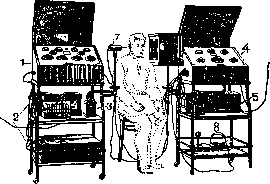
Figure 2. Otoaudion (model of the firm 'Audion-Craft' in S-Blasien): 1-main cathode sound generator; 2-storage batteries for it; 3-street current rectifier for charging the batteries; 4-cathode sound amplifier; 5-its storage batteries; 6-loudspeaker-dynamic; 7-sounding rod for investigating bone conduction; 8-microphone and telephone for investigating hard-of-hearing by speech.
gradually increase, or all the more so if they decrease; adaptation in turn depends either on the decomposition of a special sound-sensitive substance (Lazarev) or on a change in the excitability of the nerve endings themselves. If, however, the force or pitch is changed by sharp jumps, the threshold is then also only approximately determined (error in the direction of exceeding its level above the true one). The threshold is determined in absolute or relative values. The first have special significance in the development of theoretical questions, architectural and technical acoustics and the physiology of hearing. The second are very often used in medicine, since in the diagnosis of ear diseases and in determining the functional capacity of the hearing organ, it is important to compare the healthy and pathological condition of the hearing organ. In both methods, the results are graphically depicted in the form of hearing curves or reliefs; in both cases, various sound frequencies selected for the investigation are plotted along the abscissa axis (e.g., levels of pitch with desired intervals of 1 or x/a octaves, etc.), and the ordinates are the values indicating the absolute or relative threshold of sensation. The scale is most often taken logarithmic; the hearing thresholds of a healthy ear are either plotted as a curve corresponding to absolute values, or according to the indications of an audiometric instrument, or are taken as 100% and all placed on the same horizontal level of the diagram. Pathological data are depicted in the first case also in the form of a curve, and in the second - in the form of a "relief", more or less dissimilar in form to the mentioned 100% health relief. A more simplified scheme includes the determination of only two or three main thresholds (for the most characteristic sections of the tonal scale), e.g., one tone from the bass and one from the treble zone of the tonal scale, and one tone of medium height for measuring bone conduction. The determination of bass and treble deafness is to a certain degree analogous to the determination of the lower and upper limits of the tonal scale (in pathological cases there is a convergence of these zones). All that has just been said is the basic form, from which various deviations and specifications are possible, depending on the purpose of the investigation. Thus, in the practice of an ear doctor, the most common audiometric instrument to this day are tuning forks (see.) due to their extreme simplicity, portability, the ability to easily regulate the sound intensity and the constancy of this intensity; in purity of tone they compete with cathode generators (otoaudion, tonvariator). Other examples of hearing measurement instruments - or
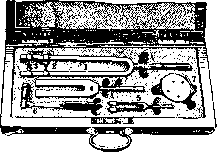
Figure 3. Simplified set of tuning forks for hearing research (according to V.I. Vonchek): 1 - overtone-free tuning fork with a number of vibrations of about 100 per sec.; 2 - large magnifying glass for direct reading of amplitude in the optical method of measuring hearing acuity according to Gradénigo-Streik; 3 - small magnifying glass with strong magnification (for small amplitudes); 4 - tuning fork with a number of vibrations of about 1,000 per sec.; 5 - tuning fork with weights (gives about 250 vibrations per sec.) - convenient for orientation in bone conduction; 6 - percussion hammer, which sets the tuning forks in sounding; 7 - Barani's muffler for determining complete unilateral deafness.
early tubes, Galton's whistle (see), monochord of Strecker, Urbanchich's harmonica, Politzer's acoumeter, pocket watches. In the absence of instruments, the acuity of H. can be measured by the voice of the examiner (whisper, conversational speech, cry). At the same time, it is possible not only to quantitatively determine the acuity of H. (by the greatest distance), but also qualitatively-by selecting known words (Voyachek's tables, Pautov's tables). Simplification of recording results consists in the fact that data is not marked graphically, but simply entered on the form of the so-called 'hearing passport', where in the middle column are placed the names of individual research methods and forms, and to the left and right of it-data corresponding to the right and left ear. For studying bone conduction, either the same otometer (to which a special device-Barany's sound electromagnet-is connected) or tuning forks (Fig. 3) and Strecker's monochord are used. Quantitative determination of hearing acuity with bone conduction is usually denoted as Schwabach's test, comparison of this conduction with air conduction corresponds to Rinne's test; finally, determination of sound lateralization, i.e., its perception on one particular side, is called Weber's test (see). Jellé's test is the determination of sensitivity of hearing to changes in pressure in the external auditory canal (with bone or air conduction). In professional selection, speech examination is most often used, and often also special methods applicable to the profession for which fitness is desirable to determine; so for example, when working with radio equipment, examination with sounds of the height at which signaling is usually carried out is most characteristic; for those working with sound-detecting devices, ototoposy, i.e., the ability to correctly guess the location of the sound source (orientation by sound), is of particular importance; its disturbance is called paracusis loci. Hearing in animals. At lower stages of development, the auditory function is so similar to other types of mechanical and vibratory sense that it is almost impossible to differentiate it from the latter. Thus, if it is said that animals having an otolithic or statolithic apparatus 'hear', this is just as true as it is a certain stretch-transfer of the term borrowed from human physiology to individual zoological species. Obviously, in insects too, some organs can be rightly called vibroacoustic in the sense that they are sensitive to vibrations of the environment (chordotonal and tympanal organs of grasshoppers and other beetles). Hearing in fish, lacking a cochlea, must also largely be based on the ability of otoliths to react to environmental vibrations and therefore only approximately corresponds to the acoustic ability of other vertebrates, for example birds, having a auditory papilla, and mammals, with their already fully expressed Corti organ, sometimes even included in a more complexly coiled cochlea than in humans. That some birds can capture at least approximately the nuances of human speech is proved by the imitative ability of parrots and other 'speaking' birds. Objectively, the perception of different sounds by animals can be recorded in two ways: 1) by the method of conditioned reflexes, whereby in dogs a higher level of the upper limit of the tone scale was found, reaching 35-50 thousand vibrations per second; by the same technique, Prof. I. P. Pavlov could confirm a number of details of auditory physiology, for example localization of the cortical auditory apparatus, dependence of ototoposy on binaural hearing (section of the corpus callosum disrupted orientation) and Helmholtz's resonator theory (limited damage to the cochlea was accompanied by loss of H. in certain areas of the tone scale); 2) through action currents-in cats, when recording action potentials from the auditory nerve, it was possible to trace the connection of this nerve function with sound stimuli, and it was possible to convert the currents in the nerve back into sounds and thus as if to directly feel what a cat must hear. In experiments with action currents, many other data were obtained, often paradoxical, for example that the eardrum is not a conductor of sound vibrations, but only a regulator of intralabyrinthine pressure, etc. Unconditioned reflexes to sound in animals are often more pronounced than in humans (for example, pricking up the ears, turning the head, contraction of the muscles of the tympanic cavity, etc.). Under the name of cochlear reflexes are usually meant reflex movements of the trunk and facial muscles (trembling, blinking of the eyes-auropalpebral reflex), as well as pupillary play, which are a reaction to unexpected and loud sounds and which have been tried in use in the diagnosis of simulation of deafness. Disorders of hearing depend on diseases and injuries of various parts of the apparatus, especially if they affect the middle ear or labyrinth (see Deafness). In processes on the auricle, H. itself usually does not suffer, but disorders of ototoposy, i.e., orientation by sound, may be observed; diseases associated with obstruction of the lumen, for example the auditory canal, lead to some weakening of H. with air conduction, approximately uniform for all areas of the tone scale, and more distinct perception of sounds on the more affected side with bone conduction. The same is characteristic of the disorder of H. in diseases of the eardrum, tympanic cavity and Eustachian tube, although here its degree may be stronger. In labyrinthine processes and processes in the auditory nerve, the auditory function changes quantitatively to any extent, reaching complete deafness, and qualitatively often gives a distortion of the typical formula, i.e., sensitivity to sounds of the treble range decreases noticeably more than to sounds of the bass range; in the perception of the tone scale, breaks are observed and bone conduction is more distinct on the less affected side. Labyrinthine disorder of H. is an essential sign of deaf-mutism (see) and a component of the so-called Hutchinson's triad in congenital syphilis. In disorders of the function of the muscles of the tympanic cavity and tube, sometimes peculiar symptoms are observed, namely, with paralysis of the stapedius muscle-hyperacusis or oxyacusia (increased auditory sensitivity), with spasm of the tensor of the eardrum-subjective sensations (flapping or ticking in the ear) and with gaping of the Eustachian tube-so-called autophony, i.e., increased sensitivity to one's own voice. Labyrinthine diseases are also often accompanied by distorted sensations (dysacousias) of various kinds, including diplacusis, when the same external sound stimulus is perceived differently in pitch or not simultaneously in both ears; in the first case we have disharmonic diplacusis, in the second-echo-like. If the same tone causes two different sensations in the ear, this is called paracusis duplicata. The ability of some patients, for example otosclerotics, to hear better in external noise, first noticed already in the 17th century by Willis, is named after him paracusis Willisii. A sharp discrepancy in the pitch of the perceived sound, in particular in the direction of its lowering, and a slowed reaction of perception are called respectively baria- and bradyacusias. These latter symptoms probably depend not on peripheral auditory receptors, but on improper functioning of the H. centers themselves, just like the peculiar subjective symptoms-phonisms-sensation of sound images without an external sound stimulus (the simplest form of auditory hallucinations) and auditory phosphenes, i.e., light sensations under the influence of external sound; other terms for designating such symptoms: psychochromesthesia, colored hearing, auditio colorata. Acoualgia (see) denotes the symptom of painful perception of tones and melodies. Since the Corti organ is connected by conducting pathways with both the right and left hemispheres, cortical deafness is possible only in cases when both auditory centers do not function; this most often occurs on the basis of hysteria or traumatic neurosis. The possibility of deafness with symmetric lesion of the centers in both halves of the brain or with localization of the process (hemorrhage, tumor) in the brain stem, where the conducting auditory pathways or subcortical centers are located relatively close to each other, is not excluded. For central deafness, loss of the ability to sound analysis and synthesis is characteristic, for example the inability of the patient to comprehend complex sound images, with satisfactory perception of test tones (observed by V. F. Undrits in typhus), loss of auditory memory, musical hearing, sharp discrepancy between air and bone conduction-Wanner's symptom (see).
Disorders of hearing are often associated with the subjective symptom of tinnitus, and they are not in strict correspondence, and sometimes it happens that the noise or ringing in the ears of the patient continues to exist despite the onset of complete deafness, and on the other hand, noises can be felt by people who have quite good hearing (noises with vasomotor lability, with neurasthenia, menopause, etc.). In terms of differential diagnosis, it is considered that high-pitched noises are characteristic of diseases of the inner ear, while low-pitched noises are for the middle ear. Special types of hearing disorders can be considered presbycusis, i.e., the appearance of symptoms of old-age hearing (see Inner ear, pathology) at a relatively early age, without a preceding specific disease of the inner ear or auditory nerve. Similarly, sometimes a delayed development of hearing is observed in a child, with the norm being that an infant begins to react distinctly to sounds no later than the second or third month of life. Professional is the disorder of H., resulting from very prolonged exposure of the hearing organ to noises associated with production or even from a single but very strong exposure to a sound wave. Such disorders are most often observed in the so-called noisy workshops of various factories, especially among boilermakers, then in workshops where airplane engines are calibrated, among textile workers, railway employees, artillerymen, etc. (For prevention, see Protective devices in production). On the weakening of H. in certain clinical forms, see Otitis, Labyrinthitis, and Otosclerosis. The fight against disorders of H. coincides with preventive and therapeutic measures against the corresponding diseases. In persistent forms of weakening of H., devices for the hard of hearing, retraining of hearing, and other methods are used (see Deafness).
V. Voyacek. Development of hearing through auditory exercises aims to stimulate the activity of the hearing organ, which is inactive due to either congenital underdevelopment or a pathological process. For therapeutic auditory exercises, various devices of different construction have been used, reflecting the sequential development of acoustic technology. At one time, the Urbančich harmonica, a set of tuning forks with resonators, Maurice's kinetophone, and others were particularly popular. Along with special devices, exercises using human speech have also been used and still retain their importance. Modern equipment, using the latest achievements in radio technology, is built on different principles and possesses qualities unavailable to many previous devices. The method of treating hearing loss through auditory exercises in the USSR became widely known through the work of the Leningrad Scientific-Practical Institute for Diseases of the Ear, Nose, Throat, and Speech in this direction, where Professor N. V. Belogolovov created his own school. Common to all devices used in auditory exercises are the following requirements: 1) the device must produce a simple or complex sound of a certain tone or work with a certain range of tones, 2) the strength of the sound produced by the device must be variable over wide ranges. According to these requirements, each device consists of the following main parts: 1) a generator, which is the source of sound, 2) a degulator-volume regulator and associated with it, 3) a receiver that directly conducts sound to the patient's ear. At present, a number of electrical devices have come into practice, for which the main technical and operational data are provided. Kenotron - a device for exercises with low tones of 50 and 100 hertz (periods per second). In its circuit, the kenotron is a frequency converter of alternating current, implemented using a two-anode rectifying lamp. Power is supplied from the lighting network with alternating current of 120 volts and 50 hertz frequency. The output of the kenotron is equipped with a volume regulator, allowing the sound strength in the headphones connected to it to be varied. The kenotron is designed for a load of 10-20 high-impedance two-ear headphones, connected in parallel. Activator is intended for auditory exercises with tones of the speech frequency range. There are two varieties of the activator: electromagnetic and tube. The first is built on the principle of an electromagnetic interrupter (buzzer) and is designed for a narrow frequency range. An ordinary telephone buzzer gives a frequency of about 200-400 hertz. When combining several buzzers in one device, a wider frequency range is obtained. Thus, Maurice's kinetophone, built on this principle, has a range from 80 to 3,500 hertz. The tube activator is built on the principle of a generator of basic oscillations with fixed frequencies. In the device produced by the Leningrad Scientific-Practical Institute, the following frequencies are selected: 128, 256, 512, 1,024, and 2,048 hertz. The tube activator is powered entirely from the lighting network. The activator provides smoothly adjustable power sufficient for very loud operation of 20-30 headphones. If necessary, the activator can also be used for hearing testing. Tone-variator (see) is used for auditory exercises in the entire range of sound frequencies 16-10,000 hertz. Speech amplifier is intended for exercising H. with conversational speech and music. The amplifier is the most important device, because exercises with speech play a decisive role in the development of H. The amplifier requires flawless, distortion-free transmission of speech and music. The amplifier is mainly designed to work from a microphone. The quality of transmission depends to a great extent on the microphone. The most suitable in terms of simplicity of operation and sufficient quality is the so-called marble microphone. Special attention deserves the application of the amplifier to gramophone recordings, which is done through an adapter - a special device for the electrical reproduction of sound recorded on a gramophone record. The use of gramophone recording transmission for hearing exercise has wide possibilities, as ordinary records specially spoken into them, and so-called tone-records with recorded individual pure tones or a range of tones are used. Sufficient amplifier power for 10-20 headphones. Powering the amplifier can be done from battery batteries and the lighting network (using a rectifier). The equipment of the installation for exercising H., called a surdo-therapeutic station, includes the listed devices and a number of auxiliary devices for facilitating the control of the devices and offices for receiving procedures. Patients receive procedures on headphones with individual degulators. With their help, the patient independently selects by hearing the necessary sound strength. Degulators are built in two types: with one adjustment for both ears at once and with two for each ear separately.
Related articles
Mentioned in
Cite this page
“HEARING.” Soviet Medical Encyclopedia. English translation of Bolshaya Meditsinskaya Entsiklopediya, 1st ed. (Moscow, 1928–1936), ed. N. A. Semashko. https://sovietmedicalencyclopedia.pages.dev/article/hearing/