Beats
Historical document, translated for reference. It reflects medical knowledge of the 1920s–30s and is not medical advice.
Summary
Beats refer to periodic changes in amplitude during various types of oscillations, commonly occurring in connected systems. This phenomenon is demonstrated with pendulums and occurs when sound waves with similar frequencies combine, creating periodic sound intensifications and attenuations.
Encyclopedia article (1928–1936)
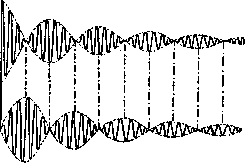
Beats, periodic changes in the magnitude of amplitude during various types of oscillations. They usually arise in oscillating connected systems. Thus, if two pendulums are suspended next to each other and their rods (or threads, if the pendulum is a weight suspended on a thread) are connected to each other by means of a thin thread, and a small weight is hung on the latter, beats can be visually observed in such a system. If one of the pendulums is set in motion, it will act on the other stationary pendulum through the connecting thread. The latter will gradually begin to swing, thereby taking energy from the first pendulum. If both pendulums are tuned to resonance, i.e., their periods of free oscillation are the same, then the energy of the first pendulum can, in the end, be completely transferred to the second, after which the process will begin in reverse order: energy will be transferred from the second pendulum to the first. As a result, the oscillations of both pendulums will proceed according to the law graphically depicted in the figure. The upper part of the figure shows the oscillations of the first pendulum, and the lower part shows the second pendulum.
Beats, among other things, arise when two sound sources with close oscillation periods sound together. As a result of the superposition of such oscillations, an extremely unpleasant periodic strengthening and weakening of sound occurs. Since the number of beats per second equals the difference between the numbers of oscillations corresponding to the two sounds, their character must obviously depend on the degree of closeness between these numbers. Helmholtz showed that, based on this principle, a doctrine of consonance (a pleasant combination of sounds) and dissonance (an unpleasant combination) can be constructed.
Related articles
Cite this page
“Beats.” Soviet Medical Encyclopedia. English translation of Bolshaya Meditsinskaya Entsiklopediya, 1st ed. (Moscow, 1928–1936), ed. N. A. Semashko. https://sovietmedicalencyclopedia.pages.dev/article/beats/