Waves
Historical document, translated for reference. It reflects medical knowledge of the 1920s–30s and is not medical advice.
Summary
This article defines waves as oscillatory motions propagating through a medium, detailing their behavior in one-dimensional (cords/rods) and three-dimensional space. It covers standing waves, pulse waves in arteries, and waves at the boundary of different media, including their mechanical effects and physical properties like reflection, refraction, and interference.
Encyclopedia article (1928–1936)
Waves, according to the definition of the founder of the wave theory of light, Young (1802), represent an oscillatory motion which propagates through all points of a medium, whereby after completing the oscillation, the particles of the medium cease their motion. The exception is the case when the oscillating body imparts successive periodic oscillations to the medium. All phenomena fitting Young's definition should be called wave phenomena. I. Waves in elastic cords and rods (waves in one-dimensional space). If end A (see Figure 1) of a loosely stretched cord is quickly raised and just as quickly lowered, a wave-like bend C (I) forms on the cord, which then travels along the cord in the form of a wave (II, III). Upon reaching obstacle B, the wave is not destroyed but undergoes reflection; in the case where end B is fixed, a change in the position of bend C occurs, as seen in Fig. 1, IV. The reflected wave propagates in space just like a wave propagating at a constant speed, and the various moments of the passage of waves in the cord are depicted in Fig. 1 (IV, V, VI). Reflections of waves are also possible in the case where one cord is connected to another having a different mass per unit length and a different elasticity.
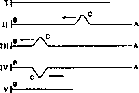
If a cord, fixed at both ends, is rhythmically raised and lowered at a certain frequency at one point A (see Figure 1), a series of propagating waves and a series of reflected waves coming from the obstacle will run along the cord; both series of waves superimpose on each other and form a new modification of waves, which bears the name of standing waves. In the simplest case, if during the time of half a full oscillation the oscillatory motion propagates from A to B in a standing wave, points A and B will be stationary, and the maximum amplitude will be at point C (see Figure 2). Successive stages of the oscillation are depicted by dashed lines. The described waves bear the name of waves with transverse oscillation; in rods, it is possible to obtain waves with longitudinal oscillations. If a push or tension is induced in a rod fixed at one end to a wall, then either compression or expansion of the layers of the rod's material forms at the end, whereby these deformations propagate in a wave-like manner along the rod to its other end, where they are reflected and again
it is possible to obtain a continuous stream of waves composed of compressed layers of matter moving along the rod. During the propagation of longitudinal waves to an obstacle and the reflection of waves from it, standing waves are also formed, characterized by the fact that some parts of the rod remain stationary (nodes of oscillation) and some parts provide maximum longitudinal movements (antinodes of oscillation); in the antinodes, where maximum movement is observed, there are no changes in the density of the substance, while in the nodes these changes are greatest. Waves in tubes with transverse displacements of particles are pulse waves in arteries, where the influx of blood causes the formation of a local distension, which, due to the elasticity of the artery walls, moves along it at a speed that does not coincide with the speed of blood flow. Waves arising in cords are capable of exerting mechanical actions during propagation. If a ring is placed on a cord fixed at one end B to a wall, and the other end of the cord A produces periodic waves, then the latter cause the ring to move from A to B. The force causing this phenomenon bears the name of wave or radiation pressure. II. Waves at the boundary of two media of different density. Examples of such waves are waves on the surface of a liquid and gas, waves propagating on the surface of oceans, seas, and lakes. Surface waves at the boundary of the earth and air, arising during earthquakes (Rayleigh waves), also belong to these waves. Waves at the boundary of two media exhibit reflection, diffraction, refraction, and interference (see) when encountering obstacles. Liquid particles in the very surface layers describe circular motions, which transition at a certain depth into elliptical ones. In nature, waves at the boundary of two media are of enormous importance not only in the study of waves on the surface of the oceans but also regarding waves formed at the boundary of two air layers of different density and humidity. These waves, as Helmholtz showed, lead to the appearance of clouds having the form of parallel rows. In large lakes of Switzerland, standing oscillations of water with a long period can form, depending on the size of the lake, fully resembling those standing oscillations of the water level that are observed in water poured into a saucer if the latter is slightly shaken. If waves fall on a floating body of large size, e.g., a log, a boat, etc., then the body, positioning itself parallel to the wave crests with its long side, experiences pressure from the waves. This explains why, when waves move toward the shore, they bring solid objects. III. Waves in three-dimensional space. Such waves can arise in any elastic media, whereby in solid elastic media longitudinal waves arise, propagating at a higher speed, and transverse waves, propagating at a lower speed. In gases, only waves with longitudinal oscillations arise. Waves with transverse oscillations arise in the ether and give rise to electromagnetic waves of light and radiotelegraphy. All these waves exhibit phenomena of reflection, refraction, interference, and diffraction. Transverse waves, in addition, exhibit polarization (see). Acoustic waves, like light waves, exert pressure on obstacles placed in their path, and the magnitude of light pressure is calculated according to Maxwell's electromagnetic theory of light. The phenomena of the aurora borealis, magnetic storms, the solar corona, and, finally, the phenomenon of cometary tails are explained by light pressure.
Related articles
Mentioned in
Cite this page
“Waves.” Soviet Medical Encyclopedia. English translation of Bolshaya Meditsinskaya Entsiklopediya, 1st ed. (Moscow, 1928–1936), ed. N. A. Semashko. https://sovietmedicalencyclopedia.pages.dev/article/waves/