Drilling Wells
Historical document, translated for reference. It reflects medical knowledge of the 1920s–30s and is not medical advice.
Summary
Drilling wells are vertical, occasionally inclined or horizontal mine shafts with circular cross-sections, created from the surface using mechanical apparatus. They serve various purposes including exploration, extraction of liquid and gaseous minerals, and drainage, with different methods and considerations for each type.
Encyclopedia article (1928–1936)
DRILLING WELLS, vertical mine shafts, occasionally inclined or horizontal, having a circular cross-section, with a significant ratio of depth to the diameter of this cross-section, and produced from the surface of the earth without access for workers inside them, by means of mechanical devices. The diameter of drilling wells varies from 50 mm to 2 m, and the depth reaches (in rare cases) up to 2,200 m. Drilling wells with a diameter of more than 2 m are called drilling shafts and are used in mining. Drilling wells are distinguished as: 1. Exploratory wells, conducted for the purpose of studying the geological structure or location of minerals (water, coal, ores, oil). 2. Exploitation wells, serving for the extraction of liquid and gaseous minerals from the earth's interior (water, mineral waters, brines, oil and combustible gases). Wells used for obtaining water for drinking and technical purposes are often called drilling wells (see). 3. Absorption wells, or wells, representing a drilling well ending in an aquifer with a low water level in it (diameter from 60 to 600 mm). When water is poured into such wells, they have the ability to absorb the water poured into them; at the same time, the water level in the well rises, and the more so, the more water is poured into it. If clean water is poured in, the well operates for a long time. When dirty water containing organic substances or solutions acting on the absorbing rock is poured in, the drilling well quickly becomes clogged and stops absorbing liquid. Absorption wells are used for drying basement floors, and sometimes for discharging wastewater after settling tanks or biological stations, etc. When some aquifers serve for absorption, and deeper ones for water supply, there is always the danger of contaminated water from the absorbing layer penetrating into clean aquifers through local破坏 of isolating layers, through loose casing pipes, through poorly sealed joints of cut pipes inside, or through rusted parts of pipes. Therefore, from a sanitary point of view, absorption wells must be considered a harmful structure that hopelessly contaminates aquifers. Usually sanitary supervision does not permit wells for these purposes. The discharge of wastewater, bath water, etc. into them should also be absolutely prohibited by sanitary supervision. 4. Auxiliary wells, used in mining and for ventilation of workings, are executed by drilling methods using percussion drilling or rotary drilling. For oil extraction in the USSR, rotary drilling is mainly used; in other cases, percussion drilling is used almost exclusively.
The process of percussion drilling consists of the following operations: 1. Lowering the drilling tool into the well on rods or cable, connecting them to the drilling rig, driven by hand or by a mechanical engine, and raising the drilling tool from the well. 2. Chiseling (drilling), i.e., crushing the rock by the drilling tool (bit, cutters, etc.), which is given an oscillatory motion by the drilling rig. 3. Cleaning the well, i.e., removing the crushed rock, done by dry method or by flushing. Cleaning by the dry method is done using a bailer, i.e., a pipe 3-5 m long, having a flap valve at the lower end, and at the upper end an arch to which a rod or cable is attached for lowering into the well for cleaning. The bailer is struck several times against the bottom of the well using the drilling rig; the crushed rock fills the bailer. The filled bailer is extracted from the well, emptied, and lowered again into the well until completely cleaned. Soft rocks—sands and clays—can sometimes be drilled through with one bailer, without preliminary crushing.
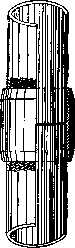
Figure 2. Riveted drilling pipe (diameter from 650 to 1,000 mm). Figure 3. Double-walled riveted drilling pipe. with a bit. The essence of another method of cleaning wells—flushing—is that during operation with the drilling chisel, water is pumped through the tubular rods from a pump or water supply; water enters the hole of the drilling chisel and strikes the bottom of the well, the crushed rock is stirred up, carried upward and flows over the surface. Thus, drilling work is significantly accelerated. During penetration in aquifers, part of the flushing water is absorbed by them; during penetration in strong aquifers, complete absorption of the flushing water can also occur—then flushing is useless. 4. Lining the walls of the well with casing pipes aims to protect unstable rocks passed through by the well from collapses, to isolate the well from the influx of water into it from the layers to be isolated, and to stop the transition of water from one aquifer to another. Lining of wells with casing pipes is done during the drilling process and as they are deepened. Casing pipes are lowered into the rock with friction. Usually 50-100 m of pipes can be lowered into the rock. When the pipes stop, the next column of casing pipes of smaller diameter, which fits in telescopically from the inside, is lowered from the surface. Deep wells are usually lined with several columns of pipes. In such cases, the inner pipes are cut in such a way that the cut upper end is several meters higher than the lower end of the larger pipe. The space between the pipes at the cut end is tightly sealed with a lead ring to prevent external water from entering the well. Casing pipes are manufactured in factories by welding sheets of cast iron. Pipes with diameters from 50 mm to 600 mm are prepared with threaded couplings, with wall thickness from 27 mm to 16 mm (see fig. 1). Pipes of larger diameter are made riveted from iron strips (see figure 2 and 3). One cannot count on complete tightness of pipe joints, and riveted pipes always leak at the seams. In rare cases, pipes of red copper are used. The longevity of drilling wells is determined by the longevity of casing pipes. The average service life of casing pipes is 10-25 years and depends, mainly, on the chemical effects of waters washing the drilling wells, both outside and inside, on iron, and on the thickness of the walls of casing pipes. Usually, casing pipes, first of all, are destroyed under the action of contaminated groundwater, and thus can contaminate the water of the drilling well. Lit.: Boky V. I., Practical course of mining, vol. III, L., 1924; Glushkov I. N., Guide to well drilling, M.-L., 1925; his same, Operation of drilling wells, SPB, 1913; Tof F., Methods of protecting water in oil and gas wells, M.-L., 1924; Uspensky N. S., Course of deep percussion drilling, M., 1924; Idelson Yu. S., Extraction of oil from wells by means of compressors, "Oil Business", 1926, No. 18; Keilgak K., Ground waters and sources, translation from German by prof. P. V. Otdarizho, SPB, 1914.


Figure 2. Riveted
drilling pipe (diameter from 650 to 1,000 mm). Figure 3. Double-walled riveted drilling pipe.
Related articles
Mentioned in
Cite this page
“Drilling Wells.” Soviet Medical Encyclopedia. English translation of Bolshaya Meditsinskaya Entsiklopediya, 1st ed. (Moscow, 1928–1936), ed. N. A. Semashko. https://sovietmedicalencyclopedia.pages.dev/article/drilling-wells/