Water Tower
Historical document, translated for reference. It reflects medical knowledge of the 1920s–30s and is not medical advice.
Summary
A water tower is a reservoir for water placed in a specially constructed tower that regulates pressure and ensures uniform water flow in a water supply network. It is a fundamental component of water supply systems, designed to handle uneven water consumption patterns and provide emergency water reserves for firefighting.
Encyclopedia article (1928–1936)
WATER TOWER, a reservoir for water, placed in a specially constructed tower and having the purpose of regulating pressure and ensuring uniform water flow in a water supply network. A water tower represents one of the basic components of a water supply system. Water consumption in urban and settlement water supply systems is uneven throughout the day.
Figure 1. Integral curves of water consumption and supply and the water level in the water tower. The average hourly consumption for the day amounts to 4.16% of the daily consumption. At night it falls to 1%, while during the day and evening (during hours of maximum consumption) it reaches 10% or more. The greatest hourly consumption exceeds the average hourly consumption by 1.5-2.5 times. With water supply systems, this coefficient of uneven consumption is smaller, larger in small cities, and in rural water supply systems it can reach up to 4. Pumping stations usually supply water to the network uniformly for 16-24 hours. With short water mains or artesian water supply with wells within the city limits, it proves advantageous during maximum consumption in the network to increase water supply and thereby reduce the required volume of the water tower reservoir. When consumption in the network exceeds the supply from the pumping station, the water deficit in the network is replenished from the water tower. At times when water consumption is less than what the pumping station supplies, the water tower is filled with water. In addition to covering the unevenness of water consumption in the network, the water tower must have a reserve of water to cover firefighting consumption for 1-2 hours. In Fig. 1 are shown the integral curves of supply and water consumption in the network. The difference in ordinates indicates the required minimum volume of the tower reservoir. The volume determined in this way should be increased by the volume of water needed for firefighting for 1-2 hours. Usually the volume of reservoirs is calculated at 5-15% of daily consumption. Water towers are constructed of brick, stone with an iron reservoir, reinforced concrete with the same type of reservoir, and iron towers with iron reservoirs. Temporary water towers are sometimes built of wood, with iron or wooden reservoirs. The shape of the reservoirs is cylindrical, with flat, spherical, and other more complex shaped bottoms. The water tower reservoir is equipped with a supply pipe that feeds it water from the network, a distribution pipe for reverse feeding of the water supply network from the reservoir, and valves for disconnecting the water tower from the network. In recent times, both pipes are replaced by one pipe performing both functions. To remove excess water and to prevent
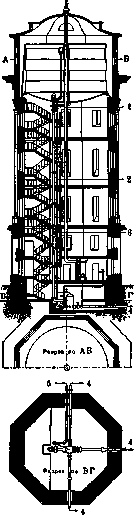
Figure 2. Water tower (height-25 m, tank volume-500 cubic m): 1-vent pipe; 2-drain pipe; 3-distribution and supply pipe; 4-to network; 5-to sewerage.
overflow of the reservoir, a drain pipe serves, and additionally, a pipe for emptying the reservoir in case of repairs and cleaning. Iron reservoirs are painted inside with oil paints that do not contain lead and other harmful to health compounds; it is better to cover the interior with asphalt varnish or asphalt composition (from 84% coal tar, 12% wood tar, 4% rubber and a small amount of linseed oil). The outer walls of the reservoir can be painted with any paint to protect against rust. Reinforced concrete water tower reservoirs are plastered inside and out; sometimes they are coated internally with compositions to make the reservoir walls watertight. Less frequently, the inner walls are asphalted. In cold climates, water tower reservoirs are surrounded by shelters built of reinforced concrete, wood, and stone. The interior of the shelter is plastered and painted. To prevent freezing of water in the reservoir, especially in the pipes, water towers are heated. Stoves are placed in the lower floor and allow warm air to rise upward. Pipes are sometimes thermally insulated. Inside water towers, ladders are installed for maintenance of the tower and reservoir. The room in which the reservoir is located must have ventilation and good daylight illumination. To prevent birds and insects from entering through windows, metal mesh is inserted. To prevent contamination of the reservoirs, the construction of passages or rooms for firefighters' duty under them should not be permitted. To indicate the water level in the reservoir, automatic indicators are installed that send signals to the tower and to the pumping station. After repairs and cleaning, the reservoir must be washed with clean water and sterilized with chlorinated water. The most advantageous location for a water tower is determined by calculation of the network; water towers, whenever possible, are built at high elevations to reduce their height. Living quarters in water tower buildings are permitted only under the condition of special sanitary supervision. The cost of constructing a water tower depends on the volume and height of the reservoir, and its material and construction. Roughly, the cost of a brick water tower can be taken as lbxVxH=N rubles, where V is the volume of the reservoir in cubic meters and H is the height of the water tower from the ground to the reservoir. Iron and reinforced concrete water towers cost somewhat less.
Related articles
Mentioned in
Cite this page
“Water Tower.” Soviet Medical Encyclopedia. English translation of Bolshaya Meditsinskaya Entsiklopediya, 1st ed. (Moscow, 1928–1936), ed. N. A. Semashko. https://sovietmedicalencyclopedia.pages.dev/article/water-tower/