CAPTAGE
Historical document, translated for reference. It reflects medical knowledge of the 1920s–30s and is not medical advice.
Summary
Captage is the construction of facilities to collect fresh or mineral spring water or groundwater without free surface exit, protecting it from harmful influences for further use. The process involves geological investigation, proper construction of water collection structures, and various engineering considerations to ensure water quality and quantity.
Encyclopedia article (1928–1936)
CAPTAGE (from French captage; from Latin cap-tare-to try to catch, seize, grasp), a structure by which fresh or mineral spring water or groundwater, which does not have a free exit to the earth's surface, is collected in one specific place and protected from various harmful influences for the purpose of its further use. The device of C. of fresh waters is usually associated with works on water supply of populated places or with industrial tasks. When capturing waters, various tasks may arise: sometimes it is only necessary to capture and secure by means of some other lining an already existing water exit, which both in quality and quantity fully satisfies the requirements. Sometimes capture works aim not only to use the amount of water that the source gives, but also to increase its yield. Finally, C. also has as its task the capture of an underground flow or stream of groundwater located under the earth's surface and not having a free exit in the form of a source. For C. to be made expedient, before starting it, it is necessary to thoroughly clarify the geological conditions of the origin and occurrence of this groundwater or source water, as well as the conditions of its exit to the earth's surface. In addition, the regime of the water to be captured should be studied, i.e., changes over time in its physico-chemical properties (chemical composition, temperature, yield, water level, etc.). The results of observations of changes in these properties are compared with meteorological data not only of the place of water exit, but of the entire area of the feeding region. Geological works carried out before capture usually consist 1) of works to compile a geological map for a more or less extensive area adjacent to the source or location of groundwater, and 2) of detailed exploration works in the area of the source exit or in the area of groundwater location. C. of fresh waters consists of the actual water-collecting structure into which water enters directly from the rocks, and of the capture chamber into which water already enters from the water collector (see Water Supply).-When capturing springs, two cases usually occur: a) ascending spring, i.e., water in it rises to the surface of the earth through vertical passages, and b) descending spring, i.e., water approaches the surface of the earth from top to bottom along inclined veins and seams. In the first case, capture works usually consist in clearing the exit of the spring as much as possible to the main rock from which the water jet breaks through, and in constructing directly above this exit a structure that protects the spring water from pollution and at the same time serves as a chamber for collecting water. In the simplest case, this structure is a bottomless well of round or square cross-section. From the well or basin, water is conveyed by a special pipe either directly to the place of consumption or to a collecting reservoir.-In descending springs, water enters the capture chamber through openings in its rear wall. Water collection galleries are also adjacent to these openings in cases where they are needed. Water is directed to the place of consumption through a pipe, the end of which is located in the capture chamber. If water cannot flow to the place of consumption by gravity, it is conveyed there by pumps. The suction pipe is lowered either directly into the capture or into a special reservoir into which water freely flows from the capture. With ascending sources, the device of such a separate reservoir is often necessary, since otherwise the level of source water is subject to sharp fluctuations under the influence of pumping, which can adversely affect its condition. The main requirement for capture is the location of water-collecting structures at such a depth that surface water cannot enter them. The minimum thickness of the soil layer sufficient for filtering the seeping water depends on the properties of the soil; in fine sandy soil it is approximately 4 m. For more reliable protection from pollution, above the flow of spring water before it enters the capture chamber, a protective trough is sometimes made of some water-impermeable material. Along this trough, surface water is diverted away from C. The entrance to the capture chamber should not be flooded by surface waters. Therefore, it is located
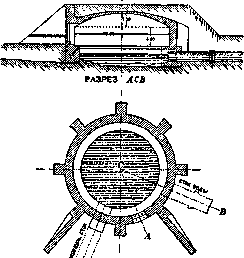
FIG. 1.
above the surface of the earth. At the same time, it should not be located directly above the basin of clean water in the capture chamber to avoid accidental contamination. Very often, special descent shafts are arranged for access to the C. of the source. These shafts are made separately from the clean water basin, and from their bottom a special water outlet is conducted. With such a device, contamination can occur only in the descent shaft, and all dirt from the latter is easily removed by washing.-Every C. should be as accessible as possible in all its parts both for inspection and for making repairs.-The capture chamber should have ventilation devices, because the spoiled air accumulated in C., firstly affects the quality of the water, and secondly is dangerous for the personnel inspecting C. from time to time, since this air usually contains much CO2. In order to prevent pollution of C. from outside through the exhaust ventilation pipe, a hood is placed over it, or a special basket is made in the air exhaust shaft. To maintain a constant temperature of the captured spring water and to protect the structure itself from freezing, the capture chamber is often covered with earth on the outside. In the case that the water intake pipe, which takes water from the capture chamber to convey it to the place of consumption, becomes clogged, water in this chamber can rise above the normal level, and sometimes completely flood the entire structure. At the same time, the captured water under the pressure created in C. can find other exits. At the same time, such backpressure can be harmful to the spring itself. To avoid such phenomena, every rationally arranged C. should be provided with a special overflow device (pipe) that automatically protects against such backpressure. In addition to the overflow pipe, C. is also equipped with a drain pipe, which serves for draining all water from C. to its very bottom in case it is necessary to repair or correct it. If the spring carries sand, the capture chamber is given the appearance of a settling basin with more or considerable length and sometimes divided by a transverse wall into two compartments. In the first compartment sand settles from the water, and from the second compartment clean water already enters the pipe, which takes water for consumption purposes.
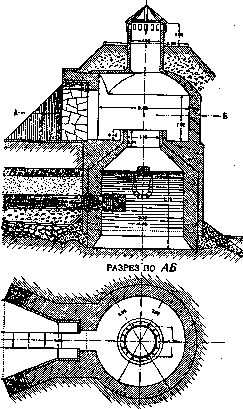
FIG. 2.
In Figs. 1, 2 and 3, some examples of capture structures for various springs are shown. Figure 1 shows C. of an ascending spring from a group of springs in the Vannes valley (water supply of the city of Paris). Figure 2 shows C. of an ascending spring, the water from which serves for water supply of the cities: Children's Village and Slutsk (former Pavlovsk); C. consists of an iron cylinder fixed on an iron support ring. The cylinder is lined with brick on both the outside and inside. The inner surface of the well is lined with faience tiles. Above the well there is an entrance chamber covered with earth. The well is equipped with water intake and overflow pipes; there is no descent pipe. To prevent the penetration of surface water into the well, at the S63 base of it there is a concrete layer covering the base of the well.-A special case of groundwater capture is drilling wells
^^
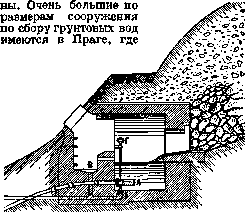
Figure 3. From the capture chamber, a water intake pipe A with a mesh is conducted. For draining water, pipe B is used, the opening of which is opened by valve G. Through the drain pipe V, excess water from the chamber enters the inspection chamber, and from there it is diverted through the descent pipe.
6 separate collection branches have been constructed with a total length of about 30 km and 600 wells, which are designed to collect up to 100,000 m3 of water per day. Captage of mineral waters. Mineral waters form a special group among underground waters, which serve for therapeutic purposes. Their captage is significantly more complex than that of ordinary fresh waters. The engineer's task here is not only to provide as much water as possible, but also to preserve, and sometimes even enhance, all its therapeutic properties. These properties do not appear in the water immediately. They are gradually acquired during its underground flow. The process of formation of mineral sources, often beginning in the deepest bowels of the earth, continues throughout their path until they emerge to the earth's surface. Therefore, all captage work must be preceded by particularly careful hydrogeological research in order to determine how the source is formed and at what depth and in what rocks it acquires its various properties. Depending on the results obtained, a captage is planned which, when it captures the water, can possess to the greatest degree the therapeutic properties necessary for the balneologist, and conversely, will be free of those properties which are undesirable for him. Thus, every captage must first of all satisfy the requirement of the expediency of its construction. In strict accordance with this requirement, in each specific case, both the depth of its installation and other details of its construction are determined. From this point of view, the view that every properly constructed captage must necessarily capture mineral water in the bedrock is completely incorrect. It cannot also be considered that in captage work it is always necessary to strive to increase the yield, mineralization, and temperature of the water. The temperature and mineralization do not always characterize the balneological value of the source, which often depends on some completely different property of the water that changes independently of temperature and mineralization, and sometimes is even inversely related to them. At the same time, an increase in yield can sometimes lead to a decrease in certain valuable properties of the water. As an example, we can cite the radioactive waters of Pyatigorsk. They do not belong to the primary Pyatigorsk sources emerging from the bedrock. This is water that, having emerged from the bedrock, enters the alluvium, is diluted there by other waters, and emerges to the earth's surface in this altered form. But it is precisely on its path from the bedrock to the earth's surface that the water acquires its radioactive properties, and therefore, by capturing it as it emerges from the bedrock, one can obtain water that is hotter, more mineralized, but deprived of precisely those properties which are most valuable in this case. In a number of cases, however, on the contrary, it is necessary to capture water not only necessarily in the bedrock, but even to deepen during captage work into these rocks, because otherwise it is impossible to rid the water of certain undesirable properties. In addition to clarifying the origin of mineral waters, before proceeding to captage work, the conditions of their circulation through the rocks and the conditions of their emergence to the earth's surface must also be carefully studied. Finally, the origin and circulation conditions of all kinds of underground waters in the area adjacent to the source must be fully elucidated, because if these waters at the present moment do not affect the origin and life of mineral waters, during the performance of captage work they may have some influence on them. When beginning captage work, one should always remember that it is not this or that mineral source that needs to be captured, but the mineral water that has found an outlet in it. Therefore, there is no need to construct a captage structure necessarily tied to this or that source. Sometimes, on the contrary, it is useful to construct this structure in a completely different place in order to, by intercepting there the main stream of mineral water, significantly increase its reserves and also improve its properties. The possible disappearance of the original source or even an entire group of sources should not be alarming, because in this case the former outlets lose their significance. However, this method of work can be permitted only in cases where the water in the sources that are offshoots of some main stream does not possess special properties acquired by it on the path from this stream to the earth's surface. In this respect, special caution and prudence must be observed. Every captage work is a complex operation and consists of various measures united by one general idea. In general, all these measures are divided into three groups of tasks: the first includes those whose aim is to capture at some depth mineral water with specific properties in a special structure from which it can be conducted to the place of consumption; the second includes works by which one tries to deprive the mineral water of the possibility of finding outlets other than the captage structure; finally, the third group of measures aims to prevent the possibility of mixing other foreign underground and surface waters with the captured mineral water. To solve the first task, works are used which, by their methods of execution, fall into two main groups. The first group includes works for capturing water, which consist in the fact that first, by means of excavations or more or less complex mining operations (shafts, adits, etc.), the water outlet is uncovered in the rock in which it is planned to capture the water, and then the latter is enclosed in the appropriate lining. As lining, the following are used: 1) wells of the ordinary type; their walls are firmly connected with the rock and cover all water outlets that need to be captured; 2) various kinds of reservoirs and basins, sometimes open at the top, sometimes closed on all sides; 3) pipes of various materials, installed directly at the water outlet. From the well or other captage structure, the water is diverted at some height from its base to the place of its consumption. It should be noted that the construction of captage structures in the form of wells or other water bodies with an open water surface is not expedient in cases where the mineral water loses its properties from contact with air, as for example water containing gases, iron-bearing water, etc. In these cases, it is much better to capture the water in the rock by means of a pipe and to conduct it directly to the place of consumption without access to air. It is also not advisable to construct a water-receiving reservoir at the very water outlet, which at the same time should serve for bathing. Unfortunately, the construction of such basins, widely practiced in the past, is still often found today. With such captage, the source outlet becomes clogged and polluted, and in addition, when the basin is filled, the source is often backed up, which adversely affects its regime. The space between the walls of the excavation and the captage structure is filled with some material (clay, etc.). However, sometimes special galleries are constructed around this structure so that, using them, one can observe the condition of the captage. Captage work by means of uncovering water outlets by excavations or mining operations has the advantage that in them the streams of mineral water are visible. They can be studied and only those that are suitable can be captured; moreover, in this case it is possible to observe the condition of the structure. But on the other hand, this method also has its disadvantages, the main of which are: 1. Relative high cost in the case of more or less deep bedding of the rock on which the captage structure must be constructed. 2. The necessity of artificially lowering the water level of the source and the surrounding groundwater; if this lowering is significant, it can disrupt the regime of the mineral water. 3. Incompleteness of mineral water capture: with this method, only the outlet of the mineral water is captured, sometimes originating only from a minor secondary fissure, and naturally, the capture of such a source does not yet solve the problem of the captage of this or that mineral water as a whole. The second group includes captage work by means of drilling wells. With this method, the water should be intercepted below its outlet. If the water flows along an inclined fissure, vertical drill holes are used for this purpose, but if it rises along a vertical fissure, inclined wells have to be used. Casing pipes of appropriate diameter are lowered into the drill hole to the required depth. In addition, if necessary, well cementing is used. The method of capture by drilling in turn also has certain disadvantages and advantages. The disadvantages include: 1. Limited choice of inexpensive material suitable for making such casing pipes that can withstand the destructive action of mineral waters; 2. Difficulty in re-drilling in case this is required for some reason; 3. The necessity of carrying out captage work in an area inaccessible to our direct observation.
This circumstance allows for resorting to drilling only after the most thorough study of all hydrogeological conditions, because otherwise, first, the drilling may not encounter the water that is intended to be captured, and second, during drilling, this water can easily be spoiled. It must be remembered that each drilling well is essentially a drainage for all waters circulating in the rocks it has passed through, and therefore it can completely change the equilibrium between them. The advantages of capture works by means of drilling include: 1) the low cost and simplicity of the works themselves; 2) favorable conditions for conducting water to the place of consumption in a completely unchanged form, since with this method of capture, the casing pipe and the connected discharge pipe form a direct continuation of the natural underground channels; 3) the possibility of more complete utilization of all hydro-mineral wealth in the given area, since, by successfully laying a well, it is possible to intercept underground not just this or that branch of the main stream feeding this water outlet, but the stream itself. Although mineral waters usually have an upward movement, in some cases it is necessary to deal with descending flows and streams (various derivatives, bitter waters, etc.). Here, for their capture, collectors of the same type as for the capture of fresh waters are used: drainage pipes, galleries, vertical wells, etc. Some features of these structures in each particular case depend on the specific conditions inherent to this mineral water. Very often, when capturing mineral springs, various methods are combined: for example, first a shaft is deepened, and then a drilling is conducted from its bottom, etc. On the Caucasian mineral waters, the combination of a drift and drilling wells was particularly frequently used. The drift here had a dual significance: 1) it facilitated access to the vein of mineral water and 2) it allowed the mouth of the drilling well to be located at the desired level. The choice of material for the capture structures is especially important when they are being constructed. This material must be such that on the one hand it is not destroyed by the action of mineral water, and on the other hand it does not adversely affect the quality of the water itself. For the lining of well walls and basins, wood, concrete, and various natural rocks (granite, porphyry, etc.) are used. For pipes - glass, ceramics, and other materials. The solution to this second main task of capture works is achieved, first, by lowering the level of water outflow in the capture structure, and second, by creating obstacles for its escape outside the capture structure. For the latter purpose, 1) all side outlets are sealed with clay, concrete, or other waterproof material, sometimes covering very large areas with them, 2) the levels of ground waters outside the capture structure are raised by creating appropriate underground barriers, flooding the surrounding area with river waters, etc. In some cases, when sealing side outlets, at the same time some of them are captured by special structures and then brought to the surface separately from the mineral water.
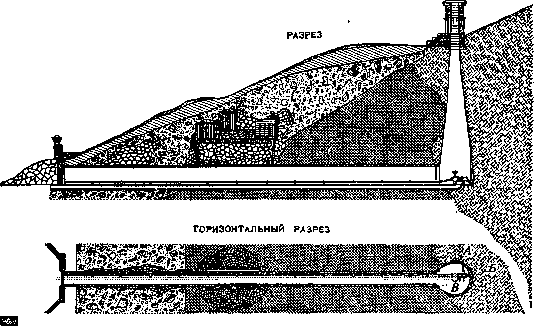
soil travertine slope deluvium, chert, marl) laying of clay fill, sand with pieces of foraminiferal horizon of Eocene (dense clay) trachyte concrete masonry of sawn Machuk travertine Figure 4. Capture of source No. 1 in Zheleznovodsk: A and B - drilling wells; V - discharge for measuring flow rate. iron, cast iron, wood, nickel, bronze, etc. Glass and ceramics are particularly good in terms of resistance to the action of mineral water, but they are brittle. Tin pipes are also very good, but their price is high. In many cases, bronze is a suitable material. Iron or cast iron pipes for better protection from the influence of water are sometimes coated with a layer of asphalt; however, this means in most cases helps little, and at the same time gives the water an unpleasant odor and taste. It is much better to use enameled pipes, provided they are of good quality. Having captured the water by one method or another, it is necessary to deprive it of the possibility of escaping somewhere else. This is done in cases where the water in these outlets has some undesirable properties and if there is a fear that, by closing such an outlet outside the capture, this will direct it into the capture structure arranged for the mineral spring. The third task of capture works is to prevent possible mixing of other underground waters with the captured mineral water. In some cases, this is achieved by constructing special protective structures in the form of barriers blocking the inflow of such waters to the mineral water stream; sometimes they are intercepted by means of drainage devices (pipe, gallery, etc.), and finally, the properly chosen level of mineral water outflow is of great importance for solving this problem. It goes without saying that for all these measures it is necessary to previously thoroughly study the equilibrium conditions between the mineral water and the surrounding foreign waters. It is easy to see that such a study must also precede the works to create pressure around the capture by raising the level of surrounding ground waters. Without observing this condition, as a result, either mixing of foreign waters with the mineral water or, conversely, the escape of mineral water into the drainage device may occur. From all of the above, it is clear that when constructing a capture, the choice of the mineral spring's outflow horizon is of particular importance, since this choice to a large extent determines the creation of this or that equilibrium conditions between the mineral and foreign waters. However, besides considerations of this kind, in choosing the most suitable outflow level, there are also considerations of another order. For example, the flow rate of the spring depends on this level. The lower the outlet of the latter is located, the more water can be obtained from it. On the other hand, considerations of the possibility of obtaining water from the spring by gravity flow are sometimes also of no small importance. The art of capturing mineral springs was known in very ancient times. As an example, one can point to the well-preserved capture of a spring in Engadin. This capture, built by Celts in the Bronze Age, is 3,000 years old. But the art of capture reached its greatest development during the period of Roman rule. From this period, a number of well-arranged captures have survived, which show that even at that time, resort was sometimes made to very complex works in order to utilize one or another mineral water. Fig. 4 shows the capture of source No. 1 in Zheleznovodsk. The capture consists of a drift and two drilling wells conducted in its face. The water is captured from a fissure in trachyte by them. The drillings are secured with cast iron casing pipes, which are directly connected to the discharge pipe laid along the bottom of the drift. The capture of Narzan in Kislovodsk (see Buvet) is of a different type; it consists of an open well into which mineral water flows from its bottom. The figure (see volume IV, pp. 289-290) shows the capture of the Dolomite Narzan of Ogilvy. The water is captured in a fissure by means of an inclined drilling well. At present, the well is secured with cast iron pipes. Capture wells--see Water supply.
The third task of capture works is to prevent possible mixing of other underground waters with the captured mineral water. In some cases, this is achieved by constructing special protective structures in the form of barriers blocking the inflow of such waters to the mineral water stream; sometimes they are intercepted by means of drainage devices (pipe, gallery, etc.), and finally, the properly chosen level of mineral water outflow is of great importance for solving this problem. It goes without saying that for all these measures it is necessary to previously thoroughly study the equilibrium conditions between the mineral water and the surrounding foreign waters. It is easy to see that such a study must also precede the works to create pressure around the capture by raising the level of surrounding ground waters. Without observing this condition, as a result, either mixing of foreign waters with the mineral water or, conversely, the escape of mineral water into the drainage device may occur. From all of the above, it is clear that when constructing a capture, the choice of the mineral spring's outflow horizon is of particular importance, since this choice to a large extent determines the creation of this or that equilibrium conditions between the mineral and foreign waters. However, besides considerations of this kind, in choosing the most suitable outflow level, there are also considerations of another order. For example, the flow rate of the spring depends on this level. The lower the outlet of the latter is located, the more water can be obtained from it. On the other hand, considerations of the possibility of obtaining water from the spring by gravity flow are sometimes also of no small importance. The art of capturing mineral springs was known in very ancient times. As an example, one can point to the well-preserved capture of a spring in Engadin. This capture, built by Celts in the Bronze Age, is 3,000 years old. But the art of capture reached its greatest development during the period of Roman rule. From this period, a number of well-arranged captures have survived, which show that even at that time, resort was sometimes made to very complex works in order to utilize one or another mineral water. Fig. 4 shows the capture of source No. 1 in Zheleznovodsk. The capture consists of a drift and two drilling wells conducted in its face. The water is captured from a fissure in trachyte by them. The drillings are secured with cast iron casing pipes, which are directly connected to the discharge pipe laid along the bottom of the drift. The capture of Narzan in Kislovodsk (see Buvet) is of a different type; it consists of an open well into which mineral water flows from its bottom. The figure (see volume IV, pp. 289-290) shows the capture of the Dolomite Narzan of Ogilvy. The water is captured in a fissure by means of an inclined drilling well. At present, the well is secured with cast iron pipes. Capture wells--see Water supply.
Related articles
Mentioned in
Cite this page
“CAPTAGE.” Soviet Medical Encyclopedia. English translation of Bolshaya Meditsinskaya Entsiklopediya, 1st ed. (Moscow, 1928–1936), ed. N. A. Semashko. https://sovietmedicalencyclopedia.pages.dev/article/captage/