Capsules
Historical document, translated for reference. It reflects medical knowledge of the 1920s–30s and is not medical advice.
Summary
This article from the 1928–1936 Soviet Medical Encyclopedia describes the types, production, and usage of pharmaceutical capsules, including gelatin capsules, pearls, and starch cachets, used for administering various medications.
Encyclopedia article (1928–1936)
CAPSULATURES, small scoops for pharmacy powders. Manufactured from horn, celluloid, oiled paper, etc. (see figure). The length of capsulatures ranges from 6 to 20 cm. Capsulatures can be replaced by pieces of clean, unpainted cardboard. CAPSULES (from Latin capsula—little box, drawer), receptacles-wrappers for medicines...
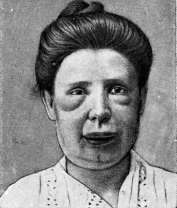
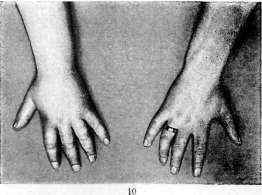
1. B. scleromae (according to Frisch). 2. B. ozaenae (according to Feld). 3. B. Friedländeri. 4. B. mucosus (according to Pfeiffer). 5. B. aerogenes (according to Escherich). 6. Cardiosclerosis. 7. Polyposis of the colon. 8, 9, and 10. Quincke edema (Fig. 8—before disease). (also honey or molasses) and gum arabic (for hard ones) or glycerin (for soft capsules). Gelatin capsules must be transparent and dissolve in water at 35–40°, yielding a transparent, tasteless liquid free of heavy metals (State Pharmacopoeia VII). The production of gelatin capsules is carried out using metal pins, the bronze heads of which are dipped into molten gelatin mass. After solidification, the capsules are trimmed and removed from the pins. If it is necessary that the capsule does not dissolve in the stomach, but passes into the intestine and dissolves only there in an alkaline environment, then gelatin capsules treated with 1/2–1% formalin, i.e., glutol capsules, are prescribed. Powders, oily liquids, ether, benzene, xylene, tinctures, and solutions with strong alcohol can be prescribed and dispensed in gelatin capsules. Figure 9. Small capsules shaped and sized like a pill, containing just the indicated or similar liquids, are called pearls (perles). In mass production of capsules and pearls and filling them with medicines, special machines are used. — 3. Cachets (nebulae, oblatae, capsulae amylaceae - State Pharmacopoeia VII) are prepared from fine wheat flour or wheat starch; they are applicable only for dispensing powders. The old form (Limousin, Fasser) consists of two identical halves with flat edges (Figs. 3 and 4). A weighed dose of powder is poured into one half; then the 2nd half is applied, whose edge is slightly moistened with water. By pressing the edges, both halves are glued together. More hygienic are the cachets of the Morstadt system (Fig. 8), which have almost entirely supplanted the old form: they consist of two unequal semi-boxes made of cachet mass; the smaller semi-cachet is filled with a dose of powder and tightly closed, like a lid, by the larger semi-cachet. For the mass filling of such cachets with powders, tablet-type machines exist, automatically measuring out (doses of) powders and automatically filling and closing the cachets. Substances that react with starch (iodine) or release iodine due to decomposition (iodide salts) should not be enclosed in starch cachets. Hard gelatin and cachet capsules are also sold empty by pharmacies; the enclosure of medicines in them can be performed by the patient or those around them. To take a capsule with medicine, it is moistened with water and swallowed, washing it down with water or another liquid. Regarding the use of capsules in X-ray diagnostics, see X-ray diagnostics.
I. Obergard.
Related articles
Mentioned in
Cite this page
“Capsules.” Soviet Medical Encyclopedia. English translation of Bolshaya Meditsinskaya Entsiklopediya, 1st ed. (Moscow, 1928–1936), ed. N. A. Semashko. https://sovietmedicalencyclopedia.pages.dev/article/capsules/