Powders
Historical document, translated for reference. It reflects medical knowledge of the 1920s–30s and is not medical advice.
Summary
This article describes powders as a solid medicinal form used both internally and externally in medicine. It details the methods of preparation, classification by fineness, mixing techniques, and precautions to be taken when handling different types of medicinal powders.
Encyclopedia article (1928–1936)
POWDERS, pulveres (Ph. VI), a solid medicinal form in which dense medicinal substances, variously pulverized, are used in medicine both internally and externally. For therapeutic application of solid medicinal substances, especially those difficult to dissolve in water, it is necessary to convert them into fine powders; for this purpose various pulverizing or crushing apparatus is used: mills, runners, mortars, etc. For the same purpose, pharmacies sometimes use copper, but more often porcelain mortars. Some medicinal substances are pulverized with great difficulty by ordinary methods. In such cases, special means of pulverization are used; for example, to pulverize camphor, its pieces are poured with ether or a mixture of ether with alcohol and rubbed in a mortar until the solvent completely evaporates. Vanilla, saffron and other vegetable substances that cannot be converted into powders are pulverized together with solid crystalline substances, such as cane sugar, etc., and preserved in the form of "trituratio," i.e., a mixture (with sugar), with the label indicating how much pure saffron or vanilla is present in the preparation (in percent). Other substances whose pulverization presents difficulties (larch sponge, colocynth, etc.) are weighed, cut into small pieces, impregnated with mucilage of gum arabic or tragacanth, dried and pulverized, with the label indicating the ratio of the weight of this mixture to the weight of the materials taken. Some materials, mainly containing a significant amount of resinous substances, can be pulverized only at low temperature, for which they are kept for some time on ice or in snow (Asa foetida, gamboge, etc.). Pulverized medicinal materials are classified according to the degree of pulverization by sifting them through sieves with holes of different sizes. Sifting is also used to free coarse pulverized materials from dust. To prevent the scattering of the materials being sifted, sieves are enclosed in wooden or metal drums (Figure 1). For sifting large
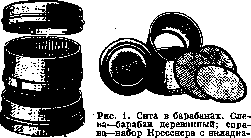
quantities of materials of different sieve numbers,
mechanical sieves operating by shaking or rotation are used. In the latter method (cylindrical sieves), to accelerate or facilitate sifting, brushes or flexible blades are placed in the sieves, which rub the powders through the sieve openings. The Ph. VI distinguishes the following categories of powders: 1) Very fine or finest, pulveres subtilissimi, tenuissimi, or alcoholisati, obtained by sifting pulverized substances through silk sieve, the fabric of which has about 2,500 openings per 1 cm2. The corresponding sieve is designated No. 1. 2) Fine powders, pulveres subtiles, obtained by sifting through silk sieve, the fabric of which has about 1,600 openings per 1 cm2. Sieve No. 2. 3) Medium-fine powders, pulveres tenues, obtained by sifting through silk sieve, the fabric of which has about 1,000 openings per 1 cm2. Sieve No. 3. 4) Medium-coarse powders, pulveres, or pulveres modici, obtained by sifting through hair or metal sieve, the fabric of which has about 320 openings per 1 cm2. Sieve No. 4. 5) Coarse powders, pulveres grossi, or grossiusculi, obtained by sifting through hair or metal sieve, the fabric of which has about 100 openings per 1 cm2. Sieve No. 5 (sieve).. 6) Very coarse powders, pulveres grossi, obtained by sifting through a metal sieve with openings of 3 mm in diameter. Sieve No. 6 (riddle). 1. List of pharmacopoeial powders sifted through silk sieve No. 1: Amylum Tritici, Carbo animalis, Carbo Ligni, Cortex Cinnamomi, Folium Belladonnae, Folium Digitalis, Folium Hyoscyami, Folium Sennae, Folium Stramonii, Folium Menyanthidis, Radix Althaeae, Radix Gentianae, Radix Glycyrrhizae, Radix Ipecacuanhae, Radix Taraxaci, Rhizoma Bistortae, Rhizoma Iridis Florentinae, Rhizoma Rhei, Rhizoma Valerianae, Rhizoma Veratri albi, Saccharum album, Saccharum lactis, Sapo medicatus, Semen Colae, Talcum purum, Tartarus stibiatus, Tragacantha. 2. List of pharmacopoeial powders sifted through silk sieve No. 2: Acidum boricum, Alumen ustum, Cortex Cascarillae, Cortex Cinchonae, Cortex Condurango, Cortex Granati, Extractum Glycyrrhizae siccum plane solubile, Radix Colombo, Radix Senegae, Rhizoma Calami, Rhizoma Filicis maris, Rhizoma Galangae, Rhizoma Zedoariae, Rhizoma Zingiberis, Stigma Croci, Tuber Jalapae, Tuber Salep. All substances for which a particular degree of fineness is not prescribed are also sifted through sieve No. 2. 3. List of pharmacopoeial powders sifted through silk sieve No. 3: Acidum tartaricum, Aloe, Alumen, Bulbus Scillae, Castoreum, Cantharis, Cortex Aurantii, Euphorbium, Flos Caryophylli, Flos Cinae, Fructus Anisi vulgaris, Fructus Anisi stellati, Fructus Cardamomi, Fructus Foeniculi, Gummi-arabicum, Gummi-resina Myrrha, Kalium bitartaricum, Kalium nitricum, Kalium sulfuricum, Natrium bicarbonicum, Natrium boricum, Opium, Plumbum oxydatum, Secale cornutum, Semen Sabadillae, Semen Sinapis, Semen Strychni. 4. List of pharmacopoeial powders sifted through hair or metal sieve No. 4: Ammonium chloratum, Fructus Capsici, Fructus Juniperi, Tuber Salep (pro decocto). 5. Only Semen Lini is sifted through hair or metal sieve No. 5. The designations of sieves by numbers adopted in the Ph. VI are not entirely convenient; in literature and catalogs, it is preferred to denote the fineness of powders by the letter M ("Maschen"-meshes) with an indication of how many meshes there are per 1 cm (see table). No. sieve Conventional designation Which powders pass through 1 2 3 4 5 6 M/50 M/40 M/32 M/18 M/10 M/3,3 Finest powders Fine powders Medium-fine powders Medium-coarse powders Coarse powders Very coarse powders and whole seeds (anise, flax, mustard, etc.) Even this designation is inaccurate, as it says nothing about the thickness of the threads of the sieve fabric, and therefore about the diameter of the meshes and particles of the powder. Therefore, for example, the German Pharmacopoea defines exactly the diameter of the opening in the mesh of the sieve fabric: No. 1 (German) corresponds to an opening diameter of 4 mm (coarsely cut materials); No. 2-3 mm (medium-cut); No. 3-2 mm (finely cut); No. 4-about 0.75 mm (coarse powders); No. 5-about 0.30 mm (medium-fine powders) and No. 6-about 0.15 mm (fine powders). When sifting powders, care is taken to mix them simultaneously, because when pulverizing chemically heterogeneous substances (for example, vegetable powders), at first a powder is obtained not only of a different color than at the end, but often of a different composition. Thus, for example, with roots, at first the bark is mainly pulverized, and then the wood; starch sometimes gives the first portions of powder from fibrous materials a lighter color, etc. The metal fabric of sieves and parts of machines (cast iron, steel) can act on the components of the substances being pulverized—especially in the presence of moisture—and contaminate the powder; therefore, in each case, the chemical composition of the substances being sifted must be taken into account and undesirable interactions with the metal of the apparatus avoided. Silk and hair sieves and porcelain or glass mortars present less danger in this respect than metal ones. Pulverized medicinal substances are sometimes prescribed in pure form (pulveres simplices), but more often mixtures of several powders are prescribed (compound powders, pulveres compositi). Mixing of powders in small quantities is done in glass or porcelain mortars (with rotational movements of the pestle) or in steel boxes with balls (Fig. 2). For complete homogeneity of mixing, this is continued until the particles of the components can no longer be distinguished with the naked eye. Then, in factory production, the powders are sifted through sieve No. 2 or (for powders, insufflations and dusting powders) No. 1. The residues remaining on the sieve are again rubbed until completely pulverized, sifted and again mixed with the entire mass of powder. In pharmacy conditions, mixing of several ingredients is done starting with rubbing the substances prescribed in the smallest quantity; but if the quantity of the latter is so small that there is a danger of losing a significant part of it due to adhesion to the walls of the mortar, then first a small part of some other ingredient is rubbed in the mortar, and then the substance that is prescribed in the smallest quantity is added. For uniform mixing of ingredients, one should avoid adding to the mortar quantities that significantly exceed the amount of powder already in the mortar. Powders that might react with each other in a moist state must (if such a reaction is undesirable) be thoroughly dried in desiccators beforehand and then mixed carefully, but not with a pestle, but with a wooden or horn spatula. Ingredients that threaten explosion when mixed (strong oxidizers with strong reducing agents) are pulverized separately and then also carefully mixed with a wooden spatula.

Figure 2. Hand ball mill - Wolsifer box.
Powders are dispensed in paper sachets or capsules, as well as in starch and gelatin capsules, in cardboard boxes, etc. Powders containing aromatic, volatile, or hygroscopic components are dispensed in waxed or paraffined capsules, and in large quantities—in glass jars tightly sealed with corks. The administration of powders not divided into individual doses is associated with inaccuracy in dosing. For example, Pulvis Magnesiae cum Rheo, prescribed to be taken by one teaspoonful, gave variations from 0.8 g to 2.5 g depending on who and with what teaspoon measured the doses. Therefore, powders should preferably be prescribed divided into doses. In the form of divided or dosed powders (pulveres divisi), the powder reaches the patient already divided into individual doses. The form of undivided powders at the present time has remained mainly for dusting powders, face powders, gargles, dental powders, etc., where dosing is not important, and for internal use—only for powders with relatively safe ingredients, the dosage of which can vary within wide limits, or for substances taken in 1-2 doses (English salt, or Glauber's salt). The physician can in the prescription specify the composition of a single dose and prescribe the number of such doses ("t. d. №...") or specify the composition of the entire mass of powder and suggest dividing it into so many equal doses ("div. in partes aeq. №..."). In both cases, each dose of powder should be weighed separately in the pharmacy. Despite all attempts at mechanization, the pharmaceutical preparation of divided powders has not yet led to satisfactory results. Basically, apparatus for this purpose can be divided into two groups: 1) individual doses are weighed, and 2) doses are measured. For weighing, table scales are used, on one pan of which a removable scoop is placed instead of a cup (Fig. 3). In more advanced systems, the change of scoops occurs automatically. Machines for measuring powders (Figs. 4 and 5) have not been adopted, and they also do not provide sufficient accuracy. For the same purpose in factory production, more complex instruments and machines are used. The difficulty of mechanizing the dosing of divided powders was the main stimulus for replacing the form of powders with the form of precisely dosed tablets.
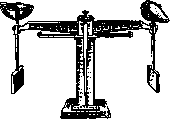
Fig. 3. Automatic scales for dosing powders.

Fig. 4. Dosing piston.
Fig. 5. Dosing spoon.
In the composition of powders, thick substances (e.g., extracts) or liquids that do not dissolve the given powder, e.g., essential oils (see Oil-sugar), can also be prescribed in small amounts. Such mixtures are dry enough to be dispensed as powders; to protect against the evaporation of essential oils and absorption of the contents by paper, such powders are dispensed in glass jars with corks, and divided powders—in paraffined or parchment capsules.
I. Obergard. Medical application of powders. The application of powders in medicine is extremely diverse and depends primarily on the specific pharmacodynamic properties of the powders. Then the degree of grinding of the medicinal powder taken often plays a significant role in the action of powders. It is by no means indifferent whether a given "remedy is applied in a particular specific case in the form of the finest (subtilissimus) or fine (subtilis) powder. Mercurous chloride, introduced into the eye in the form of the powder preparation Hydrarg. chloratum mite, causes a sharply expressed inflammatory condition of the cornea, whereas the same mercurous chloride, but introduced in the form of Hydrarg. chloratum vapore paratum, representing a much finer powder, acts gently on the cornea and causes only moderate irritation. To protect the diseased skin in acute general eczema, wheat or rice starch is used as a dusting powder, necessarily thoroughly ground to the state of pulvis subtilissimus. Pulvis Amyli Tritici subtilis applied in the same cases not only does not give the desired therapeutic effect, but can cause an even greater exacerbation of the pathological process. When powders are introduced internally, their action also often depends on the degree of their grinding. For a laxative effect, "a coarser powder of mercurous chloride is given, namely the preparation Hydrarg. chloratum mite, and not the fine Hydrarg. chloratum vapore paratum, since the first more strongly irrits the mucous membrane of the gastrointestinal tract and thereby causes more energetic peristalsis and more abundant secretion of intestinal juices. Along with the grinding of medicinal substances, their trituration or pounding, as well as the use of various other methods, the powder is often transferred from a crystalline state to an amorphous state, which also affects the intensity, and consequently the qualitative aspect of the action. The amorphous powder of mercurous chloride—Hydrarg. chlorat. via humida paratum—when introduced internally in the same dose will have a less energetic laxative effect compared to the crystalline Hydrarg. chloratum mite. On the other hand, the first salt, remaining in the intestine for a longer time than the second, can be absorbed in larger quantities and cause symptoms of poisoning. However, even with internal use of powders, it may be necessary to convert the powder into an especially fine state, e.g. in the case of prescribing the powder as an adsorbent or when using the powder as a mechanically protective agent for the mucous membrane of the gastrointestinal tract. The dependence of the action of powders on the degree of their grinding deserves special attention not only of physicians, but also of workers in the pharmaceutical industry, especially when the question of replacing the powder of one or another substance with another dosage form, e.g. pills or tablets, is raised. In such a case, when discussing all the conditions that prompt the replacement of the powder with another dosage form in a particular specific case, it is necessary to especially carefully study the change in the quantitative and qualitative aspects of the action of the drug in connection with the change in the size of the particles of the medicinal powder taken. The doses in which powdered substances are prescribed internally for a single administration vary from fractions of a milligram for especially poisonous and strongly acting substances to 2-3 g for less actively affecting means. Usually, however, the size of the entire mass of powder for a single internal administration ranges from 0.2-0.3 to 0.5-0.8-1.0.
Related articles
Mentioned in
Cite this page
“Powders.” Soviet Medical Encyclopedia. English translation of Bolshaya Meditsinskaya Entsiklopediya, 1st ed. (Moscow, 1928–1936), ed. N. A. Semashko. https://sovietmedicalencyclopedia.pages.dev/article/powders/