Bittersweet Nightshade
Historical document, translated for reference. It reflects medical knowledge of the 1920s–30s and is not medical advice.
Summary
Bittersweet Nightshade is a plant from the nightshade family that contains toxic compounds but has been used in traditional medicine for bronchial diseases and skin conditions. The article describes its botanical characteristics, chemical composition, and historical medical applications.
Encyclopedia article (1928–1936)
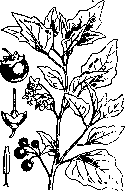
BITTERSWEET NIGHTSHADE (sweet-bitter), Solanum dulcamara, the name of a plant from the nightshade family (Solanaceae), to which the edible potato (Solanum tuberosum L.) and black nightshade (Solanum nigrum L.) (psinka) also belong - a poisonous annual herbaceous weed (see illustration), about 50 cm in height, found almost everywhere in gardens, fields, along roads, etc. Solanum dulcamara L. - sweet-bitter nightshade (crowberries or magpie berries) - a perennial semi-shrub 1-3 m in height, blooms from May to September; the fruits are egg-shaped bright red berries; grows almost everywhere (Europe, Asia, America, etc.) on moist soil. The green parts of the plant are poisonous, while the ripe fruits are almost harmless. The toxicity of this genus of nightshades is attributed to the solanine contained in them (see Potato). The stems of sweet-bitter nightshade contain dulcamaric acid (an acidic saponin glycoside), dulcamaretinic acid, solaceine (a basic glycoside); the dulcamarin previously isolated turned out to be an impure chemical substance; in addition, magnesium malate and succinic acid have been isolated. Previously, dried stems of sweet-bitter nightshade (Stipites, s. Caules Dulcamarae), collected in autumn after the leaves fell or in spring before their development, were used in medicine. It was taken orally in the form of powders in doses of 0.5-2.0, in the form of mixtures, for example, Averin tea (see), decoctions and in the form of extract (Extr. Dulcamarae), in diseases of the bronchi and chronic skin ailments. At present, nightshade is not used for treatment.
In the present time, nightshade is not used for treatment.
Related articles
Mentioned in
Cite this page
“Bittersweet Nightshade.” Soviet Medical Encyclopedia. English translation of Bolshaya Meditsinskaya Entsiklopediya, 1st ed. (Moscow, 1928–1936), ed. N. A. Semashko. https://sovietmedicalencyclopedia.pages.dev/article/bittersweet-nightshade/