Solvent
Historical document, translated for reference. It reflects medical knowledge of the 1920s–30s and is not medical advice.
Summary
This article from the 1930s Soviet medical encyclopedia details the properties, toxicity, and uses of solvents, particularly solvent naphtha, as a disinfectant and insecticide. It describes methods for treating infested clothing and bedding in specialized chambers and boxes.
Encyclopedia article (1928–1936)
SOLVENT. Solvent naphtha-benzene is a liquid fraction of light oil from coal tar, obtained at 120-180°C. The main component of S.-naphtha is xylene (62-24%). S.-naphtha is slightly toxic, does not cause poisoning, does not irritate the kidneys; it is not explosive; its flammability equals that of kerosene. Solvents are also obtained from oil from various deposits. S.-naphtha is a transparent liquid, odorless, with a pleasant smell; petroleum is dark brown, not always transparent, with a sharp unpleasant smell, sometimes with significant toxicity. Lastochkin and others experimented with solvents (yellow and red-brown; it is not specified whether these were S.-naphtha or petroleum) and established significant toxicity of the tested samples. According to Okunevsky's observations over 3 years on a large material, mild poisonings in workers were observed only when working with some petroleum solvents and very rarely. The composition of solvents is not standardized, although their wide application in sanitary practice requires this measure. The greatest value in sanitary terms belongs to S.-naphtha, which possesses an energetic disinsectional action. However, solvents obtained from oil rich in aromatic hydrocarbons also possess significant insecticidal properties. S.-naphtha and some petroleum solvents exhibit disinsectional action on lice, bedbugs, fleas, and cockroaches. Cockroaches are the most resistant to solvents. Lice die in 50 seconds when moistened in S.-naphtha, nits in 60 minutes. The disinsectional effect of S.-naphtha and other solvents under conditions of moistening insects gave grounds to propose it in a mixture with soap and water in baths and sanitary passageways for the treatment of hairy parts of the bodies of louse-infested people (soap-50 parts, water-200 parts, S.-naphtha-250 parts, green soap-25 parts, water-25 parts, solvent-50 parts). Vapors of S.-naphtha and other solvents at ordinary temperature are less active, especially in relation to nits. Vapors of solvents sharply increase their action with increasing temperature. This circumstance gave Okunevsky grounds to propose applying S.-naphtha and petroleum solvents possessing disinsectional power for mass treatment of louse-infested things in chambers installed at baths and sanitary passageways and to develop a chamber type (Fig. 1). Both S.-naphtha and other solvents for sanitary purposes should be applied in a purified state.
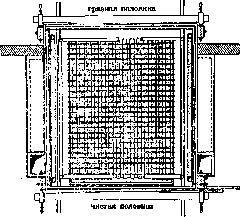
Figure 1. General view of a solvent chamber installed at the Leningrad isolation house.
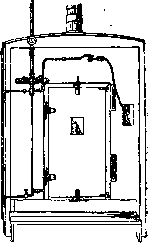
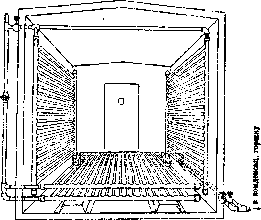
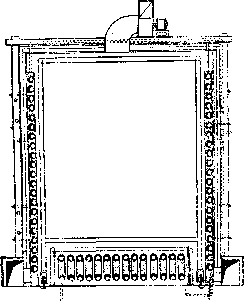
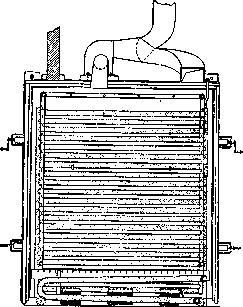
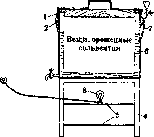
Figure 2. Schematic diagram of the heating appliances of Okunevsky's disinfection chamber. The chamber is installed at the Havana sanitary passageway (Leningrad). Chamber capacity 10 m3. 'purified solvents'. Solvent chambers have the appearance of a small room with two doors, capacity 4-6-12 m3; heated by steam, a system of coils located at the bottom and on the sides of the chamber (Fig. 2). The heating surface of the coils is 2.4-3 m2 per 1 m3 of chamber. Steam temperature in the steam generator for heating the coils is 142.8°C; pressure 3 atm. Solvent chambers can be installed at any enterprise having a satisfactory steam economy. The chamber works at a temperature of 65°C with the admixture of solvent vapors. Solvent is supplied by a nozzle, as in the Japanese chamber, which is best, or evaporates from trays placed on the coils. Solvent is introduced at 150 cm3 per 1 m3. For each cubic meter of the chamber, 2.5-3 sets of clothing are loaded in winter and 3-4 sets in summer; the whole session lasts 1 hour 10 minutes. The chamber does not spoil either fur or leather dry things. Under the nozzle a canopy must be arranged, as in the Japanese chamber. The chamber can serve in the presence of a nozzle for steam-formalin disinfection (by the Japanese method). In the latter case it can serve for disinfection and disinsection purposes. A solvent chamber must be equipped with supply-exhaust ventilation and can have devices for recirculation of heated air and solvent vapors (Fig. 3-5). For delousing individual sets of clothing and individual bedding at room temperature, solvent boxes (Fig. 6) are used, in which pulverized things are kept for 6-12 hours. Clothing boxes are also arranged and by the type of thermostats-double-walled; hot water (80-90°C) is poured between the walls to activate the solvent; things are kept in the warm box for at least 3 hours.
Figure 3. Okunevsky's solvent chamber at the dormitory bath (Leningrad). Frontal section. The chamber is equipped with supply-exhaust ventilation and devices for recirculation of heated air and solvent vapors (designed by Prof. L. A. Pogorselsky).
Figure 4. Longitudinal section of Okunevsky's chamber.
Figure 5. Plan of Okunevsky's chamber.
Figure 6. Schematic diagram of the device of Okunevsky's solvent box. For disinfection and disinsection of living premises, a 10% solution of lizol, 25% green soap, and 65-70% solvent is used. To enhance the disinsectional action, turpentine and kerosene (10-20%) are added. 20% hot soap-cresol solvent solutions are used for treating dwellings. A 25% solvent-soap emulsion (solvent-25 parts, soap-5 parts, water-70 parts) was tested by I. M. Reshetnikov for the treatment of lousiness in horses. Skin irritation in horses is not observed; the treatment effect is good; the operation is simple. Smoking is strictly prohibited when working with solvents and health protection measures for workers are observed.
Related articles
Mentioned in
Cite this page
“Solvent.” Soviet Medical Encyclopedia. English translation of Bolshaya Meditsinskaya Entsiklopediya, 1st ed. (Moscow, 1928–1936), ed. N. A. Semashko. https://sovietmedicalencyclopedia.pages.dev/article/solvent/