Belladonna
Historical document, translated for reference. It reflects medical knowledge of the 1920s–30s and is not medical advice.
Summary
This article describes the botanical characteristics, chemical composition, and medical applications of the Belladonna plant (Atropa belladonna). It details the physiological effects of its alkaloids, specifically atropine and hyoscyamine, and provides guidelines for its pharmaceutical use and the treatment of poisoning.
Encyclopedia article (1928–1936)
BELLADONNA, deadly nightshade, sleeping nightshade (Atropa Belladonna), family Solanaceae, a perennial herbaceous plant with a spindle-shaped, branched root that is brownish on the outside and white on the inside; the stem is fuzzy, green, sometimes with a reddish-brown tint; the leaves of Belladonna are alternate, dark green, ovate, large, and entire-margined; the flowers are large, bell-shaped, drooping, and dark violet; the fruit is a shiny black, many-seeded berry. It blooms in June and July. It grows in Central and Southern Europe and in Asia. In the USSR, Belladonna is found in the Crimea and the Caucasus. The entire plant is extremely poisonous. For medical purposes, the leaves and lateral branches of the root are used, which are collected during flowering and contain alkaloids: atropine (C17H23NO3), the isomer hyoscyamine, and belladonnine (C17H21NO2). The physiological effect of belladonna on the animal organism is caused by atropine and hyoscyamine. Pharmaceutical preparations: root (Radix Belladonnae), prescribed in powders and pills at 0.015–0.06 (maximum daily dose 0.18); leaves (Folia Belladonnae), prescribed in powders, pills, and mixtures (maximum single dose 0.2; daily 0.6); alcoholic tincture prepared from the leaves (Tinctura Belladonnae), prescribed in drops (maximum single dose 0.5; daily 1.5); extract (Extractum Belladonnae), prescribed in powders, pills, drops, and mixtures (maximum single dose 0.05; daily 0.15); ointment (Unguentum Belladonnae), used externally; atropine sulfate, prescribed internally, subcutaneously, and in the form of eye drops (0.5% solutions). Belladonna and its preparations are used as sedatives for pain, gastrointestinal diseases (accompanied by a spastic state of the gastrointestinal tract and increased secretion of its glands), neuralgias, bronchial asthma, against night sweats in consumptives, in eye practice (when it is
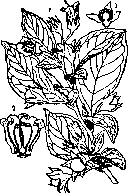
Atropa Belladonna: with flowers and fruits; 2—opened corolla; a—longitudinal section of the fruit.
necessary to induce pupil dilation) and as an antidote for poisoning by morphine and mushrooms. In cases of belladonna poisoning, the same phenomena are observed as in atropine poisoning: dryness in the mouth and throat, hoarseness, difficulty swallowing, nausea, rapid pulse, redness of the face, redness and dryness of the skin, dilation of the pupils, headache, dizziness, a feeling of anxiety and restlessness; in severe cases, hallucinations and delirium appear. (Regarding forensic medical examination, see Atropine.) Treatment of poisoning consists of removing the poison by washing the stomach and intestines and administering emetics and laxatives; in cases of severe agitation—chloral hydrate, morphine, ice compresses, cold dousing of the head; in cases of exhaustion—stimulants in the form of strong black coffee, wine, and mustard plasters on the calves.
d. Russian.
Related articles
Mentioned in
Cite this page
“Belladonna.” Soviet Medical Encyclopedia. English translation of Bolshaya Meditsinskaya Entsiklopediya, 1st ed. (Moscow, 1928–1936), ed. N. A. Semashko. https://sovietmedicalencyclopedia.pages.dev/article/belladonna/