Mandragora
Historical document, translated for reference. It reflects medical knowledge of the 1920s–30s and is not medical advice.
Summary
Mandragora is a genus of plants belonging to the nightshade family, native to the Mediterranean region, with a long history of medicinal use as a sedative and analgesic. The article details its species, historical and mythological significance, folk beliefs regarding its anthropomorphic roots, and the chemical composition of its alkaloids.
Encyclopedia article (1928–1936)
MANDRAGORA, Mandragora, a plant of the nightshade family (Solanaceae-Mandragorinae), growing in countries adjacent to the Mediterranean Sea. Two species are distinguished: Mandragora officinarum L. (M. vernalis Bertolini) with light green flowers and M. autumnalis Spr. with violet flowers. Among nightshades, Mandragora most closely resembles belladonna, but unlike the latter, the leaves of Mandragora are located at the base without a stem, large, egg-shaped, mostly with entire margins. The root is dark brown on the outside, almost black, white on the inside, divided into two parts, less often into several parts. Mandragora is mentioned already in the Ebers papyrus; further the plant was described by Dioscorides. From the root of the plant, as well as from the fruits, a juice was obtained which was mixed with three parts of wine and used as a sleeping and pain-relieving remedy. The Hippocratics recommended Mandragora (or Atropa Belladonna) for melancholy, for various cramps, intermittent fever, in the form of pessaries to induce menstruation, and in the form of poultices for uterine inflammation or prolapse of the rectum. In the Middle Ages, plasters and oils were prepared from Mandragora and applied to the forehead and ears for the same purposes. Numerous legends existed about the extraordinary sleep-inducing effect of Mandragora. Goethe and Shakespeare also mention the magical and narcotic properties of mandrake. In the 16th century, Mandragora for some reason disappeared from the European market and from pharmacies, but mysterious stories about the human-shaped root multiplied all the more.
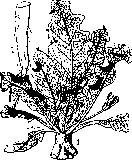
Mandragora: 1-flowering plant; 2-root; 3-expanded corolla. <897 surrounding flora prove to be futile, and then it began to be counterfeited with various other plants; human-shaped figures (male and female) were carved from them, which served as amulets and supposedly 'helped to open the veil of the future, brought happiness, contentment, fertility, multiplied wealth, bewitched a husband,' and so on. In the absence of Mandragora, figures were prepared from the mountain onion (Adam's root), as well as from bryony, in China from ginseng, in Japan from ginger, in Bohemia from belladonna. Amulets made of Mandragora were sold for huge sums. In the Vienna Court Library, there is a Mandragora bought by King Rudolph II for 100 thalers. A similar specimen is located in the German Museum. In Europe, since 1902, Scopolia carniolica has begun to be used under the name of mandrake. At the end of the 19th century and the beginning of the 20th century, the study of Mandragora began to be intensified. Thus, Richardson observed the effect of Mandragora extract on animals and humans and established that the smallest doses caused a tendency to sleep, while large doses acted in an exciting manner on the nervous system; Ahrens discovered hyoscine, hyoscyamine, atropine, and an isomer of atropine in the Mandragora root, which he named mandragorine; Wentzel proves that Ahrens' mandragorine is none other than a mixture of hyoscine and hyoscyamine, while the content of active principles in Mandragora is as follows: hyoscine 0.03%, atropine 0.04%, hyoscyamine 0.1%; besides, there is also some water-soluble alkaloid; according to Hesse, there is additionally 0.01% pseudohyoscyamine; then the base C7H15ON (a-metoxy-w-methyl-piperidin) was found. The found atropine, according to Tschirch, constitutes a product of metabolic decomposition from hyoscyamine; myristic acid and phytosterol have also been found. In the USSR, Scopolia carniolica, cultivated to obtain atropine, is called mandrake.
И. Лошнштейн
Related articles
Cite this page
“Mandragora.” Soviet Medical Encyclopedia. English translation of Bolshaya Meditsinskaya Entsiklopediya, 1st ed. (Moscow, 1928–1936), ed. N. A. Semashko. https://sovietmedicalencyclopedia.pages.dev/article/mandragora/