Blister Beetles
Historical document, translated for reference. It reflects medical knowledge of the 1920s–30s and is not medical advice.
Summary
Blister beetles (Meloidae) are insects that retain medicinal importance due to the cantharidin in their blood, which causes blistering when applied to human skin. They undergo hypermetamorphosis with parasitic stages and play both beneficial and harmful roles in agriculture.
Encyclopedia article (1928–1936)
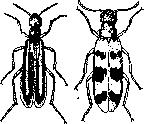
Blister beetles, family Meloidae (Vesicantia), insects which to this day have retained significance as a medicinal substance. Their bodies are of medium or larger size, often brightly colored. They undergo a complex transformation (hypermetamorphosis), the stages of which are associated with parasitism. In the red-headed blister beetle (Epicauta erythrocephala), the emerging larvae, called triungulins, parasitize in locust egg pods, consuming their eggs. The second larva of blister beetles first resembles a ground beetle larva, then a scarab beetle larva; the next stage of metamorphosis is the pseudo-chrysalis; after wintering, it produces a fourth larva, which finally transforms into a true pupa. Until the pseudo-chrysalis stage, the insect lives in the locust egg pod. Blister beetles contain in their blood, as well as in one pair of accessory glands of the male sexual apparatus, cantharidin; this substance, when applied to human skin, causes changes in the spinous layers of epidermal cells, where initial blisters form, which then merge into a large blister. Due to these properties1 , blister beetles are used to prepare a blistering plaster. Blister beetles possess the property of blood-letting; through special openings in the leg joints, they release droplets of their blood, which is brightly colored yellow, serving as a defensive reaction for these beetles. In some places, blister beetle blood is used as a folk remedy for removing warts. Besides their medical significance, some blister beetles play an important role as natural enemy-destroyers of locusts; others themselves are harmful agricultural insects (larval parasitism on bees, consumption of vegetables and grains).- Lytta vesicatoria, Spanish fly (see.) contains 4.06 parts per thousand of cantharidin; Mylabris cichorii-4.26 parts per thousand; Mylabris pustulata-3.5 parts per thousand; Epicauta erythrocephala, red-headed blister beetle (fig. 1); Meloe scarabaeus, black blister beetle. As medicinal raw material, Mylabris (fig. 2), Meloe and other species are also stored. When stored in pharmacies, dried blister beetles may be consumed by certain beetles and small mites. For all these animals, cantharidin is not poisonous at all.
Footnote 1: These properties refer to the vesicant (blister-causing) qualities of cantharidin.
Related articles
Mentioned in
Cite this page
“Blister Beetles.” Soviet Medical Encyclopedia. English translation of Bolshaya Meditsinskaya Entsiklopediya, 1st ed. (Moscow, 1928–1936), ed. N. A. Semashko. https://sovietmedicalencyclopedia.pages.dev/article/blister-beetles/