Insects
Historical document, translated for reference. It reflects medical knowledge of the 1920s–30s and is not medical advice.
Summary
Insects (Insecta, or Hexapoda) are a class of arthropods with an extremely numerous species count. This article describes their anatomy, physiology, reproduction, and various adaptations.
Encyclopedia article (1928–1936)
INSECTS (Insecta, or Hexapoda), a class of the type Arthropoda, extremely numerous. The total number of species of I. on Earth is unknown. According to an approximate count by Reilly, it reaches 10 million. The number of already known and described species of I. approaches a million; in the European part of the USSR alone, there live over 80,000 species of insects. The body of I. is divided into head, thorax, and abdomen. The thorax usually consists of three segments of the body, but in some Hymenoptera (bees, wasps, bumblebees), the first abdominal segment of the larva, during transformation into a pupa, fuses with the last thoracic segment. The thorax is divided into three parts: prothorax, mesothorax, and metathorax; in some I., the prothorax is sharply separated from the mesothorax and metathorax, which are fused together with the abdomen (beetles, orthopterans), while in others (flies, butterflies, Hymenoptera), all three thoracic segments are fused together. The abdomen in typical cases consists of ten segments; often this number is reduced due to the reduction of the last segments or their being drawn into the abdomen. On the head are a pair of antennae, mouthparts, simple or compound eyes (often both), and sometimes various outgrowths—horns, spines, etc.; on the thorax—three pairs of segmented legs and in many I. typically two (or one) pairs of wings (on the meso- and metathorax); the abdomen lacks appendages; at the posterior end in the female there is an ovipositor, and in the male—copulatory organs. The body of I. is covered with a chitinous cuticle, which in some species is soft, while in others, on the contrary, is hard; it is produced by the underlying layer of epithelial cells (hypodermis) and serves as an exoskeleton, since muscle bundles are attached to its inner surface. The coloration of I. is very diverse and often variegated; it depends on the presence of pigment in the body coverings or is determined by the physical structure of the chitin surface; in the latter case, the changing metallic luster of the coloration depends on the refraction of light rays falling on the chitin surface marked with lines ('structural' coloration). I. during their development periodically shed their old chitinous cuticle, which is replaced by a new one. This process is called molting, or ecdysis; it is associated with periodic increase in body size or the passage of transformation stages. The cells of the skin layer of I. (hypodermis) are capable of specializing in different parts of the body, forming glands, which may be unicellular, bicellular, tricellular, and multicellular (for example, the Vesalian glands of butterfly caterpillars). Their significance is very diverse. The secretions of skin glands include wax, fragrant substances, poisonous products, and others. For movement serve the legs and wings; the typical form of legs (consisting of coxa, trochanter, femur, tibia, and tarsus) is running; variants of their legs are jumping, grasping, digging, swimming, collecting, attaching. With the help of wings, which are chitinous folds, I. fly, being in general excellent fliers. Wings may be modified (transformation into hard elytra) or completely disappear [for example, in parasitic I. (lice, bird lice, fleas), as well as in cave species and inhabitants of oceanic islands]. In some I., the absence of wings is a sign of a primitive character, since even in the ancestors of these species there were never wings (for example Apterygota). Wings are penetrated by thickenings of linear form and various sizes, called veins; the character of vein distribution on the wing (or 'venation' of wings) is very different in different groups of I. and is important for taxonomic purposes. The mouthparts of I. in their basic structure consist of the unsegmented upper lip (labrum) and upper jaws (mandibles), segmented lower jaws (maxillae) and lower lip (labium), formed by the fusion of the second pair of lower jaws; the maxillae and lower lip bear segmented palps. In addition to these parts, there may also be a tongue or hypopharynx. Typically, the mouthparts of I. are chewing (for example, cockroach). The original form of these gives various variants: sucking organs (for example, butterflies), piercing-sucking (mosquitoes), licking (bee). In connection with the change in function stands also the change in structure of the mouthparts, which are transformed into thin, long piercing needles and a grooved proboscis (bug, mosquito) or undergo partial reduction (butterflies, whose sucking proboscis consists of modified lower jaws). I. feed on plant or animal food. They gnaw leaves, stems, roots, fruits, seeds of plants, suck juices, remaining freely living forms; I. often settle on their food plants. Other species lay eggs inside plants, and the hatching larvae lead a parasitic way of life; larvae can also themselves gnaw from the outside into leaves, trunks, roots, fruits, etc. Feeding on animal food amounts to predation, i.e., the devouring of other animals whole (for example, dragonflies, diving beetles), to parasitism (feeding at the expense of the juices or body tissues of the host); special mention should be made of I. that feed on carrion, corpses, as well as on the dung and excrement of other animals. Some I. use very specialized food (wood in joinery, wool and woolen things, hair, feathers, skin, wax of honeycombs, etc.). The digestive apparatus (fig. 1) of I. consists of a tube, divided into foregut, midgut, and hindgut; the first sometimes itself expands into a crop or has a separate appendix in the form of one; it begins with the mouth opening, leading into the pharynx, followed by the esophagus, crop, and muscular stomach. The midgut (stomach) is the place of digestion of food; the hindgut divides into the thin and thick intestine and sometimes has other appendages. Between the midgut and hindgut into the digestive canal open the Malpighian vessels, which are excretory organs. The intestine opens outward through the anus. Many I. have variously arranged salivary glands, usually located in the thorax, partly in the abdomen or even in the head. The saliva of some species of I. has poisonous properties. I. breathe air through the respiratory openings (fig. 1) and finely branching tubes—tracheae, which deeply penetrate with their numerous branches into the body tissues. The circulatory system is poorly developed; it consists of the dorsal vessel (heart), divided into chambers having lateral ostia. In front the heart continues into the aorta, opening into the body cavity. The blood of I. is white, it at the same time is the hemolymph. Between the organs in the body cavity lie layers of fat body. In the fat body are stored reserve nutrients. In addition, in the fat body are laid special cells—enocytes, serving the function of intracellular excretion. The nervous system of I. consists of a chain of ventral ganglia (fig. 1), connecting with commissures to the supraesophageal ganglion, which lies in the head and plays the role of the brain. The sense organs are well developed: eyes, organs of smell (antennae), touch, taste, chordotonal and tympanal (hearing) organs, sound-producing and others. In general, among all invertebrate animals, I. achieve the highest degree of development. All the above-mentioned organs are vegetative, as they perform functions necessary for the individual life of the individual. I. are dioecious; sexual dimorphism in many species is well expressed due to differences in wing coloration, the presence in males of horns and other processes on the head and thorax, etc. In some I., reproduction through fertilization is replaced by reproduction without fertilization (parthenogenesis). Reproduction is in rare cases also characteristic of larvae (pedogenesis of the two-winged Miastor). There are also phenomena of polyembryony, when from one fertilized egg many embryos develop (parasitic Hymenoptera). The male reproductive apparatus (fig. 1) of I. consists of testes, sperm ducts, accessory glands, ejaculatory duct, and copulatory organ. In the female there are paired ovaries, paired oviducts, passing into an unpaired vagina, cement or accessory glands, spermatheca, copulatory pouch, and genital opening. In viviparous insects the vagina has an expansion called the uterus. The complete set of these parts is not present in all I. The eggs of I. as a rule are rich in nutritive yolk. The vast majority of I. are egg-laying; some species are viviparous, sometimes this is in insects with incomplete metamorphosis (aphids), and sometimes in insects with complete metamorphosis larvae are born—{Wohlfart's fly, nasal botfly, etc.}). In some I., the form in which I. hatches from the egg is similar to the adult stage, and for reaching the latter no transformation, or metamorphosis, is required. Such are I. of the group Ametabola or Insecta epimorpha. In other I. there is incomplete metamorphosis, in which the form emerging from the egg differs from the adult by the absence of wings; postembryonic development proceeds gradually with the sequential growth of wings (for example, locust; fig. 2). In other cases, the I. hatching from the egg (larva) is not at all similar to the adult form, but transformation occurs without passing through a resting phase (i.e., the pupal stage) (for example, dragonfly; figure 3).
Finally, in I. with complete metamorphosis (fig. 4), the larvae do not resemble the mature individuals; the transformation in the latter occurs through the pupa stage, which is usually immobile and never feeds. The larva transforms into a pupa at the final molt. From the pupa, the adult I. (imago) emerges through a rupture of its covering. This is the metamorphosis in fleas, beetles, butterflies, etc. The larvae not only have a different structure than adults, but also often live in a different biological environment. The mosquito larva lives in water, while the adult mosquito lives in the air. Due to differences in habitat and lifestyle, I. larvae often have specialized organs unique to them, e.g., tracheal gills of mayfly larvae, silk glands, organs for attachment to the substrate on which the larva lives, etc. I. pupae are either free, or open (pupa libera, e.g., in beetles), or covered (pupa obtecta in butterflies); in the first case, the features of the future adult form are clearly visible in the pupa, in the seco
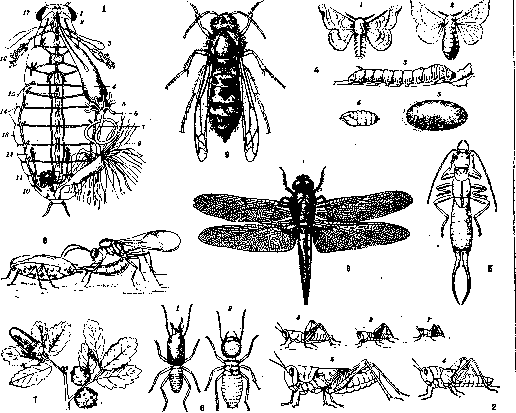
Figure 1. Structure of the male cockroach body: 1-pharynx; 2-esophagus; 3-salivary gland reservoir; 4-crop; 5-muscular stomach; 6-stomach blind sacs; 7-stomach; 8-Malpighian vessels; 9-rectum; 10-sperm duct; 11-accessory gland; 12-testis; 13-tracheae; 14-spiracles; 15-nerve chain; 16-salivary gland; 17-eyes. Figure 2. Incomplete metamorphosis of the migratory locust: 1-4-metamorphosis stages; 5-adult insect. On the right-egg. Figure 3. Dragonfly-Leptetrum guadrimaculatum (imago). Figure 4. Complete metamorphosis of the silkworm-Bombyx mori: 1-male; 2-female; 3-caterpillar; 4-pupa; 5-cocoon. Figure 5. Earwig-Forficula auricularia. Figure 6. Termites: 1-Capritermes speciosus-soldier; 2-Hodotermes ochraceus-worker. Figure 7. Galls on an oak from Cynips tinctoriae.
'Figure 8. The ichneumon wasp Diaretus obsoletus, infecting the grain aphid (laying an egg in it). Figure 9. The hornet Vespa erabro. B. M. E. Vol. XX. 26 - there are only hints of the imago outlines. Many flies have barrel-shaped pupae (pupa coarctata), with the actual pupa being hidden in a case of the unshed larval skin after the final molt. In some insects, the pupae are mobile (mosquitoes). Pupation often occurs in protected places, and the pupating larva of many species spins a silken cocoon. Thus, the metamorphosis of insects is characterized by the external discontinuity of postembryonic development due to molts and the parallel progression of transformation stages. The most significant turning point in insect metamorphosis is the pupal stage; under the apparent external calm of the pupal case, the imago forms; the larval organs are gradually restructured and transform into imago organs. In other insects (for example, flies), this restructuring is associated with the destruction of many old larval organs through histolysis (tissue breakdown) and phagocytosis; the new final organs develop from special cell clusters called imaginal discs, which are laid down early in the larva, and in some insects, they form even in the embryo. In some species, metamorphosis is further complicated by the passage of several larval and pupal stages; such excessive transformation, called hypermetamorphosis, is characteristic of some parasitic insects (see Blister beetles). The larval stage in the life of insects is primarily a stage of feeding and vegetative life, while the imago primarily performs reproductive functions. Such division of labor between different transformation stages in some insects can be very distinct. For example, mayfly larvae live in water and feed abundantly for up to two years, while the imago lives for a few days and does not take any food at all. The same is observed with bot flies, whose larvae live as parasites in the bodies of animals, while the imago fly in the air. Insects inhabit the most diverse biotopes: on land, in the earth, in water (mainly fresh), in decaying substances, in plants, in animals, in humans, and in some special biotopes. Some species are exclusively terrestrial, while others spend part of their lives in water or underground. There are insects that live in water in all stages of transformation. Insects can be found in an active state at all times of the year; for example, Boreus, Chionea, and others are caught on snow. Insects are very widely distributed throughout the globe; the fauna of hot countries is particularly rich in them. The role of insects in the economy of nature is very great. Their participation in soil formation (ants, termites, etc.) is undoubtedly significant but still insufficiently studied. Phytophagous insects are pests of their food plants. The larvae of many butterflies, by eating leaves and needles, cause great harm to trees (monarch, gypsy, oak, and goldtail tussock moths, etc.); locusts are a scourge to field crops; phylloxera destroys grapevines; the sugar beet weevil destroys and damages vast areas planted with sugar beets. There are numerous harmful insects for forests, gardens, and vegetable gardens. Along with this, the benefit from insects in many cases is exceptionally great. For example, many Hymenoptera and Diptera, visiting flowers to feed on nectar, transfer pollen from flower to flower and thus promote pollination. Many plants cannot reproduce without the assistance of insects. By feeding on decaying carcasses, insects contribute to their more rapid destruction, which is a positive factor in the life of nature. Insects serve as food for various animals (arachnids, mites, vertebrates, etc.) and themselves destroy other animals. Pests of insects are those animals and plants that kill them in one way or another. These include parasitic protozoa if they are pathogenic for insects; parasitic worms, which in some cases cause parasitic castration (for example, parasitic nematodes in bark beetles); mites living on insects; insects parasitizing in insects (for example, ichneumon wasps, etc.); insects poisoning other insects (for example, the paralysis of honeybees by the sting of the bee wolf-philanthus); the eating of eggs, larvae, pupae, and adult insects by insects and various other animals; finally, insects can become infected with bacteria and fungi pathogenic to them. In many insects, bacteria, fungi, or protozoa live as symbionts in different parts of the body. The connection between an insect and its symbiont sometimes becomes so close that the symbionts turn into an essential component of the insect's body (for example, the so-called false yolk of aphids with yeast fungi, the mycetome of lice, the interstitial cells of the fat body of cockroaches with Bacillus Cuenoti and many others). The significance of symbionts for insects is varied. The luminescence of larvae and males of Lampyris (firefly) is due to luminous bacteria living in certain parts of the fat body of this beetle. Yeast-like symbionts of insects (butterflies, etc.) contribute to the accumulation of yolk in insect eggs. Fungi (Isaria) in the intestine of caterpillars of the wood-boring moth enable the digestion of wood, which these caterpillars feed on, etc. It is remarkable that in many cases symbionts have become very closely associated with insects, which is also reflected in the 'intrauterine' infection of insects with symbionts, when the future insect is still in the egg stage in the ovary of the maternal organism. Symbionts penetrate the egg, and as the embryo develops, they occupy one place or another in its organs. Thus, the life cycles of the insect and its symbionts flow continuously and in parallel. There are other ways of infecting insects with symbionts (per os, etc.). Some symbionts can apparently become harmful to insects, which depends on the habitat of the symbiont. For example, Coccus-bacillus acridiorum is a permanent inhabitant of the locust's intestine, where it is non-pathogenic; but when it moves from the intestine into the body cavity, when this coccus bacillus accumulates in the blood and its virulence increases, it becomes the causative agent of a mass disease of locusts. The significance of insects for humans is very great and varied. Insects bring direct or indirect benefit or harm to people and the economy. Direct benefit: the use as food of products produced by insects (honey); some tribes sometimes eat insects (for example, Chinese eat locusts); the use in everyday life and technology of insects and their special products [cochineal (Coccus cacti, which gives carmine), ink nuts with tannic acid on oak leaves (gall wasp Cynips tinctoria) (figure 7); beeswax, lac from scale insects, threads of silkworm cocoons, etc.]; the use of insects or their products as medicinal substances (blister beetles, cockroaches, bee venom) or in the form of constituens (wax). Indirect benefit of insects: the use of insect pollinators to increase the yield of clover and other plants; the breeding of parasitic insects and their release into nature as natural enemies of some pests of great agricultural importance (ichneumon wasps and various harmful insects); the use of predatory insects to combat animals harmful to humans. Harm from insects to humans: parasitism on humans (ectoparasites: lice, fleas, bedbugs, etc.) and less frequently inside the human body (see Myiasis); the spread by insects of pathogens of infectious diseases (so-called insect vectors of diseases); insects as intermediate hosts of parasites. Toxicity of insects: some cause poisoning by the sting of mouthparts (with poisonous salivary glands), stings (with accessory poisonous glands of the female reproductive system), chitinous hairs or spines (with poisonous skin glands); other insects do not have a piercing poisonous apparatus, but their bodies contain poisonous secretions, which are concentrated in special protective (unarmed) glands (scent and anal glands of beetles) or are present in the body tissues (for example, cantharidin in the blood of blister beetles); the toxicity of unarmed insects manifests itself when their poison acts on human mucous membranes, skin, respiratory and visual organs, as well as when such poisonous insects are accidentally eaten. During mass appearances, some insects can interfere with various activities, for example, swarms of mayflies, mosquitoes, etc. Crawling insects on the body sometimes causes severe irritation from tickling the skin and necessitates waving them away, which interferes with various labor processes (earthworks, mining, field work). Often, this irritation is combined with painful stings from the same insects, which further increases the disturbance they cause (for example, 'gnats' in Siberia). All of the above about the harm from insects also characterizes their indirect harm to humans, which occurs when the object of the insects' action in the mentioned relations are domestic or commercial animals. The indirect harm from insects extends to the economy and technology: the consumption and spoilage of food products in houses and warehouses (see Warehouse pests); the spoilage of furs, woolen goods, and fabrics (see Moths); the spoilage of books (cockroaches, termites, beetles); the gnawing and spoilage of various items [clothing, wood in handicrafts, etc.
(termites]; destruction of wooden buildings and parts of many structures (telegraph poles, railroad ties, beams and rafters); spoilage of medicinal raw materials (roots and parts of medicinal plants and others).-The spread of harmful insects in some cases is caused by human activity (transportation of contaminated goods, raw materials, transportation of livestock with parasitic insects in them, passive movement of harmful insects, settling on steamships, flying into cars or using horse transport). The possibility of importing dangerous pests in some cases necessitates the organization of quarantine measures (delaying livestock herds for cleaning them from parasites), disinsection of the entire mass of material suspected of being infested with insects (e.g. cotton) and others. Passive transport can be experienced by insects that are very important from a sanitary-epidemiological point of view, for example the carrier of the yellow fever pathogen-the mosquito Aedes argenteus, mosquitoes that transmit dengue fever, malaria mosquitoes and others.-Insects have long been a most valuable object of various scientific research, both general biological and applied; due to their abundance, wide distribution and accessibility, the scientific study of insects has developed into a separate science-entomology. Classification of insects. Subclass A. Lower insects (Apterygota, or Ametabola); characterized by complete absence of wings. Most Apterygota have on the abdomen highly modified limbs. Small. Order Protura (proturans); completely lack antennae; live in rotten wood, pine bark stumps and others (Acerentomon doderoi).Order Collembola (springtails); with a fork on the abdomen, formed from modified abdominal limbs. Podura aquatica (water springtail)-on the surface of standing water; Podurhippus lives in stable dust, moves to horses and causes itching in them with the development of rash and hair loss. Order Thysanura (silverfish); Lepisma saccharina (silverfish) often lives in houses, eats sugar, gnaws bread and others. Subclass B. Insects with incomplete metamorphosis (Insecta anamorpha, or Hemimetabola). Order Orthoptera (grasshoppers). Mouthparts gnawing. Wings-two pairs; the front pair is transformed into elytra in the form of narrow leathery strips. Many orthopterans have long and strong hind legs; thanks to them, insects jump well. Such are for example Decticus verrucivorus (green bush-cricket), Locusta migratoria (locust). Gryllus domesticus (house cricket) lives in bakeries, baths, kitchens, has sound organs. Devours food products and kitchen waste. Its sanitary-hygienic significance is the same as that of cockroaches. Gryllotalpa gryllo-talpa (mole cricket) has the front pair of legs, strongly developed and specially modified as digging legs; harms garden crops. Order Dermatoptera (earwigs); highly developed forceps at the end of the abdomen. Feed on plant substances. Can be found in human dwellings. Unjustly accused of the ability to damage the eardrum when crawling into a person's ear (e.g. Forficula auricularia; fig. 5). Among earwigs there are intermediate hosts of the rat tapeworm, Hymenolepis diminuta (Anisolabis annulipes). Order Blattodea (cockroaches); gnawing mouthparts; walking legs; wings membranous; elytra developed differently; can, like wings, be reduced. Among cockroaches, those inhabiting human dwellings are important from a medical point of view: Blatella germanica (German cockroach), Blat-ta (Periplaneta) orientalis (black cockroach), Periplaneta americana (American cockroach), introduced from the tropics to Europe, and others. The specific smell of cockroaches in dwellings depends on the vapors of the secretions of odorous skin glands. Devour products, waste, feces and others. Contaminate food substances with bacteria, helminth eggs, cysts of protozoa, serving as mechanical carriers of these objects. Serve as intermediate hosts for some nematodes and flukes. Order Odonata (dragonflies); together with mayflies, they were previously included in the order Pseudoneuroptera (false net-winged insects); now they are allocated to a separate order. Slender insects with four large, long and almost equally developed wings. Predatory. Adult dragonflies devour mosquitoes, including malaria ones, catching them in flight. Dragonfly larvae live in water, where they can devour mosquito larvae and pupae. Are a natural enemy of mosquitoes. Dragonfly genera Libellula, Aeschna and others. Order Isoptera [termites (figure 6), incorrectly called white ants]; insects with highly developed forms of social life; live in colonies, members of which perform different work, which is associated with differences in the structure of such groups of individuals (polymorphism): male, female, workers, soldiers and others. Many termites build large ground structures*, so-called termite mounds, in the form of large and very strong earth cones or other shapes. In Central Asia, termites dig deep tunnels into which water can be absorbed when conducting canals through eroded areas. Termites gnaw wooden structures, railroad ties, various things and are very important pests. Live in warm and hot countries. In Central Asia, Hodotermes turkestanicus is found; near Odessa-Leucotermes lucifugus. Order Pseudorhynchota (false bugs); all its representatives are external parasites of humans, mammals and birds. Lice (see), Parasita, feed on the blood of humans and mammals. Anoplura, or Mallophaga [biting lice (see), or bird lice]; devour the hair of mammals and the feathers of birds.
t Order Rhynchota (beaked insects); they have a segmented proboscis in which bristle-like mandibles rest; the mouthparts are piercing-sucking. The wings are structured differently. True hemipterans (Hemiptera) are so-called bugs; their hind wings are membranous, while the forewings are half-hardened (Hemiptera-Heteroptera). Among them, some plant bugs are agricultural pests (for example, the wheat bug - Eurygaster maurus); predatory bugs (Reduviidae) are at the same time venomous insects (saliva); this property is also possessed by bugs of the family Nepidae (water scorpions), Notonectidae - water boatmen (water bee); bugs of the family Cimicidae parasitize in human dwellings and bird nests (bed bug). The order Homoptera ("equal-winged"), the former suborder of hemipteran insects (Hemiptera); characterized by the same structure of wings throughout their length; the forewings are either thin, membranous, or thicker, leathery. The mouthparts are sucking; the mandibles are bristle-like. Food-plant juices. This order includes the suborders: Cicadina (cicadas); the males of these insects possess a special sound-producing apparatus located behind the hind legs, on the ventral surface of the metathorax. Young branches at the places where cicadas suck release a large amount of sweet juice, which hardens in the air and forms the so-called "manna"; Cercopidae-with larvae that secrete saliva-like foam (Aphrophora-spittlebug); Cicadellidae (leafhoppers); Fulgoridae; the abdomen of some species secretes threads of a wax-like substance (in China it finds technical application). Suborder Phytophtires (plant parasites); Psyllidae (plant lice) with pests of apple trees and other trees; Aphidae (aphids) with many pests of cultivated plants (phylloxera, the blood aphid and others); Coccidae (scale insects), also harming various plants; from scale insects, females of Dactylopius coccus (cochineal) (Mexico) are used for making carmine; recently in Armenia and Turkestan insects have been found that also give carmine. Other scale insects provide wax; from the secretions of Tachardia lacca (lac insect) shellac is obtained. Subclass S. Insects with complete metamorphosis. Insecta metamorpha, or Holometabola. Order Coleoptera (beetles, or hard-winged). Order Lepidoptera (butterflies, or scaly-winged). Order Aphaniptera (fleas). Order Neuroptera (net-winged); wings are membranous with a dense network of veins; mouthparts are chewing. Myrmeleon formicarius (antlion); its larvae dig funnel-shaped pits, into which small insects roll down, where they fall into the jaws of the larva. Chrysopa (green lacewings)-delicate insects, whose skin glands give off an odor similar to the odor of fresh excrement. The larvae are predatory. Order Trichoptera (caddisflies); adult insects in many ways resemble butterflies, but have chewing mouthparts. The larvae live in water and build cases from spider webs and various objects (sand grains, shells, pieces of plants), for example, Phryganea grandis. Order Diptera (two-winged); one pair of wings; hind wings are reduced; Table of insects. Order Name of Insect Pathogenic significance for humans Venomosity Parasitism Carriers of invasion and infection pathogens Blattodea (cockroaches) Periplaneta orientalis (black cockroach) Periplaneta americana Blatella germanica (German cockroach) Gnaws the epidermis of human skin; saliva has some toxicity; in the body-diuretic principles The ability to gnaw the human epidermis is noted. Mechanically spreads cholera bacteria, Bact. coli Vas. "pseudo-oedematis maligni", helminth eggs, cysts of protozoa. Transfer of pathogens occurs when contaminated cockroaches crawl over food products or by dispersing excreta after cockroaches have eaten infected food Parasita (lice) Pediculus capitis (head louse) Pediculus vestimenti (body louse) Toxic effect of saliva on human skin surfaces and general resorptive effect on the body (toxemia); melanoderma, disease of vagrants; urticaria; the toxic principle is produced by the bean-shaped salivary glands of lice Phthirius pubis (pubic louse) Polyplax spinulosus Appearance of taches bleues on the skin under the influence of saliva; toxemia Permanent ectoparasites in all stages of metamorphosis, starting from the larva; feed on human blood Permanent ectoparasite Ectoparasite of rats Mechanical transfer of pathogens of phlyctenular conjunctivitis, eczema, scabies, impetigo cortagiosa, leprosy (?), pityriasis, plague (experimentally), plica polonica, pyoderma. Specific carrier of spirochetes of recurrent fever and the causative agent of typhus, trench fever, trench fever Itching; blepharitis Transmission of recurrent spirochetes under experimental conditions, as well as tick-borne recurrent spirochetes (to rats) Rhynchota (beaked insects) Cimex lectularius (bed bug) Cimex rotundatus Cimex columbarium (pigeon bug) Aeciacus hirundinis (swallow nest bug) Reduvius personatus (masked reduviid) Toxic properties of saliva; pain of the bite; skin reaction to the bug bite varies in different people from the formation of small blisters to the development of severe urticaria. Bugs parasitizing on birds also attack humans and have a toxic effect on their skin surfaces The bite is very painful due to the toxic properties of saliva Ectoparasite in all stages of metamorphosis Predator with respect to various arthropods Survival of recurrent spirochetes in the body of the bug Are not carriers of human invasions or infections Triatoma (Soporhinus) megista Rhodnius prolixus Harpactor annulatus Arilus carinatus Notonecta glauca (water boatman) Painfulness of the bite with mouthparts The bite with mouthparts is slightly painful The bite is very painful due to the properties of saliva Its bite is painful for humans (property of saliva) Belostoma grande Saliva is toxic; has a vigorous proteolytic action + Predatory insects for various small animals; Belostoma kills fish Transmits the causative agent of Chagas disease, Trypanosoma cruzi Are not carriers of human invasion and infection pathogens Rhynchota (beaked insects) Nepa cinerea (water scorpion) The bite is painful due to the toxicity of saliva Predator for small aquatic inhabitants Is not a carrier of invasion and infection pathogens Coleoptera (beetles) Anthrenus museorum Attagenus pellio Dermestes vulpinus Ptinus sp. Fam. Curculionidae (weevils) Onthophagus bifasciatus Do not have venom Are not parasites of humans Meloe proscarbaeus (oil beetle) Mylabris Epicauta erythrocephala Lytta vesicatoria Diamphidia locusta Paederus riparius, Paederus albipilis and others. Cantharidin in the blood and in some accessory glands of the reproductive apparatus of males; blood is ejected by beetles from When feeding on corpses and skins, they swallow spores of the anthrax bacillus, which are then excreted with the excrement of skins and thus dispersed in the external environment that has a close relationship to humans Larvae as pseudoparasites of the intestine of children Pseudoparasite of the intestine Parasitism on insects in the larval stage; have no special relationship to humans in the form of parasites in the joints (foramina repugnatoria). Used in the preparation of medicinal substances in the making of "blister flies" In larvae "blister poison", imago are not venomous In blood of imago poison, causing blistering dermatitis Are not parasites Are not carriers of invasion and infection pathogens of humans Aphaniptera (fleas) Pulex irritans Ctenocephalus canis Ctenocephalus felis Ceratophyllus tesquorum of the groundhog Ceratophyllus fasciatus of the rat Ceratophyllus consimilis Ceratophyllus MoKrzeckyi Neopsylla setosa of the groundhog Toxic effect of saliva on the skin, varying depending on the species of flea and the sensitivity of the subject, roseola pulicosa, purpura pulicosa, urticaria. Although fleas in general easily pass from one host to a host of another species, not all fleas bite humans. For example: from groundhog fleas Ctenopluhalmus pollex, Ct. breviatus do not touch humans, while Ceratophyllus tesquorum and Neopsylla setosa eagerly drink blood and cause the appearance of a characteristic reaction on the skin Imago-ectoparasites; larvae do not lead a parasitic life, as they feed on decaying organic substances and excrement of adult fleas, but can also be on the host of adult fleas. Some species of fleas are intermediate hosts of the cucumber-like tapeworm - Dipylidium caninum, which can parasitize in humans. The larva of the flea becomes infected with this parasite, and the adult flea infects the final host (when swallowed) Carriers of plague. Fleas can transmit plague from animals to humans and from animals to animals. Apparently their main role comes down to maintaining plague epizootics.
The transmission of plague bacteria occurs through the excretion of feces by infected fleas or through the regurgitation of blood ingested by the flea, which encounters in the proventriculus a solid plug of multiplied plague bacteria. Order Name of insect Pathogenic significance for humans Toxicity Parasitism Transfer of invasion and infection agents Aphaniptera (fleas) Xenopsylla cheopis of rats Ctenophthalmus breviatus of suslik Toxic effect of saliva on the integument, varying depending on the flea species and the subject's sensitivity, roseola pulicosa, purpura pulicosa, urticaria Ctenophthalmus plexus of suslik Ctenophthalmus orientalis Oropsylla Silanti-ewi of tarbagan Leptopsylla musculi of mice Ceratophyllus acutus Dermatophilus penetrans Imago - ectoparasite; larvae do not parasitize The fertilized female penetrates the epidermis and becomes overgrown with it. Plague carriers; transmit plague from rats (X. cheopis), susliks (Ctenophthalmus), tarbagan (Oropsylla) Transmits tularemia (under experimental conditions) Carrier of Bac. tetani Diptera (two-winged) Aedes argenteus Aedes silvestris Theobaldia Culex pipiens Culex fatigans Anopheles maculipennis Anopheles bifurcatus Anopheles plumbeus Toxic effect of saliva, varying according to mosquito species and individual human sensitivity. Saliva is produced by paired salivary glands, which vary in their external appearance - in Anopheles from the typical three-lobed to one-lobed form. In the lobes themselves, parts of different histological structure are distinguished. The toxicity of mosquito stings is associated precisely with the properties of saliva, as proven by precise experiments. The opinion that the cause of the toxicity of mosquito stings is the fungi of the mosquito's proventriculus blisters has been refuted. The effect of mosquito stings also depends on the dosage, i.e., on the number of Anopheles insects attacking. Anopheles hircanus Anopheles pulcherrimus Anopheles superpictus Simulium columbaezense Culicoides Imago - ectoparasite; lead a free lifestyle and attack the host only for blood drinking; this procedure lasts a short time (1-2 min.). Bloodsucking (and therefore parasitic) only female mosquitoes. Males feed on plant juices, which female mosquitoes can also do. Larvae are never parasites or pseudoparasites. The circle of hosts is very wide. Preference shown by Anopheles to domestic animals is noted under certain conditions. Carrier of dengue fever pathogen, yellow fever, Trypanosoma rhodesiense (experimentally) A very poisonous insect for domestic animals; stings are toxic Toxic saliva Only imago are temporary ectoparasites. Can carry anthrax Carrier of Dirofilaria immitis Carrier of Wuchereria bancrofti Carriers of malaria plasmodia of all forms of malaria. A. hircanus apparently is not a carrier of tropical malaria pathogen. Various species of tropical Anopheles (A. rossi, A. costalis, recently found in Central Asia A. algeriensis, etc.) serve as carriers of Wuchereria bancrofti In tropical Africa Culicoides austeni is a carrier of the nematode Acanthocheilonema perstans, Simulium damnosum - nematode Onchocerca volvulus Order Name of insect Pathogenic significance for humans Toxicity Parasitism Transfer of invasion and infection agents Diptera (two-winged) Phlebotomus patasi Phlebotomus argentipes Phlebotomus sergenti Phlebotomus minutus Phlebotomus perniciosus Phlebotomus chinensis Toxic effect of saliva, giving a large local effect in sensitive people due to the toxic properties of saliva. Only female sandflies are bloodsucking Imago - ectoparasite, associated with the host only for the time necessary for saturation. Larvae feed on dung Musca domestica (housefly) Cannot sting with proboscis; however, saliva has some toxicity, as when introduced intracutaneously it causes an inflammatory reaction Stomoxys calcitrans (stable fly) Carrier of papatachi fever pathogen and cutaneous leishmaniasis; transmission of kala-azar is very likely Pseudoparasitism of larvae (intestinal and tissue myiasis) Development of leishmaniasis - kala-azar pathogens, was observed in various species of sandflies, but experiments on infecting kala-azar through the medium of infected sandflies have so far given negative results Mechanically carries bacteria of cholera, typhoid, summer diarrhea, diphtheria, Bac. pyocyaneus, anthrax, Bact. coli, erysipelas, gangrene, paratyphoid, plague, tularemia, Treponema pertenue, smallpox, trachoma, eggs; helminth eggs, cysts of protozoa (dysentery amebas, etc.) Painfulness of sting with mouthparts; toxicity of saliva Glossina palpalis (tsetse fly) Calliphora erythrocephala Calliphora vomitoria (blue blowfly) Lucilia caesar (green bottle fly) Sarcophaga carmaria (grey flesh fly) Sarcophila Wohlfahrtii (Wohlfahrt's fly) Cordylobia anthropophaga Auchmeromyia luteola Imago - ectoparasite Stings humans, but the Imago - free-living ecto-effect of local saliva action is weak
The mouthparts do not have piercing parts. They cannot pierce humans, but cause irritation (tickling) of the skin when crawling over the body. Pseudoparasitism of larvae (myiasis), which can live in wounds and ulcers, as well as in the human intestine. Cochliomyia macellaria. Anthomyia (Fannia) canicularis. Carrier of the causative agent of sleeping sickness Trypanosoma gambiense. Parasitism of larvae (tissue cavity myiasis). Parasitism of larvae (tissue myiasis). Larvae suck human blood (ectoparasites). Parasitism of larvae (cavity and tissue myiasis). Mechanical carrier of septicemia, anthrax, tularemia (experimentally). Carrier of dysentery amoebas; carrier of anthrax by dispersing their excrement into wounds; spreads cholera bacteria and Bact. coli. Spreads anthrax and Bact. coli. Carrier of causative agents of septicemia, anthrax and Bact. coli. The main role in pathology is the parasitism of larvae. Pseudoparasitism of larvae in the intestine and urethra. Order. Name of insect. Pathogenic significance for humans. Toxicity. Parasitism. Carrier of causative agents of invasions and infections. Diptera (two-winged). Piophila casei (cheese fly). "Corrosive" effect of larvae on fingers when frequently removing larvae. Drosophila melanogaster. Cannot pierce humans with mouthparts. Eristalis tenax. Pseudoparasitism of larvae in the intestine. Larvae can be pseudoparasites of the human stomach. Borborus punctipennis. Tabanus bovinus. Tabanus atratus. Saliva has varying degrees of toxicity; mouthparts are piercing. Tabanus striatus. Chrysops caecutiens. Chrysops sp. Haematopota pluvialis. Some flies of the genus Drosophila can mechanically carry causative agents of acute contagious intestinal diseases. Spreads cholera bacteria. Mechanical carrier of eggs of helminths due to larvae feeding on faeces and dispersing their excrement. Imago-free-living ectoparasite, attacking the host only for blood-sucking; this procedure lasts for a short time. Larvae are also free-living and predatory. Mechanical carriers of anthrax, septicemia. Carrier of anthrax. Chrysops dimidiatus is a carrier of the nematode Loa loa. Carrier of the causative agent of tularemia. Anthrax. Gastrophilus intestinalis [stomach bot fly (horse)]. Gastrophilus haemonhoidalis. Gastrophilus pecorum. Gastrophilus veternus. Oestrus ovis (sheep bot fly). Rhinoestrus purpureus (horse bot fly). Hypoderma bovis (cattle warble fly). Dermatobia hominis (human bot fly). Adult bot flies have reduced mouthparts; they do not take any food; cannot pierce hosts; however, animals react to the appearance of bot flies and try to protect themselves from infection with bot fly larvae or eggs. Larva of stage I can be a tissue parasite in the thickness of the epidermis of human skin (larva migrans, creeping disease), normally they are mainly parasites of the horse stomach. Tissue parasitism of larvae in the human eye; in sheep they parasitize in the nasal cavities. Tissue parasitism of larvae in the conjunctiva of the eye. Tissue parasitism of larvae in the human cutis and in front of the anterior chamber of the eye and in the eyelids. Parasitism of larvae under human skin. Order. Name of insect. Pathogenic significance for humans. Toxicity. Parasitism. Carrier of causative agents of invasions and infections. Lepidoptera (butterflies and moths). Thaumetopoea pityocampa. Thaumetopoea processionea. Euproctis chrysorrhoea (goldtail). Lagoa crispata. Lasiocampa pini. Megalopyge opercularis. Porthesia similis. Poisonous hairs of the integument of caterpillars of butterflies; toxic effect on the skin due to injection; ophthalmia nodosa when hairs get into the eye; irritation of the respiratory tract when inhaling broken hairs; can be the cause of some professional skin diseases when handling poisonous caterpillars (collecting and destroying caterpillar nests, disassembling laboratory material, etc.). They do not become parasites. Do not play a role in the transmission of causative agents of invasions and infections. Hymenoptera (wasps, bees, ants). Apis mellifera (honey bee). Bombus sp. (bumblebee). Polistes sp. Vespa crabro (hornet). Vespa germanica (wasp). Vespa vulgaris. Mutilla maura. Toxicity of the sting. Sometimes toxicity of honey ("drunken honey"). Toxicity of the sting due to the presence of two venomous glands and a piercing apparatus in the form of a modified ovipositor (stinger); the effect of the sting depends on the properties of the venom, the sensitivity of the subject (there may be immunity), the amount of venom injected and the place of the sting. Only females sting. Melipona sp. Trigona bipunctata. Trigona amalthea. Trigona ruficrus. Trigona limao. Toxicity of honey. Bees without stings; cannot sting humans. The bite of some Melipona causes skin inflammation either under the influence of flowing saliva or due to the injection of secretion from venomous glands. Ponera coarctata. Myrmica laevinodis. Monomorium pharaonis (house ant). Toxicity of the sting (there is a sting) due to the presence of a pair of venomous glands, which, as in other Hymenoptera, are derivatives of accessory glands of the female reproductive system; therefore only females are venomous. Stages of metamorphosis do not become parasites. Bees contaminate honey, as they often land on excrement and get dirty with pathogenic bacteria, which they bring into the nest, where they contaminate honey. They can be the cause of the spread of acute contagious intestinal epidemics. Inhabitants of dwellings; spread causative agents of some contagious diseases (see Ants), for example: typhoid, dysentery, plague and possibly anthrax. Transfer of bacteria by ants occurs mechanically when crawling and dispersing contaminated excrement. Order. Name of insect. Pathogenic significance for humans. Toxicity. Parasitism. Carrier of causative agents of invasions and infections. Hymenoptera (wasps, bees, ants). Camponotus herculeanus (carpenter ant). Sting is reduced; they bite with jaws and inject into the wound the secretion of venomous glands. They do not become parasites of humans at any stage of development. Formica rufa (red forest ant). Lasius niger (garden ant). Rudiments of them-in the form of club-shaped appendages of the metathorax, called halteres or drumsticks. There are also completely wingless forms. Mouthparts are piercing-sucking or licking. I. Nematocera (long-legged). Tipulidae (crane flies) are not blood-sucking. Culicidae (mosquitoes). Psychodidae (moth flies); small gnats of the genera Psychoda, Pericoma, Phlebotomus (see Sandflies). Chironomidae (midges); most are not blood-sucking; larvae of Chironomus (midge)-important food for fish; blood-sucking species of the genus Culicoides and others. C. austeni-carrier of the nematode Acanthocheilonema perstaris. Cecidomyidae (gall midges); larvae lead a predatory lifestyle or parasitize in diseased growths or swellings on plants (galls), the development of which they cause themselves. Mycetophilidae (fungus gnats); larvae are called "fungus worms". Simuliidae-small blood-sucking gnats Simulium. Reproducing in masses, they attack livestock and cause mass mortality of cattle (toxic effect of Simulium columbaczensis saliva). Simulium damnosum-carrier of filaria Onchocerca volvulus. II. Brachycera-short-legged, or flies (horseflies, bot flies). Order Hymenoptera (membranous-winged); wings are membranous with a sparse network of veins; sometimes they are completely reduced; mouthparts are gnawing or a combination of gnawing with licking. Siricidae (horntails); larvae live in the wood of sick or dying trees; adults can emerge from firewood brought into houses. Tenthredinidae (sawflies), ovipositor in the form of short, saw-toothed plates; larvae resemble caterpillars of butterflies and many have the ability to eject blood through holes in the skin; e.g. Cimbex betulae. Cynipidae (gall wasps); ovipositor of females is short and thin. Eggs are laid in plant tissues, which react to the development of larvae in them by forming growths called galls, e.g. ink nuts (see above); other Cynipidae are parasites of insects. Chalcididae (shining chalcid wasps), phytophagous forms or parasites of butterflies, various dipterans, gall wasps, etc.; e.g. Isosoma, Pteromalus and others. Braconidae (braconid wasps) (figure 8); larvae parasitize in insects and spiders, for example Apanteles, Bracon. Ichneumonidae (true ichneumon wasps), lay eggs on or under the skin of insects and spiders; larvae usually lead an endoparasitic lifestyle, and their host dies. Parasitoid wasps parasitize on many harmful insects (for example caterpillars of the nun butterfly, various silkworms, etc.); some species parasitize in insect parasites (so-called hyperparasitism). Examples: Ichneumon, Pimpla. Apidae (bees), with a stinging ovipositor; live solitary or in societies; Bombus (bumblebees); Apis mellifera (honey bee); Xylocopa (carpenter bee); Osmia, Chalicodoma, Anthidium and others. Vespidae (social wasps); Vespa crabro (hornet) (figure 9); Vespa vulgaris (common wasp), venomous, sting (like bees) is very painful. Pompilidae (spider wasps), paralyze spiders with their sting and prepare them as food for their larvae in nests or burrows; Pompilus viaticus.
Sphegidae (digger wasps), paralyze with similar goals caterpillars of butterflies, various I. and others; Sphex, Philanthus, Psammophyla, Ammophila. Formicidae-see Ants. Study and control of I. in view of their enormous practical importance is carried out in special institutes. In the USSR, such a research institution is the All-Union Institute for Plant Protection from Pests, which is part of the All-Union Academy of Agricultural Sciences named after V. I. Lenin with a network of zone stations. On the medical front, work is carried out at the departments of general biology and parasitology of the Military Medical Academy, in tropical institutes, at malaria stations, etc. In the Zoological Museum of the All-Union Academy of Sciences, there are huge collections of I., and work is being done on the study of I. by special departments and the Commission for the Study of Ectoparasites. At various higher educational institutions, there are departments of entomology. Specialists in the practice of combating harmful insects are trained at the Institute of Applied Zoology in Leningrad. The organization of practical control of I. along the agricultural line is carried out by the All-Union Association for the Control of Pests of Agriculture and Forestry. On the other hand, for the study of useful I.-the silkworm and bees-at the All-Union Academy of Sciences named after V. I. Lenin, there is an extensive network of sericultural experimental institutions-three specialized institutes (in Tashkent, Tiflis and in Moscow) with a large number of zone stations and one central institute for beekeeping in Tula, in connection with which there are 7 zone stations.
Related articles
Mentioned in
Cite this page
“Insects.” Soviet Medical Encyclopedia. English translation of Bolshaya Meditsinskaya Entsiklopediya, 1st ed. (Moscow, 1928–1936), ed. N. A. Semashko. https://sovietmedicalencyclopedia.pages.dev/article/insects/