Sandflies
Historical document, translated for reference. It reflects medical knowledge of the 1920s–30s and is not medical advice.
Summary
Sandflies are small blood-sucking dipteran insects found in warm and hot countries, particularly of the genus Phlebotomus. They are vectors for diseases like pappataci fever and leishmaniasis.
Encyclopedia article (1928–1936)
Sandflies (from Portuguese mosquito-flies or mosquitoes; Lat. musca-fly), a general name for blood-sucking dipterans of warm and hot countries; in foreign literature, M. refers to mosquitoes (family Culicidae) and gnats (family Simuliidae). In Russian literature, sandflies specifically refer to small dipterans of the genus Phlebotomus. This understanding forms the basis of the further exposition. The genus Phlebotomus belongs to the family Psychodidae (moth-flies), the group of long-beaked (Nematocera), the order of dipterans (Diptera), the class of insects (Insecta), and the type of arthropods (Arthropoda). Small, densely-haired insects (fig. 1) with elongated, pointed wings, which at rest are held raised upward and applied to each other. The wings lack scales but have hairs. The head bears a pair of compound eyes; antennae are long, 16-segmented; proboscis is thick with 5-segmented maxillary palps. The general color of sandflies is yellowish-brown. Males are somewhat smaller than females; they differ by the presence at the end of the abdomen of copulatory appendages in the form of large forceps (fig. 10). The shape of various parts of the copulatory apparatus, the character and arrangement of spines and tufts of hair are important features for the classification of sandflies. The mouth apparatus consists of the lower lip, forming a proboscis with terminal lobes (labellulae). The upper lip is in the form of a narrow groove, tapering toward the end and bearing rows of terminal hairs of a special structure. The upper jaws of sandflies are knife-shaped; in front of the apex, the edge is serrated. The lower jaws are narrow, grooved, of various shapes. The hypopharynx is in the form of a wide plate with a salivary canal and serrated edges at the apex. All these parts form a device with which the female pierces the skin to suck blood. Males do not suck blood. At the base of the hypopharynx opens the common excretory duct of two salivary glands, each consisting of one vesicle (fig. 3 and 4). The digestive canal (fig. 2) begins with the pharynx; the structure of its chitinous lining is also important for taxonomy. Into the esophagus opens a sac-like crop. There are four Malpighian vessels; they open into the intestine. Of the internal reproductive organs of females, the shape of the chitinous lining of the spermatheca (fig. 5-8) is particularly important; this structural detail is recently being highlighted as an important feature in determining females. Sandflies are nocturnal insects. During the day they sit quietly on walls and in shaded and lit rooms. Sandflies attack humans at night (rarely during the day). After sucking blood, the eggs of the females mature (fig. 11), which she lays in dark, damp (but not wet) places with organic substances (e.g., animal droppings). Up to 30-60 eggs are laid. Repeated clutches are rare. From the egg, after 8-9 days (Phlebot. papatasii), a larva emerges (fig. 12). The larva is white, legless, twelve-segmented, externally resembling a caterpillar. At the posterior end of the body in the first phase it bears a pair of long caudal filaments. The larvae molt and successively pass through four stages until they turn into pupae. Larvae, starting from the 2nd stage, have four caudal filaments. The mouth organs of larvae are gnawing with scraping upper jaws. Newly hatched larvae are about 0.5 mm long, and adult larvae are up to 2.5-4.0 mm. The duration of metamorphosis depends on temperature and the amount of food. Pupation of sandflies occurs on the 25-28-30th day of larval life (Whittingham, Burakova). After the 4th molt, the pupa (fig. 13) emerges from a slit on the back of the first two body rings, at the posterior end of which the shed larval skin remains attached. The pupa lies for 9-11-16 days. Apparently, adult sandfly larvae overwinter. Finding them in nature has so far only been possible in isolated cases - on earthen floors with chicken droppings, in a goat stall, in a rat burrow (Phlebotomus argentipes; India), in soil cracks and earthen embankments (Phi. papatasii). In southern Europe, two periods of mass sandfly flight are noted (in June and in August-September). The taxonomy of sandflies is quite confusing; initially it was based on the principle of phlebotometry, i.e., measuring various details of the external morphology of sandflies with the establishment of the magnitude of certain indices. This technique was introduced by Franca and Parrot. In addition, for determining males, details of the structure of the copulatory apparatus are important. However, the application of phlebotometry on a large amount of material showed the insufficiency of this method due to the significant variability of the measured traits (Gusevich and Magnitsky). Recently, various details of the internal anatomy of sandflies are being put forward as the main specific features, as mentioned above (fig. 7, 9 and 10). The fauna of sandflies in the USSR is being studied quite energetically. In the USSR, they are distributed in Crimea, the Caucasus, and Central Asia. The northern boundary of their distribution in the USSR has not yet been precisely determined. The most important species of sandflies in the USSR: Phlebotomus papatasii Scop.; found in Central Asia, Transcaucasia, Mineralnye Vody, and Sevastopol; Phi. chinensis Newstead, Central Asia, Mineralnye Vody, Transcaucasia, Simferopol; Phi. major Annandal; Central Asia, Yalta, Alushta; Phi. sergenti Parrot, Central Asia, Transcaucasia, Gurzuf; Phi. caucasicus Marz. (=Phl. И Popoff), Central Asia, Transcaucasia. Marcynowski asserts that the Phi. И described by Popov is a synonym of Phi. caucasicus. The question also arises whether Phi. caucasicus is a synonym of Phi. Grimmi, described by Porchinsky as early as 1876. Phi. selectus Chodukin, Phi. Grecovi Chodukin, Phi. Kandelaki, Shurenkova are little-studied species of limited distribution: the first two in Central Asia, the latter in Transcaucasia. Phi. minutus is a collective species, which upon detailed study breaks down into a number of independent species. Its representatives are found in Central Asia. The significance of sandflies for humans. The bite of sandflies is felt by many people as very painful. From the poisonous effect of saliva on the skin, a papule or even a vesicle appears. Habituation to sandfly bites is observed. At the site of the sandfly bite, dilation of blood vessels without any noticeable edema, status spongioides, alteration cavitaire of the epidermis, inflammatory infiltration of leukocytes, lymphocytes, and sometimes eosinophils (E. Pavlovsky, A. Stein and P. Perfilyev) are observed. In addition, sandflies, in particular Phi. papatasii, are carriers of the causative agent of pappataci fever. Ed. Sergent with colleagues put forward the hypothesis about the role of sandflies as carriers of the causative agents of leishmaniasis (see). - The fight against sandflies is difficult. Due to their small size, they get through the mesh of anti-mosquito nets. Sandflies avoid drafts; therefore, it is recommended to place an electric fan at the bedroom door to blow air out of it. When spraying a mixture of 10 parts Citronellae and 3 parts camphor on nets and canopies, sandflies avoid them for several hours. The main difficulty in the fight against sandflies lies in the insufficient knowledge of the places where sandflies breed. To prevent their reproduction, cracks in floors and walls are well puttied; depressions are filled with sawdust or sand moistened with creosol. Floors are washed with a creosol solution. Around the dwelling, heaps and ruins are destroyed; walls and fences are plastered. Droppings are removed from the yard and the premises are kept clean.
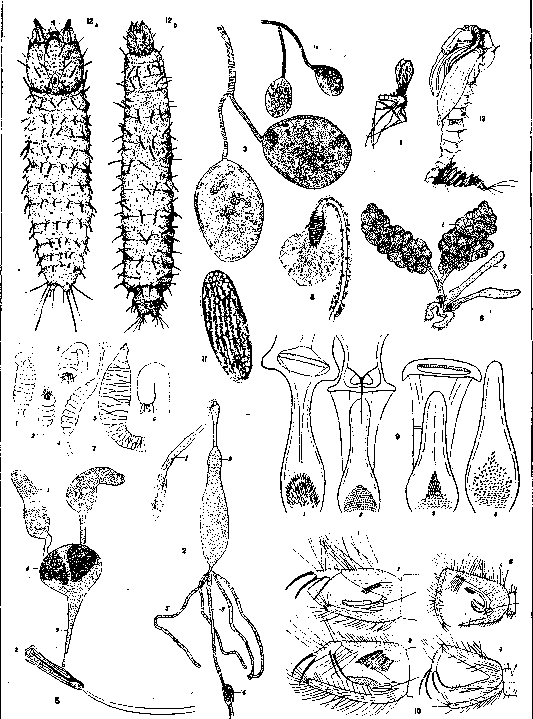
Figure 1. Female sandfly (Phlebotomus). Figure 2. Intestine of female Phlebotomus papatasii: 1-crop; 2-stomach; 3-intestine; 4-rectal vesicle; 5-Malpighian vessels. Figure 3. Salivary glands of female Phi. papatasii. Figure 4. Salivary glands of male Phi. papatasii. Figure 5. Male reproductive apparatus of Phi. papatasii: 1-testes; 2-copulatory organ; 3-spermatic duct; 4-seminal vesicle. Figure 6. Female reproductive apparatus of Phi. papatasii: 1-ovary; 2-accessory glands. Figure 7. Various forms of the spermatheca (spermatheca) of sandflies (only the internal chitinous capsule is drawn): 1-Phi. papatasii; 2-Phi. Sergenti; 3-Phi. caucasicus; 4-Phi. major; 5-Phi. chinensis; 6-Phi. of the minutus group. Figure 8. Spermatheca of Phi. papatasii with cellular elements. Figure 9. Structure of chitinous plates of the pharynx (1-4) of sandflies of the minutus group. Figure 10. Copulatory organs of male sandflies: 1-Phi. Sergenti; 2-Phi. caucasicus; 3-Phi. papatasii; 4-Phi. minutus var. sogdianus. Figure 11. Egg of sandfly Phi. papatasii. Figure 12. Larvae of sandflies Phi. papatasii: a-first stage; b-fourth stage. Figure 13. Pupa of sandfly.
Parrot L., On some Bukharan sandflies, Vestn. mikrobiol., epidemiol. i parazitol., vol. VII (print); Perfil'ev P., On the anatomy of sandflies of the genus Phlebotomus, Russ. entomol. obozr., vol. XX, 1926; ibid. On the systematics and distribution of sandflies in Tadzhikistan and Uzbekistan (Animal parasites and some parasitic diseases of man in Tadzhikistan, coll. under ed. of E. Pavlovsky, L., 1929); Popov P., An attempt at the study of Phlebotomus in Russia, Russ. jurn. trop. med., 1926, no. 29; Shchurenkova A., Demina N. and Pavlova P., A simple and rapid method for determining females of Phlebotomus, Tropical Medicine and Veterinary Science, 1929, no. 10; Adler S. and Theodor O., a series of articles, Ann. of trop. med. a. paras., v. XX-XXI and XXIII, 1926-27 and 1929; Laussé F., Etude systematique et medicale des Phlebotomes, these, P., 1921; Nasonov N., The Phlebotomus papatasi Scopoli and the three-day fever (febris pappataci) in the Crimea, Reports of the Academy of Sciences of the USSR, ser. A, L., 1926; ibid., Notes on sandflies, ibid.; Parrot L. and Franca C., Introduction a l'etude systematique des dipteres du genre Phlebotomus, Bull. de la Soc. de path. exot., v. VIII, 1920;inton J., The synonymy of the asiatic species of Phlebotomus, Indian J. of med. research., v. XVI, 1926. In addition, a number of articles by E. Martynovsky, P. Popov, A. Shchurenkova and others in Russ. jurn. tropicheskoy med. from 1927; P. Perfil'ev, L. Khodukin and F. Shevchenko in the journal Medical Thought of Uzbekistan, from 1927. See also lit. to article Leishmanioses.
Related articles
Mentioned in
Cite this page
“Sandflies.” Soviet Medical Encyclopedia. English translation of Bolshaya Meditsinskaya Entsiklopediya, 1st ed. (Moscow, 1928–1936), ed. N. A. Semashko. https://sovietmedicalencyclopedia.pages.dev/article/sandflies/