Sandblasting Apparatus
Historical document, translated for reference. It reflects medical knowledge of the 1920s–30s and is not medical advice.
Summary
Sandblasting apparatus uses air or water to propel sand for cleaning metal surfaces from contamination, scale, and dust. The article describes various types of sandblasting equipment, health hazards from silica dust, and hygiene measures to protect workers.
Encyclopedia article (1928–1936)
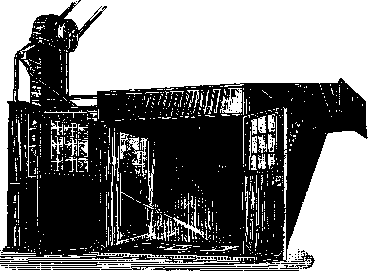
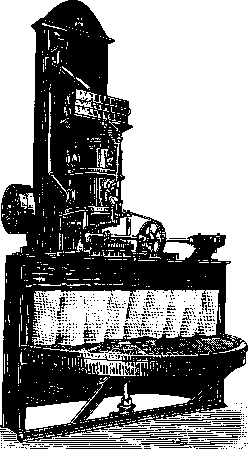
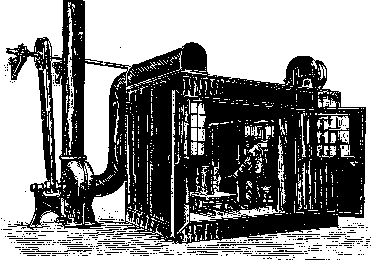
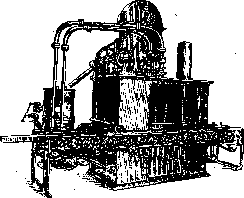
SANDBLASTING APPARATUS (industrial), apparatus of various designs, in which a stream of sand is set in strong rectilinear motion by air (pneumatic S. a.) or water (hydraulic S. a.) and directed onto the object being processed from a nozzle. S. a. is used for cleaning metal products from contamination, adhering earth, dust, scale, etc. (e.g., for cleaning castings in fettling departments, for removal of scale before electroplating processes, etc.). For cleaning castings, as well as for cleaning products from scale depending on their size, sandblasting drums, tables [rotating (fig. 2) and through-type (fig. 4)] and sandblasting chambers [closed and open (figures 1 and 3)] are used; for small castings - drums, for medium-sized - tables, and for large ones - chambers. In S. a., quartz and river sand are used, and in recent years steel sand (shot) is increasingly being used. The size of sand particles is taken depending on the product being cleaned, with particles from 1 to 2 mm being used for cleaning castings, and particles of 0.75 mm and smaller for removing scale. Part of the sand (5-8%) during operation in S. a., being crushed, turns into dust. The amount of dust found near S. a. at the sandblaster's workplace reaches (with satisfactory ventilation) 10-30 mg of dust in 1 m³ of air. With very good ventilation, Beintker found no dust at all. With insufficient ventilation, Leshchinskaya found 175 mg, and in some cases even above 200 mg, Kagan 133-160 mg, Froboese 334-453 mg of dust in 1 m³. Without ventilation, Beintker inside the chamber found 2,690 mg. In size, 92-97% of dust particles are up to 10 μ. In chemical composition, dust when cleaning castings consists of mixed dust of quartz sand and molding sand. The dust formed during S. a. is non-toxic, except for dust when cleaning
Figure 1. Sandblasting chamber.
lead products, such as battery plates. Example of dust composition obtained when cleaning castings: SiO₂-88.3%; Al₂O₃-4%; Fe₂O₃-3.6%, the rest-organic substances. S. a. dust, mainly quartz in all cases, can seriously affect the respiratory organs (see Dust, Pneumoconioses). Working with S. a. replaced processes previously performed on grinding and polishing machines and accompanied by significant dust formation. The use of S. a. has a certain positive significance from the point of view of occupational hygiene, since a) it does not require rough physical strength, as in fettling, b) provided with rational dust removal devices, it makes it possible to protect the worker from significant amounts of dust released during cleaning. The significant amounts of dust mentioned above found when working with S. a. show that the absence of appropriate devices for dust removal and supervision of S. a. operation can turn the latter into a significant source of dust formation, and the dust forcefully ejected from S. a. not only penetrates the body together with the inhaled air, but also strikes the worker, getting on his face, eyes, etc. Hygienic measures that significantly reduce dust removal consist of 1) suction of spent sand and the resulting dust by an exhaust fan; 2) separation of the worker directing the S. a. nozzle by a partition from the place of sand spraying; 3) constant repair of all cracks in the S. a. itself and its pipes that pass sand and dust outside. To ensure protection of the worker from dust when working with S. drums, their hermetic sealing is sufficient; when working with S. rotating tables, it is necessary to cover the workplace (rear part) of the table with a hood (canvas, rubber plates) to protect from scattered dust and sand particles, as well as their sufficient suction, leaving only small openings for loading and unloading products; when working with S. chambers (depending on whether they are closed or open): in closed ones - allocation of a special compartment (booth) for the worker, where the worker is placed in front of the door, which has openings allowing him to direct the nozzle and observe the cleaning process; exhaust fans that exhaust air inside the chamber create a rarefied space in it, as a result of which the air flow goes from outside (from the compartment where the worker is) into the chamber, and the possibility of air (containing dust) entering from the chamber (where cleaning is taking place) through the door openings into the worker's booth is eliminated; in open chambers, where the worker is inside the chamber itself to direct the nozzle, helmets (fig. 5) are necessary, with breathing occurring through tubes that exhaust exhaled air and supply inhaled air (see Protective devices in production), and appropriate special clothing with tightly fitting sleeves and trouser ends. Recently, hydraulic cleaning of castings in chambers has begun to be used, performed by a water jet under high pressure (35-100 atm.). Hydraulic cleaning is more hygienic than sandblasting, since with it there is absolutely no dust, which with S. a. still to some degree pollutes the air of the room. Abroad, sand-hydraulic cleaning is beginning to be used, in which sand is carried not by an air stream, as in S. a., but by a water jet under pressure.

Related articles
Cite this page
“Sandblasting Apparatus.” Soviet Medical Encyclopedia. English translation of Bolshaya Meditsinskaya Entsiklopediya, 1st ed. (Moscow, 1928–1936), ed. N. A. Semashko. https://sovietmedicalencyclopedia.pages.dev/article/sandblasting-apparatus/