True Bugs
Historical document, translated for reference. It reflects medical knowledge of the 1920s–30s and is not medical advice.
Summary
True bugs (Hemiptera-Heteroptera) are a suborder of insects characterized by their piercing-sucking mouthparts. This article describes their anatomy, life cycle, and medical significance, including various species that are blood-sucking parasites and disease vectors.
Encyclopedia article (1928–1936)
TRUE BUGS, or true hemipterans, constitute a suborder of hemipterans (Hemiptera-Heteroptera), of the order Rhynchota. They are characterized by a grooved proboscis bent ventrally on the body, divided along its length into segments. In the proboscis groove, which forms the lower lip, lie bristle-like upper and lower jaws forming piercing-sucking mouthparts (fig. 1). The upper lip has the form of a short plate. The jaw palpi are absent. The antennae are 4(5, 3)-segmented. The legs are running or swimming. Typically there are 4 wings; the front wings are leathery or hard chitinous in their greater part; the remaining part of them, as well as the hind pair of wings, are transparent and membranous. The front wings differ from the hind ones also in their venation. The wings in some bugs are partially or completely reduced. They are folded flat on the back. Bugs emit very characteristic odors, different for different species. The odor of bugs depends on the secretion of special cutaneous scent glands, which in adult bugs open on the metathorax near the base of the hind legs (fig. 2), and in larvae-on the dorsal surface of the abdomen. The transformation in bugs is incomplete. The larvae are similar in general body form and segmentation to the adult form and lead a similar way of life. About 21,000 species of bugs are known; they lead a terrestrial or aquatic life. They feed on plant juices or suck the blood of animals. Among plant-feeding bugs there are many species that are important pests of cultivated plants. Blood-sucking bugs are important as parasites, as poisonous animals, and as carriers of pathogens of some diseases. The poisonous action of bugs depends on the properties of the secretion of their complex salivary glands (fig. 4), which flows into the grooved space between the spiny oral bristles (upper jaws). Some species of bugs have served as objects of important cytological studies on the maturation of sex cells. The following families have medical significance. Family Reduviidae; from this family the most common is Reduvius personatus-the masked reduviid bug (figs. 3 and 5); it lives under tree bark, in houses, barns, etc., where it attacks various insects (and in particular bed bugs). Its sting is very painful for humans. Harpactor annulatus (of European forests) also stings painfully. Particularly poisonous is the Brazilian Arilus carinatus. Phonergastes bicoloripes (Angola) sucks the blood of Ornithodorus moubata ticks, which are carriers of relapsing fever spirochetes, and at the same time attacks humans, who react strongly to its bite. The kissing bug [Triatoma (Conorhinus) megista; fig. 6] lives in cracks in earthen walls and feeds on human blood (Brazil). In contrast to other Reduviidae, the sting of Triatoma is barely felt. However, this bug is a carrier of Trypanosoma cruzi-the causative agent of Chagas disease, along with another bug, Rhodnius prolixus (Venezuela) (fig. 7). The invasive form of trypanosomes is excreted with the bug's feces and contaminates the skin, through which it enters the human body. Family Cimicidae with species Cimex lectularius-the bed bug (fig. 8) (C. rotundatus), Oeciacus hirundinis-swallow's nest bug, Cimex vespertilionis (on bats) and others. In Cimex lectularius the body is dorsoventrally flattened, on the head there are long 4-segmented antennae, there are no wings; on the prothorax there are two characteristic lateral expansions in the form of broad lobes. In the male, at the posterior end of the abdomen lies asymmetrically a sickle-shaped copulatory apparatus. The legs are running. The size of the male is 4.9-6.4x2.7-3.2 mm; the female-4.8-8.4x2.9-3.9 mm. In a minute it can run up to 125 cm. From abandoned houses it moves to other premises. It is a nocturnal insect; during the day it hides in cracks in walls, ceilings, floors, furniture, under wallpaper, baseboards, frames, curtains, clothing, etc. It runs away from artificial light. It attacks humans at night and in the dark, sucking blood from exposed parts of the body; it drinks up to 7 mg of blood. It can suck the blood of chickens, pigeons, dogs, cats, mice and other animals. The blood-sucking procedure by an adult bug lasts up to 15 minutes (fig. 9). It can fast for up to 7 years or longer. While sucking blood, it injects saliva, under the influence of which a blister soon appears on the skin with a sensation of itching and burning. The intensity of the reaction and its duration vary in different subjects
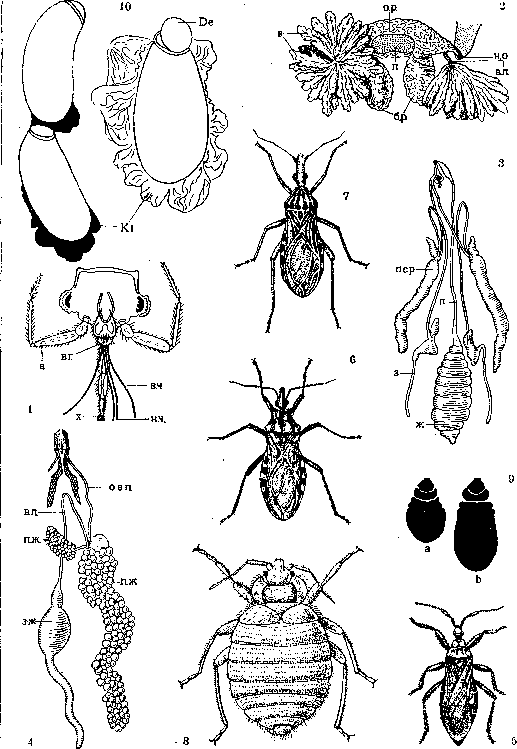
Figure 1. Mouthparts of Cimex lectularius: a-antenna; v.g.-upper lip; v.ch.-upper jaw; n.ch.-lower jaw; x-proboscis. Figure 2. Scent gland of C. lectul. from the dorsal side: o.r.-common reservoir; p-kidney-shaped organ; b.r.-lateral reservoirs; v-scent gland; i.o.-external opening of the scent gland; v.p.-excretory duct of the scent gland. Figure 3. Salivary glands of Reduvius personatus: np-anterior gland; p-esophagus; z-posterior gland; g-stomach. Figure 4. Salivary glands of Nepa cinerea: pz-anterior gland; hz-posterior gland; vp-its excretory duct; ovp-common excretory duct. Figure 5. Reduvius personatus Figure 6. Triatoma megista Figure 7. Rhodnius prolixus Figure 8. Cimex lectularius Figure 9. Comparative size of the bug before (a) and after (b) blood-sucking. Figure 10. Cimex lectularius-eggs: De-lid; Ki-sticky mass.
various. There are people who do not react at all to bedbug bites. Small animals (mice) can be killed by mass attacks of bedbugs. The bedbug is resistant to low temperatures; therefore, the common practice of 'freezing' beds and other items to rid them of bugs does not give proper results. Bedbug eggs are white, barrel-shaped, with a cap at the end, slightly curved, about 1 mm long (figure 10). After being laid, the eggs turn yellow. They are glued by the female to picture frames, curtains, in crevices of beds and walls, to clothing, books in dry places, because bugs cannot tolerate moisture. The fertility of the female depends on the abundance of food and temperature. The optimum temperature for egg laying is +25°C. The temperature limits at which egg laying occurs range from 12-37°C. The female lays 1-12 eggs per day (usually about 5); egg laying is not related to the time of year; the maximum number of eggs laid by a female in her lifetime is 250. At temperatures from -4°C to +6°C, eggs do not develop, but do not die even for a month and a half. The hatching of larvae from bedbug eggs occurs, according to Hase (A. Hase), at 14-18°C - on average after 21-22 days (15-29 days), at 22-26°C - on average after 8-9 days (5-12 days), at 35-37°C - on average after 5-6 days (4-7 days). Larvae of the first phase of transformation are white with a small abdomen and a long proboscis. They live in the same places as adult bedbugs. The metamorphosis of the bedbug is associated with successive molts, which occur each time after at least one feeding. With abundant food and a temperature of 30°C, molts occur consecutively after 6, 5, 5, 5, 6 days. At room temperature and sufficient food, the metamorphosis of the bedbug is extended from 28 days to 6-8 weeks. With an even greater decrease in temperature, metamorphosis slows down even more. Larvae can fast for up to 18 months. The gradual increase in the length of larvae after each molt: I phase - 1.3; II - 2.0; III - 3.0; IV - 3.7 and V - 5.0 mm (sizes of hungry insects). Natural enemies of bugs are ants, pseudoscorpions (Chelifer), and the centipede Scutigera (house centipede). The significance of bedbugs is determined by their habitat in human dwellings, their use of human blood for food, and human reaction to bug bites; bedbugs have been accused of transmitting spirochetes of relapsing fever, but without sufficient basis; just like plague bacilli, spirochetes of relapsing fever can live in the bug's body for some time, but this fact alone does not make the bedbug a carrier of these microorganisms. Although plague bacilli are excreted with the bedbug's feces, the practical significance of this fact is negligible, because the bedbug defecates in its shelters. Leishmanias can also survive in the bug's intestine, but epidemiological considerations speak against the involvement of bugs in the spread of kala-azar, because where bedbugs are abundant, kala-azar is associated only with certain houses. Despite all this, bedbugs are indicators of unsanitary conditions in housing, and the fight against them is just as necessary as against other ectoparasites of humans. It is difficult to protect oneself from bug attacks when forced to stay overnight in an infested room. Persian powder, camphor, and naphthalene do not repel hungry bugs. Sleeping under artificial lighting may be of some help. In metal beds, bedbugs are burned in crevices with an alcohol burner. Wooden objects are washed with hot soapy water with creosote or kerosene; a mixture is also used: carbon disulfide 1 part, kerosene 20 parts, creosote with soap 7 parts. The mixture is thoroughly shaken before use and diluted tenfold with water. A mixture of 50 parts of ammonia alcohol with 10 parts of turpentine is introduced into deep crevices. Using for the same purpose the steam from boiling water from a special 'kettle' is of little effect, because when it comes into contact with cold objects, especially in the depths of crevices, the steam settles in a droplet-liquid state and does not have the proper effect on hidden bugs. Boiling water as such can be used to destroy bug eggs on sheets, curtains, valances, clothing, and other items. Picture frames, photograph frames, and small items with bugs are placed in tightly closing boxes into which gasoline, chloroform, creosote, and other substances are poured. Their vapors should act for a week or more for radical cleaning of items. The most radical method of combating bugs is the gas method. Sulfur dioxide is obtained by burning sulfur at a rate of 13.0 g per 1 m³ of a tightly closed room; the duration of action is 1-2 days. The most radical measure is considered to be cyanide gas, however, its use in residential premises is dangerous due to its extreme absorption by various items and walls. In general, the radical fight against bugs is not easy and often must be accompanied by repair of the premises. For general cleaning of premises from bedbugs, see Disinsection. Fam. Nepidae - water scorpions, with a flat body and a characteristic tubular appendage at the posterior end for breathing. Nepa cinerea - the common water scorpion, lives in standing waters, on the bottom. The bite of its mouthparts is painful. - Fam. Notonectidae - backswimmers; the body is keeled above, flat below; legs are swimming. Notonecta glauca - the 'water bee' of German authors. Common in fresh waters. Its bite is poisonous. Not all people are equally sensitive to the bite of Notonecta. The typical reaction to a bite consists of: a) the appearance of a drop of blood from the bite site, b) the development of erythema over an area of 2-5 cm in diameter, c) the appearance of hemorrhages near the bite site approximately an hour later (they disappear in the second half of the day), d) the formation of a blister that appears shortly after the bite. The bite is accompanied by a sensation of sharp pain and burning lasting 15-20 minutes. Sometimes secondary effects of the bite occur: a new attack of pain, inflammation and swelling of adjacent areas of skin, and the formation of papules. These symptoms develop 7-9 hours after the bite, reach their maximum after 20-30 hours, and disappear after about 45 hours. - Family Belostomatidae with the largest representative Belostoma grande up to 10-10.7 cm in length (Brazil). The bite is poisonous. - From non-bloodsucking (plant-eating) hemipterans, humans can be bitten by Leptodemus minutus, Geocoris henoni (both from the family Lygaeidae), Dysdercus superstitiosus, Pyrrhocoris apterus and other species.
Related articles
Cite this page
“True Bugs.” Soviet Medical Encyclopedia. English translation of Bolshaya Meditsinskaya Entsiklopediya, 1st ed. (Moscow, 1928–1936), ed. N. A. Semashko. https://sovietmedicalencyclopedia.pages.dev/article/true-bugs/