Gastrophilus Equi
Historical document, translated for reference. It reflects medical knowledge of the 1920s–30s and is not medical advice.
Summary
Gastrophilus equi, or stomach bot fly, is a parasitic insect that lays eggs on horse hair. The larvae develop in the horse's stomach, causing lesions and potentially toxic effects, and can also accidentally infect humans.
Encyclopedia article (1928–1936)
GASTROPHILUS EQUI, stomach bot fly, an insect of the family Tachinidae (this family now includes the former family Oestridae), order Diptera. G. equi lays eggs and attaches them to the hairs of horses (see Figure 1). The larva developing in the egg emerges from the eggshell and bores into the epidermis, where it tunnels. Under the influence of itching, the horse scratches its skin with its teeth and swallows the bot fly larvae from the tunnels opened by scratching, as well as larvae emerging from eggs. In the stomach, the larva molts twice and reaches 1½-2 cm in length. Its body is wide, covered with spines (see Figure 2); at the head end it has two powerful hooks with which the larva attaches itself to the stomach wall, leaving a trace in the form of a funnel-shaped depression. Around the resulting ulceration, papillomatous growths may appear, sometimes taking on a carcinomatous character. Up to 1,000 larvae may be present in a horse's stomach (see Figure 3). Subsequently, the larvae detach from the stomach wall, pass with its contents into the intestine, and are expelled outside. In the soil, the larva pupates. From the resulting bean-shaped pupa emerges the winged insect. The larvae of G. e. contain a poison that strongly affects horses. When extracts are injected intravenously, horses die. The larvae taken from horses suffering from pernicious anemia possess even greater toxicity. K. and R. Seyderhelm attribute to the larvae of G. e. a causal role in the etiology of the mentioned disease, which, however, is disputed by other authors. Van Es and Schalk observed severe intoxication when injecting extracts from Gastrophilus equi larvae only in those horses that were infected with these parasites. In such
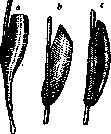
Figure 1.
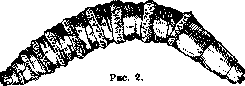
cases, there is more evidence to speak of the manifestation of anaphylaxis. There are cases of abnormal localization of G. equi larvae; thus, when they are found in the horse's esophagus, paralysis of the larynx and esophagus was observed, which depends on the toxic effect of the parasite. Mature larvae can be parasites (see), for example, in the stomach of a dog and even a bird when these hosts accidentally swallow the parasites that have fallen from the horse's intestine. There is only one old report from Siberia regarding the finding of a G. equi larva in a human stomach. However, there are many known cases when the larvae of phase I of G. e. are parasites in human skin. According to the research of E. Pavlovsky and A. Stein, the larva of Gastrophilus equi tunnels through the thickness of the epidermis, specifically in its Malpighian layer. On the surface of the skin, the tunnel made by the larva is visible in the form of a reddish or bluish-red elevated strip, which appears on fresh skin areas and gradually
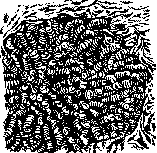
Figure 3. Part of the mucous membrane of a horse's stomach with larvae of G. intestinalis attached (according to Kholodkovsky). GASTROCIRRHOSIS disappears in old areas after peeling. Subjectively, itching and partly burning are felt. The larva's tunnel can be very winding; in a day it advances 7-8 centimeters. The larva itself can be extracted if the epidermis is immediately pierced with a needle just ahead of the fresh end of the strip on the skin. The larva is white, covered with numerous spines and has good armament at the head end, also in the form of spines and hooks. The larva of G. e. can penetrate human skin in two ways: 1) when sweaty skin comes into contact with horse hair on which there are G. e. eggs with developed larvae; the larva emerges from the egg and bores into the human epidermis; 2) when G. e. eggs are directly attached to human hair; the larva, upon emerging, immediately bores into the epidermis.-When examining cases of G. e. larvae parasitizing humans, it is necessary to search for G. e. eggs on the hairs at the old beginning of the tunnel. In addition to G. e., other species are known - G. hemorrhoidalis, G. veterinus, etc. (see also Larva migrans and Bot fly).
E. Pavlovsky. GASTROCIRRHOSIS, gastrocirrhosis (from Greek gaster-stomach, kirrhos-properly reddish, a word used to denote the hardening of an organ due to the proliferation of connective tissue in it), a rarely used term; more often one says 'cirrhosis of the stomach' (cirrhosis ventriculi, synonym linitis plastica). The terms mentioned imply the proliferation of connective tissue in the stomach wall, which shrinks and leads to the constriction and reduction in size of the entire stomach or only its outlet part, while the stomach wall appears thickened and dense. This change occurs after poisonings (for example, by acids) and also complicates some forms of chronic catarrh of the stomach; sometimes it can simulate cancer (scirrhus) of the stomach.
Related articles
Mentioned in
Cite this page
“Gastrophilus Equi.” Soviet Medical Encyclopedia. English translation of Bolshaya Meditsinskaya Entsiklopediya, 1st ed. (Moscow, 1928–1936), ed. N. A. Semashko. https://sovietmedicalencyclopedia.pages.dev/article/gastrophilus-equi/