Tumbu Fly
Historical document, translated for reference. It reflects medical knowledge of the 1920s–30s and is not medical advice.
Summary
The tumbu fly is a non-bloodsucking fly found in tropical Africa whose larvae parasitize humans and animals. The fly lays eggs in soil, and the resulting larvae burrow into the skin of hosts, causing furuncle-like swellings before pupating and emerging as adults.
Encyclopedia entry (1928–1936)
TUMBU FLY, the larva of a non-bloodsucking fly, Cordylobia anthropophaga (E. Blanchard), inhabiting tropical Africa.
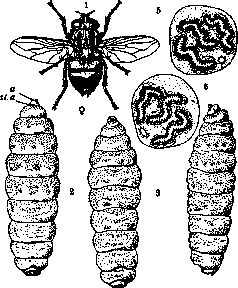
1-Cordylobia anthropophaga (enlarged 1.5 times); 2-adult larva of Cordylob. anthrop. from the dorsal side (enlarged 3.5 times); 3-larva from the ventral side; *-larva from the side; 5 and 6-areas bearing stigmata in the larva; a-antenna; st. a-anterior stigma.
The fly lays eggs in the soil. Larvae emerging from the eggs move to the surface of the soil and bore into the skin coverings of a suitable host, which can be a human, dog, cat, or some other animal. The larva lives under the epidermis for about 12 days, reaching a length of 8-12 mm during this time. At the site of the larva's location, a furuncle-like swelling forms. After leaving the host, the larva pupates freely. From the puparium, the fly emerges in about 20 days. The larva of Cordylobia anthropophaga is a true parasite.
Related articles
Cite this page
“Tumbu Fly.” Soviet Medical Encyclopedia. English translation of Bolshaya Meditsinskaya Entsiklopediya, 1st ed. (Moscow, 1928–1936), ed. N. A. Semashko. https://sovietmedicalencyclopedia.pages.dev/article/tumbu-fly/