LINARIA VULGARIS
Historical document, translated for reference. It reflects medical knowledge of the 1920s–30s and is not medical advice.
Summary
Linarium Vulgaris is a medicinal plant used for its laxative and diuretic properties. The article also describes Linguatulidae, parasitic arthropods that can infect mammals including humans.
Encyclopedia article (1928–1936)
LINARIA VULGARIS Miller (Antirrhinum linaria L.), linaria, a herbaceous plant of the figwort family (Scrophulariaceae), 30-60 cm in height; distributed throughout Western Europe and the USSR, often in sandy places. The herb (Herba Linariae) is used; it is collected during flowering in July and late August. The lower coarse woody parts of the stems are discarded. Almost odorless, with an unpleasant bitter taste. Constituent parts (in general little studied): linarin, linarakrin, linarezin, linarosmin, antocorrin, antirrhinic acid, formic acid, citric, acetic, malic acid, gum, sugar, pectin substances, pigment, fatty oil, glycosides: alpha-linarin and alpha-pectolinarin. The amount of glycosides reaches 1.5-2.8%. Physiological action - laxative and diuretic. From fresh herb, a hemorrhoid ointment is prepared. LINGUATULIDAE, highly modified arthropod animals of the class Arachnoidea, in which they are distinguished along with ticks into the order Linguatuliformes. Adult L. have a worm-like ringed body without limbs; the mouth is surrounded by two pairs of hooks; they live in the respiratory tracts of mammals and reptiles; larvae inhabit as tissue parasites in various organs of mammals. Linguatula serrata (= rhinaria), the common pentastomid (fig. 1); the female is 80-130 mm in length, 8-10 mm in width at the front and 2 mm at the rear end. Males are 18-20 x 3-0.5 mm. The body is elongated-lanceolate, widened forward. On the outside, up to 90 distinct rings are counted, to which no internal segmentation corresponds. The mouth lies on the ventral
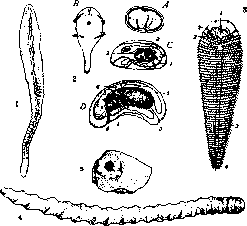
Figure 1. Linguatula serrata (female). Fig. 2. Larva of L. serrata: A-developing in the egg; B-embryo with 2 pairs of limbs with hooks; C-larva from rabbit liver; D-larva 9 weeks (1-nerve node; 2-digestive tube; 3-skin glands; 4-intestine; 5-anus; 6-sex gland). Figure 3. Linguatula serrata (mature larva, capable of infecting a dog): 1-mouth; 2-two pairs of hooks (rudiments of legs); 3-intestine; 4-anus. Figure 4. Porocephalus armillatus (female). Figure 5. Larva of P. armill., encapsulated under the serous covering.
side at the front end. Anus is shifted to the rear end of the body. The male sexual opening lies on the ventral side near the mouth, while in the female it is shifted toward the anal opening. The digestive canal is in the form of a straight tube. There is neither circulatory nor respiratory system. Muscles are striated. The female reproductive apparatus consists of a long tubular ovary, two oviducts, and a long thin vagina with a pair of seminal receptacles. In the male there are testes, a seminal reservoir, two sperm ducts, and two copulatory organs. The nervous system is in the form of a pharyngeal ring. There are no eyes. It lives in the nasal and frontal cavities, causing sharp catarrhal phenomena, bleeding, pus discharge, etc. It parasitizes dogs, wolves, foxes, horses and other animals; in humans it occurs in exceptionally rare cases. The eggs are oval 0.09 x 0.07 mm (fig. 2, A). They are expelled to the outside with nasal mucus. When swallowed by herbivores (hare, rabbit, sheep, goat, cow) or by humans, they are opened in the stomach. The larva emerging from them with two pairs of legs (fig. 2, B) pierces through the intestinal wall and enters the liver or other organs, where it becomes encapsulated (fig. 2, C). After several molts, the larvae transform into a wandering larva (fig. 3), which travels through the body, enters serous cavities and other organs, where it can become secondarily encapsulated. It is often found in the mesenteric glands of cattle, causing their pseudocaseous degeneration, simulating tuberculosis. When eaten by the definitive host, it transforms into the sexually mature form. In the stomach of the latter, the larva is released, actively moves to the nasal cavity of the host, where it reaches sexual maturity. A fully formed larva is 4-6 x 2 mm; the body is wedge-shaped with 80-90 rings; the body segments bear spines along the edge. These larvae have also been described under the separate name Pentastomum denticulatum. In humans, they become calcified in the liver, forming whitish nodules, and are apparently harmless. Pentastomum denticulatum is widely distributed in cattle. According to data from inspection of slaughter cattle at the Leningrad abattoir, Ukrainian cattle is infected in 87.5-92.31%, Belarusian - in 86-88%, Volga region - in 88.8-90%, West Siberian - in 93.7-96.6% and Kazakhstani - in 91.9% (Bogdashew). - Porocephalus armillatus (fig. 4) lives in the trachea and lungs of large African snakes (pythons, Bitis, etc.); the body is elongated, cylindrical, with constrictions, 9-12 cm long, 5-9 mm in diameter. Larvae (nymphs) are found in giraffes, antelopes, rhinoceroses, hedgehogs, monkeys and in humans in an encysted state under the serous membrane of the liver (fig. 5), pleura, intestine, etc. If a person swallows eggs of Porocephalus armillatus, the larvae emerging from them do not cause any appreciable harm to him. However, when eating raw meat of animals with encapsulated nymphs, the latter are released and bore through the intestinal wall into the abdominal cavity. When the parasites further penetrate the liver, lungs or other organs, peritonitis, severe pneumonia and even fatal outcomes develop. Thus, in contrast to Linguatula serrata, Porocephalus armillatus is a much more dangerous parasite for humans.
Related articles
Cite this page
“LINARIA VULGARIS.” Soviet Medical Encyclopedia. English translation of Bolshaya Meditsinskaya Entsiklopediya, 1st ed. (Moscow, 1928–1936), ed. N. A. Semashko. https://sovietmedicalencyclopedia.pages.dev/article/linaria-vulgaris/