Granary Weevil
Historical document, translated for reference. It reflects medical knowledge of the 1920s–30s and is not medical advice.
Summary
The granary weevil (Sitophilus granarius) is a major pest of grain and flour, with its life cycle occurring entirely within the grain kernel. The article describes its biological characteristics and notes that it cannot tolerate the smell of tar.
Encyclopedia article (1928–1936)
Granary Weevil, Calandra granaria L., a beetle of the weevil (snout beetle) family Curculionidae, the most important pest of grain and flour; length without snout 3.7 mm. It lays eggs on the thick end of the grain, gnawing an opening that is closed with a plug of flour. The larva that emerges from the egg lives inside the grain, and here it also transforms into a pupa, eating the inside of the grain. About 40 days after the egg is laid, the beetle emerges from the grain. The granary weevil cannot tolerate the smell of tar (see Granary Pests).

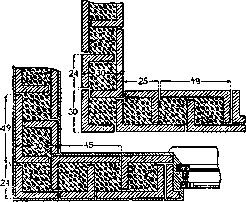
Figure 1. Plans of two adjacent courses of masonry for external walls using 'Amby' stones. Wall thickness is 30 cm, corresponding to the climatic conditions of the middle zone of Western Europe. The voids are filled with slag or lean slag concrete. The lower plan shows the plastering of the external and internal surfaces of the walls.
With a joint thickness of 1 cm, a hollow wall 30 cm thick is obtained, with vertical channels of 20 cm × 20 cm cross-section. These channels are filled with slag or low-conductivity slag or pumice concrete. A wall thickness of 30 cm is sufficient for the climatic conditions in Germany, and such a wall is used there for constructing residential buildings up to two stories high. In the vertical plane, each course has a height of 31 cm including the joint. The method of bonding the stones in the wall by laying them in a staggered pattern is visible from the figure showing two adjacent courses of masonry, where the short shelves of the upper course of stones coincide with the short shelves of the lower course, ensuring good transverse bonding of the masonry. For the climatic conditions of the middle and northern zones of the USSR, a wall thickness of 30 cm is insufficient, and it has to be increased to 35-40 cm. This can be achieved with the same stones by correspondingly spacing them apart or by using stones in which the short shelf has a length of 30-32 cm instead of 24 cm. Under Soviet conditions, for filling the channels, in addition to the materials mentioned above, sphagnum, infusorial earth, cheap grades of asbestos, etc., can be used in a loose state. The mentioned loose low-conductivity materials are poured into the channels formed between the stones and slightly tamped. In most cases, having a lower coefficient of thermal conductivity than slag and pumice concrete, loose backfill materials give the wall a lower coefficient of thermal conductivity than when filling the channels with a dense mass in the form of concrete, but loose backfill in some cases settles, and the air spaces formed above the settled backfill in the channels are sometimes places of local freezing of the wall. Window and door openings in walls made of stones of system A are covered with concrete lintels in the form of a beam, with the height of the lintel corresponding to the height of one course of stones. For installing window frames, it is advisable to use either one common frame or two separate frames connected with intermediate filling from boards, as shown in the figures. The production of Amby stones is carried out in simple iron molds made from correspondingly curved sheets of boiler iron, covering the four external faces of the angle bracket and equipped with hooks for connecting individual molds to each other. During concreting, 31 such interconnected molds are set up on a wooden platform, yielding 30 stones at once. With the same molds, by using appropriate wooden inserts, smaller stones are made, which are required when laying corners and window openings (see Figure 2). Stones for the external surfaces of the wall are made from concrete of the following composition: 1 part cement, 3 parts sand, and 4 parts gravel or crushed stone; when concreting stones for internal wall surfaces, gravel or crushed stone is usually replaced with slag; this facilitates driving nails into the wall. The advantages of system A consist in good bonding and simplicity of masonry, simplicity of molds and production of stones, low consumption of concrete and its replacement with cheaper backfill material. Amby walls can be used not only for constructing small residential buildings but also for filling frame structures of large public and industrial
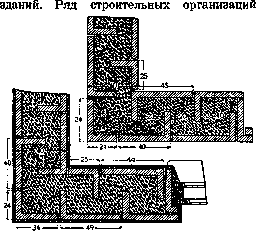
Figure 2. Masonry of two adjacent courses for external walls using 'Amby' stones, with a wall thickness of 35-40 cm, corresponding, depending on the material used to fill the voids, to the climatic conditions of the middle zone of the USSR.
The USSR has molds for making Amby stones, and there are already several buildings constructed according to this system.
Related articles
Mentioned in
Cite this page
“Granary Weevil.” Soviet Medical Encyclopedia. English translation of Bolshaya Meditsinskaya Entsiklopediya, 1st ed. (Moscow, 1928–1936), ed. N. A. Semashko. https://sovietmedicalencyclopedia.pages.dev/article/granary-weevil/