Beetles
Historical document, translated for reference. It reflects medical knowledge of the 1920s–30s and is not medical advice.
Summary
This article from the 1928–1936 Soviet Great Medical Encyclopedia provides an overview of the order Coleoptera (beetles), detailing their anatomy, metamorphosis, and ecological roles. It highlights their medical and economic significance, including their roles as pests, intermediate hosts for parasites, and sources of medicinal or poisonous substances, while categorizing various families.
Encyclopedia article (1928–1936)
BEETLES, or Coleoptera, an order of insects characterized by the transformation of the forewings into hard elytra, which at rest cover the entire abdomen or a part of it from above. Membranous hind wings serve for flight. Far from all species of beetles fly. The mouthparts are typically chewing. The abdomen is sessile. The back of the abdomen under the elytra is weakly chitinized; the remaining parts of its surface are hard. The digestive tube is especially long in herbivorous beetles, as well as in those feeding on manure. The digestive apparatus includes the esophagus, crop (in carnivorous beetles), muscular stomach, midgut, and hindgut. There are 4–6 Malpighian tubules. The respiratory tubes in good fliers expand into air sacs. The reproductive organs of the male, in addition to the testes and efferent ducts, possess various accessory glands and a copulatory apparatus. In females, besides the ovaries and oviducts, there are a seminal receptacle, a copulatory pouch, and adhesive glands. They reproduce, with the rarest exceptions, by laying fertilized eggs. Metamorphosis is complete. Beetle larvae are quite diverse in external form but always have a head. They live in the ground, in water, in plant tissues, in wood, etc. The pupa is free (pupa libera). In some beetles (Meloidae), a complicated metamorphosis (hypermetamorphosis) is observed. In the economy of nature, beetles play a large role, as among them there are many forms that feed at the expense of various plants and their products. Besides beetles that cause economic damage, poisonous beetles are also important to humans (larvae of Diamphidia locusta are used for poisoning arrows; various species of the genus Paederus and others are also poisonous) and beetles that are intermediate hosts of worms, as well as beetles that are false parasites; such are, for example, dung beetles, Onthophagus bifasciatus (in Ceylon, in the human intestine), infection with which likely occurs upon swallowing eggs or young larvae with dried fish. Other cases of false parasitism of beetles are known. Among beetles, there are also true parasites—Platypsyllus castoris, living on the beaver, and Silphopsylla desmanae, on the desman. Some beetles are important objects of experimental research, for example, the potato pest—the Colorado beetle (Leptinotarsa), the mutations of which, caused by the influence of external factors, were studied by Tower. Medicinal beetles and beetles that are natural enemies of harmful insects (for example, ladybird larvae) are useful to humans. Due to the abundance of species, the systematics of beetles is very complex. Below are some of the most important families. 1. Fam. Carabidae—ground beetles—with more than 10,000 species. On the posterior end of the abdomen, a pair of anal glands opens, spraying a caustic, unpleasant-smelling secretion. Many are useful by exterminating caterpillars and pupae of harmful butterflies (Fig. 8). 2. Fam. Dytiscidae—predaceous diving beetles—carnivorous beetles living in various water bodies. They are useful by exterminating mosquito larvae and pupae; large diving beetles are harmful in fish farming (Figs. 3 and 13). 3. Fam. Staphylinidae—predators, or rove beetles. A family of beetles rich in species,
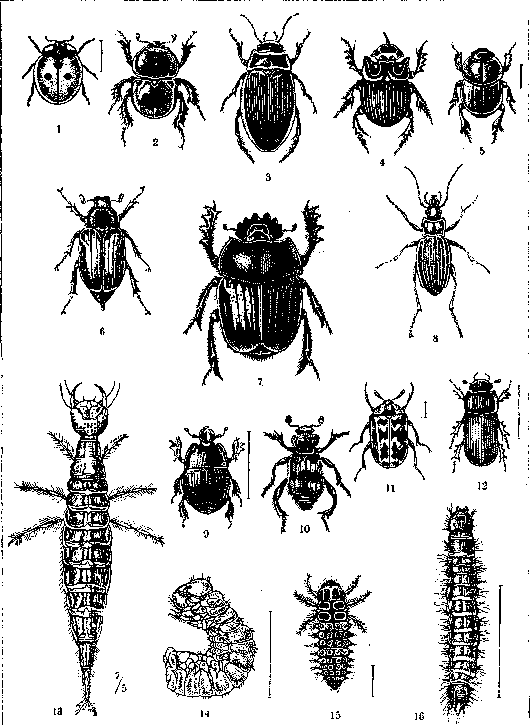
Beetles: 1—Coccinella septempunctata; 2—Geotrupes inermis; 3—Dytiscus marginalis; 4—Copris lunaris; 5—Onthophagus christophi; 6—Melolontha melolontha; 7—Scarabaeus sacer; 8—Carabus auratus; 9—Hister inaequalis; 10—Necrophorus vespillo; 11—Anthrenus museorum; 12—Aphodius rufipes; 13—larva of Dytiscus marginalis; 14—larva of Geotrupes stercorarius; 15—larva of Coccinella bipunctata; 16—larva of Lacon murinus. (From Jacobson.) (Figures 2–4, 6–8, and 10 are life-size.)
mostly small. They are predatory or feed on decomposing organic matter, in particular on animal corpses. Beetles of the genus Paederus are poisonous and, when crushed, cause vesicular dermatitis on human skin. 4. Fam. Silphidae—carrion beetles. Larvae and adults feed on the corpses of small animals, with the burying beetle (Necrophorus, Figure 10) burying them in the ground. The carrion beetle Silpha is found on carrion. 5. Fam. Histeridae—hister beetles—live in manure, carrion, in nests, etc. They are useful by exterminating fly larvae and other harmful insects (Fig. 9). 6. Fam. Elateridae—click beetles; when placed on their backs, they strike the substrate, jump up, and, falling, land on their feet. The larva ("wireworm") of some species causes great damage to crops (Fig. 16). 7. Fam. Buprestidae—jewel beetles—with beautiful, often bright metallic coloration. The larvae live in the wood of deciduous trees. 8. Fam. Anobiidae—death-watch beetles and spider beetles—live in dry wood, in plant and animal substances. They spoil furniture, beams, rusks, fur items, groats, grain, roots of medicinal plants, stuffed animals, collections, etc. (see Anobiidae). 9. Fam. Dermestidae—skin beetles—harm hides, grain, and warehouse goods. Dermestes lardarius, the larder beetle. The body is elongated-oval, yellowish below, densely covered with short black hairs above. At the base of the elytra is a wide yellowish-brown band with dots; the thoracic shield has small yellowish spots. The antennae are short, club-shaped. The legs are short, retractable. When touched, it presses its legs and antennae to its body and "plays dead." 7–8 mm long. Widely distributed throughout Europe and other parts of the world. In houses, it often lives on fur coats, hides, in various collections, and on meat products. It is also found on carrion and can take part in the destruction of a human corpse. Both the beetle itself, which devours and spoils the items listed above, and its brown, densely hairy larva, which attacks grain bread, ham, lard, cheese, dried meat, etc., are harmful. The larva is twice as long as the beetle itself. The metamorphosis cycle at a favorable temperature and sufficient nutrition lasts six weeks. Carbon disulfide is used to destroy Dermestes lardarius. Items must be thoroughly beaten and aired from time to time. Anthrenus museorum is a pest of museum collections (Fig. 11). 10. Fam. Mycetophagidae—hairy fungus beetles—live in fungi, in wood. 11. Fam. Coccinellidae—ladybirds. They release caustic blood from the joints of their legs. Predatory larvae destroy a mass of small harmful insects (Figures 1 and 15). 12. Fam. Meloidae—see Blister beetles. 13. Fam. Tenebrionidae—darkling beetles—live mostly in steppes and deserts. Some species have special scent glands opening at the posterior end of the body (see Blaps). 14. Fam. Cerambycidae—longhorn beetles. The larvae live in wood and under the bark of living or dead plants. They cause technical damage. 15. Fam. Bruchidae (= Lariidae)—seed beetles (see Bruchus). 16. Fam. Curculionidae—weevils, over 30,000 species with many important pests of agricultural and cultivated plants. 17. Fam. Ipidae—bark beetles—live under the bark and in the wood of trees. Important forest pests. 18. Fam. Scarabaeidae—dung beetles and scarabs. The larvae of the former feed on manure, which is stored for them (in some species) by the parents. Onthophagus, Caecobius (Figure 5), Oniticellus, and Aphodius (Fig. 12) are intermediate hosts of the nematode Gongylonema, which is found as a rare guest parasite in humans. Geotrupes (Figs. 2 and 14), the scarab (Fig. 7), and the copris (Fig. 4) also feed on manure. May beetles—Melolontha—are intermediate hosts of the giant thorny-headed worm (Fig. 6).
Related articles
Mentioned in
Cite this page
“Beetles.” Soviet Medical Encyclopedia. English translation of Bolshaya Meditsinskaya Entsiklopediya, 1st ed. (Moscow, 1928–1936), ed. N. A. Semashko. https://sovietmedicalencyclopedia.pages.dev/article/beetles/