Warble Fly
Historical document, translated for reference. It reflects medical knowledge of the 1920s–30s and is not medical advice.
Summary
The article describes the warble fly (Ovod), a parasitic insect affecting cattle and occasionally humans. It details the life cycle of different species, their effects on livestock, and human cases of infestation.
Encyclopedia article (1928–1936)
WARBLE FLY, short-bristled dipteran, family Tachinidae. In the adult state, they live freely and do not feed at all, while their larvae parasitize under the skin, in the nasal and pharyngeal cavities, and in the digestive tract of ungulates. Depending on the site of parasitism, skin, cavity, and stomach warbles are distinguished. The skin warble (Hypoderma bovis), also called the cattle warble. The female warble fly (fig. 1) attaches eggs (fig. 2) to the hairs of cattle on their legs. The larva (fig. 3), upon emerging from the egg, bores into the skin and moves upward through the subcutaneous tissue, penetrates the connective tissue of the esophagus, then moves dorsally again and appears under the skin of the back in the form of large swellings. Openings then appear on the swellings, from each of which the larval spiracle protrudes. Mature larvae (fig. 2) fall out, drop to the ground, and pupate. From the puparium, the adult insect eventually hatches. The larvae devalue the skin, as they pierce it in many places. Additionally, crushed larvae under the skin can cause in cattle the so-called Rosenfieber and even shock due to the developed anaphylaxis. Notable cases of ectoparasitism of Hypoderma bovis larvae of the II-III stages under the skin and even in the human eye have been observed. When parasitizing human skin, the larvae lie in the connective tissue layers, unlike Gastrophilus, which are localized in the thickness of the epidermis. Among cavity warbles, besides the head fly (see), the sheep warble, Oestrus ovis, is known, whose life cycle is identical in nature to that of Rhinoestrus purpureus. In sheep, this parasite can cause symptoms of false vertigo due to destruction of the ethmoid bone and pressure on the meninges. Oestrus ovis can also give birth to larvae in the human eye (fig. 4 and 5). Ocular myiasis from Oestrus ovis is observed less frequently than from Rhinoestrus purpureus. Stomach or intestinal warbles.
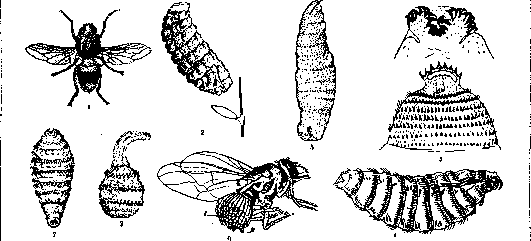
Figure 1. Female warble fly. Figure 2. Mature larva and egg of Hypoderma bovis, deposited on a cow's hair. Figure 3. First-stage larva of Hypoderma bovis. Figure 4. First-stage larva of Oestrus ovis from the human eye. Figure 5. Posterior end of the larva of Oestrus ovis, below - posterior end of Rhinoestrus purpureus. Figure 6. Bot fly, on whose abdomen a packet of eggs (2) deposited by the female Dermatobia cyaniventris is attached; 2 - larva emerging from the egg. Figure 7. Dermatobia cyaniventris - mature larva from human skin.
represents a favorite drink for patients. Oatmeal and flour serve not only for nutrition but also for preparing mouthwashes, softening poultices, and enemas. According to research by Aschenheim and Stern, adding a decoction of oatmeal, oatmeal flour, and wheat flour to cow's milk prevents the formation of large curds of casein in the stomach, for which reason such an addition is recommended when feeding infants. Oat decoction (decoctum) is prepared in pharmacies from two weight parts of oatmeal to 100 parts of water. Nutritional preparations from oats are numerous. Avenose - oatmeal flour mixed with soluble gastric malt extract. Oat cocoa - oatmeal flour (25%), refined sugar (50%), partially defatted cocoa (25%). Avenacia contains about 7% fat, 14% protein substances, 66% carbohydrates, and 3% salts. Knorr's oat flour and Weibezahn's oat flour represent nutritious flour containing 9% protein, 5.7% fat, 72% carbohydrates, 1% salts, and 10% water. Kathreiner's Hercules is made from roasted oat grains and is used as a coffee substitute. Processed American oat flour contains 6.71% fat, 16.3% nitrogenous substances, 64.44% non-nitrogenous extractives, 1.82% ash, and 10.77% water. In the USSR, from oats are prepared: oatmeal and several varieties of cereal (see Cereal).
H. Kornilov. see Gastrophilus equi. Among true human parasites, the skin warble is the Brazilian warble, Dermatobia hominis. This insect attaches its eggs to the abdomen of blood-sucking insects (fig. 6) (mosquitoes, bot flies, etc.). When the latter drink blood, the Dermatobia larvae emerge from the eggs and bore into the human skin, where they reach a length of 1 cm (fig. 7). In Guiana, these parasites are known under the name Ver macaque.
Related articles
Mentioned in
Cite this page
“Warble Fly.” Soviet Medical Encyclopedia. English translation of Bolshaya Meditsinskaya Entsiklopediya, 1st ed. (Moscow, 1928–1936), ed. N. A. Semashko. https://sovietmedicalencyclopedia.pages.dev/article/warble-fly/