Wohlfahrt Fly
Historical document, translated for reference. It reflects medical knowledge of the 1920s–30s and is not medical advice.
Summary
This 1930s encyclopedia article describes the Wohlfahrt fly (Wohlfahrtia magnifica), a parasitic flesh fly whose larvae infest living tissues in humans and animals, causing myiasis. It details the geographical distribution, morphology, lifecycle, and control measures.
Encyclopedia article (1928–1936)
WOHLFAHRT FLY (Wohlfahrtia magnifica Schiner 1862 = Sarcophila Wohlfahrtii Portsch, 1874), from the family Sarcophagidae, named in honor of the physician Wohlfahrt, who in 1770 first published an illustration of the larva and adult fly. It is a parasite of animals, mainly domestic ones, and of man. The female deposits 120-170 larvae, which parasitize the living tissues of man in the ears, nasal and oral cavities, eyes, vagina, and anus. The larvae destroy tissues and cause severe diseases known as myiasis. Geographical distribution: Egypt, Central Asia, Caucasus, middle and southern parts of the RSFSR; its distribution extends far north, up to and including the Tobolsk District; it is also partially known in Western Europe (Denmark).
The Wohlfahrt fly has a light gray body and a head of a shiny silvery-white color with a sheen (see figure 1). On the thorax, there are three dark longitudinal stripes and, closer to the middle stripe, two more narrow, short, intermediate lines. The abdomen is oval, with a shiny black pattern; on the rear edge of each of the first three segments sit three black spots, of which the middle one lengthens anteriorly, becomes narrower, and then connects with the middle spot of the following anterior segment. By their mutual connection, these spots form a longitudinal, strongly angular dorsal stripe. The lateral spots are round and smaller; on the rear edge of the fourth segment, there are three identical black spots. The legs are black. In the male, the tibias of the middle pair of legs have dense, soft, short hairs on the lower and inner surfaces. The claws on the tarsi are very short in females, whereas in males, on the contrary, they are very long, rather thick, and arcuately curved. The size of the fly is 9-13 mm. The Wohlfahrt fly is viviparous. Its larvae in all three of their stages differ sharply from the larvae of other
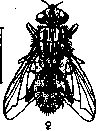
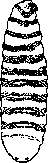
Figure 2. Larva
flies found in the human body by the presence on the body segments of broad bands of small spines, which are clearly visible only under low magnification (see figure 2). First-stage larvae have 3 curved hooks on the head segment, while second- and third-stage larvae have 2 hooks each. The size of the adult larva is 14-16 mm. Pupation occurs in the ground; the false cocoon of the Wohlfahrt fly is easily recognized by the presence of spines on the surface. The pupal stage lasts 12-17 days. Within the USSR, there are several species of the Wohlfahrt fly, of which only Wohlfahrtia magnifica Schin. is known as a parasite of animals and humans. - Control measures. The Wohlfahrt fly deposits larvae mainly in the wounds of domestic animals; consequently, control measures should be reduced predominantly to the destruction of fly larvae in wounds.
Related articles
Mentioned in
Cite this page
“Wohlfahrt Fly.” Soviet Medical Encyclopedia. English translation of Bolshaya Meditsinskaya Entsiklopediya, 1st ed. (Moscow, 1928–1936), ed. N. A. Semashko. https://sovietmedicalencyclopedia.pages.dev/article/wohlfahrt-fly/