Metastrongylus elongatus
Historical document, translated for reference. It reflects medical knowledge of the 1920s–30s and is not medical advice.
Summary
Metastrongylus elongatus is a parasitic roundworm that primarily infects the respiratory tract of pigs, with rare, incidental cases reported in humans. The article details its life cycle, which requires earthworms as intermediate hosts, and discusses the clinical presentation in animals and theoretical transmission routes for humans.
Encyclopedia article (1928–1936)
Metastrongylus elongatus (Dujardin, 1845), a roundworm of the family Metastrongylidae, parasitizing the trachea and bronchi of pigs, but capable of facultatively parasitizing the same organs in humans. The male is 11 to 25 mm in length with a width of 0.16–0.225 mm (see figure). The esophagus is 0.5–0.85 cm in length with a maximum width of 0.081–0.084 mm. The nerve ring is at a distance of 0.31 mm from the head end. The spicules are on average 4.0–4.2–5.0 mm in length with a width of 0.01 mm. The distal end of the spicule bears a pointed hook, curved like a fishhook. The female is 20–50 mm in length and 0.4–0.5 mm in width. The length of the esophagus is 0.63–0.77 mm with a width of 0.27 mm. The anus is located at a distance of 0.033–0.09 mm from the tail end. The vulva is directly near the anus. The eggs are on average 0.050–0.060 x 0.032–0.036 mm in size; inside is a larva. The biology, deciphered by Hobmaier and Schwarz (Hobmaier, 1929; Schwarz, 1930), boils down to the following: the eggs laid by the female in the lumen of the respiratory tract are coughed out into the external environment (in animals, they are swallowed and pass through the entire digestive tract), where, in the presence of moisture, a larva hatches from the egg, capable of maintaining viability for a long period of time. For further development, an intermediate host is necessary, which are earthworms that ingest these larvae. The latter settle in the internal organs of the earthworms, undergoing molting in their bodies. Pigs become infected with the parasites when, rooting in the ground,
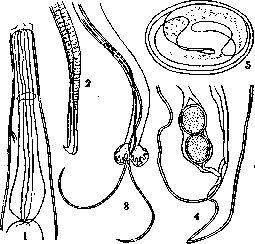
Metastrongylus elongatus: 1—head end; 2—end of spicule; 3—bursa of the male with spicules; 4—tail end of the female; 5—egg with larva.
they devour earthworms infested with M. elongatus larvae. The parasite is a cosmopolitan; it is found quite often in pigs (14–20%). The clinical picture of metastrongylosis has been studied only in animals: the animals lose weight significantly, cough, and a mucous discharge is secreted from the nasal openings; in the presence of an intense infestation, a picture of severe catarrhal pneumonia develops, often ending in death. Young animals suffer particularly, among which entire epizootics are observed with a high percentage of mortality (30–40%). The clinical picture of human metastrongylosis has not yet been studied, as this parasite has so far been registered only by pathologists during autopsies. In humans, the first case of metastrongylosis was described by Jortsits (1845; Germany), who found many specimens of this species in the lungs of a six-year-old boy. A case of extracting this parasite from the human trachea and larynx has been described. In the USSR, the only case so far has been noted by V. A. Kosarev, which Skryabin and Shults (1930) interpret as metastrongylosis. Human infection, according to Hobmaier (1929), can occur through the accidental ingestion of vegetables containing earthworms. Skryabin considers this method of infection to be too unlikely and believes that the only possibility of human infection with metastrongylosis arises if a fisherman, while baiting a fishhook with an earthworm, contaminates his fingers during this procedure with the leaking internal organs of the earthworm containing metastrongylid larvae. If, without washing his hands, the fisherman starts eating, the penetration of the parasite larvae is possible, first per os, and then hematogenously into the lungs. Prophylaxis: caution when handling earthworms. Therapy has not yet been developed.
Related articles
Cite this page
“Metastrongylus elongatus.” Soviet Medical Encyclopedia. English translation of Bolshaya Meditsinskaya Entsiklopediya, 1st ed. (Moscow, 1928–1936), ed. N. A. Semashko. https://sovietmedicalencyclopedia.pages.dev/article/metastrongylus-elongatus/