Whipworm
Historical document, translated for reference. It reflects medical knowledge of the 1920s–30s and is not medical advice.
Summary
This article from the 1928–1936 Soviet medical encyclopedia details the whipworm (Trichocephalus trichiurus), describing its anatomy, life cycle, pathogenesis, clinical symptoms, and treatment methods.
Encyclopedia article (1928–1936)
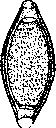
WHIPWORM, a trichinellid, Trichocephalus trichiurus (L. 1771), synonyms: Trichuris trichiura, Trichocephalus dispar. It belongs to roundworms, family Trichocephalidae Baird 1853. It parasitizes humans and some anthropoid apes in the cecum, often also in other parts of the large intestines, less frequently in the lower part of the small intestine. It is one of the most common parasitic worms of humans; it occurs everywhere, especially frequently in more southern regions (for example, in Odessa, in some points of Armenia and Azerbaijan, the invasion of W. reaches 100%). The anterior part of the whipworm's body is long (about 3/5 of the length of the whole body), thread-like; the posterior part is significantly thicker and shorter. The anal opening is at the posterior end of the body in both sexes. The male is 4.0–4.5 cm in length, equipped with a spicule (2.5 mm) lying in the vagina, armed with spines; the posterior end of the body is spirally twisted (see Figure 1 B). The female (see Figure 1 A) is 4.5–5.0 cm in length, with a slightly bent posterior end of the body; the vaginal opening is at the boundary between the anterior small and posterior large parts of the body. The egg is 0.045–0.05 mm in length and 0.023 mm in width, barrel-shaped, with a thick, shiny brown shell; both poles of the egg seem to be plugged with colorless plugs (see Figure 2). The development cycle of W. has no intermediate host. Eggs, excreted by the female in the host's intestine, are excreted to the outside with feces in an immature state and mature in the external environment in different periods of time, depending on temperature conditions and humidity, after which only 15:>
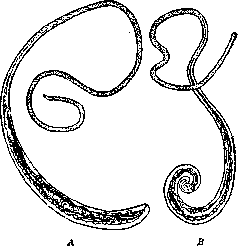
Figure 1.
and become invasive; eggs possess great resistance and can preserve viability for a long time. Humans become infected by swallowing mature eggs, mainly together with unwashed raw vegetables, with raw contaminated water. Mechanical disseminators of the invasion can also be flies. Fixation of the parasite occurs via the thin anterior end, with which W., like a thread, pierces the mucosal wall of the host's intestine, sometimes penetrating even into its muscular part, and attaches so firmly that on fresh cadaveric material it is often extracted with difficulty. Invasion of W. is accompanied by disruption of the epithelium of the intestinal mucosa and leads to patho-anatomical changes in the surrounding tissue. W. apparently feeds on the host's blood. By disrupting the integrity of the intestinal mucosa, W. can, on the one hand, cause bleeding (in strong invasion sometimes significant), and on the other--contribute to the invasion of the intestinal microflora into its wall and thereby cause local inflammatory processes (typhlitis, appendicitis, etc.), and possibly also general infectious diseases; for example, French authors attach great importance to the role of W. in the epidemiology of acute infectious diseases, especially typhoid fever. Finally, the whipworm possesses significant toxic action, which, mainly, explains the phenomena observed in trichocephalosis. The clinical picture in trichocephalosis depends to a large extent on the intensity of the invasion. Thus, single specimens may not influence the general condition of the host at all, while hundreds (and all the more thousands) of specimens can sometimes lead to a fatal outcome. Trichocephalosis can give a different picture of the disease with a predominant effect on 1) the digestive tract, 2) the nervous system, and 3) the blood. Combinational forms of the disease are often observed. 1. Symptoms of the disease of the digestive tract may include constipation, diarrhea, or a change of constipation and diarrhea. In rare cases, diarrhea is accompanied by minor bleeding, and feces sometimes give a positive reaction for blood. The disease can sometimes be accompanied by significant fever, bringing the patient to severe exhaustion. Rare cases of death have been described. Also observed are indistinct, sometimes very sharp abdominal pains, nausea; finally, there can be symptoms of appendicitis and typhlitis. 2. Symptoms of the disease of the nervous system can be observed from the lightest, such as irritability, insomnia, dizziness, headaches, palpitations, to the most severe, for example, fainting states, epileptoid attacks, aphonia, pareses, various meningeal phenomena, up to a fatal outcome in the phenomena of meningitis. 3. The disease can acquire the character of malignant anemia both in the general clinical picture and in the blood picture. Sometimes, with a timely diagnosis and antihelminthic therapy, the disease can end in recovery. Severe cases of trichocephalosis are observed relatively rarely; this disease more often proceeds without sharp clinical symptoms.
Diagnosis is easily made by the discovery of W. eggs in the feces. Treatment must be prolonged and persistent, since the method of fixation of W. makes it difficult for medicinal substances to reach it. Among old remedies, the most reliable is thymol. Shcherbak recommends 1.0–2.0 g of thymol, well ground into powder (preferably in gelatin capsules); take once a day on an empty stomach, washed down with 2–3 glasses of hot water or tea, for a week in a row. If eggs are still found in the feces, a monthly break is necessary before prescribing a new course. Treatment sometimes has to be carried out for a year. Treatment with thymol can be combined with benzene enemas, which can be prescribed for several days in a row if they do not cause irritation phenomena of the intestine. In a bottle with 1 liter of water, add a spoonful of benzene and shake thoroughly. The part of the benzene remaining after mixing on the surface of the water is poured off. The water saturated with benzene is used for the enema. During treatment with thymol, fats and spirits must be excluded from the diet. A contraindication is disease of the urinary tract. Recently, the Russian arsenical preparation Osarsol (Pod'yapol'skaya and Medvedeva-Kobrinets) is applied with fairly good results, 0.25–0.5 g three to four tablets a day, between meals, for four days in a row. Osarsol can be given with methylene blue (0.15 g three times a day after meals). At the end of the course of treatment, a laxative (except calomel) is given for two days in a row.
Personal prophylaxis should consist of observing cleanliness and neatness, abstaining from eating unwashed vegetables, drinking contaminated water, protecting food products from flies, etc. Public prophylaxis should consist of sanitary education of the population, regulation of water supply, arrangement of sewage, protection of water bodies from drainage from latrines and cesspools, arrangement of rational latrines, and the fight against flies.
Related articles
Mentioned in
Cite this page
“Whipworm.” Soviet Medical Encyclopedia. English translation of Bolshaya Meditsinskaya Entsiklopediya, 1st ed. (Moscow, 1928–1936), ed. N. A. Semashko. https://sovietmedicalencyclopedia.pages.dev/article/whipworm/