Pharmacy
Historical document, translated for reference. It reflects medical knowledge of the 1920s–30s and is not medical advice.
Summary
Pharmacy is an institution for the storage, preparation, and dispensing of medications. This article traces the historical development of pharmacies in Russia from the 16th century through the Soviet era, including their transformation from private enterprises to state-owned establishments.
Encyclopedia article (1928–1936)
Pharmacy (from the Greek apotheke - storage), an institution for the storage, preparation, and dispensing of medications. In ancient times, healing and the preparation of medications were carried out by the same persons; however, indications of the existence of independent pharmacies appear even before the Christian era. In Russia, medical-pharmaceutical affairs received their initial development under Ivan IV. The first pharmacy was established in 1581 by an English traveler who brought with him 160 foreign remedies, which at that time was an exceptionally large assortment of medications. These remedies, 'suitable for the great sovereign,' were used only by the tsar, his family, and the court. The people used remedies from 'green and fumigating' shops. Under Alexis Mikhailovich, two state pharmacies were established - in Moscow (1672), and then in Vologda. In 1701, Peter I for the first time permitted the opening of 8 private pharmacies, establishing the pharmacy privilege (see). In 1721, the decree on the opening of private pharmacies was extended to other cities. In the first half of the 18th century, there were 14 pharmacies in Moscow. Gradually the number of pharmacies increased; the growth in the number of private pharmacies in Russia is as follows: in 1843 - 1,302; 1866 - 1,582; 1878 - 1,860; 1886 - 2,766; 1895 - 3,133; 1900 - 3,452; 1904 - 3,757; 1910 - 4,523 (for the number of pharmacies in the USSR see Pharmacy network). All pharmacy activities were strictly regulated by law in the form of special Pharmacy statutes (the first in 1790). Pharmacists were engaged in cultivating and collecting medicinal herbs, drying and processing them, manufacturing many chemical products and complex pharmaceutical preparations. Up to the 20th century, pharmacists were also almost the only analysts to whom all chemical and forensic-medical analyses were entrusted (especially in the provinces). However, already from the second half of the 19th century, a number of factors emerged that undermined the prestige and monopoly role of the pharmacy. From the 1860s abroad, rapid development of large-scale pharmaceutical industry began, which began to manufacture medications and preparations by factory (cheaper) methods. For the cultivation and collection of medicinal plants, large firms also began to be organized. With the emergence of zemstvo medicine in Russia, the free and reduced-cost dispensing of medications from zemstvo pharmacies began. To circumvent the restrictive pharmacy privilege, surrogates for pharmacies appeared - pharmacy stores (see), competing with pharmacies. The economic foundations of the old pharmacy thus began to fluctuate. Pharmacies, which arose on a monopoly system, being surrounded by competitors, were no longer able to adapt to the new conditions. Their owners united and waged an energetic struggle to defend their privileges against free trade in pharmaceutical goods, against the rights of zemstvos and cities to provide free medical assistance, against the opening of new pharmacies, against the emergence and development of pharmaceutical factories and plants, etc. Russia was consequently flooded with chemical and pharmaceutical products of German and French production, and pharmacists became simply their resellers. Pharmacies, which had been laboratories from which many scientific discoveries had once emerged, turned into a place for petty buying and selling. The quality of dispensed medications deteriorated. Pharmacies, especially in the provinces, also began to widely engage in giving medical advice. Privileges for opening pharmacies were issued without any system and were resold for enormous sums. Unfavorable material and moral conditions of labor and life forced pharmacy employees to seek protection for their interests in professional associations. In the 1880s, the first attempt to form societies of pharmaceutical employees arose, which, along with defending their economic interests, also put forward the slogan about the proper development and rationalization of pharmaceutical assistance. First and foremost, demands were made for the abolition of the pharmacy monopoly, and then (in 1905) the slogan of municipalization of pharmacies was put forward. In 1912, a law granting local self-governments preferential rights to open pharmacies de facto was passed through the State Duma. After the October Revolution, organizations of pharmaceutical employees, on their own initiative, began to implement the idea of nationalizing pharmacies in practice. On the basis of a decree of the Council of People's Commissars of December 28, 1918, all pharmacies in the USSR passed into state ownership. The expulsion of private capital gave pharmacies a completely new direction, and they ceased to serve as a means of enrichment and profit-making. Pharmacy became an organic part of the medical-sanitary network; the distinction between the so-called free and hospital pharmacies disappeared, and the division of pharmacies into urban, rural, and others, with varying quality of work, was discontinued. The process of gradually replacing the artisanal method of preparing dosage forms with technically more advanced ones (mechanization of prescription preparation, mass preparation) received free development. The rationalization of the medication catalog began. When transitioning to the new economic policy, pharmacies were transferred to a business accounting basis (1921-23), but the lack of material means did not make it possible to restore all pharmacies immediately; therefore, some of them were leased. Permission was even given for the opening of new pharmacies by private individuals. But the state pharmacy very soon overcame these difficulties and completely eliminated private capital. In the USSR today, there are two types of pharmacies: hospital and non-hospital. Hospital pharmacies are located at hospitals, outpatient clinics, and other medical institutions, are maintained on state or local budgets, and serve free of charge both the institutions they are attached to and the rest of the population. Non-hospital pharmacies dispense medications by prescription from physicians for a fee and operate on a business accounting basis. In most places, especially in cities and factory-plant districts, service with free medication assistance for insured and equivalent groups is provided from pharmacies operating on a business accounting basis, at the expense of health authorities. Of the 38 million prescriptions dispensed in 1925 from pharmacies operating on a business accounting basis, 25 million were dispensed to insured and equivalent groups. In view of this, pharmacies at non-stationary medical institutions are being liquidated, and service of the population is transferred to pharmacies operating on a business accounting basis. The latter are mostly under the jurisdiction of pharmacy administrations (see), have independent budgets, and are managed by the head of the pharmacy, appointed by the pharmacy administration and approved by the health department. The arrangement of pharmacies and the order of their functioning are provided for in all states by special laws. In the USSR, pharmacy activities are regulated by the People's Commissariat of Health.-According to existing rules, a pharmacy must be arranged in a bright, dry, high room and located on one floor (not higher than the second); a pharmacy consists of the following rooms: 1) reception room for receiving prescriptions
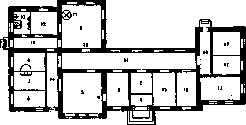
Pharmacy plan: 1-vestibule; 2-hallway; 3-reception room; 4-transfer window; 5-prescription room; 6-room for employees; 7-office; 8-washing room; 9-material room; 10-transfer window; 11-entrance to basement; 12-unpacking room; 13-restrooms; 14-corridors; 15-office; 16-duty room; 17-apartment of the manager.
and dispensing medications; the reception room must have, in addition to appropriate furniture for visitors, addresses of medical institutions, a table of emergency aid and antidotes, a box for applications, and a clock; the reception room should also be used for sanitary-educational exhibitions, posters, and slogans; 2) prescription room-for preparing medications; 3) material room-for storing supplies of medicines and other materials; 4) cooking room and washroom-for cooking medicines, preparing utensils, and other similar work; 5) room for duty personnel; 6) basement, ice cellar, and shed. A pharmacy must be supplied with a sufficient quantity of medicines according to the minimum list, which includes 300 preparations and 8 sterile solutions in ampoules, and with hygiene items and patient care supplies according to a special list containing 50 items. A minimum list of instruments for the assistant has been established, as well as a list of instruments and reagents for chemical control of prepared medicines. A reference library for the pharmacy has also been standardized (10 books). In storing, checking, and dispensing medicines, the pharmacy is guided by the state pharmacopoeia (see). The physician should also be guided by it when prescribing medicines. The pharmacy must also dispense necessary medicines at night. In some cities, only duty pharmacies operate at night. Dispensing of medicines. Medicines from a pharmacy are dispensed on prescriptions from physicians and other medical personnel, on copies of prescriptions, as well as on written and oral requests from all citizens. For dispensing poisonous and potent substances on physician prescriptions, there are special rules (see Prescription). On requests from all citizens, all medicines that do not contain poisonous or potent substances in their composition may be dispensed. As an exception to this rule, provincial health departments are authorized to issue lists of the most commonly used potent substances in the given locality that are dispensed from pharmacies without a physician's prescription. Dispensing of poisonous and potent substances for technical purposes is carried out according to special rules. In order to combat pharmacy charlatanism in the USSR, pharmacies are prohibited from dispensing means with the name of the disease for which these means are prescribed (tooth drops, tablets for headache, etc.), preparing medicines at the discretion of the pharmacist (exception-first aid), and dispensing medicines according to special prescriptions without indicating the composition. Payment for dispensed medicines is regulated by the pharmacy tariff (see), periodically issued by the People's Commissariat of Health. The right to work in pharmacies is enjoyed by persons holding pharmaceutical titles and trained in higher and secondary pharmaceutical educational institutions (see Pharmacy personnel). For guidance, control, and management of pharmacy affairs, there is a pharmaceutical department in the Medical Administration of the People's Commissariat of Health, and pharmaceutical departments in local health departments. Pharmacies are periodically inspected, during which their business activities and work order, as well as the quality of medicines dispensed, are checked. (On the rules for storage and control of medicinal substances-see Medicines, on homeopathic pharmacies-see Homeopathy.)
I. Levinstein. PHARMACY TARIFF, a guide for evaluating medicines dispensed from pharmacies on physician prescriptions. The P.T. consists of four parts: 1) introduction, which states the principles for compiling the tariff, 2) evaluation of medicinal substances included in medicines, 3) evaluation of containers, and 4) evaluation of labor processes in the preparation and dispensing of medicines. In Russia, the first P.T. was published in 1789, the last complete P.T. was published in 1911. The current tariff in the RSFSR was published by the People's Commissariat of Health of the RSFSR in 1926. Unlike the pre-war tariff, the current one does not charge for dispensing "simplicia" (simple medicines that do not require preparation in pharmacies). The tariff in the RSFSR is maximum, and pharmacies are not allowed to sell above its prices. On the territory of other union republics, tariffs published by the respective people's commissariats of health of the union republics are in effect. When dispensing medicines to insured and equivalent groups at the expense of health authorities, the P.T. is not applied. This dispensing, which accounts for up to 66% of all pharmacy prescriptions, is carried out according to an order of the People's Commissariat of Health at cost price. The average cost of such a prescription (in the RSFSR) for 1925/26 was 24 k.
Related articles
Mentioned in
Cite this page
“Pharmacy.” Soviet Medical Encyclopedia. English translation of Bolshaya Meditsinskaya Entsiklopediya, 1st ed. (Moscow, 1928–1936), ed. N. A. Semashko. https://sovietmedicalencyclopedia.pages.dev/article/pharmacy/