Dispensary
Historical document, translated for reference. It reflects medical knowledge of the 1920s–30s and is not medical advice.
Summary
A Soviet medical institution that provides comprehensive healthcare to outpatients, studying their living and working conditions to apply both individual treatment and social therapy measures.
Encyclopedia article (1928–1936)
DISPENSARY (from the English dispensary - a poorhouse, French dispensaire - a charitable pharmacy), a medical-sanitary institution (for outpatients) which in the USSR sets as its task, in addition to thorough investigation of the patient who has sought help, detailed study of the conditions of their domestic life and labor, and in connection with this, applies not only individual drug therapy but also strives to influence the improvement of living and working conditions of the sick, as well as conducts extensive health education work. -- Characteristic features of the structure of a D. are: the presence of medical investigative personnel who study on-site the working conditions and domestic life of the patient (and their family); the presence of qualified assistance both for the purpose of thorough diagnosis and therapy, and finally, most importantly, the presence of public organization, which makes it possible to implement social therapy measures (improvement of housing conditions, nutrition conditions, change of workplace, improvement of home environment, etc.). With more expanded activities, a D. sets as its task the active detection of patients with early forms through mass examinations among certain population groups (infants, schoolchildren, adolescent workers, workers of specific professions, etc.) or residents of a particular area served by this D., thereby taking 'health' of the population under account and observing through repeated periodic examinations changes in physical development and health status of various population groups (see Dispensarization). The originator of the D. can be considered the poorhouses (dispensary) that arose in the XVIII century in England, created by charitable societies. Their appearance was facilitated by the sharp increase in urban population as a result of the industrial revolution, accompanied by the rapid proletarianization of peasants and artisans. On the other hand, the creation of D. was pushed by the humane ideas of the still revolutionary bourgeoisie of the XVIII century, represented by J.J. Rousseau, who called for participation in the fate of all the destitute and suffering. At the same time, advanced figures in England (Lind, Pringle, Pereival) proclaimed a new understanding of the tasks of fighting diseases not only through individual treatment, but mainly through broad health measures (see Healthcare). The first D. served only the indigent citizens, from whom proof of poverty was required; lady patrons, visiting the poor dwellings of these patients, determined the nature of their needs on-site. The charitable organizations themselves set as their task to help with medicines, to isolate the sick if necessary, to supply the patient with fuel, warm clothing, better food, etc. DISPENSARY
SOO
29» It is interesting to note that in Russia itself at the very beginning of the XIX century (not without the influence of English D.), 'Dispensaries for the Poor' arose in Petersburg on the initiative of the Medico-Philanthropic Committee (1804). They set as their task to help not only those who had fallen into poverty among serving people and the burghers, but also, which was particularly emphasized, the numerous artisans and peasants coming to the capital for work, among whom various diseases had taken root. According to surviving reports, these dispensaries also provided medical assistance in the hospital and at home, ensured 'visitors' (sisters of mercy), set as their task health education propaganda and even sought to study the influence of the environment on the occurrence of diseases. All these D. of the late XVIII century and first half of the XIX century served patients with all sorts of diseases in this direction. However, these institutions, unstable and shaky due to their dependence on the will and whim of the philanthropist, could not take deep root; and the humiliating nature of the service itself (proof of poverty) repelled from the dispensaries the classes most in need of them - primarily the proletarian masses afflicted with illness. Therefore, the development of the workers' movement as workers became aware of their position and rights, especially during the period of radicalization of trade unions (1887-95), led in England to the creation of a new type of D. specifically for fighting proletarian disease-tuberculosis. It was founded by R. Philips in 1887 in Edinburgh (Scotland). The R. Philips dispensary is connected with all treatment and care institutions of the district, provides social assistance to the sick with tuberculosis, to which private charity is attracted, and to some extent local self-government also participates. Sisters of social assistance visit the patient at home and take measures for the hygienic education of the patient themselves, their family, and improvement of the home environment. Factories and other industrial institutions, due to the conditions of the capitalist state, remain outside the sphere of study and influence by both English D. and the French one, which arose somewhat later. -- The founder of the French type of D. is Calmet, who in 1901 in Lille, the center of the textile industry, established the Dispensaire de prophylaxie sociale antituberculeuse. In Calmet's D., they recognize the disease, make an accurate diagnosis, visit the patient at home, take special pains for their hygienic education, supply beds, spittoons, provide assistance with additional nutrition, sometimes with referral to a dacha. Treatment, however, these D. do not engage in, leaving it (due to the characteristic in France of doctors' opposition to the introduction of social insurance) to private medical practice. -- In Germany, anti-tuberculosis D. appeared only after 1903 in connection with the discovered shortcomings in the fight against tuberculosis through sanatorium treatment, although the very idea of social care for tuberculosis patients (Fiirsorge) was partially implemented in Germany earlier. Here, the D. also retains predominantly a diagnostic-consultative character (Beratungsstelle), without applying treatment methods at its institution. A. Fournier in 1902 at the Brussels congress put forward the idea of organizing D. for the fight against venereal diseases; built on the same principles as anti-tuberculosis D. The growth of D. until the war of 1914 went, however, extremely slowly. After the imperialist
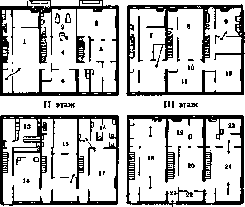
Lower floor
1st floor
Plan of a health center in New York (type of general dispensary): 1-charitable organization committee; 2-dental department; 3-other departments; 4-waiting room; 5-disease prevention department; 6-eye diseases department; 7-general assistance committee of charitable organizations; 8-home care department; 9-receptionist; 10-American Christian Youth Union; 11-Women's Union; 12-office work; 13-diet kitchen; 14-milk preparation and child consultation; 15-consultation for infants and mothers; 16-restrooms; 17-additional room for the tuberculosis department; 18-meeting hall; 19-psychiatrists' offices; 20-registration; 21-main entrance; 22-information; 23-doctors' offices; 24-waiting room for tuberculosis patients. After the war, due to the worsening position of the proletariat and thanks to the revolutionary upsurge of the workers' movement, European governments were forced in the first years after the Versailles peace to embark on the path of social reforms in the field of health protection, and the number of D. began to grow. This was particularly facilitated by American aid, which began its intervention in European affairs through the path of 'humanitarian intervention' and in particular through the Rockefeller Foundation and the American Red Cross, whose funds poured in a broad wave into France, Czechoslovakia, Poland, Belgium and other countries for the establishment of D. of all types. In the U.S.A., mainly on the initiative of the Red Cross, life insurance societies and individual philanthropic organizations, by this time in the field of dispensary construction, they began to organize 'general' D. (so-called health centers, centres de sante), which set as their task the unification of investigative work and the coordination of measures of social assistance. Numerous D. have been created, in which under one roof are located consultations for pregnant women, for infants, for child health protection, D. for fighting tbc, venereal diseases, alcoholism, for psychogenic hygiene, etc. (see illustration). Here, space is also allocated for representatives of charitable and public organizations financing this 'health center'. These 'health centers' widely promote and conduct periodic medical examinations of their subscribers (paying up to 20 dollars a year) or persons for whom payment is made on appropriate contractual terms by life insurance societies, factory managements, and other institutions. In England, there is a growing tendency to include hospitals in these 'health centers'. The development of the 'general D.' (osrodki zdrowia) in Poland is of particular interest to us, a country whose sanitary condition is close to our conditions. In recent years, several dozen general dispensaries have been created here, i.e., those that unite 3 or more D. (6 of them in Warsaw). In addition to the diseases mentioned above, they strive to serve the goals of fighting malaria, trachoma, sometimes concentrate sanitary organization around themselves and organize vaccination work. In Russia, in the field of fighting tbc, the features of D. were borne by the outpatient-supervision clinics founded by the Anti-Tuberculosis League (1911-13), which functioned either as independent institutions or being connected in one form or another with the existing medical institutions in the given locality. They provided for the presence of nurse-investigators ('supervisory sisters'), sanitary-educational work, treatment, social assistance, and a network of auxiliary institutions. Dispensary methods of work in the field of venereal diseases were first applied in Russia by Glavche in the polyclinic he founded in Odessa. The dispensary movement in Russia itself did not and could not take on a broad character due to the autocratic-police system. Only after the October Revolution did a network of D. begin to develop, primarily in the field of fighting tbc and venereal diseases (see). In recent years, dispensary methods of work are beginning to be gradually applied by the entire network of medical-sanitary institutions, and there is a tendency to create in this way a unified D. This latter is conceived as a polyclinic-type consultation, connected on the one hand with medical posts at enterprises and with the organization of home care, and on the other hand with a whole range of auxiliary treatment and preventive institutions, including those of a stationary type (see Dispensarization). Under the conditions of the Soviet state, D. becomes on the one hand a center for the development of proletarian public activity, developing broad and diverse initiative (through health sections, social assistance councils or commissions for improving labor and living conditions, commissions for labor protection and health cells), and on the other hand an institution closely united and relying on the entire system of Soviet construction (departments of labor, municipal services, insurance funds, trade unions, cooperatives, etc.). Thus it becomes capable of carrying out such measures of social therapy as improving and changing working conditions, replacing harmful and heavy work for a given person with healthier and less heavy work, improving housing conditions, improving nutrition, providing additional leave, etc. And if the social therapy of the Soviet D. is limited in scope by the temporary lack of material resources, then bourgeois society is quite unable to carry out such extensive social therapy, because in this case it would have to encroach on its own existence, abandon capitalist rationalization. Therefore, it is understandable that the organization of D. abroad does not have a systematic and planned character. All initiatives in this regard must be considered as separate experiments, and moreover, in most cases, confined to the narrow circle of initiative and possibilities of private charity. The state and local self-government bodies little strive for the broad development of these forms of social-preventive assistance, embarking on them only under political pressure and at the first opportunity curbing them. D. are established abroad mainly by charitable societies, various leagues for fighting tbc, venereal diseases, alcoholism, life insurance societies, and even by private individuals, partly by insurance and professional organizations. To provide social assistance at D., special committees are created, which include representatives of bourgeois charitable societies, clergy, the Christian Youth Union, and in very rare cases representatives of workers' organizations. The medical circles view the development of D. unfavorably, fearing and seeing in them a competitor to their private practice. Under their influence, tendencies are emerging to give D. and even 'health centers' in the U.S.A. the function of auxiliary institutions for practicing physicians, performing for them all sorts of special research methods, and making them a kind of intermediate link for attracting sick and practically healthy persons to private treatment offices, which already carry out further treatment. As a result, D. in a capitalist state remains only a point of application of individual charity and supervisory guardianship over individual 'indigent' patients (this tendency is particularly vivid in France). Those institutions that are intended to serve the proletariat almost exclusively perform diagnostic functions, and even for this narrow purpose they are inadequately equipped, do not have corresponding specialists, and the conditions for using them are extremely limited (rare and very brief consultations). In the matter of improving labor and living conditions for the proletariat, only the Soviet D. carries out work developed in all directions (For characteristics and forms of activity of the Soviet D. in individual fields-see Venereal diseases, Psychogenic hygiene, Health protection of children, Occupational diseases, Tuberculosis.)
Related articles
Mentioned in
Cite this page
“Dispensary.” Soviet Medical Encyclopedia. English translation of Bolshaya Meditsinskaya Entsiklopediya, 1st ed. (Moscow, 1928–1936), ed. N. A. Semashko. https://sovietmedicalencyclopedia.pages.dev/article/dispensary/