Belgium
Historical document, translated for reference. It reflects medical knowledge of the 1920s–30s and is not medical advice.
Summary
This article provides demographic statistics for Belgium as of the mid-1920s, detailing population density, gender distribution, and the impact of the First World War on birth and death rates.
Encyclopedia article (1928–1936)
BELGIUM. Area—30,444 sq. km, population (as of December 31, 1925)—7,811,876 people, of which 3,859,600 were men and 3,952,276 were women; population density—257 persons per sq. km (the highest of all states). As of December 31, 1913, the population of Belgium was 7,638,757 people, of which 3,790,319 were men and 3,848,438 were women. The slow growth of the population of Belgium is explained by losses during the war (1914–1918). The natural movement of the population is expressed in the following figures (per 1,000 people): Years 1901–05 (avg. per year), 1906–10 (avg. per year), 1912... [table data: birth rates, death rates, and natural increase rates for the period 1912–1925]. During the war, the birth rate dropped sharply, and the death rate rose significantly. The lowest birth rate and the highest death rate were observed in 1918. If one summarizes the decrease in population due to the decline in the birth rate, the increase in the death rate, emigration, and losses at the front (about 35,000 people per year), then the total losses over 7 years amount to about 560,000 people.
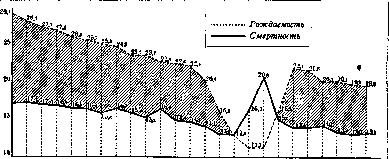
Birth rate and mortality in Belgium for 1901-1925 (per 1,000 people). Birth rate. In 1925, out of 160,954 total births, there were 6,656 stillbirths, or 3.49 per 100 births. Of the 154,298 live births, there were 78,779 boys and 75,519 girls. The birth rate is distributed fairly evenly throughout the months of the year and does not show sharp seasonal fluctuations. - Mortality. Seasonal mortality also does not show sharp fluctuations. The lowest mortality figures are observed in the summer-autumn period, higher ones in the winter-spring period. - Infant mortality. Per 100 births, deaths under the age of 1 year were: in 1921—11.53, in 1922—10.70, in 1923—9.31, in 1924—8.88, in 1925—10.00. Mortality by cause. Population distribution (by census by age). Age groups: Men, Women, Total, % of sum. Under 1 year... 76,813 (men), 74,280 (women), 151,093 (total), 2.0 (%). 1 to 5 years... 183,253, 179,519, 362,772, 4.9 (%). 5 to 15 years... 669,760, 665,925, 1,335,685, 18.0 (%). 15 to 20 years... 364,161, 363,494, 727,655, 9.8 (%). 20 to 40 years... 1,172,853, 1,206,492, 2,379,345, 32.2 (%). 40 to 60 years... 833,180, 857,794, 1,690,974, 22.8 (%). Older than 60 years... 344,968, 413,807, 758,775, 10.3 (%). Total... 100.0. Mortality from three infections (smallpox, typhoid fever, diphtheria), starting from 1871, is presented in the following absolute figures (on average per year): Years: 1871-80 (Smallpox 49, Typhoid 2,807, Diphtheria 4,761), 1881-90 (Smallpox 49, Typhoid 4,216, Diphtheria 2,438), 1891-1900 (Smallpox 38, Typhoid 1,501, Diphtheria 1,153), 1901-05 (Typhoid 916, Diphtheria 1,076), 1906-10 (Typhoid 768, Diphtheria 924), 1911-13 (Typhoid 583, Diphtheria 818), 1919-20 (Typhoid 696, Diphtheria 250). These figures indicate a steady decline in mortality from the three specified infections. The main causes of death for 1924 and 1925 were as follows (absolute figures): Cause of death: Typhoid and paratyphoid (1924: 271, 1925: 82), Smallpox (1924: 16, 1925: 874), Measles (1924: 534, 1925: 175), Scarlet fever (1924: 149, 1925: 306), Diphtheria (1924: 259, 1925: 300), Whooping cough (1924: 924, 1925: 1,056), Influenza (1924: 103, 1925: 1,493), TB of respiratory tract (1924: 420, 1925: 864), TB of central nervous system (1924: 818, 1925: 1,486), TB of other organs (1924: 696, 1925: 323), Epidemic cerebrospinal meningitis (1924: 250, 1925: 87), Tetanus (1924: 82, 1925: 63), Cancer and other malignant tumors (1924: 874, 1925: 1,036), Heart disease (1924: 175, 1925: 1,496), Alcoholism (1924: 306, 1925: 5), Postpartum diseases (1924: 300, 1925: 5), Old age (1924: 1,056, 1925: 1,252). No cases of relapsing fever were registered during the period 1919-26. Health organization. By the law of December 16, 1921, the Ministry of the Interior was renamed the Ministry of the Interior and Hygiene. At the head of healthcare (Directorate of Health and Public Hygiene) is the Secretary General of the Ministry (currently M. O. Velghe). Attached to the Directorate of Health and under its jurisdiction are: 1. Royal Academy of Medicine. Exists since 1841, consists of 40 members appointed by the King. Divided into sections: a) individual and group hygiene, b) prevention of venereal diseases, c) prevention of tuberculosis, d) food hygiene, e) hygiene of dwellings and populated areas, f) industrial and occupational hygiene. 2. Supreme Council of Public Hygiene. By the law of December 30, 1884, its composition was set at 18 members (later expanded to 21). The tasks of the council include: a) study of health issues, b) providing opinions on issues coming to the Ministry of the Interior and Hygiene, in particular: on the prevention and control of epidemics and improvement of sanitary conditions of the population, on projects for the construction of hospitals, on the arrangement and maintenance of industries harmful and dangerous to the population, on the arrangement of workers' housing, on water supply, sewage, arrangement of cemeteries, etc. In the Supreme Council of Hygiene, measures for serving the army are partly combined (the general medical inspector of the army is an ex-officio member). 3. Pharmacopoeia Commission. Task: development of the official pharmacopoeia, as well as providing opinions on pharmaceutical issues. 4. Institute of Sanitary Doctors. Exists since 1845; later it was reorganized and in its present form has been functioning since 1911; there are currently 22 sanitary doctors. 5. Food sanitary inspectors—21 in number. Exist on the basis of the law of August 4, 1890, on the falsification of food products. 6. Pharmaceutical inspection; represented by 4 pharmacists. Task: supervision of pharmacies, apothecary shops and warehouses, and the fight against the falsification of medicines. 7. Sanitary-technical supervision; represented by 4 engineers. Task: to provide opinions on projects of sanitary installations, control over work performed with a state subsidy. These subsidies are provided for by law (in the amount of 1/3 to 1/2 of the cost of the structure). Projects of all structures receiving a subsidy must be submitted for preliminary opinion. 8. Provincial medical commissions. Their members are doctors and pharmacists appointed by the King. Mandatory members, in addition, are: a veterinarian, an engineer, an architect, and the director of the provincial bacteriological laboratory. The task of the commissions is to monitor the implementation of laws and regulations in the field of healthcare, to submit information to the ministry about the appearance of infectious diseases and measures to combat them, to provide preliminary opinions on projects of sanitary installations built with the help of state subsidies, to supervise medical work (checking documents of persons wishing to work in a given province, etc.), etc. 9. Port sanitary commissions. Exist in all port cities (Antwerp, Ostend, Nieuwpoort, and Bruges). The Directorate of Health is closely connected with various national societies that play a large role in the healthcare of Belgium. It influences their work through a system of annual state subsidies. The largest of these societies are: for the construction of water supply facilities, for the protection of the health of children and infants, for the fight against TB, venereal diseases, cancer, etc. Under the jurisdiction of the Directorate of Health are two large scientific and practical institutions: the State Bacteriological Laboratory (in Brussels, since 1907) and the Central Smallpox Bureau (at the Veterinary Institute, since 1882). From the list provided, the main functions of the Directorate of Health are visible: this is the development of legislative proposals, the implementation of sanitary-preventive measures, and the supervision of the implementation of laws in the field of healthcare. All branches of clinical medicine are outside the jurisdiction of the Ministry of the Interior and Hygiene. Sanitary legislation. Communal sanitation. There is no consolidated sanitary legislation, just as there is no general law on combating epidemics: individual laws are scattered in parliamentary decrees and royal decrees. Water supply. The first laws on the protection of water supply sources date back to the 17th century (edict of August 13, 1669, on the protection of water supply sources and forests). Later laws, which mainly boiled down to protection against pollution of rivers and canals, date back to 1865, 1877, 1886, 1889, and subsequent years. In 1907, a law was issued on associations for the construction and operation of water supply facilities. Communes were granted the right to enter into agreements with other communes or provinces for this purpose and to form associations similar to cooperative societies. In 1913, a law was issued on the organization of the State Water Supply Society, also operating as a cooperative society. The state took on half of all shares (2,500 out of 5,000), which in this way influences (through the Ministry of the Interior and Hygiene) the activities of the society; the remaining shares are distributed among the provinces. The tasks of the society include the development of projects for water supply facilities, the construction of these facilities, and their operation. The ultimate goal of the society is the unification of the water supply of all of Belgium. At present, about 40% of the country's population is provided with water supply from water mains. The latter are fed by water from deep wells (wells of the Brussels water supply at a depth of up to 50 m, Liège's—up to 88 m). Only large centers are provided with sewage systems. The housing issue in Belgium is severe. The rapid growth of industrial centers maintains a constant housing crisis. The first laws on urban improvement and the housing issue date back to 1858 and 1867 and are called Expropriation Laws. By these laws, communes were granted the right, for the purpose of improving populated areas, to expropriate land plots and real estate: this gave them the opportunity to demolish a number of buildings in the most crowded quarters and adorn themselves with gardens and parks. Major unrest observed among workers in 1886 and caused to a significant extent by unacceptably poor housing conditions (the opinion of the government commission that investigated the causes of these unrests) resulted in the appearance of the laws of August 9 and October 9, 1889, On Workers' Housing. According to these laws, committees are established in each administrative district, which are entrusted with the duty of arranging hygienic workers' housing and renting or selling them to workers.
In their work, the committees must be connected with provincial medical commissions, and reports on the sanitary condition of dwellings must be submitted to the Ministry. Savings banks must issue loans for workers' housing construction. Thanks to this law, by July 1914, approx. 140,000 dwellings for workers had been built in Belgium (in total, in Belgium by the beginning of the war, there were approx. 1,300,000 dwellings). During the war, about 80,000 residential houses were destroyed in Belgium. After the war, housing construction proceeded along two lines: on one hand, the restoration of destroyed places, and on the other, normal construction. The first task was entrusted to a department specially formed under the Ministry of the Interior (law of April 9, 1919). All houses were restored at the expense of the state. In a number of industrial regions, settlements of the garden-city type were set up. For 'normal' construction, the law of October 11, 1919, on the 'National Society for Cheap Dwellings' was passed, which makes wide use of the support of the state and provinces (a state subsidy in the amount of 1/4 of the construction cost of each new dwelling). By the end of 1922, this society had 190 branches, which in 1 1/2 years had built about 15,000 houses, including 19,000 apartments (in Belgium, as a rule, houses are built as individual ones, i.e., designed for 1 family). Sanitary doctors have the right to declare individual houses unfit for habitation. Thanks to this, they have the opportunity to make demands for the improvement of dwellings. — Food hygiene. The Criminal Code of June 8, 1867, contains articles punishing the falsification of food products. Subsequently, a number of laws (more than 50) were issued on the manufacture, storage, and sale of food products and beverages. In 1891, a special food inspection was created. Special attention is paid to meat products (laws of 1860, 1887, 1901, etc.), in particular, to those imported from other countries. Supervision of them is under the jurisdiction of veterinary doctors. For the analysis of food products, a Central State Laboratory was created (in 1909). Control of contagious diseases. The first law on the control of plague was issued in 1831; in 1843, a sanitary convention was concluded between Belgium and Holland regarding navigation on the river Scheldt, which had the task of protecting borders from the introduction of plague. In 1893, a law on mandatory notification of cholera and regulations for the control of cholera were issued. In 1899, mandatory notification of plague was introduced. In 1910, a port sanitary organization was established. For the control of smallpox, there is a law of April 18, 1818, on optional (for certain groups of the population) vaccination, supplemented by the law of February 4, 1895, on the vaccination of persons working with rags. For the control of rabies, a law was issued on October 29, 1908 (collars and muzzles for dogs and the extermination of stray dogs). By the law of May 31, 1880, the control of contagious diseases is entrusted to provincial and communal medical commissions. At the present time, the control of contagious diseases is presented in the following form. Notification of contagious patients is mandatory with respect to plague, cholera, smallpox, typhus, and relapsing fever. Bacterial examination is performed free of charge either in a provincial laboratory or in the laboratory of a sanitary doctor. Isolation of contagious patients is mandatory either at home or in a hospital (law of March 10, 1925). Disinfection is under the jurisdiction of the sanitary doctor and his assistants. The network of disinfection institutions is quite developed (besides cities, also in communes) thanks to state subsidies for the construction of disinfection facilities. The expenses for their operation are covered partly also by the state, and partly by the commune. Bacterial preparations are manufactured, mainly, by the state bacterial laboratory (the detritus-smallpox department at the veterinary institute); state control of bacterial preparations was introduced by the laws of August 2, 1901, and March 5, 1909. Infectious morbidity in Belgium is not high (see above): plague and cholera have not been observed for a long time; typhus and relapsing fever were noted in isolated cases during the war, in recent years not a single case has been registered; smallpox yields isolated cases. — Control of social diseases. The fight against tuberculosis is conducted, mainly, by three organizations: the National League for the Fight Against Tuberculosis, the National Society for the Fight Against Tuberculosis, and the Society for the Fight Against Childhood Tuberculosis. All of them receive a state subsidy. In 1926, about 100 dispensaries, about 4,000 sanatorium beds, and about 7,000 beds for pre-tuberculous children were concentrated in these societies. A number of tuberculosis institutions are under the jurisdiction of various ministries, as well as provinces and communes. The fight against venereal diseases is concentrated, mainly, in the National Society for the Fight Against Venereal Diseases. According to the law of August 5, 1920, every patient with a venereal disease has the right to free treatment (including RW and salvarsan) from any doctor or in any special institution. There are more than 300 dispensaries and other institutions for the fight against venereal diseases, operating on somewhat different principles than in the USSR (see Dispensary). — Control of cancer diseases. By the law of September 25, 1908, a special commission for the study of cancer was created. Besides this commission, in Belgium there are several societies for the fight against cancer. In Brussels, there is a special cancer institute. Protection of maternity and infancy is concentrated in the National Society for the Protection of Children, under the jurisdiction of which is a network of maternity hospitals, child consultations, nurseries, children's colonies, etc. In total, there are about 2,500 such institutions in Belgium. Sanitary education has been carried out widely in recent times. In particular, hygiene as a mandatory subject is taught in all schools. The health budget, according to the estimate of the Ministry of the Interior and Hygiene for 1925, amounted to 40.1 million francs, of which for subsidies: for sanitary installations - 5 million francs, for water supply - 6 million francs, for child protection - 14 million francs, for the fight against tuberculosis - 7 million francs, for the fight against venereal diseases - 2.3 million francs, for the fight against cancer - 1 million francs, etc. A whole number of branches of healthcare are outside the Ministry of the Interior and Hygiene. Thus, medical institutions (somatic and psychiatric) are under the jurisdiction of the Ministry of Justice, as are maternity hospitals, almshouses, orphanages, and charitable institutions for serving the 'poor'; school sanitary inspection - under the jurisdiction of the Ministry of Education, medical-sanitary service of emigrants - under the jurisdiction of the Ministry of Foreign Affairs (large institutions in Antwerp), transport service - in the Ministry of Transport, colonial service - in the Ministry of Colonies; army service - under the jurisdiction of the military department. Labor protection, which is under the jurisdiction of the Ministry of Labor, deserves special attention. The Institute of Sanitary Inspection was introduced by the law of June 17, 1902 (technical inspection was introduced in 1888). Its functions were clarified in the law of June 25, 1919. At the present time, it works with a staff of a general inspector, 9 regional sanitary inspectors, and 1 inspectress (all doctors). In Brussels, there is a central laboratory of sanitary inspection. The main tasks of the sanitary inspection (law of 1919): study of the physiology and pathology of labor, protection of the labor of women and adolescents, improvement of the sanitary condition of enterprises, and supervision of the execution of mandatory regulations of a sanitary nature. Periodic examination of those working in hazardous industries (lead, mercury) is mandatory, as well as for adolescents - according to the law of 1920 (in 1925, 63,420 adolescents were examined). Among the achievements in the field of the fight against occupational diseases, one should mention the fight against ankylostomiasis. In 1901, a committee was organized to study the degree of prevalence of ankylostomiasis among miners and to develop measures to combat it. An examination of 28,000 underground workers of the Liège coal basin revealed 25% carriers of the ankylostoma. In 1903, a special dispensary was organized in Liège with the tasks: 1) mass examination of all underground workers and identification of ankylostoma carriers, 2) treatment of the latter, and 3) examination of all newly hired workers, identification and treatment of the sick, and prevention of new carriers entering the mines. As a result - a steady drop in ankylostomiasis: from 25% in 1902 to 11.4% in 1904-06, 5.3% in 1908-10, 2.1% in 1912, and 1.5% in 1913. At the present time, ankylostomiasis is encountered in isolated cases: in 1925, out of 33,514 examined underground workers, 29 carriers were found. Another major work in the field of the fight against occupational diseases relates to miners' nystagmus. Stassen's examination in 1912 of more than 20,000 miners revealed among them about 25% suffering from one form or another of nystagmus.
The fight against it is being conducted along the lines of improving mine lighting. The most important labor protection legislation includes: the laws of January 29, 1863, December 27, 1886, and May 31, 1887, on hazardous industries (their classification and the requirements imposed upon opening them); the laws of September 21, 1894, and October 3, 1898, on the mandatory notification of accidents and the provision of medical assistance to victims (the latest being that of January 17, 1921); the law of December 13, 1889, on the protection of the labor of women, children, and adolescents (prohibition of hired labor for children under 12 years of age, prohibition of night work for children under 16 and for women under 21, etc.); the law of December 31, 1909, on the duration of underground work (no more than 9 hours); the law of June 1, 1920, on the periodic examination of adolescents, etc. The sanitary labor inspection publishes its own journal, Bulletin du service medical du Travail, which has been issued since 1920. Students receive medical education at 4 universities: in Brussels, Ghent, Liège, and Leuven. At the School of Tropical Medicine in Brussels (which publishes the journal Annales de la société belge de médecine tropicale), doctors receive training for work in the colonies.
BELGIUM. I. Dobreytser. UNDERWEAR. A distinction is made between body underwear—the lower part of clothing directly in contact with the body—bed linen, and table linen. The significance of body underwear, like all clothing in general, lies in the regulation (according to climate and season) of the body's heat dissipation, and in protecting it from contamination and external insults. Historical information about underwear is extremely scarce. Among ancient peoples (Greeks and Romans), a distinction was made between undergarments, which covered the body (endymata, vestis clausa), and outer garments (epiblemata, amictus). The Greek chiton and the Roman tunica can be considered as items of undergarments, corresponding to underwear; however, the mild climate of Greece and Rome often allowed for the use of only outer garments. A single chiton or tunica was considered incomplete attire, especially in a public place; however, one outer garment (heimation or tribon) was recognized as sufficient. Ancient peoples undoubtedly used towels for wiping their hands. As for bed linen, the Greeks used linen sheets and summer blankets, which were replaced in winter by sheepskins and furs. Ancient Slavs, according to Procopius, apparently did not have underwear and, 'entering battle, did not wear armor; some did not even have a cloak or a shirt, only trousers' (Solovyov). In later, pre-Petrine times, Russians, at least the wealthy classes, undoubtedly had underwear. Body underwear, from a sanitary point of view, must satisfy the following basic requirements: 1) it must possess high air permeability (both in a dry and in a wetted state), ensuring proper ventilation of the skin; 2) insignificant thickness, smoothness, good elasticity, and low specific gravity, excluding the possibility of mechanical irritation of the skin; and 3) the least possible wettability, slow absorption of moisture, and equally slow release of it during drying, since fabrics possessing these properties have the most constant thermal conductivity under various atmospheric conditions. Furthermore, fabrics for underwear, especially those intended for wear in winter, must be distinguished by the lowest thermal conductivity and, accordingly, high porosity. From a practical side, fabrics for underwear must be sufficiently durable, wearable, easily washable, and cheap. Woolen fabric, consisting of elastic fibers with an uneven scaly surface, is distinguished by great elasticity and contains, besides large pores ensuring good air permeability, a huge number of tiny pores filled with air, thanks to which woolen underwear is distinguished by high heat capacity and low thermal conductivity. Wetted woolen underwear (compared to linen, cotton, and silk underwear) changes its thermal conductivity and air permeability little; the slow drying of woolen underwear wetted with water or sweat is accompanied by an equally slow and gradual cooling of the skin surface, whereas the rapid drying on the surface of our body of linen, cotton, and silk underwear is accompanied by very significant heat losses, noticeably upsetting the thermal economy of our organism, especially in windy weather during the cold season (Erisman). The following table shows the physical properties of various fabrics used for underwear: Name of material | Specific gravity | Coeff. of air permeability | True thermal conductivity | Researchers. Cotton cloth | 0.69 | 79.2 | 0.0001296 | Kostyamin. Flannel | 1.29 | 50.4 | 0.0000978 | Trzhemesky. Linen | 0.28 | 91 | 0.0001227 | Trzhemesky. Woolen undershirt | 4.60 | 63.28 | 0.0000785 | Kostyamin. Linen fabrics of peasant manufacture | 0.869 | 19.50 | 10.24 | 65.72 | 0.43 | 2.6 | Vinogradov-Volzhinsky. The physical properties of fabrics used for underwear depend to a large extent on the method of processing the base material, which is visible from the following table: Name of material | Smooth fabric | In the form of tricot | In the form of flannel | Smooth fabric | In the form of tricot | Smooth wool | In the form of tricot | In the form of flannel | Specific gravity. 1) Loose varieties of fabric, regardless of their base material, possess low specific gravity, corresponding to high porosity, lower thermal conductivity, and greater air permeability than dense varieties. Knitted and flannel varieties of fabrics for underwear are characterized by lower density compared to cotton and linen fabrics. Significant roughness and nap of these fabrics, when the body is kept untidy, contribute to the rapid multiplication of insect parasites in the underwear. In summer, instead of an undershirt (or under it), mesh shirts are often worn, the use of which must be recognized as rational, since the mesh, without reducing skin ventilation, prevents the outer clothing from getting wet from sweat and, thus, preserves its natural physical properties, protecting the body from excessively rapid cooling. It should be recognized as irrational to use dyed underwear, since poisonous substances—arsenic, antimony, and lead—sometimes enter into the composition of dyes. Antimony preparations are sometimes used for dyeing stockings red; arsenic is contained in the form of a mordant or a technical impurity in aniline dyes. Some organic artificial dyes act harmfully on the skin, e.g., urzol (Khlopin). In the literature, cases of both local (eczema) and general poisoning by dyes when using dyed fabrics are described (see Aniline). Fabrics used for sewing underwear possess a fairly significant ability to adsorb various gases, including chemical warfare gases, and upon the reverse release of these gases into the air of a living space, poisonings can occur. Under the influence of many chemical warfare gases, for example, chlorine, phosgene, etc., underwear fabrics significantly change their strength and color. The strength of underwear fabrics is noticeably lowered during the disinfestation of underwear with sulfurous gas (Okunevsky). Urban population strata sew underwear, mainly, from thin varieties of linen or cotton fabrics. Peasants of the USSR use either chintz or linen fabrics of home manufacture for underwear, characterized by relatively significant thickness, durability, and air permeability (Vinogradov-Volzhinsky). Underwear must be tailored sufficiently loosely, so as not to restrict movements, not to constrict the neck, limbs, and abdomen. From this point of view, it is irrational to wear stiff starched linen, paper, or celluloid collars, which can be replaced by turn-down, sufficiently spacious collars. Also irrational are tapes for attaching long johns to the lower part of the lower leg, because in this case, due to the compression of superficial vessels, the blood circulation of the lower limbs is upset. This method of attaching long johns is especially harmful for infantrymen on the march and professions associated with large daily movements on foot, since prolonged disturbance of the blood circulation of the lower limbs causes or intensifies varicose veins and skin, nervous, muscular, and bone diseases. Knitted underwear, which fits the lower leg sufficiently tightly and elastically, is devoid of this drawback. In some cases (e.g., in the cavalry, artillery units), the ties of long johns can be successfully replaced with stirrups. The cut of underwear must correspond to the age, sex, and in some cases, the profession of the person. Underwear for infants must consist of diapers, a swaddling cloth, a baby shirt, and a jacket. For preschool children, underwear consists of a shirt, a bodice, and short long johns attached to the bodice with buttons (V. Solovyov). Body underwear must be changed at least 1-2 times a week. Being subjected to constant friction, stretching, and frequent pressure during wear, underwear fabrics wear out, whereby individual hairs protruding above the surface are worn away, fibers in places come together, in places separate, as a result of which the density of the fabric becomes uneven and its permeability to air increases (Khlopin). The durability of underwear during wear depends on the quality of the fabric, the cut of the underwear, the frequency and method of washing, care for it, and the nature of wear in accordance with the person's profession. Cotton, calico underwear wears out relatively quickly, whereby long johns wear out faster than undershirts. Linen underwear wears out within 1-3 years; woolen underwear (on the condition of use only in the winter time)—within 5-7 years (V. Solovyov). Along with the loss of strength and certain useful hygienic properties, underwear is constantly contaminated during wear. Contamination of underwear occurs, predominantly, from the inside, from our skin and its solid (epithelium), liquid (sweat), and gaseous secretions. Contamination of underwear occurs, mainly, due to the accumulation of so-called 'permanent dirt,' removed only by washing in hot and weakly alkaline (with soap) water. Dirty underwear contains 4-5% dirt by weight; in shirts and long johns after 10 days of wear—2-11%, whereby the dirt contains 8-9% nitrogen (Khlopin). During the wearing of underwear, along with chemical, bacteriological contamination also occurs. It is undoubted that the underwear of infectious patients is also a significant epidemiological factor.
Cholera vibrios multiply well on a piece of wet linen folded in several layers. According to Dunham, cholera vibrios persist on linen for 8 to 48 hours, and on flannel for 9 to 13 days. According to Uffelmann, vibrios live on dry linen fabrics for 1 to 4 days and up to 12 days on damp ones. According to Gamaleya and Karlinsky, the lifespan of cholera vibrios on linen reaches several weeks. The typhoid bacillus survives on linen fabrics for 50-80 days (Müller). Anthrax spores, dried on threads, retained their virulence for 13 years and 8 months (Harkins). Plague bacilli in linen contaminated with mucus, pus, or blood persist for many days and even weeks (Klodnitsky). Gonococci survive for 5 hours on dry linen and several days on damp linen (Kolle and Hetsch). The diphtheria bacillus retains its viability on linen for 5-12 days (Müller). Contaminated linen also serves as a breeding ground for parasitic insects and is often a transmitter of typhus and relapsing fever. The data presented indicate the highly important epidemiological significance of linen and the necessity for very thorough organization of its disinfection and disinsection during epidemic diseases. Sanitary supervision over the sale of used linen and rags is also of great importance. - From a sanitary point of view, it is especially important to have an adequate supply of linen for hospital institutions (see Hospital), children's institutions (see Children's Home and Nursery), and military units. - In the Red Army, in addition to 3 calico shirts and 4 pairs of drawers, the following are issued per year: 3 handkerchiefs, 3 pairs of summer foot wraps, 2 pairs of winter foot wraps, 4 towels (for 2 years), 4 upper pillowcases (for 2 years); 4 sheets (for 2 years), 1 lower pillowcase (for 3 years), 1 lower mattress cover (for 3 years), and 1 blanket (for 3 years). Underwear supplied to the Red Army is manufactured in three sizes (three heights). Among the items of army linen supply, summer (calico) and winter (woolen) foot wraps are of great importance (especially for the infantry), for which it is necessary to select materials of sufficient durability and high air permeability. Foot wraps, which become soiled quickly, especially in the summer, must be washed more often than the rest of the linen. The ability to properly wrap the foot wrap is of great importance in order to avoid the formation of significant folds on the dorsal surface of the foot (see Footwear). Bed linen consists of sheets, pillowcases, duvet covers, and towels. Nightshirts and jackets should also be included here. Sheets, duvet covers, and pillowcases are necessary for cleanliness, to protect the body from contamination by an uncovered mattress and pillow. In addition, nightwear, like other parts of the bedding, participates in creating the most favorable conditions for prolonged night rest. Nightwear is usually sewn from linen or cotton fabrics. Sheets should not have seams or patches. Duvet covers must be wide enough so that their edges can be folded and attached to the upper side of the blanket. Men's nightshirts should be cut more loosely than daytime shirts and be longer than the knees. It is useful to air out daytime underwear during the night. In the summer (in a warm climate and in winter), it is rational to sleep without night underwear. A significant majority of the peasantry in the USSR does not have bed linen and does not remove their daytime underwear during sleep. The towel has important epidemiological significance. When one towel is used by several people, cases of transmission of infectious diseases (trachoma, syphilis, gonorrheal diseases, etc.) have often been observed. From a hygienic point of view, it is necessary to introduce individual towels into everyday use. - Table linen (tablecloths and napkins, which are mostly made of linen) in public canteens and other public catering establishments is more hygienic to replace: the tablecloth with oilcloth, and napkins with paper napkins (for methods of hygienic examination of fabrics for linen and other details of a general nature, see Clothing).
Related articles
Cite this page
“Belgium.” Soviet Medical Encyclopedia. English translation of Bolshaya Meditsinskaya Entsiklopediya, 1st ed. (Moscow, 1928–1936), ed. N. A. Semashko. https://sovietmedicalencyclopedia.pages.dev/article/belgium/