Consultation
Historical document, translated for reference. It reflects medical knowledge of the 1920s–30s and is not medical advice.
Summary
This article describes the Soviet medical consultation system established for protecting motherhood and infancy, including its historical development, structure, methodology, and various specialized types.
Encyclopedia article (1928–1936)
CONSULTATION. Contents: Historical data ..............659 Structure of C...................660 Methodology of work ............ . . 662 Pedagogical consultation..........664 Air-solar platform for C........667 Consultation for children from 1 to 4 years . . . 668 Home assistance............. . . . 670 Consultation for women............672 Legal C. for women..........676 Hygienic consultation..........678 Consultation on sexual hygiene........681 Consultation (from Latin consultum - advice) for the protection of motherhood and infancy - a complex therapeutic-prophylactic and cultural-domestic institution. C. influences the life of a woman in connection with motherhood from the period of puberty to menopause and is supplemented by consultation on questions of sexual life, the consultation also organizes proper care and upbringing of the child in the family. The modern unified consultation was formed through the connection and further development of two independent institutions: consultation for infants and consultation for pregnant women. Historical data. The founder of C. for infants is considered to be Budin, who in 1892 founded a C. at the obstetric clinic of Charite in Paris. It is thanks to the example and activities of Budin that C. became widespread in France and other Western European countries. The usual addition to C. in Western Europe, and still is to this day, are "Milk Drops" (Gouttes de lait), which supply children with high-quality sterilized milk or mixtures corresponding to the child's age, without entering into the basis of prescription of one or another type of nutrition, which is prescribed by C. or a private practicing physician. The first C. were founded in Belgium (1897), then in Italy (1900), in Germany (1905), in England (1906), in Kiev (Sklovsky; 1906). Subsequently, C. were opened in 1907 in Moscow (Speransky), in 1908 in Odessa (Gershenson), in 1911 in St. Petersburg. By 1917, the number of C. in pre-revolutionary Russia did not exceed 20. The extensive construction of C. in cities began only after the October Revolution. -The first C. for pregnant women was also founded in Paris in 1890 by Pinard. In old Russia, the first C. for pregnant women was organized in 1910 in Riga (Keilman), the next - in 1917 in Petrograd (Z. Michnik). At present, as abroad and in the USSR, many C. do not yet include C. for pregnant women. The first attempt at organizing C. in rural areas was made in Russia in 1913 in the Saratov province. In 1915, the All-Russian Guardianship for the Protection of Motherhood and Infancy opened several primitive rural C., which were supervised by sisters. In 1917, there were 7 such C. The beginning of the actual construction of consultations in rural areas should be considered 1924-25. The development of the network of C. in the RSFSR by year is as follows: Consultations 1918 1923 751 498 520 Urban C. for children Urban C. for pregnant women Rural C. . . . 39 j 137 - 28 165 95 262 169 117 390 199 122 447 293 272 649 416 369 In the USSR as of 1/1 1929, there were C. for children 1,399, for pregnant women--683 and rural--905. Structure of C. A developed C. at present is a complex of the following units: 1) C. for infants, 2) C. for women, 3) C. for children from 1 to 3 years, 4) legal C. (socio-legal office), 5) pedagogical C., 6) patronage apparatus, 7) milk kitchen, 8) health-improvement platform, 9) medical assistance at home. Such a C., conducting broad, comprehensive dispensary work, has outgrown its original name, which remains only by tradition due to its popularity. At present, such a C. is in essence a dispensary (see) for the protection of motherhood and infancy. Most C. in the USSR still have a simpler structure and consist of a children's C. (serving children up to two years), C. for pregnant women (C. for women), patronage apparatus and milk kitchen. Rural C. usually have an even more primitive structure and consist of a children's C. (serving children up to 3 years), C. for pregnant women and patronage. In this case, the physician of the children's C. also conducts the C. for pregnant women. With the development of collectivization of agriculture, C. are organized primarily in the center of a district of continuous collectivization, in the area of operation of inter-village tractor stations and tractor columns. In cities, where there are several C., each serves its strictly limited district. The district C. becomes the center of the "Union for the Protection of Motherhood and Infancy", to which all institutions of the district belong. When organizing health care according to the type of a single dispensary and forming therapeutic-prophylactic associations, complex systems and associations for the protection of motherhood and infancy are included there. When building a single dispensary as a new institution of the polyclinic type, consultations are included in its composition, being separated from the general mass of served dispensaries by a separate entrance and a special waiting room. -In its work, the consultation relies on the organized proletarian masses of its district, uniting representatives of public organizations of the district-factory committees of enterprises, delegates, insurance funds, ROKK'a-in the commissions for the improvement of labor and living conditions (KOTIB), now operating at consultations. The premises of C., if based on minimal requirements, should consist of the following (not counting the milk kitchen) rooms: 1) room ("filter"), where children are preliminarily examined by a sister to identify possible acute infectious diseases; 2) isolation ward (communicating separately with the "filter" and having its own exit) with several glass boxes (see) for isolating patients suspicious of infection; 3) waiting room, where healthy children are sent by the sister from the "filter"; 4) registration office, also for weighing and measuring children, with special children's scales and a height meter; 5) and 6) medical offices for receiving children and women (fig. 1 and 2). -Staff of C. (minimal): pediatrician, obstetrician, three sisters, midwife and technical worker. In rural areas usually - pediatrician, one sister and technical worker. The physician of C. for infants, from a modern point of view, should be a clinically trained pediatrician with thorough training in the field of infancy and social hygiene (for rural C. also obstetrics), with a broad preventive orientation and social aspirations. The patronage sister of C. should receive thorough medical, social and pedagogical training in the appropriate technical schools or professional schools and possess personal qualities ensuring a skillful approach to the mother and to the entire family of the child.-The norm for receiving children is considered 30 children per day per one physician. Under such conditions, with a continuous week and one reception per day, C. can serve up to 1,200 children per year, i.e. about 30,000 population. C. for infants. The original, remaining and at present basic social-hygienic tasks of C. were 1) propaganda of breastfeeding and struggle with early irrational supplementary feeding; 2) teaching mothers proper feeding and rational care for children; 3) systematic observation of the development of a healthy infant in the family with the aim of preventing possible diseases. The tasks of C. also include the prescription and distribution of milk mixtures or high-quality milk for children with insufficient breastfeeding. To this was later added a number of new tasks: vaccination, improvement of the environment (family) in which the child lives, struggle (prevention and treatment) with social diseases-rickets, tbc, syphilis, treatment of nutritional and digestive disorders, respiratory tract diseases, as well as other diseases except acute infectious ones, systematic observation of children placed in patronage, socio-legal assistance to mother and child. Methodology of work. The main method of work of C.-sanitary education of mothers, bringing their infants to C. systematically, not less than 1 time in 15-20 days throughout the first year of life. To attract mothers with infants from the first weeks of life, a connection is established between C. and the maternity hospital (receiving directly or by mail the addresses of discharged maternity patients), as well as with the registry office.-The child brought to C. is registered, weighed, measured and directed to the physician by the sister after preliminary examination. The physician, having questioned the mother in detail, carefully examines the child and, having recorded all the data of the examination in a special individual development sheet, gives the mother advice on the question of feeding and care for the child. Patronage deepens the educational influence of C. The physician, before giving instructions to the mother, must always take into account the data of patronage examination about the domestic living conditions of the child. The medical reception can be conducted by three methods: either the physician examines the child and gives instructions to the mother in the presence of all the mothers who came (general reception) or a small group of them (group reception) or receives each mother separately (individual reception). All three methods have their supporters and their advantages.-Within the limits described above, accepting only healthy children, initially worked the so-called "pure", "Budin" C."
In the present time in accordance with the resolutions of the III and IV All-Union Congresses of Okhmatmlad (1925 and 1929) the majority of Consultations, while still placing primary importance on the preventive care of a healthy infant, strives to provide its charges with comprehensive medical assistance. However, the medical work in Consultations is conducted primarily on a
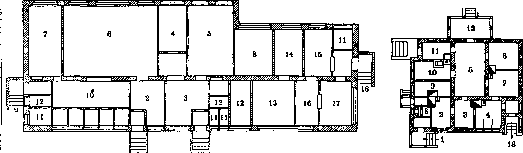
Figure 1.
Figure 2.
Figure 1. Plan of a children's consultation with a milk kitchen and women's consultation: 1- entrance; 2- preliminary examination; 3- cloakroom; 4- registry and weighing; 5- waiting room for women; 6- waiting room for mothers; 7- doctor's office for children; 8- office; 9- entrance to isolation ward; 10- isolation ward; 11- lavatories; 12- washbasins; 13- sterilization room; 14- dispensing room; 15- washroom; 16- milk distribution; 17- waiting room; 18- entrance to milk kitchen; 19- exit. Figure 2. Plan of a rural consultation 1-entrance; 2-cloakroom; 3- preliminary examination; 4- isolation ward; 5-waiting room; 6-medical office; 7-children's and women's office; 8-lavatory; 9- technician's room; 10- milk kitchen; 11- washroom; 12- terrace; 13- exit from isolation ward. 664: on prophylactic bases. C., pushing drug therapy into the background, strives for the protection of the sick child- through hygienic-dietetic, social assistance. C. has taken the path of treating primarily disorders of nutrition and digestion. Here the work of the milk kitchen (see) is of great importance. C. plays no less a role in the fight against rickets- in its prevention and treatment. Special therapeutic-prophylactic installations at C. serve the same purpose: a quartz lamp and health-improving areas. C., being one of the outposts in the fight against tbc of childhood age, also strives for the earliest possible detection of tbc in infants through careful collection of anamnesis, clinical research, and the use of immunobiological reactions (Pirke, Mantoux). Families identified in C. with tuberculosis are taken on special record and referred to a tuberculosis dispensary. Subsequently, the child is under the simultaneous observation of both institutions, the connection between which is maintained with the help of special exchange individual cards.- C. also establishes the diagnosis of congenital syphilis through clinical, serological research and careful collection of anamnesis. It is desirable to treat the child in C. itself with the help of a consultant venereologist, coordinating its measures with the venereal dispensary.- C. carries on the fight with influenza and influenza pneumonias in infants by explaining the nature of this contact infection, by wide propaganda for the prolonged stay of the child in the fresh air and by thorough ventilation of the room of a healthy or sick child. C. must adapt its work to seasonal diseases (summer infantile diarrhea, rickets, tetany, influenza and pneumonias), preparing for them in advance, taking on special record all children who are most threatened socially and biologically, and carrying on preventive-therapeutic struggle with these diseases by all dispensary methods available to it.- C. also widely uses the method of sanitary education through general conversations with mothers, lectures, with the help of a magic lantern, motion pictures, as well as a library (books are read in the waiting room and given to mothers to read at home) and exhibitions at C. (in the waiting room or in a separate room). Its sanitary-educational work, C. as far as possible carries outside the walls of the institution, taking part in the general sanitary-educational work of the area through its representatives (doctors and sisters) in clubs, residential communities and at enterprises. Rural consultation work has its methodological peculiarities and is conducted in various forms. 1. The basic form is a permanent independent C. with a separate staff and in a separate building at the district medical station. 2. C. also serves 2-3 nearby villages by systematic visits of the doctor and sister. 3. On the periphery of the district at a distance of 5-8 km from the rural C., so-called 'primary consultation points' are organized in large villages. Here a visiting nurse or midwife is stationed. Once a week the doctor of the district C., coming, conducts a consultation reception of children and pregnant women, and the rest of the time the sister (midwife), having on record all small children and pregnant women, daily conducts educational visiting. The most desirable is the combination of the functions of the primary consultation and midwifery points. 4. A mobile C., working 3-4 months in a certain village for agitation purposes- to awaken interest and the need for organizing a permanent C. 5. A mobile (car) C. serves periodically the population of railway stations and nearby villages. 6. In order to make consultation work in the village more mass in character, it is also conducted by appropriately prepared district doctors on certain so-called 'consultation days or hours'. Here the participation of visiting, entrusted to the district midwife or a regular visiting nurse, is mandatory. Accounting of C. work. Statistics of the results of C. activity are still very little developed. Undoubted is the significant influence of C. on the decrease in infant mortality (Paevsky, Antonov, Stuke). However, the work of C. can be effective in this respect only if C. covers a significant majority of infants and pregnant women of a given city or district, if the majority of children come under the observation of C. from the first weeks of life, and women- from the first months of pregnancy, if the observation of C. is sufficiently long and visits to children and women are systematic. Accounting for the effectiveness of C. work presupposes preliminary study of the sanitary, demographic and production peculiarities and indicators of the served area. This information C. collects together with the district sanitary organization and the local statistics department.- Statistics of consultation coverage in the RSFSR in 1928 are as follows: in cities children under one year are covered by C. by 70%; 36.9% of all children were taken under observation of C. in a timely manner (at an age of under 1 month); on average there are 6-7 visits per child per year. In rural areas only 6.2% of children under one year are covered by C., and on average there are 3.8 visits per child per year. The vast consultation material of the city and countryside gives wide possibilities for conducting scientific research work, for example on the question of the physiological development and growth of children in various regions of the Union, the lactation capacity of mothers, the morbidity and mortality of children and its dependence on various socio-economic and biological conditions, etc. All this however presupposes correct scientifically organized statistical accounting of C. activity-desirably through the medium of a special scientific-statistical office at it. g. Stuke. Pedagogical consultation sets as its task the propaganda among the masses of the ideas of rational upbringing of the child in the family. In it indications are given as to what needs to be done in order to bring up the child not only physically healthy but also harmoniously developed. Through these C. the improvement of the family life is achieved in accordance with the principles of Soviet pedagogy.-History of pedagogical C. and their replacement by pedological ones. In foreign literature there are no indications of the existence of such C. In the USSR in the field of protection of motherhood and infancy these C. have arisen recently and are also still comparatively little spread due mainly to the lack of qualified personnel. In 1924/25 the first pedagogical C. was organized in the Kharkov institute of ochmatmold. In 1926 the first pedological C. (reception) was organized at the children's C. of the State scientific institute of ochmatmold in Moscow. At the present time (1930) there is information about pedological C. already organized and being organized in localities (Urals, Saratov, Tver, etc.).-The tasks set by pedagogical C., our knowledge about the child and the data of experience lead to the necessity of replacing pedagogical C. with pedological ones by changing the method of work in essence. Pedagogical C. is only a supplement to the medical one. In it the pedagogue gives advice on the upbringing of the child, and the doctor-pediatrician- on feeding, treatment. In the pedological C., on the contrary, a complex analysis of all material about the child is carried out by one person; in it there is a view of the child as a smoothly developing whole organism, the parts of which are inseparable from each other, mutually condition and supplement one another. From this it is clear that the method of work in pedagogical C. is different from that in pedological, and that the first can be accepted only as one of the transitional stages to the second. Organizational forms of pedologization of children's C. Pedological C. should not exist as independent institutions. They must be organized in those institutions which already work with families (nurseries, children's C., etc.). The organization of them in C. as institutions covering broad sections of the population deserves the greatest attention. The ultimate goal of introducing pedological work into C. is the pedologization of all C. work. The present form of work of children's C. (purely medical) inevitably must become obsolete and be replaced by a new one- in the direction of the pedological essence of work.-Basic elements of work. 1. A doctor-pediatrician with pedological training conducts the entire reception in the children's C. and gives the mother instructions both on the feeding of the child and on his upbringing. 2. The sister of the children's C., with pedagogical training, having investigated the life of the child at home and having given information about it to the doctor, conducts general visiting 'on upbringing', physiological and pedagogical. Thus the entire life of the child will be covered by a single rational influence.-Due to the lack of qualified personnel it is not possible to proceed directly to such a form of conducting C. Below are the stages of development of the pedologization of children's C.
State Scientific Institute of Okhmatdet in Moscow. 1st stage: a pedological physician saw children from 0 to 4 years old on specially designated days in the presence of the physician K. and nurses. Literature was indicated to workers of K. for study. Conversations were held with workers of K. on special topics in pedology and early childhood pedagogy. 2nd stage: a pedological physician saw children with the participation of physician K. and nurses on specially designated days. Nurses began to conduct socio-domestic surveys. Patronage was introduced. 3rd stage: the pediatric physician K. began to independently see some children (from 0 to 5 months) with the participation of the pedologist and nurses of K. 4th stage: the pediatric physician began to independently see a certain number of children from the first day of life. Nurses began to conduct independent patronage. The pedologist sees children who are particularly difficult in behavior.-For proper organization of work in localities, it is necessary to have a pedological physician or a pedagogue with pedological training. If it is not possible to have such a person, the pediatric physician of K. must himself engage in improving his own qualifications and the qualifications of the personnel working with him on pedological-pedagogical questions, using the study of literature and his own experience. The stages indicated above can also be carried out in localities. The content of pedological work in the children's K. includes 1) conversations with mothers and personnel of K. on pedological-pedagogical questions; 2) survey of the child's life at home (socio-domestic survey); 3) conduct of pedological reception: a) review of the nurse's materials from the home survey, b) questioning of the mother by the physician (or pedologist), c) examination of the child (somatometric, somatoscopic, testing), d) in the absence of the mother- analysis of the case and development of recommended educational methods, e) giving instructions to the mother and appointment for a repeat visit; 4) patronage 'for education'.- Organization of the environment. Necessary equipment for pedological reception: 1) anthropometric instruments (scales, stadiometer, centimeter, large and small calipers, small sliding caliper); 2) forms and aids for testing research according to Tret'yak-Durnovo (for children from 0 to 2 years); 3) a series of lotto, Rossolimo's box, a set of pictures for research of older children (2-4 years)-according to Dyakova; 4) a playpen for researching motor skills of younger children; 5) a library for personnel and mothers; 6) an exhibition of recommended clothing, furniture, dishes, toys for children (set for different ages) and didactic material, organization of a children's corner (arrangement of two corners - adapted to different material conditions of the family). Work with mothers occupies an important place. The task of K.-to re-educate the mother, to raise her cultural level. This is achieved through conversations with mothers and work with each mother separately (consultation, patronage). When conducting conversations with mothers, the following should be kept in mind: conversations should be simple and brief (no more than 1/2 hour); the form of conversations in the form of questions and answers is good; conversations should be conducted in the waiting room during children's visits.-Practice has shown that under any conditions of the child's life in the family, his upbringing can be organized. But not for every family can the same method of work be applied. An important moment for the success of the matter is the identification of the type of mother. All mothers can be divided into several types: 1) mothers who are pedagogically knowledgeable, cultured; 2) active and conscious; 3) physically healthy, mentally balanced; 4) pedagogically ignorant and overly self-confident; 5) passive and indecisive; 6) mentally ill and neurotics. From all mothers, it is necessary to educate people who know how to observe the child, to monitor and evaluate both the child's condition and their own behavior. It is necessary to strive, as much as possible, to avoid ready-made recipes. This is easily achievable with mothers of the 1st, 2nd and 3rd categories. At the first visit, one can agree with them on carrying out certain measures on all sections of the child's life. In subsequent visits, one can deepen and expand work with them. A repeat visit can be scheduled for them once a month. Mothers of categories 4th, 5th and 6th are difficult to re-educate. With them, caution and gradualness in work must be observed. At the first visit, one has to agree with them only on certain moments of the child's life, without covering all his behavior as a whole, and to give them assignments to work on at home. Sometimes it is necessary to give them ready-made recipes and insist on their implementation. A repeat visit should be scheduled for them two or three times, and sometimes even four times a month-- When working with mothers, attention is paid to the following moments in relation to the child's upbringing: 1) coordination in the work of all family members, commonality of approaches, measures of influence; 2) organization of a corner for the child; 3) establishment of a daily routine; 4) proper organization of the environment for the development of motor skills, especially for children under 1 year; 5) proper organization of nutrition, sleep, walks, play, organized activities; 6) proper work in instilling in the child hygienic, labor, collective skills; 7) work on the development of speech.
N.
Dyakova. Air-sun terrace of K. pursues a dual purpose: therapeutic-prophylactic and sanitary-educational. Therapeutic-prophylactic tasks: struggle with rickets and tuberculosis of early childhood, strengthening the child's body after severe illnesses. Sanitary-educational tasks: propaganda of the wide use of air and sun in the matter of child upbringing. While terraces for preschool and school-age children have long existed both in the USSR and abroad, terraces for infant children until 1925 did not exist anywhere. The first terraces for infant children were organized in Moscow in the summer of 1925 (one at the Scientific Institute of Okhmatdet, another at the 21st consultation of the Moscow Health Department). - There are two types of terraces: either mothers remain on the terrace together with the children or the children remain on the terraces without mothers under the supervision of the personnel. All Moscow terraces belong to the latter type. Terraces work either year-round or only in the summer months.-A necessary condition for opening a terrace is the availability of sufficient green area; the latter must include both a shaded part of the garden and an open area for the sun. Each terrace must have a covered, glass-sided terrace open in front. Terraces working year-round must have at their disposal a warm room consisting of a reception room, a toilet room, and a dining room. Equipment for the terrace--of the nursery type, but somewhat more primitive. Special attention should be paid to warm clothing on terraces working in winter. Children must have warm coats, leggings, mittens, valenki, and warm sleeping bags; personnel-warm work clothes.- Nutrition is delivered from the milk kitchen of K. or, which is much more expedient and advantageous, from nearby nurseries. For nutrition, on average, 25-30 kopecks are allocated per day. TTT t a -ty of terraces for 30-35 children: 1 physician, two nurses, a technical worker; to help the personnel on the terrace, one or two duty mothers work. The cost of equipment for a permanent terrace for 30 children (on average)-2,000 rubles, for a summer one-1,000 rubles. This amount does not include the construction of the terrace. The cost of maintaining a bed per month-20 rubles for a permanent terrace and from 11 to 13 rubles for a summer one. - Terraces work 8 hours in summer, 6 in winter. In summer, children spend the whole day outdoors or (in case of rain) on the terrace. By prescription of the physician and under his supervision, they take air, sun, and salt baths, showers, etc. In winter, children are outdoors for 4 hours, with a break for meals when they are taken into a warm room. Thus, they are continuously outdoors no more than 2-2 1/2 hours; at this time, younger children lie in warm sleeping bags and usually sleep. Older children take one walk on foot, and the second time, like the younger ones, they sleep in sleeping bags. Experience shows that terraces can function at -20-22°. The age of children admitted to terraces-from 6 months to 4 years. The duration of stay on the terrace is set at 3 months, but can be extended. Selection of children for terraces is done by a selection commission at the KOTIV, in which the physician of K. and representatives of public organizations participate. Children are sent to the commission by physicians of K. or by the head of maternal and infant protection (of the city, district, area). Children with tuberculous intoxication recover more slowly. For them, the three-month period is often insufficient.
E. Vaevich. Consultation for children from 1 year to 4 years. Until recently, C. [Consultation] conducted work among a group of children of infant age and up to a maximum of 2 years. The significant success in the fight against infant mortality in the first year with the help of C. for children up to 1 year, and the unsatisfactory state of health of children entering kindergartens and schools, made it necessary to expand the age group of children in C. These two circumstances became particularly clear in Germany during and after the world war: mortality of children under 1 year remained at a favorable level (breastfeeding, special attention to children of this age), while the state of health of children after 1 year and up to 6 years of age became progressively worse and mortality in this age group began to increase. For these reasons in Germany, for the age from 1 year to 6 years (these children are called Kleinkinder), preventive institutions were already created before the war and especially later, and alongside Sauglingsfürsorge (care for infants), care for children up to 6 years (Kleinkinderfürsorge) appeared. In England, the question of preventive work with children from 2 to 5 years by 1927 had progressed very little. In 1924, steps were taken toward an 'experimental' study of this age, i.e., systematic observation of certain groups of children from 2 to 5 years with the aim of obtaining data to advance this issue. In the USSR, this issue became urgent in recent years after the successful development of C. for children up to 1-2 years. In 1929, at the IV All-Union Congress for the Protection of Motherhood and Infancy, a resolution was adopted on the need to include in the work of C. children up to 4 years. Preventive work with children after the first year can be divided into several parts: prevention of nutritional and digestive disorders continues to be the primary concern for children from 1 year to 2 years, followed by prevention and treatment of rickets, prevention of tbc [tuberculosis], helminthic diseases, prevention of acute infectious diseases, psych. [psychological] neglect and neuropathies. Given that the number of children from 1 year to 4 years exceeds the number of children under 1 year, full coverage of them requires additional space and staff, although children after 1 year should visit C. less frequently: a healthy child from 1 year to 4 years visits C. once every 3 months, more often only on a doctor's prescription. The age from 1 year to 4 years can be divided into 2 periods: children from 1 year to 2 years go to the general consultation with children under 1 year. Children from 2 years to 4 years should be separated into a special consultation. In Germany, in some institutions, mothers are accepted simultaneously with children from birth to 6 years. This method is inconvenient: excessive noise, introduction of infection, distraction of the mother's and doctor's attention. The methods of C. for children up to 4 years are the same as for C. up to 1 year: san. [sanitary] education within the C., san.-educational [sanitary-educational] home visits, san.-educational work in collectives (factory, workshop, housing), improvement of the child's living conditions, socio-legal assistance, application of organized preventive and therapeutic measures: health playground, irradiation, normal and dietary nutrition, protective vaccination against acute infections, observation of chronic infections and referral to specialized institutions: tubercular and venereal dispensaries, institutes of physical therapy methods, institutions for defective children, etc. In view of the detection after 1 year and especially after 2 years of abnormalities in psych. development in very many children, C. should pay special attention to questions of proper child upbringing and proper organization of the environment and maintain close connection with pedagogical C. [consultation]. When equipping C., provision should be made for a kitchen for issuing food to the home, a demonstration corner with furniture, clothing, and toys for children up to 4 years. The C. exhibition should be supplemented with material on development and care in this age group. A new branch of such C. is the establishment of a dental consultation. Mother schools and classes with adolescents should be expanded to include teaching about children up to 4 years and conducting practical classes on care and upbringing at this age. N. Al'tgauzen. Home Assistance. Definition and Purpose. Home assistance should be understood as a new branch of C. work—providing children with C. in cases of illness with medical assistance at home by the forces of the C. itself. Its purpose is more complete coverage, full dispensarization [dispensary care] of early childhood. By taking on home assistance, C. implements the principle of continuity and continuity of medical observation; this gives C. the opportunity to provide dispensary care a) through direct connection of home visiting doctors with C. and its departments—visiting nursing, milk kitchens, socio-legal office; b) through connection via C. with diagnostic, therapeutic, preventive, sanitary, and public organizations of the city. Qualified service by a C. specialist facilitates early and more accurate recognition of diseases, which is of particular importance for combating the spread of acute infectious diseases and for timely preventive and therapeutic immunization; penetration of clinical-preventive specialists into the family facilitates the san.-educational task of instilling sound concepts into the population regarding care of the sick, regarding sanitation and domestic hygiene; this is of particular importance for the prevention of social diseases of childhood: tbc, syphilis, rickets, summer diarrhea; the new approach makes it possible to more deeply study the living conditions of the sick and collect valuable scientific and statistical material. Historical Data. Home assistance through C. according to the principles outlined was first organized on the initiative of Michnik as an experiment at the 15th Center for the Protection of Motherhood and Infancy on Vasilievsky Island in Leningrad in April 1927. From 1/1 1928, the function of providing medical assistance to the child population of Leningrad up to three years of age was removed from the jurisdiction of outpatient care institutions and transferred to institutions of Okhmatmald [Maternal and Child Health Protection] (centers). From 1/V 1928, service (compulsorily) was limited to the age up to 1 year; children over 1 year receive assistance only optionally (mandatory assistance is provided through outpatient care institutions). The issue was raised among the program items at the IV All-Union Congress for the Protection of Motherhood and Infancy in Moscow in June 1929 and from this year it is introduced into the practice of C. work. Structure. Home assistance is carried out through a staff of specially appointed pediatricians. Calls are accepted during designated (morning) 72 hours (personally and by telephone) by a specially designated (until the introduction of a special unit) from the C. staff nurse after preliminary questioning. The questioning consists of clarifying the address, surname and name, age, number of the C. book (individual card) and the nature of the illness. The number of accepted calls is coordinated with the number of scheduled visits (for 1 unit, 8 visits per day are approved). Those unable to receive help on the day of the call due to exceeding the norm are either invited to the C. consultation, or are recorded for the following day, or are referred to emergency assistance (after 7 p.m.). Priority is given to (on the day of the call) suspicious or patients with acute infectious diseases, at the request of the C. doctor among those who have visited the consultation, seriously ill patients who for some reason did not get into the hospital. Applications are accepted from family members, C. doctors, visiting nurses, emergency doctors, home visiting doctors (for repeat visits). Home visiting doctors are obliged before going to the patient to familiarize themselves with the developmental history (according to the individual C. card) and the visiting nurse's sheet. Data from observations are entered into special forms. Doctors consult as needed with C. doctors and have the right to invite consultants in narrow specialties to the patient. The doctor's duties include both treatment of the patient and taking therapeutic and social preventive measures by connecting with appropriate institutions: sanitary bureau, disinfection teams, hospital, laboratory, pharmacy; the doctor conducts san.-educational work, performs medical-technical procedures (injections, wraps, etc.). The doctor has the necessary equipment at his disposal (bag); the doctor uses all departments of C. (milk kitchen, socio-legal). A nurse is assigned to assist the doctor (from the visiting nurse staff until a special staff is introduced); the nurse teaches the mother care of the sick, hygiene and sanitation of the home environment of the sick, performs medical-technical procedures as prescribed by doctors, attends to other needs of the patient. Conditions and Limits of Application. Conditions for rational organization: 1) presence of qualified personnel (doctors and nurses); 2) sufficient staff (for C. with 3,000 visits per month, a staff of at least 3 doctors and 2 nurses is required); 3) the doctor's workload should not exceed 6 visits per day. For the near future, service should be limited to compulsory care only for the first age group (up to 1 year); home assistance for children up to 4 years should be introduced only after dispensarization, i.e., after the organization of C. for young children.
The organization of home assistance by no means excludes the need for the rationalization and expansion of inpatient treatment for certain groups (acute infectious diseases, etc.). The latter serves as one of the important conditions for the rational organization of home assistance. When all the indicated requirements are observed, home assistance will fill the gap in the chain of medical-social assistance to the child that exists between consultative (outpatient) and hospital care. - Evaluation. Qualified dispensary care at home is all the more valuable as it makes it possible to preserve for small children individual (maternal) care and natural feeding—the basic requirements of infant hygiene. To carry out qualified individual care in severe cases and to replace a working mother, it would be extremely advisable to introduce the institution of 'mother substitutes' (nurses and nannies). With the organization indicated, home assistance has great significance and value also from an economic point of view, successfully replacing expensive inpatient treatment. Home assistance, requiring expenses only for the maintenance of the staff of doctors and nurses, for office needs and medical supplies, is undoubtedly cheaper than inpatient care, and at the same time for certain cases not only does it not yield to, but even has advantages over, inpatient care.
Z. Michnik. Consultation for women has as its task the protection of women's health, beginning from the period of her sexual maturity and ending with the climacteric period, as well as antenatal protection of the infant, i.e., sexual education of the girl and married woman, observation of the pregnant woman and parturient, the fight against abortion, and observation of women in the climacteric period. Consultations for women developed from consultations for pregnant women, which set as their task the observation of the pregnant woman, the selection and treatment of pregnancy pathology. They were located at maternity homes and were served by its personnel. The III All-Union Congress for the Protection of Motherhood and Infancy (1925) marked the beginning of the organization of consultations for women as an independent institution with broader tasks. The first such consultation for women was opened at the State Scientific Institute for the Protection of Motherhood and Infancy in Moscow in 1925. The number of consultations in the RSFSR in 1925 was 169, in 1926 - 199, in 1927 - 293, in 1928 - 416, in 1929 - 498. For the USSR as of January 1, 1929, there were 683 consultations for women. Premises. The consultation is most often organized together with the consultation for infants and consists of: 1) an entrance hall with a cloakroom and a heated toilet; 2) a waiting room with an exhibition on the protection of motherhood and infancy, where sanitary-educational work with mothers is carried out; 3) 1-2 doctor's offices; 4) an office for receiving women regarding contraceptives, and the furnishings of this office are as follows: washbasin, gynecological chair, hard low couch, writing desk, 3-4 chairs, 2 tables (for sublimate, instruments, brushes), instrument cabinet, medicine cabinet, scales, height gauge. The instrumentation includes everything necessary for the examination of pregnant women, parturients, and gynecological patients: simple and obstetric stethoscope, plessimeter, hammer, apparatus for measuring blood pressure, pelvimeter, Breisky's compass, measuring centimeter tape, forceps, Kocher clamps, 2 forceps (1 anatomical, 1 surgical), scissors, soft catheter, thermometer, Rekordovsky syringe in 1 cm2, nail cleaner, rubber gloves, sterilizer, Schimmelbusch box, dressing material, medicines. Laboratory equipment for examining urine (for sugar, protein), vaginal flora. Linen calculated at 1 sheet per 5-10 women and 1 pad per woman examined; pillowcases, towels, bathrobes, headscarves. Staff of the consultation: doctor, head of the consultation, 1 midwife, 1 visiting nurse. For one doctor during 4 hours of work, 25 women should be seen. The main method of work of the consultation consists of periodic observation of the woman and giving her individual advice. The ultimate goal of the consultation's work is to reduce maternal morbidity and mortality. The therapeutic functions of the consultation are limited, and the treatment of gynecological patients, pregnant women and parturients with diseases of internal organs, the treatment of syphilis and tuberculosis of pregnant women does not fall within the tasks of the consultation. In relation to individual groups of women, the methods and tasks of the consultation are as follows. 1. Observation of the period of sexual maturity of the girl. The work of the consultation is carried out in three directions: propaganda among parents of the principles of sexual hygiene of the adolescent and acquainting them with the functional and organic deficiencies of the girl's sexual apparatus; conducting in schools of the first and second levels a course on the protection of motherhood and infancy, which is a method of sexual education of the adolescent; attracting girls to the consultation for medical observation. The goal that the consultation sets in this area is the struggle for a healthy generation and a reasonable future mother. 2. Observation of pregnant women. The main contingent of women applying to the consultation consists of pregnant women. Each pregnant woman is examined in all respects in the consultation and visits it 4-5 times during the entire pregnancy. At each visit, the pregnant woman's urine is examined, her blood pressure is measured, and she is weighed. If syphilis is suspected, an RW is performed; if gonorrhea is suspected, an examination of the vaginal flora is conducted. Detailed obstetric examination, examination of internal organs, and finally laboratory examinations make it possible to early diagnose developing pathological processes and take a number of preventive measures (placing the pregnant woman in a ward for pregnant women, early treatment of syphilis, etc.). Each pregnant woman receives medical instructions and hygienic advice. In examining pregnant women, the consultation sets a whole series of tasks, mainly aimed at the antenatal protection of the infant and the fight against postpartum mortality and morbidity of pregnant women. a) Selection of socially threatening cases of pregnancy has as its purpose providing help to primigravidas wishing to have an abortion, neglected mothers, groups of workers engaged in heavy physical or harmful labor, etc. All these pregnant women are directed to the OMTIK, where they are given one or another form of social assistance, assistance in transferring to lighter work, in being released from harmful industries, etc. b) Selection and observation of pathology of pregnancy. Detailed examination of pregnant women makes it possible to diagnose pathology of pregnancy, direct such cases for treatment in appropriate medical institutions (outpatient clinics, hospitals, dispensaries, maternity homes), thanks to which the percentage of maternal morbidity and mortality and the number of stillbirths decrease. c) The fight against syphilis in pregnant women. All pregnant women suspected of syphilis undergo an RW; they are examined by a venereologist and are jointly observed with him in the postpartum period. Treatment of syphilitic pregnant women is carried out in a venereal dispensary or in the consultation by a venereologist. All pregnant women suspected of disease are under patronage, thanks to which it is possible to discover syphilis in the family of the pregnant woman. d) The fight against tuberculosis in pregnant women. Detailed examination of the pregnant woman makes it possible to identify a number of tuberculous patients. Pregnant women suspected of tuberculosis are shown to a doctor at a tuberculosis dispensary, where their treatment is carried out. The consultation informs the maternity home and the consultation for infants about each case of tuberculosis in pregnancy in order to take preventive measures with respect to the child (vaccination by Calmette, isolation of the mother, patronage of the infant). e) Protection of the labor of the pregnant woman. For the early diagnosis and prevention of developing pathological processes related to profession, the consultation studies the nature of the pregnant woman's work, regulates it, and develops indications for transferring pregnant women to lighter work and for releasing them from night work; finally, the consultation issues maternity leaves for pregnancy, as well as leaves caused by temporary loss of working capacity. f) The fight against abortion. In connection with the increase in abortions and their harmfulness, the consultation carries out mass work to fight against abortion, as well as clarifying in each individual case of pregnancy the indications and contraindications to it. Women needing an abortion for medical or social indications are directed to abortion commissions of the OMTIK. g) In all areas of the consultation's work there are elements of antenatal protection of infancy (see below): in the patronage of pregnant women, in the early diagnosis and treatment of pathology of pregnancy, in the protection of the labor of the pregnant woman, in social insurance of pregnant women, etc. All these measures reduce the number of stillbirths and 'inadequate' children. 3. The consultation's observation of parturients begins three weeks after childbirth and has as its task the early recognition of diseases of the sexual sphere and the taking of medical measures. Mild cases of disease in parturients (e.g., subinvolutio uteri) can be treated by the doctor of the consultation. Severe cases of disease are directed for treatment to appropriate institutions (outpatient clinic, hospital). 4. Observation of women in the climacteric period has as its task the early diagnosis of cancer and the fight against a number of somatic disorders in this period, associated with the phenomena of ovarian function failure. The consultation uses in this respect the method of attracting women to the doctor through sanitary-educational work, as well as periodic examination of entire groups of the female population. The task of the consultation for women includes conducting so-called sexual consultation (see below), as well as consultation on the regulation of childbirth, or consultation on contraceptives. The main task of the consultation on the regulation of childbirth is the fight against artificial abortion through advice on contraceptives. The consultation carries out extensive explanatory work about the harm of abortion, pointing out the possibility of preventing pregnancy. The work of preventing pregnancy itself is separated from the general reception and is carried out on days specially designated for this purpose. The method of work in this area consists of careful, individual instruction of the woman in the prescribed contraceptive and careful selection of means depending on the anatomical peculiarities of the sexual sphere. The consultation for women is organizationally connected with a number of medical and public institutions: 1) with the maternity home, to which the consultation directs both pathological and physiological cases of pregnancy.
This connection is carried out both through the card system and through the Consultation physician, who works in the maternity home; 2) with venereal and tuberculosis dispensaries, to which the Consultation refers all cases suspicious of syphilis and tbc; 3) with outpatient clinics and patients (dental, for internal diseases, gynecological, surgical diseases), to which the Consultation refers all sick women for treatment and observation; 4) with Consultations for infants for joint conduct of patronage, sanitary-educational work, for joint observation of tuberculous and syphilitic women; 5) with legal Consultations, with commissions for improving the labor and living conditions of women at the soviets, with registry offices for providing women with appropriate legal and material assistance; 6) with schools of the 1st and 2nd levels for conducting sexual education of adolescents there; 7) with abortion commissions, to which the Consultation refers pregnant women to obtain permission for an abortion.-The Consultation as a preventive institution conducts sanitary-educational work among women. In the Consultation itself, a school for mothers is held - periodic conversations with pregnant women and with women who come for contraceptives. In the Consultation, exhibitions, small libraries, "corners for mother and child" are arranged. Along with this, the Consultation conducts extensive sanitary-educational work in the state farms, worker barracks of its district, arranging lectures, conversations, corners for the pregnant woman, etc. The Consultation observes the pregnant woman in her home environment, striving to improve her living conditions. Therefore, a patronage of pregnant and parturient women exists at the Consultation. It has a cultural-educational character; its tasks: to attract women to the Consultation, to teach them care for the child, to introduce hygiene of the pregnant woman and parturient into their way of life. Under modern conditions of Consultation work in cities, the task of patronage does not include home care for pathological pregnancies, as well as sick parturient women. Development of such work is possible only with a small number of maternity beds and mainly in rural areas.Patronage of pregnant and parturient women is combined with the patronage of the infant Consultation and is carried out by the same sister for the protection of motherhood and infancy. Thus, continuity is achieved in the observation of the same woman and her child in her home environment by the same medical personnel. The Consultation for women at a medical unit is connected with the Consultation for infants and is conducted by the same physician. The main aspects of the work of rural Consultations in the field of protection of motherhood remain the same as in the city, the difference is only in the volume of work. The rural Consultation is organizationally closely linked with obstetric points, the work of which it directs. Here its main task is the organization of a mobile system of obstetric care, selection of obstetric pathology, the fight against midwifery, as well as the organization of maternity care in agricultural collectives (communes, collective farms) and state farms. In this connection, patronage in rural areas acquires great importance. The cultural-educational patronage in the village sets itself the task of identifying and registering pregnant and parturient women, attracting peasant women to the Consultation, identifying pathological cases of pregnancy, referring them to the Consultation, fighting prejudices, preparing for home delivery, medical observation of the parturient woman and introducing the basic skills of postpartum hygiene into her way of life. Scientific activity of the Consultation. Questions of hygiene, physiology and pathology of pregnancy, questions of social gynecology, contraception, sexual questions, study of methods of Consultation work, questions of professional diseases and domestic harmfulness, antenatal protection of the infant, study of social diseases-all this can be studied on the material of the Consultation. The method of scientific work of the Consultation-mainly statistical and therefore accessible to broad medical masses.
A.
Lurie. Legal Consultations for Women. The complete emancipation of women, legal equality in family and marital relations, the maximum attention given by legislation to the protection of motherhood, the care with which Soviet law treats the interests of the child—unknown in any bourgeois country—all this has led to the creation of extensive legislation on family and child law, the protection of women's labor, social insurance, etc. Familiarization with these laws, assistance in their timely use, the search for fathers who have abandoned their wives and children, establishment of paternity, collection of alimony, provision of labor and social assistance, and propaganda of the rights of mother and child constitute the tasks of legal consultations of Okhmatmald (Circular of the People's Commissariat of Health of 3/III1925, No. 3 on the tasks of the legal consultations being opened—Bulletin of the People's Commissariat of Health 1925, No. 5, p. 6; Circular of the People's Commissariat of Health, People's Commissariat of Justice, and People's Commissariat of Education of 14/VI 1925—Bulletin of the People's Commissariat of Health 1925, No. 12). In Moscow, the emergence of these consultations dates back to the end of 1923, when the first children's legal consultations arose, having the same tasks of providing legal assistance to minors, underage persons, and those having care for them (Circular of the People's Commissariat of Education of the RSFSR of April 1921, No. 1072). The opening of the first children's legal consultation at the Moscow Department of People's Education dates back to January 1923. The number of legal consultations at Okhmatmald institutions, according to official data from the Okhmatmald department in the RSFSR, reaches 140. Legal consultations are established according to the model at children's consultations and at consultations for women. The methods of work of the legal consultations of Okhmatmald differ significantly from the methods of work of other legal consultations opened by the presidium of the bar association and trade unions. The latter, for the most part, are limited to explaining laws, preparing necessary documents, statements of claim, complaints, certificates, and providing defense in judicial instances. The methods used by the legal consultations of Okhmatmald are in close dependence on the contingent of persons seeking legal assistance, on the nature of the cases with which these persons come, and on the nature of the help required by mother and child. Women-mothers and wives, pregnant, single, abandoned, deceived women turn to the legal consultations of Okhmatmald. The cases are in the vast majority about the collection of alimony, establishment of paternity, fewer—housing cases, labor, property (division of property between spouses). The legal assistance provided by these legal consultations to their clients is more active and has a socio-legal character. The methods used by the legal consultations basically come down to the following. 1. Reception in general legal consultations is conducted by rotating duty lawyers (members of the bar association or legal consultants of professional organizations); in most legal consultations of Okhmatmald, however, there are permanent workers (lawyers) who know the mothers of their consultation and all their diverse needs. 2. The questioning of mothers is usually more detailed, not limited only to the questions with which the mother turned (for example, a mother seeks help in finding a job, and in addition to this, they help establish paternity, collect alimony, etc.). 3. Home investigation of visitors to the consultation (sometimes the defendant) is applied in cases where it is necessary to clarify the living conditions of the mother and her child for the purpose of improving housing conditions, providing material assistance, providing work, checking the attitude of the mother (or father) to their child, resolving a dispute about the child, clarifying the living conditions and upbringing of the child, etc. Sometimes the investigation aims to help the mother on the spot: negotiations with the housing administration, resolution of housing or family conflict. Investigations are carried out by the patronage nurse of the consultation or a delegate, a member of the section of the council. 4. Summoning interested persons to the legal consultation pursues the same goals of obtaining additional comprehensive information, hearing the other side, clarifying inaccuracies in the case, explaining to the defendant the relevant norms, rules, obligations, reconciling the parties, peacefully resolving conflicts, etc. The summoning practiced by the consultations for the protection of motherhood often prevents the initiation of a case in court. 5. In order to assist the mother in obtaining a certificate, document, or collection of alimony as soon as possible, the legal consultations send inquiries in their name to various institutions; most often, inquiries are sent regarding the search for fathers who are hiding both before receiving the enforcement order for the collection of alimony and in the presence of an enforcement order in cases of non-payment of alimony. Inquiries are sent to court bailiffs regarding the regulation of alimony collection and to the place of work to determine and verify the amount of earnings, etc. 6. In a huge number of cases, the legal consultations, through social assistance councils, provide social assistance to the mother (single, homeless, needy): placement in a job, registration with the labor exchange, material support (sending to one's homeland, etc.), placement of the mother or her child in the appropriate institution of Okhmatmald or the People's Commissariat of Education. Over single homeless mothers and their children, some legal consultations establish constant supervision, more or less long-term observation for the prevention of child abandonment; a homeless mother is taken under the supervision of the consultation sometimes even before the birth of the child. The last two points in the work of legal consultations—social assistance and long-term observation, registration of homeless mothers—constitute the content of 'social patronage,' applied by some legal consultations. The strengthening of social assistance, the introduction of social patronage, and the strengthening of the active, initiative role of legal consultations in the fight against maternal and child homelessness have led to the reorganization of legal consultations into socio-legal offices at consultations. At present, socio-legal offices exist in Leningrad and Moscow at institutes of Okhmatmald, in Ryazan, Nizhny-Novgorod, and several other cities. In their daily work, legal consultations use special registration cards (questionnaire forms) where all data about the mother being questioned and about the progress of her case are entered; special 'summons' cards for inviting the necessary person to the consultation; specially developed 'acts' of investigation on the case.
S. Kopylanskaya. Hygienic consultation is understood both as a type of medical-prophylactic work and as a special type of institution that has emerged in recent years. 1. C. as a type of medical-prophylactic work developed along two main channels: a) along the line of work of therapeutic and therapeutic-prophylactic institutions and b) along the line of mass sanitary-educational work, mainly in clubs and to a lesser extent in production. -a) In medical institutions, hygienic C. as a component of general medical work first found its place and took root most firmly in preventive institutions, first and foremost in the dispensary both in the USSR and abroad (see Dispensary). Then, as preventive principles were introduced into medical practice and elements of the dispensary method of work were implemented to one degree or another in purely medical institutions (outpatient clinic, polyclinic), hygienic C. also found its place there. The content of hygienic C. usually consists of instructions to the patient regarding lifestyle, regimen, etc. To a certain extent, such instructions are an essential part of any medical consultation, and when speaking of hygienic C. as a special type of work, reference is made to special emphasis on such instructions, giving them special attention. Thus, proposals were made and began to be implemented to issue written hygienic advice to every visitor to a medical office, partially printed in ready-made form and partially filled out by the doctor depending on the health status of the given patient and their living conditions ('preventive prescriptions'). The issuance of written hygienic instructions is supplemented by the issuance of popular literature to patients for reading with subsequent return. Chubov and Landa published the results of developing evaluation cards filled out by patients based on the books issued to them. In a number of large polyclinics in Ukraine, the practice of issuing literature to patients at the conclusion of a medical consultation depending on their illness is used as a permanent method of work. In other places, literature is issued at the registration desk after the medical consultation upon the doctor's instructions (prescription). To a certain extent, in addition to doctors, trained middle medical personnel are involved in hygienic C., mainly for issuing information about the procedure for receiving further treatment, the most appropriate regimen, behavior towards others, etc. Hygienic C. also takes place in inpatient institutions (hospitals, sanatoriums), but here, due to the significantly longer period of communication between the doctor and the patient and greater freedom in choosing time, it takes the form of more in-depth conversations, sometimes even lectures, and loses the specific characteristics of C. Similar to hygienic C. in the outpatient clinic are the concluding instructions of the supervising doctor when discharging a patient from the hospital regarding further behavior, regimen, etc. In some places, the practice of issuing written hygienic instructions to discharged patients, similar to 'preventive prescriptions' in the outpatient clinic, is followed. b) Along the line of mass sanitary-educational work, hygienic C. found its place mainly in the club (see). As a result of medical lectures or evenings of questions and answers on health protection topics, questions often arise among listeners that require subsequent conversation with the questioner for clarification, as well as intimate questions that require a private conversation; the presence of such questions led to the emergence of individual C. as a concluding part of each public appearance by a doctor in a club. With the further development of this work, a special room and specially designated hours were required. Another, more frequent source of the emergence of hygienic C. are information bureaus or general C., which have become common in a significant number of clubs. Usually, in the information bureaus of clubs, a lawyer and a trade union worker accept and provide information and advice at certain hours on corresponding questions; sometimes they are joined by a special consultant on questions of political education, as well as on questions of special interest to women (questions of family law, alimony, courses in women's labor, etc.), a consultant on child-rearing (so-called pedagogical propaganda), and others. It was quite natural to add hygienic C. to such a multifaceted C. or information bureau, which found its place in some clubs. Sometimes thematic grouping of hygienic C. is practiced, i.e., it is announced that on such and such a day the doctor will give advice on questions of child nutrition or questions of housing hygiene, questions of physical culture, women's hygiene, etc. Such an organization makes it possible to attract specialized doctors and thereby increases the qualification and authority of hygienic C. In addition to oral, there is (but much less frequently) also written C. on written requests—through a special bulletin board. Records of advisory and information work are usually kept on a special card. In some cases, hygienic C. takes place not in a club but at an enterprise, mainly in red corners during lunch breaks. Having advantages over work in a club in terms of greater proximity to the working masses, hygienic C. in an enterprise has no significant differences from C. in a club. 2. Hygienic C. as a special type of institution was first created in Odessa in 1928 as a result of the natural development of hygienic consultations of the primitive types described above. The main difference between hygienic C. of this developed type and C. at a club is the giving of advice by qualified specialists in offices, rather than by a general practitioner. In this respect, hygienic C. as a special institution relates to C. at a club in the same way as a specialized polyclinic relates to a primary outpatient clinic and first aid point. Following Odessa, several more C. were opened (also in Ukraine—Dnepropetrovsk, Kharkov, etc.). The Odessa C. was opened with the following offices: prevention of internal diseases (diagnostics), prevention of tuberculosis, hygiene of upbringing, hygiene of labor, hygiene of daily life; later were added offices of sexual hygiene, prevention of women's diseases, hygiene of physical culture. The composition of offices is generally the same in other C. According to the first experience, the largest number of consultations are in the offices of psychogenic hygiene, hygiene of child upbringing, and hygiene of labor. Among visitors to C., men significantly outnumber women (whereas in ordinary polyclinics the opposite relationship exists). Similar to the C. described above in medical institutions, special hygienic C. practice issuing books of appropriate content to visitors for reading at home, as well as issuing advice and instructions in written form. Referral of visitors occurs both on their own initiative and through referral slips from doctors in medical institutions, clubs, enterprises, schools, etc. The experience of Odessa is still controversial and has not yet become widespread, although it represents considerable methodological interest as a new form of in-depth individual sanitary-educational work.
CONSULTATION
Although it represents considerable methodological interest as a new form of in-depth individual sanitary-educational work.
P. Zabludovsky. Consultation on sexual hygiene (eugenic consultation)—an institution that sets for itself the task of improving the sexual lifestyle of the population. From its very inception, the development of C. in the West (Ehe-Sexualberatungsstelle) followed two main channels: 1) questions of birth control, propaganda for contraceptives; 2) premarital advice for those entering marriage. The first type is organized by radical activists and social organizations, such as the League for the Protection of Motherhood and Sexual Reform in Germany, and pursues goals of helping not only in matters of reproduction from a biological, but also from a socio-psychological point of view, as well as in matters of mental conflicts. At present, C. of this league exist in many cities in Germany (Hamburg, Frankfurt, Berlin, Breslau, etc.), often alongside state and municipal C. The second type of C.—narrowly eugenic (see Eugenics), setting for itself the task of preventing marriages of persons with heavy pathological burdens threatening to offspring. For the first time, this type of C., for the purpose of determining the health of persons entering marriage, arose in America in 1895. In 1911, similar institutions, which became the center of the struggle for mandatory exchange of medical certificates before marriage, were organized in Germany. After the war, ideas of such C. were readily accepted by some state organizations setting the task of selective hygiene. Similar C. began to be established in German countries, especially Germany. Thus, the Prussian Ministry of Health issued a circular in 1926 on the organization of marital C. in all major districts under the leadership of physicians, mainly familiar with issues of eugenics and heredity. At the same time, some municipalities (Berlin) and sick funds (Dresden) undertook to maintain such C. Life expands the scope of work of C. despite the opposition of reactionary state circles, so that part of them deals with the resolution of questions of sexual life in the broad sense of the word, such as: 1) hygiene of sexual life, 2) questions of entering marriage, 3) regulation of birth control, 4) sexual education of children. In the USSR, C. on sexual hygiene arose for the first time in 1925 in Moscow (C. for improving lifestyle). Soon, questions of women's hygiene were singled out into the sphere of competence of C. on women's hygiene, organized under the institutions of Okhmatdyt. A number of venereal institutions organized C., which to a large extent deal with sexual pathology. Finally, individual institutes and houses of sanitary education organize C. for improving sexual lifestyle. Such C. concentrate around themselves various specialists: physicians of social hygiene, neurologists, venereologists, pedologists, educators, and lawyers. Becoming a kind of dispensaries, these C. apply the following methods in their work: a) outpatient reception, advice at reception or after appropriate conclusion by a specialist; referral in necessary cases to the appropriate institution for treatment (neuropsychiatric, venereal dispensaries), regular observation of those applying (for conducting examinations at home, the C. has a nursing staff); b) correspondence with those applying and publications in the press; c) group C. discussion on specific requests received in advance; d) mass work, question and answer evenings. The objects of service of C. are, first of all, organized collectives (workers' clubs, dormitories)—by organizing mobile C. on site and conducting mass work, and registry offices—by propaganda of medical examination before marriage and providing socio-legal assistance to the weaker party in the registration of divorces and births in cases of paternity not established. C. on career choice—see Professional selection.
L. Gurvich»
Related articles
Mentioned in
- Age Categories
- Alexander Nikolayevich Rakhmanov
- Alimony
- Ambulatory
- Childhood Diseases
- Childhood Institutions
- Club
- Contraceptives
- Decapitation (or decapitation, is an obstetrical operation)
- Dietary Tables
- Dispensaryization
- Eclampsia
- Eunuchoidism
- Feeding of Young Children
- Finland
- Flerov
- FREZE
- Haas, Fyodor Petrovich
- House of Sanitary Enlightenment
- Medical Board
Cite this page
“Consultation.” Soviet Medical Encyclopedia. English translation of Bolshaya Meditsinskaya Entsiklopediya, 1st ed. (Moscow, 1928–1936), ed. N. A. Semashko. https://sovietmedicalencyclopedia.pages.dev/article/consultation/