Eunuchoidism
Historical document, translated for reference. It reflects medical knowledge of the 1920s–30s and is not medical advice.
Summary
Eunuchoidism is a congenital anomaly characterized by underdeveloped sexual organs, skeletal abnormalities, and absence of secondary sexual characteristics. The condition results from distorted development of the entire body while sometimes preserving spermatogenesis and sexual function.
Encyclopedia article (1928–1936)
EUNUCHOIDISM, EUNUCHOIDISM, a condition characterized by underdevelopment of the sexual organs and other physical features resembling those of castrated individuals. This condition is often associated with hereditary factors and may be linked to other diseases such as retinitis pigmentosa, diabetes, etc. Individuals who are themselves healthy but have a family history of these diseases are considered limited in their capabilities; marriage with relatives or individuals with similar hereditary diseases is prohibited for them. Those currently incapable (temporarily) are individuals suffering from contagious diseases (venereal diseases primarily) until their recovery. In Germany, premarital consultations are increasingly becoming part of life, and a growing number of citizens are seeking their help. In the USSR, according to Article 6 of the 'Code of Laws on Marriage, Family and Guardianship' (1927 edition), 'marriages shall not be registered... b) between persons, at least one of whom has been declared legally feeble-minded or mentally ill...'. Additionally, according to Article 132 of the same code, 'those registering the marriage must submit... a statement that they are mutually informed about their health status, particularly regarding venereal, mental and tuberculosis diseases...'. Under Article 133, 'the official responsible for registering the marriage must read to the marrying couple Articles 4, 5 and 6 (prohibiting registration of marriages before 18 years of age, marriages between relatives and the mentally ill) of the Marriage Code and warn them of criminal liability for false testimony'. It is self-evident that such 'mutual information' between spouses about their health before marriage without presentation of medical certificates is an eugenically extremely insufficient measure. Those marrying often do not know about their disease or understand its significance. The requirement in our law for only 'mutual information' about health is motivated by the fact that exchange of medical certificates in the USSR would be difficult to implement due to the lack and shortage of doctors, especially in rural areas, and is undoubtedly only the first step in eugenic legislation. Besides premarital consultations, the tasks of E. include control of conceptions, social assistance (reduction of taxes, improvement of housing conditions, etc.) for gifted individuals with the aim of promoting their reproduction, facilitating their access to higher education, etc. The task of preventive E. includes combating conditions that may be assumed to contribute to the occurrence of prolonged negative modifications (poverty, syphilis, alcoholism, overwork, poor housing, etc.); minimizing diseases that cause infertility, interfere with proper development of the fetus in the mother's womb; combating diseases that indiscriminately destroy both the strong and the weak (infections). Finally, the task of E. is also the proper organization of education in accordance with existing natural abilities, proper professional selection. Medicine is satisfied with eliminating disorders that remove a person from participation in life, work; the task of E. is not only to restore working capacity but to find the best type (or, more correctly, the best types) of working capacity. E. includes not only constitutional pathology but also constitutional pedagogy and constitutional psychotechnology.
EUNUCHOIDISM, EUNUCHOIDISM, a condition in which the gonads function for some time, and only then does their activity cease (abiotrophy).-Pathological anatomy is poorly studied. The tunica albuginea of the testes is thick, the seminiferous tubules are underdeveloped (resembling tubules in children), the cells are poorly differentiated, spermatogenesis is poor; the tissue between the tubules is rich in elastic fibers and connective tissue cells.-Pathogenesis. E. is a congenital anomaly; unlike infantilism, in which there is a delay in development and complete absence of germinal capacity, in E. there is distorted development of the entire body with sometimes preserved spermatogenesis and even capacity for sexual functions. Falta associates E. with congenitally incomplete development of the central nervous system, noting the frequent combination of E. with epilepsy, idiocy, etc. Course of the disease and symptomatology. Of the main symptoms characterizing E., first place must be given to aplasia or hypoplasia of the sexual apparatus and anomalies of the skeleton. 1. Hypoplasia of the sexual apparatus concerns both the morphological side [size of the sexual organ, etc. (see separate table, fig. 1)] and function (libido, potency). Usually the penis, scrotum, prostate gland are very small, the testes are often the size of a pea, there is unilateral or bilateral cryptorchidism. Inguinal canals are absent; libido, facultas coeundi are absent or weakened, sometimes homosexual tendencies are present. Morphological and functional disorders mostly go in parallel, but in individual cases dissociation is observed: e.g. hypoplasia of sexual organs and preserved facultas coeundi or vice versa. Secondary sexual characteristics are absent: beard, mustache (see separate table, fig. 2), as well as hair on the trunk and limbs, in the armpits, on the pubis and around the anus are absent. On the head, conversely, there is hypertrichosis. This is explained by the fact that scalp hair depends mainly on the thyroid gland, while hair on the rest of the body depends mainly on the gonads. The larynx does not ossify, the Adam's apple barely protrudes; the voice does not change (remains high). The pelvis is 'asexual'. In women, breasts do not develop. In addition, eunuchoids have thin, pale and delicate skin, senile wrinkles on the face (so-called geroderma), flabby musculature, physical weakness. 2. Skeletal anomalies (in French terminology-anomalies of tertiary sexual characteristics) are expressed in disproportion between the upper and lower halves of the body. Eunuchoids are characterized by long tubular bones, long and narrow fingers and a relatively small skull. To skeletal anomalies belongs above all the predominance of the length of the lower part of the body (from the pubis to the ground) over the upper. In a newborn, under normal conditions, the length of the upper part of the body relates to the length of the lower as 100:50, and if by 25 years this ratio equals 100:95, then with loss of function of the gonads, when there is no influence of their formative capacity, the average ratio is 100:125. Furthermore, in E. the span of both arms exceeds the height (the fingertips almost reach the knees). Skeletal anomalies are associated with late closure of epiphyseal sutures in E. (sometimes only by 30 years). Bone nuclei are normally developed in this case. To skeletal anomalies also belongs the ratio of shoulder diameter to pelvic diameter. Under normal conditions these ratios for men are 100:81; for women-100:97; in E. the average is-100:85. These are figures for asexual embryonic forms; the pelvis in this case has infantile dimensions. Genu valgum and flat foot are often observed. Hyperextensibility of joints (especially fingers) and tendency to spontaneous dislocations are often present.-To eunuchoid features also belongs selective obesity in the chest, abdomen (with a characteristic fold over the mons pubis) and thighs. Such relative obesity is often observed even in lean eunuchoid giants. Depending on whether the above growth characteristics or obesity predominate, two forms of E. are distinguished: eunuchoid gigantism and eunuchoid obesity. Mixed forms are most common. The form of E. depends on the condition of the pituitary gland, its greater or lesser activity, as well as hereditary-biological data and individual constitutional features (Bauer). Thus, in families of mixed-type eunuchoids, both giants and obese individuals are found, in families of eunuchoid-giants-just giants.-As a symptom having some significance, rudimentary development of lateral incisors must be mentioned. Heart, aorta are hypoplastic, blood pressure is often low, there is acrocyanosis. The prostate gland is often atrophic. The presence of the thymus gland in adults (thymus persistens) alongside lymphocytosis and numerous papillae at the root of the tongue allows in many eunuchoids to establish status lymphaticus. For blood, besides lymphocytosis, decreased hemoglobin and mononucleosis are characteristic. Decreased or absence of cremaster and lower abdominal reflexes. Basic metabolism is usually normal or even decreased. Experimental data concerning the dependence between the gonads and gas exchange are contradictory. Loewy and Richter found after castration a decrease in basic metabolism on average by 20%, Korenchevsky denies such dependence. However, clinical facts (about 7/3 of women gain weight during pregnancy, lactation, menopause) speak in favor of such dependence. It is possible that the decrease in basic metabolism is masked by the compensatory influence of the thyroid gland and pituitary. Protein metabolism is often decreased. Sugar tolerance according to some authors is increased, according to others-decreased. E. is very rarely found in women, and in a less severe form (disproportions of skeleton, late menstruation, dysmenorrhea). This is explained by the fact that in women the substituting influence of other endocrine glands appears early. Opinions on the influence of the gonads on the psyche are completely opposite. While some believe that
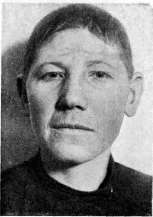
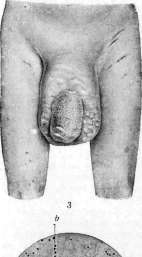
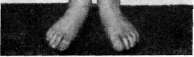
Figure 1. Underdevelopment of genitals, secondary sexual characteristics; isolated obesity on the abdomen. Figure 2. Face of a eunuchoid. Characteristic folds at the lips, absence of facial hair. Figure 3. Elephantiasis penis et scroti. Figure 4. Etat crible: a-areas of sparse brain substance; b-capillaries. The entire psyche, tone, and individuality of the subject depend on the sex glands; others do not recognize the dominant influence of these glands on the psyche. In E. the defects of the psyche mainly concern character, not intellect, which is most often within normal limits (and in rare cases even above normal). But if the intellect is not impaired, eunuchoids lack sufficient impulses for its development; they have little initiative. According to Fischer (Fischer), the sharply defined somatic type of a eunuchoid corresponds to a certain psychic structure. The character of a eunuchoid is similar to that of an epileptic in negative traits: irritability, viscosity, egocentricity, pedantry; at the same time, eunuchoids do not possess the activity that distinguishes epileptics: eunuchoids are withdrawn, asocial, and it is not surprising that many are found among criminal types. It should be noted the often inherent traits of eunuchoids - stubbornness and shyness. The latter trait, as well as withdrawal, lack of sociability, are related to the socio-psychological attitude of eunuchoids. In many, there is a tendency to fantasize, a 'high' style, etc. Most authors dispute the existence of a single psychic type of eunuchoids. Thus, Sterling (Sterling) distinguishes three types: 1) normal in psychic regard, with traits of altruism, 2) oligophrenics, emotionally sluggish, 3) close to the epileptic type. It is important to note that epileptic seizures are often observed in eunuchoids. This can to some extent be connected with the sympathicotonia caused by the absence of sex glands. In recent times Kretschmer (Kretschmer) and others have drawn attention to the similarity between eunuchoid and schizoid psychics (somatically they are connected by a common asthenic body build). Among schizophrenics there are many eunuchoids; in women suffering from schizophrenia, hypoplasia of the sexual apparatus is often noted. However, it should be noted that there is no pathogenetic connection between hypoplasia of the sexual apparatus and schizophrenia. True psychoses in eunuchoids are rarely observed. Korsakov described a case where after castration delusional ideas appeared, and in the case of Krafft-Ebing (Krafft-Ebing) - a severe depressive state was noted. Usually castration leads to minor psychic changes, mood swings, irritability, fatigue, indecisiveness. In addition to the E. described above, 'pubertal E.' and 'late E.' are also distinguished. Under p u-bertal E. is understood the condition of transient eunuchoid obesity or gigantism, which later smooths out. In girls, sweaty, cold hands are observed, a tendency of hands and feet to paronychia and cutaneous tbc. Under poz d'n im E. (as opposed to congenital E.) is understood a form of the disease associated with regressive development of the sexual apparatus and secondary sexual characteristics at a later age in fully formed subjects. Selective obesity appears. There are no anomalies of the skeleton, due to the completed process of ossification. Among psychic changes, apathy, forgetfulness, irritability are noted, although sometimes liveliness as well. This picture of the disease was first described by Larrey (Larrey). German authors called this disease 'late E.', French authors - Gandy (Gandy) and others - 'regressive' or 'late infantilism' (infantilismus tardive). These cases should not be confused with the pluriglandular disease of Claude and Gougerot (Claude, Gougerot), in which regressive changes occur simultaneously throughout the entire system of endocrine glands. They should also not be confused with cases of secondary regressive changes in pituitary diseases. Etiologically, late E. is associated with injuries, inflammation of the testicles on the basis of syphilis, gonorrhea, severe acute infections, etc.; Stefko described cases of E. due to undernutrition in famine years. It is interesting that cases of late E. in women are not described, just as late castration in women does not lead to this syndrome. Diagnosis. In differential diagnosis, the most important thing is the distinction of E. from adiposo-genital dystrophy, in which the main symptoms are also hypoplasia of the sexual apparatus and obesity. An important difference is the tendency to tall stature in E. and, conversely, to short stature in dystrophy. Furthermore, in E. there is often, in contrast to adiposo-genital dystrophy, thymus persistens. In E.-hypertrichosis, in dystrophy, on the contrary, sparse hair on the head. In E., the basal metabolism is normal or decreased, in dystrophy the basal metabolism is normal, the specific dynamic action is decreased. The Turkish saddle in E. is either normal or has a low and flat wall (the pituitary is reduced). Particularly difficult, and sometimes directly impossible, is the differential diagnosis in the prepubertal age. There are fewer difficulties in differential diagnosis with infantilism, in which there are childlike proportions of the skeleton and a child-sized, not pathologically altered, sexual apparatus. The psyche is infantile in it, which cannot be said of E., which is why the classification of E. as infantilism (Peritz) is incorrect. Prognosis. E. is difficult to treat. Life is not threatened by E. - cases of 75-77-year-old eunuchoids have been described, but in most there is reduced resistance to diseases, especially to tbc. It must be borne in mind that cases of early E. may undergo spontaneous healing at the age of sexual development. Treatment. Replacement therapy has very limited significance. The therapeutic success of preparations of sex glands, especially spermine, is limited to their general tonic, not specific effect, which is largely explained by the unsatisfactory quality of the preparations (low content of specific substances). Only recently, thanks to the biological test found by Allen-Doisy (Allen, Doisy), has it become possible to more accurately verify and dose the specific effect of ovarian preparations. The 'folliculin' preparation obtained by Zondek and Aschheim (Zondek, Aschheim) from cow folliclets gives reason to expect greater clinical success. Of the preparations produced in the USSR, the best results are obtained from the subcutaneous (not per os) application of ovariin, prepared by the Kharkov laboratory (V. Ya. Danilevsky).. In recent times, in connection with views on the pituitary as the 'motor of sexuality', combined treatment with pituitary and sex gland preparations has been used in individual cases with good results. Noticeable results, especially in younger patients, are obtained from the use of thyroidin: obesity decreases, sexual organs increase, hair growth intensifies; as for libido, its increase in many cases must be attributed to self-suggestion (it also occurs after injections of table salt, etc.). Some success is noted with irradiation or diathermy of the pituitary. In recent times, some results (better for men) have been achieved by means of transplants of sex glands. The most successful place for transplants, protecting from trauma, is the musculature of the inginal region. Into this place, on each side, half of a testicle split lengthwise is placed; the testicle is left together with the tunica albuginea to reduce resorption. The operation should be performed under general, not local anesthesia for better engraftment. A healthy or cryptorchid testicle is taken as the transplant; testicles from a corpse give a less lasting effect. An even weaker result is obtained with heterotransplantation (from monkeys, rams, etc.). The failure of transplants is explained by the fact that the transplant is not supplied with nerves and is more or less quickly resorbed. Thus, the transplant method ultimately also comes down to replacement therapy, especially in heterotransplantation. Sometimes before transplantation, considering the changes in the pituitary in E., it is useful to give pituitary preparations for 3-4 months. Under the influence of such combined therapy, a decrease in weight, the appearance of pigmentation, etc., was observed. The best results are obtained in the treatment of cases of late traumatic E.: of 7 cases of Lichtenstern (Lichtenstern), in 5 a lasting success was noted (in one of them already for 8 years). Secondary sexual characteristics appear, libido increases, hair growth intensifies. In ordinary E., the results manifest later, sometimes only several months after the operation. In some cases, the success of transplantation is explained by the stimulating effect on the sex glands preserved in a rudimentary state. In cases of prepubertal eunuchoidism, one should not rush with transplantation, since the period of sexual maturity may smooth out the phenomena of absence of sex glands.
M. Sereyskiy. YEVPATORIA, a district city of the Crimean SSR, located in the western part of the Crimean Peninsula at 45°12' N. latitude and 51°3' E. longitude, at a wide-open bay of the Black Sea. It is famous for its sea bathing and therapeutic muds, extracted from surrounding lakes, and over the last three decades has been rapidly developing as a resort. The climate of Y. is maritime-steppe, warm, moderately humid, without sharp fluctuations in temperature. Over 6 years (from 1923 to 1928), the number of days with sunshine, on average for 7 months (from April to October inclusive), was 194.5 (from 3 to 6 or more hours), which amounts to 27.8 sunny days per month. This allows for the maximum utilization of the sun during the spring-summer-autumn period, given other favorable climatic features of Y. during this time. The average temperature in the shade at 1 p.m. for the same period: April +13.5°, May +20.1°, June +24.3°, July +27.5°, August +26.1°, September +23.6°, October +16.7°. The annual average is +14.5°. In the summer half-year (May-September) it is +24° (almost the same as Yalta). In summer, winds blow from the south, southwest, west, and northwest, while in autumn, winter, and spring they blow from the north, east, northeast, and southeast. Constant summer and autumn sea breezes with their cooling effect help to withstand the scorching sun of Y. and contribute to the widespread use of sun and air-sun baths on the seashore, especially for children. The average annual humidity is 78%, in summer 70%, and in winter 82%. Fogs are rarely encountered in spring and autumn. The average annual air pressure is 761 mm and fluctuates little. The average monthly summer sea temperature (for 1923-28): in May +16.0°, in June +20.2°, in July +21.7°, in August +21.8°, in September +20.2°; near the shore, thanks to the shallowness, the temperature in summer is 4-5° higher. Under the conditions of a marine beach with moderate air movement (not exceeding 2 m per sec.), with moderate effect of solar radiation heat (not exceeding 1 cal. per min. per cm2 of horizontal surface) and with an effective temperature of about 14-17°, the taking of air-sun baths should be considered as one of the main therapeutic and health-strengthening factors in Y. The shallow bay with insignificant surf, almost complete absence of tides and ebb, excellent sandy beach, as well as continuous insolation and favorable climate—all this creates exceptionally good conditions for sea bathing in Y. The extremely hygroscopic, slowly drying and quickly heating sand of the beach, due to its intense insolation and the presence of heated salt compounds of sea water, is used in the form of natural solar-heated sand baths. These baths are used especially in children—rickets, scrofula, with consequences of infantile paralysis, as well as as subsequent treatment, mainly after mud therapy.
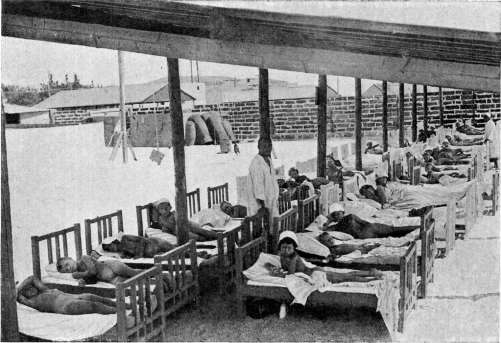
Figure 1. Air baths.
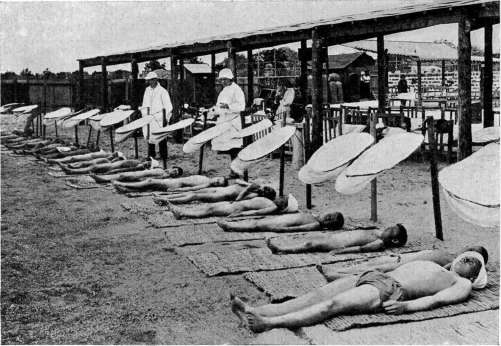
Figure 2. Sun baths.
The water of Yevpatoria Bay is clean and transparent to a great depth. From May to mid-October and even until the end of October, sea bathing is quite possible. Thus, the sea in Y. is used for bathing for almost 7 months. Sun baths, general and local, can be taken with the greatest convenience and ease on the seashore, on the sandy beach. In addition to sun baths, air baths are widely used—before and after sun baths, and also as a substitute for the latter for those who need a milder effect of irritating direct sun rays. Y. as a maritime climate station and children's resort is indicated: a) in adults, mainly in subacute and chronic tuberculosis of bones, joints, external and internal glands: bronchial and peritoneal, without extensive suppurations, without hectic fever; in tuberculosis of the peritoneum without temperature rise above 37.5°; in tuberculosis of the skin without tendency to hypertrophic processes; b) in children, especially sluggish, torpid, of asthenic type; c) in chronic infectious diseases, mainly tuberculosis of various organs and tissues (except lungs), in exhaustion after acute diseases, in metabolic disorders: consequences of rickets, scrofula, and arthritic diathesis. Yevpatoria is also indicated in certain diseases of the nervous system and organs of movement, most often in combination with mud therapy.—Among the natural therapeutic agents of Y., the foremost place therapeutically should be given to the liman mud and brine from the nearby Maynak salt lake (liman). This lake is located 2.7 km from the old city, to the west of it. The greatest length of the lake reaches 3 km, the greatest width is about 850 sazhenes, depth—0.7-1.5 m. On the bottom of the lake lies a layer of mud from 13 to 65 cm. The brine of Maynak Lake is concentrated sea water, seeping through the spit separating this lake from the sea, and undergoing significant changes under the influence of physical, chemical, and biological processes occurring in the lake. The brine is of a yellowish color with a characteristic, rather sharp smell noticeably smelling of hydrogen sulfide. It is much denser than sea water, with specific gravity fluctuating between 11.7° and 17.2° Baumé. The composition of Maynak Lake brine according to the analysis of A. F. Sagaydachny (July 25, 1925): Specific gravity................1.334 Cl'.................11.1720 Anions \ SO4"................1.4692 /Ca"...............0.0996 Cations { Mg"............... 0.7880 iNa"...............6.3420 Sum of ions.................19.9607 Dry residue.................19.6020 The same data, listed as salts: Calcium sulfate CaSO4..........0.3377 »
potassium KCl...........16.1230 The mud of Maynak Lake is a very viscous mass—bluish-black in color, delicate, oily,—highly plastic silt, with a smell of hydrogen sulfide. The composition of Maynak mud according to the analysis of the same researcher (July 20, 1925, basin № 2): Water......................45.100 Hydrogen sulfide H2S (bound).......0.003 Salts, dissolved in water (together with Ca SO4) . . 16.710 Soluble in HCl part: Iron oxide Fe2O3.............. 0.859 Alumina Al2O3................1.530 Silica SiO2................0.660 Phosphoric acid P2O5 . . .........0.257 Calcium oxide CaO.........'.........9.770 Carbon dioxide CO2...............7.500 Insoluble in HCl part: Iron oxide Fe2O3.............0.160 Alumina Al2O3...............1.538 Silica SiO2 ..............13.207 Calcium oxide CaO ............ \ » magnesium MgO......... . . . . I » sodium Na2O.............( 0.838 » potassium K2O .............. J Maynak Lake is leased by Zustrakh and is used for therapeutic purposes (see Mud Therapy Areas) with an extensive, newly renovated and significantly expanded mud bathhouse for mud (natural solar and artificial heating) and brine baths. In addition to Maynak Lake, near Y., besides the widely exploited for industrial and therapeutic purposes Saki Lake, there are also a number of salt lakes awaiting their study and medical exploitation and belonging to the Yevpatorial group, namely: Bakalskoye, Dzharylgach (near Ak-Mechet), Kypchak at Tarkhankut, Lake Donuzlav with lateral appendages—Tabuldinsky, Terekly, and Sultan-Eli, then Aji-Baychi, Ayburun, Aircha, Konrat, Andermen and finally near Y. itself, Sasyk-Sivash and Kizil-Yar.—In recent years, a whole range of medical institutions has been established in Y.: a large number of sanatoriums with a total of over 2,000 beds, health resorts, rest homes, and boarding houses. For children, over 250 stationary places have been opened in sanatoriums; in addition, a day children's sanatorium and a children's beach have been opened. Outpatients are served by the central resort polyclinic. Bath buildings have been restored and are functioning. In the last five years, intensive scientific work has been carried out at the resort. With the participation of a number of biophysicists, biochemists, and specialist physicians, a comprehensive experimental-clinical study of the natural therapeutic factors of Y. and their effect on the sick organism in diseases indicated for treatment in Y. has been conducted. The results of scientific work have been published in the proceedings of resort congresses, Yevpatorial conferences, and in the general medical press.
A. Shenk.
EUNUCHOIDISM, EUNUCHOID (from Greek eunuchos - servant, caring for the bed, castrated), a pathological condition arising in connection with congenital or acquired aplasia or hypoplasia of the gonads. The name E. was proposed by Griffith because the clinical picture resembles that of eunuchs. A classic description of E. was given by Tandler and Gross. The etiology is not entirely clear. E. is predominantly a congenital disease; exogenous factors play only a role as a provoking factor. Bauer associates E. with a general constitutional developmental delay. In some cases, there is a hereditary predisposition. Thus, in Sainton's case, out of 5 brothers and sisters, three suffered from E., in addition—one uncle and the maternal grandfather's brother. In some cases, the gonads in the first years function
Related articles
Mentioned in
Cite this page
“Eunuchoidism.” Soviet Medical Encyclopedia. English translation of Bolshaya Meditsinskaya Entsiklopediya, 1st ed. (Moscow, 1928–1936), ed. N. A. Semashko. https://sovietmedicalencyclopedia.pages.dev/article/eunuchoidism/