Milk Kitchen
Historical document, translated for reference. It reflects medical knowledge of the 1920s–30s and is not medical advice.
Summary
A historical overview of the 'milk kitchen' (Milchküche), an institution for infant nutrition and maternal support that emerged in the late 19th century. The article details its evolution from a simple sterilization center to a vital, mechanized component of public health, emphasizing its role in infant feeding and social welfare.
Encyclopedia article (1928–1936)
MILK KITCHEN (Milchküche, Goutte de lait, milk laboratory), one of the institutions for the protection of motherhood and infancy. Milk kitchens prepare infant food, i.e., those nutritional mixtures used for feeding small children (up to 1.5–2 years of age), and in some places, they also prepare supplementary foods (kissels, porridges, etc.). A milk kitchen must prepare its products from the best milk, in compliance with all sanitary-hygienic requirements. In the history of institutions for the protection of early childhood, the milk kitchen chronologically occupies one of the first places and its appearance precedes the consultation. The milk kitchen originated in the West at the end of the 1890s; it appeared first in Germany and almost simultaneously in the USA, and then in other countries (France, Belgium, England, Italy). In Russia, the first milk kitchens appeared in 1893. They were opened in Kiev, St. Petersburg, Odessa, Samara, Kharkov, Ivanovo-Voznesensk, and other cities, and even (very primitive ones) in a small number of rural localities. The very idea of the milk kitchen stemmed from the opinion that the spoilage of milk caused by bacterial flora is the main cause of infantile summer diarrhea and, at the same time, of high infant mortality. The founder of this idea is F. Soxhlet, and the practical expression of his scientific views is the world-famous "Soxhlet apparatus" for the sterilization of milk (and milk mixtures) in home conditions. These views on the bacteriological nature of the etiology of diarrhea prevailed for many years. Having as their justification this overly narrow and one-sided understanding of the causes of infant mortality, milk kitchens in the first years of their existence followed a false path of development and attempted to occupy an independent position in the field of combating infant mortality. Institutions called "Drop of Milk" appeared, which reduced the fight against this enormous social evil to supplying mothers with sterilized, as pure as possible, milk, either whole or diluted. In some cases, doctors nevertheless arrived at the thought that observation of the child's weight gain was also required, and for this purpose, they placed scales in their institutions. A more rational approach to this issue was taken by Budin (Paris), who created (1892) at an obstetric clinic a consultation for mothers on issues of infant feeding and thus shifted the center of gravity in the fight against infant mortality to the consultation (see). Subsequently, consultations for mothers began to open in many cities. However, milk kitchens also continued to lead an independent existence in many cities, and thus, between one institution and the other, a dispute seemed to occur regarding the right to a dominant position in the matter of infant protection. This question was resolved at the III International Congress on the Protection of Infancy in Berlin (1911), at which a resolution was adopted that the primary role in directing child protection should belong to the consultation. Since then, the milk kitchen has occupied its rightful place as an auxiliary institution attached to the consultation, which takes into account the totality of biological and social factors influencing infant mortality. However, this arrangement did not in the least diminish the importance of the milk kitchen in the fight against infant mortality. On the contrary, its importance even increased. This period in the history of the milk kitchen coincided with the flourishing of the study of early age, falling chronologically in the last decade before the World War and in the immediate years after the October Revolution. The study of early childhood, the etiology and therapy of diarrhea, and the fight against infant mortality in this era were entirely based on the recognition of the alimentary factor in all branches of the physiology and pathology of the child's organism. From this, the role of the milk kitchen emerged by itself. If nutrition determines to the greatest degree the development of a healthy child, if food is the most important therapeutic agent during his illness, then the milk kitchen, which prepares this food, is a necessary and irreplaceable assistant to the doctor in his practical work, since the milk kitchen prepares for the child exactly that food which the doctor finds necessary to give him in the presence of certain phenomena in the state of his health. The milk kitchen also helps the doctor in another area of work, where he is a researcher and experimenter, since it prepares for him the material with the help of which he conducts his research. Only on the condition that the doctor operates with food containing a specific complex of nutritional ingredients, taken in specific quantities and ratios, can he draw any conclusions from his observations. In this regard, it is necessary to especially emphasize the significance that the milk kitchen acquired in the first period of its development, having stepped onto the path of combating child illness in the role of an alimentary pharmacy, preparing specific medicinal food mixtures according to the doctor's prescription. The fact is that, besides simple infant food used for the ordinary feeding of a child, the milk kitchen also prepares a whole range of therapeutic nutritional mixtures that find application in various pathological conditions of the child. Finally, the significance of the milk kitchen as a social-everyday factor of primary importance has been defined particularly clearly and in the near future should appear even more clearly. By taking upon itself the duty of preparing food for the healthy and sick child, the milk kitchen frees the mother from all the cares associated with this task and gives her the opportunity to devote her time to industrial and social work. Undergoing thus an evolution in its historical development, the milk kitchen in the current stage of its existence is organized either as a small department attached to a consultation or as a large organization possessing more or less powerful mechanized equipment and serving as a central milk kitchen for several children's institutions. At the present time, small milk kitchens attached to consultations are still numerically predominant. There is no doubt that milk kitchens must be equipped sufficiently fully and appropriately with apparatuses. The number of these apparatuses is very limited, but due to their insufficiency, small institutions often have to perform their work by manual methods. As long as the volume of work of the institution does not exceed modest dimensions, it is possible to put up with such an arrangement of affairs. However, in the case of the need to serve a city with a child population of several thousand people, such primitive milk kitchens without mechanized equipment can no longer satisfy the needs, and in recent years, large central milk kitchens are being organized in large cities and factory-plant centers. A large milk kitchen, where the supply of a whole series of children's institutions is concentrated, is easier to provide with well-trained personnel and qualified management and easier to equip with improved apparatuses. Centralization reduces the cost of production. In a well-organized milk kitchen, the following branches of work must be represented. 1. Reception of milk. Upon the reception of milk, its examination is performed to determine suitability for consumption, and then filtration and cooling. Accordingly, the milk kitchen must possess a laboratory, as well as a device for cooling. The laboratory of the milk kitchen is very limited in its equipment, just as the number of those examinations to which the milk is subjected is limited. They are reduced to the determination of the degree of acidity, contamination, the value of specific gravity, and fat content. The examination of milk in the dimensions in which it is performed in the milk kitchen is an absolutely necessary part of the entire work of this institution. Not to mention the fact that the examination reveals defects in the milk, it also provides the opportunity to impart standardization to the products of the milk kitchen, which is necessary for the work of the doctor who uses the milk kitchen both for the purposes of feeding and for the purposes of research work. -For the examination of milk, the milk kitchen must possess the following apparatuses: an instrument for titration, a set for determining the percentage of fat content according to Gerber, a lactodensimeter (Quevenne or Soxhlet), and an instrument for determining the degree of contamination. It is understandable that in a milk kitchen, one can set up laboratory work much more broadly; for example, one can perform bacteriological examination of milk. But such examinations go beyond the limits of the ordinary work of the milk kitchen and require both special equipment and the presence of appropriate personnel. For the filtration of milk, some kind of filter is used, either cotton or linen. In large institutions, they are not satisfied with passing milk through a filter. It cannot be denied that filtration in itself is a rather dubious method, since subsequent layers of milk, passing through the filter, inevitably pass through a layer of dirt deposited on the surface of the filter. For this reason, the filtration of milk is replaced by its purification by means of centrifugation. For this purpose, special centrifuges are used, which set the milk into rotation, thanks to which dirt (sand grains, coal particles, manure, etc.) is thrown out of it. It must be kept in mind that filtration and centrifugation remove only mechanical contamination, but not bacteria.- The cooling of milk is carried out most often with the help of the so-called Schmidt cooler.
This device is a metal tube bent into a spiral, through which water, previously passed through layers of ice, is pumped. Milk flows along the outer surface of this tube and becomes cold due to contact with the cold metal. 2. Cleaning of utensils. The bottles used in the Milk Kitchen are washed with brushes, with the brush being operated by mechanisms of varying complexity. There are relatively simple washing machines with one brush, operated either by hand or by a motor, and machines of more complex design, operated by a motor, with a whole set of brushes that clean the bottle from all sides, with a device for spraying the bottle with water from the inside (Fig. 1). In machines of the newest design, brushes are excluded. In them, cleaning
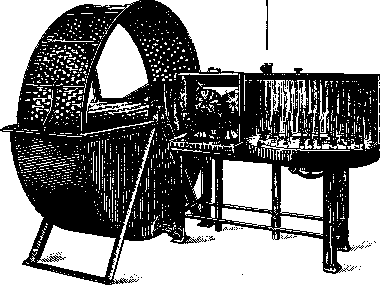
Figure 1. Washing machine. -of bottles is achieved by the fact that they are repeatedly sprayed with a hot lye solution. After cleaning on the machine, the bottle must either be dried with hot air, or boiled, or sterilized with hot steam. All utensils used in the Milk Kitchen are cleaned with hot water and soap. In large-sized institutions, specially designed apparatuses are used for cleaning utensils. 3. Preparation of infant food. Nutritional mixtures in the Milk Kitchen are prepared either from milk with the addition of other products—sugar, flour, butter, etc.—or from milk derivatives—curd, cream, buttermilk, etc. Some types of infant food, such as, for example, protein milk, the food of Czerny and Kleinschmidt, require special techniques and sometimes special devices for their preparation. In general, however, infant food is prepared by hand, which remains the same regardless of the size of the institution. For the production of cream, the Milk Kitchen must have a separator. The components of the infant food are mixed in the proper quantities together, and the nutritional mixture obtained in this way (see Milk mixtures) is poured into bottles. Special apparatuses of varying complexity are used for filling. Some of them make it possible to fill only one bottle at a time. With the help of apparatuses of more complex design, it is possible to fill large quantities of bottles simultaneously. In the largest institutions, it is necessary to use machines that seal the bottle immediately after filling.-
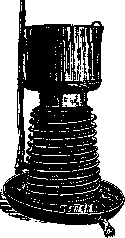
4. Prepared and bottled food must be heated to 100°. For this purpose, the bottles are placed in a sterilizer. There are two main types of sterilizers: water bath and steam bath. There are very many types of sterilizers, all of which boil down to variations of the same idea. When using a water sterilizer (Figure 2), bottles with the prepared food are placed in water and the temperature of the latter is brought to 100°. In a steam sterilizer (Fig. 3), the bottles are placed in an atmosphere of steam heated to 100°. 5. Application of cold. The most essential importance in the work of the Milk Kitchen belongs to the application of cold. Cold is needed in the Milk Kitchen both to preserve the entire mass of milk delivered to it, and to prepare certain types of infant food. In medium-scale institutions, one can limit oneself to yard ice houses for obtaining cold, with above-ground or side storage of ice (see Ice). In large institutions of the central type, refrigeration machines are necessary. When setting up a central Milk Kitchen, one must strive to ensure that an increase in the volume of work does not affect the urgency of production, since the entire output of the Milk Kitchen must always be ready by a certain hour. This can be achieved only on the condition that, thanks to mechanization, the influence of those factors that usually serve as the cause of slowing down the work of the Milk Kitchen is eliminated. These factors include 1) cooling of
Figure 2. Water sterilizer. -the incoming milk, 2) cooling of the prepared infant food after its sterilization, 3) filling, and 4) cleaning of bottles. To accelerate all these stages of work, the central Milk Kitchen must be mechanized. The Milk Kitchen prepares infant food according to a doctor's prescription and, as a result, exercises control over the feeding of the child. As far as the sanitary properties of the product from which infant food is prepared are concerned, the Milk Kitchen can do very little. The Milk Kitchen does not allow very sour milk into circulation and, by means of timely and sufficient cooling and sterilization, prevents further souring of the product. But the Milk Kitchen is forced to use the milk that is sent to it. If it paralyzes the reproduction and vital activity of microorganisms by cooling and heating, it is, in any case, unable to remove the dead bacterial bodies contained in the milk. Likewise, the Milk Kitchen cannot increase the vitamin content in the milk. In other words, the Milk Kitchen cannot make good milk out of bad milk. From this it follows that the Milk Kitchen must receive good, clean, and vitamin-rich milk. Thus, the goal of the Milk Kitchen's work—the improvement of the health of the child population, insofar as it depends on the quality of food—can be achieved only on the condition that the Milk Kitchen and the dairy farm work together, complementing one another. The premises of the Milk Kitchen are arranged in accordance with the given scheme of work. The most appropriate sequence of rooms according to the stages of work appears to be: 1) for the delivery of milk and its testing, 2) for cooling the milk, 3) for separating, 4) for the preparation of nutritional mixtures, 5) for sterilization, 6) a room for distribution to mothers. Furthermore, rooms are needed for: 1) returned utensils, 2) cleaning of utensils, 3) storage of clean utensils. Personnel. Premises for personnel: 1) a room for the doctor and laboratory, 2) for intermediate and junior staff, 3) office. Services: 1) storeroom, 2) inventory room. For work in the Milk Kitchen, personnel who have received special training are used. Such training is provided primarily by medical technical schools, in which the entire complex of sciences is studied, the knowledge of which is necessary for workers in the field of maternity and infant protection, and which includes information related to the Milk Kitchen. In addition, in some larger or smaller Milk Kitchens, practical and theoretical training is provided for persons who wish to dedicate themselves to this work. The personnel of the Milk Kitchen consists primarily of Milk Kitchen sisters. They directly prepare the infant food. These workers must be well acquainted with milk as a market commodity and raw material for the preparation of infant food. They must be able to perform all studies of milk used in the Milk Kitchen and must be familiar with all methods of preparing infant food. In addition to the work of directly preparing food, the Milk Kitchen has to perform a fairly large amount of accounting work. To facilitate accounting work, the People's Commissariat of Health has issued sample ledgers containing ready-made breakdowns for all types of infant food and for all its quantities. The Milk Kitchen must be under the supervision of a doctor, especially in those cases where the institution is large and performs the duties of a central Milk Kitchen, and especially if teaching is conducted there. At the present time, the Milk Kitchen is found everywhere where work on the protection of infant age is conducted. In connection with the peculiarities of infant dietetics adopted in each individual country, the content and methods of work of the Milk Kitchen acquire a local imprint. In this regard, the peculiarities of the work of the Milk Kitchen in America deserve attention. In Western Europe and in the USSR, it is customary to compose infant food from individual components included in its products
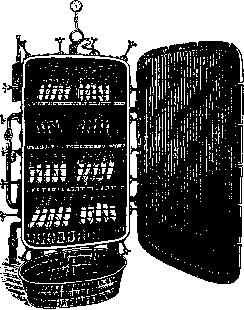
Figure 3. Steam sterilizer.
products (milk, water, decoctions, etc.), measured quantitatively (e.g., 120 cm3 of milk, 60 cm3 of water, 9 g of sugar, etc.). In America, the components are calculated according to the quantity of basic nutritional elements they contain. The amount of fat, protein, carbohydrates, and other components required for the child's corresponding age and weight is calculated beforehand; then, the amount of milk, cream, sugar, etc., containing these components is calculated accordingly. The American method is, of course, more precise, but there is no essential difference, since in the USSR and Western Europe they proceed from the same principle, only they take average values for the content of nutrients in food. The number of Milk Kitchens at the present time is significant, and their combined work is of enormous importance in reducing infant mortality. Consultations in rural areas, as a rule, do not yet have Milk Kitchens, mainly due to a shortage of workers. In recent years, when the question of organizing public child nutrition has been raised, the functions of the Milk Kitchen are expanding, and a tendency is emerging for them to develop into a central food station for infants and young children. A central food station is built as a large, mechanized institution under qualified medical supervision and consists of: a) a Milk Kitchen, producing simple and therapeutic milk mixtures, whole milk, and supplementary food for infants; b) a vitamin kitchen, producing special children's dishes rich in vitamin-containing products; c) a children's kitchen for small children, producing ordinary, but age-appropriate food for children from 1 to 3-4 years old. The central food station prepares food for consultations, dietary canteens for young children, for food distribution to homes, for nurseries, and other institutions for the protection of motherhood and infancy. Thus, the Milk Kitchen is breaking away from the consultation, once again turning into an independent institution, but now of immeasurably greater scale and significance, and is becoming an important link in the socialist organization of the upbringing of future generations. The first experiment of such an organization is being set up by the State Scientific Institute for the Protection of Motherhood and Infancy of the People's Commissariat of Health of the RSFSR in Moscow.
Related articles
Mentioned in
Cite this page
“Milk Kitchen.” Soviet Medical Encyclopedia. English translation of Bolshaya Meditsinskaya Entsiklopediya, 1st ed. (Moscow, 1928–1936), ed. N. A. Semashko. https://sovietmedicalencyclopedia.pages.dev/article/milk-kitchen/