Boxes (Hospital)
Historical document, translated for reference. It reflects medical knowledge of the 1920s–30s and is not medical advice.
Summary
This article from the 1928–1936 Soviet Great Medical Encyclopedia discusses hospital boxes (cubicles) used for the individual isolation of patients to prevent nosocomial infections, particularly in pediatric wards. It details the types of boxes (open, closed, and mixed), their historical development by figures such as Rauchfuss and Grancher, and the necessary conditions for their effectiveness, including proper ventilation and individual patient care.
Encyclopedia article (1928–1936)
BOXES (from English box), a name given to a part of a hospital ward isolated in the form of a stall or cage and formed by partitions separating one patient from another. Partitions are either movable, in the form of screens, or permanent. Their height ranges from 2 to 2.5 m, length 2–2.5 m, width 1.5–2.2 m, and up to 1 m from the floor they are solid, while higher up they are glazed. The material for partitions is iron or wood. The main types of boxes are: 1) the most common—open, without doors, stall-type; 2) less common—closed, with doors, like small wards having a common corridor, with each box having separate ventilation, piped hot and cold water, a separate bathroom, a floor drain for the bath, and an anteroom (first instituted by the Pasteur Hospital in Paris, and in the USSR by the State Scientific Institute for the Protection of Motherhood and Infancy of the People's Commissariat of Health in Moscow); 3) mixed-type—a combination of closed and open boxes: the ward is divided into several parts by solid glass partitions reaching the ceiling, and each such compartment, in turn, has a series of open boxes (e.g., the infant ward of the Model Children's Hospital in Moscow). Usually, boxes are located along the walls, which serve as their third side, or, conversely, the ward is divided by a solid glazed partition roughly in half, and the boxes are arranged perpendicularly to it with their exit facing the walls. In each box, for example, of a children's hospital, there are: a bed, a bedside table, a bathtub, a hermetically sealed diaper pail, a complete set of equipment for childcare (thermometer, spatula, basins for washing the child, powder box, etc.), gowns for nursing mothers and staff, and a chair. — The purpose of constructing boxes. Already at the end of the 19th century, a great evil for hospitals, and especially children's hospitals, was the huge percentage of nosocomial infections (see Nosocomial infections) caused by placing children with various diseases—contagious, therapeutic, and surgical—in the same ward. According to Grancher's statistics in Paris, the percentage of such diseases reached 67. In the fight against this scourge, the construction of children's hospitals followed two main paths: 1. According to the idea of the Russian pediatrician Rauchfuss, in 1869 hospitals were first built with isolated departments for therapeutic patients, surgical patients, infectious patients (separately for each infection), as well as with suspicious and mixed departments. 2. According to Grancher's idea, in 1888 individual isolation of the box system was first introduced, initially through the construction of primitive partitions between beds in the form of cloths stretched on iron rods. The system introduced by Rauchfuss reduced the percentage of nosocomial infections to 10–12. The box system, soon improved in the form of boxes of one type or another described at the beginning of the article, found wide application first in France and then in other countries. According to statistical data from various authors (Grancher, Lesage, Heubner, Schlossmann), it reduced the percentage of nosocomial morbidity to tenths of a percent. At present, along with purely box departments where children with various infections are placed, additional boxes are built in first-type hospitals (Rauchfuss) to protect children from the transmission of both
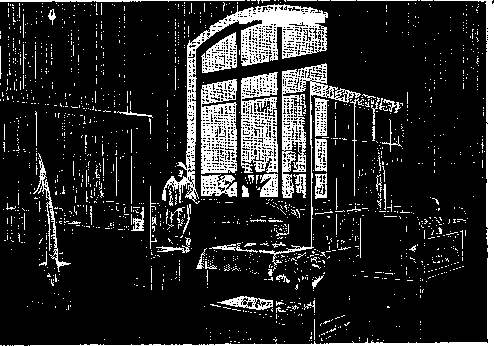
Open boxes.
BULGARIA
infections from the outside (incubation) and complications (pneumonia, diarrhea, etc.). Without going into a relative evaluation of boxes of various systems, it must be noted that at present the majority of authors, without denying the importance of physical isolation in boxes of any type, attach paramount importance to properly organized individual care, for which the following are necessary: 1) complete equipment of the box with all necessary care items, 2) the presence of sufficient (1 nurse for 6–7 children), well-qualified, and disciplined staff. Some illustration of this provision, with sufficient air cubic capacity and the importance of ventilation, can be provided by data cited by doctors Rindle and Burton (Liverpool). In a pavilion without boxes, with an air cubic capacity of 64 cubic meters per child, large windows opening frequently between beds, and strict individual care, out of 668 children only two fell ill, despite the fact that children with various infections (measles, scarlet fever, diphtheria, erysipelas) were placed in the general ward. At the beginning of the present century, boxes began to be built in our hospitals as well (infant wards, contagious pavilions, isolation wards), and currently the construction of boxes has found wide application in many institutions, especially for young children (consultation centers, nurseries, infant homes, etc.). Unfortunately, the statistics of our institutions, aside from the motley nature of the results obtained (Danilevich), generally do not yet yield the minimum infection percentages indicated by foreign authors. The reasons for this must be considered: 1) the general disorganization of hospital amenities, the lack of good sanitary and hygienic conditions, etc.; 2) the inadequacy of supplies and individual equipment; 3) the insufficiency of nursing medical personnel, their poor qualification, and weak discipline. While paying due tribute to boxes as the best method of individual isolation, modern authorities are increasingly pointing out one of the negative sides of the box regime, which is true, unavoidable for now under modern conditions, namely: psychological hospitalism—the trauma inflicted on the child by solitary confinement in the monotonous environment of a box, which apparently does not pass without leaving a trace on the course of the physiological and pathological processes of the child.
Related articles
Cite this page
“Boxes (Hospital).” Soviet Medical Encyclopedia. English translation of Bolshaya Meditsinskaya Entsiklopediya, 1st ed. (Moscow, 1928–1936), ed. N. A. Semashko. https://sovietmedicalencyclopedia.pages.dev/article/boxes/