Bowman's Glands
Historical document, translated for reference. It reflects medical knowledge of the 1920s–30s and is not medical advice.
Summary
Bowman's glands are named after the English scientist Bowman by Kolliker. These are glands of the mucous membrane of the olfactory region, with ducts that pierce the olfactory membrane and are lined with flattened cells.
Encyclopedia entry (1928–1936)
Bowman's glands, a name given by Kolliker after the English scientist Bowman, to the glands of the mucous membrane of the olfactory region (glandulae olfactoriae). Their excretory ducts pierce the olfactory membrane and are lined with flattened cells; behind them follow expanded sections or diverticula (usually in number two), into which the tubular ends of the glands open, running obliquely downward or parallel to the surface and winding. The expanded sections and tubes are lined with a single layer of cuboidal epithelium, which shows fine granularity in its body and stains with eosin. Most authors consider Bowman's glands to be serous; some described mucous cells in their composition; in animals they contain a yellow pigment. Bowman's membrane, see Cornea. Bowman's disks, see Striated muscles. Bowman's capsules, glomeruli, see Kidneys.
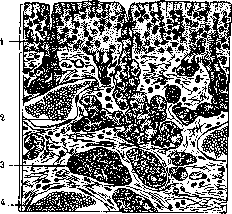
Cross-section of the olfactory mucous membrane of a rabbit: 1-excretory duct; 2-Bowman's glands; 3-cross-section of a nerve; 4-vein.
Related articles
Cite this page
“Bowman's Glands.” Soviet Medical Encyclopedia. English translation of Bolshaya Meditsinskaya Entsiklopediya, 1st ed. (Moscow, 1928–1936), ed. N. A. Semashko. https://sovietmedicalencyclopedia.pages.dev/article/bowmans-glands/