Eosin
Historical document, translated for reference. It reflects medical knowledge of the 1920s–30s and is not medical advice.
Summary
Overview of eosin, a group of acidic dibasic oxyphthalein dyes widely used in microscopic techniques, including its chemical varieties, preparation methods, and staining applications in histology.
Encyclopedia article (1928–1936)
EOSIN, a group of acidic dibasic oxyphthalein dyes widely used in microscopic technique. Brands: 1. "Eosin", or "Eosin gelblich", or "Eosin wasserlöslich" (Eosin A., Eosin G., Eosin extra Höchst) represents the potassium or sodium salt of tetrabromofluorescein, Br
Br
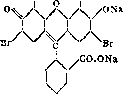
obtained by brominating fluorescein; it forms red crystals with a bluish tinge or a reddish-brown powder. Readily soluble in water and alcohol. The concentrated aqueous solution is dark violet, the diluted one is red-
or pink-yellow with a clear yellow-green fluorescence. The concentrated alcoholic solution is red-yellow, the diluted one is pink with a yellow-green fluorescence. 2. Iodeosin, or Erythrosin (see below) - sodium salt of diiodofluorescein or tetraiodofluorescein. 3. Rose bengale - sodium salt of tetraiododichlorofluorescein - brown powders dissolving in water with a cherry-red color without fluorescence. The application of eosin as an acidic low-molecular-weight dye is based on its property of easily diffusing into wide-pored substrates and providing a diffuse staining of the "impregnating" type (v. Möllendorff). Eosin is a typical dye for oxyphilic elements. It is used either as an additional "plasmatic" stain after preliminary staining with one or another basic "nuclear" dye, but mostly after staining with blue basic dyes (alum hematoxylins, methylene or toluidine blue, etc.), or in a mixture with the latter, for example, in the form of various azur-eosin mixtures - Giemsa, May-Grünwald solutions, as well as in a mixture with methylene blue (Mann's method). For additional staining, aqueous or alcoholic, less frequently glycerin solutions are most often used. Both aqueous and alcoholic solutions are usually prepared in a 0.5% dilution, and the alcohol is usually 70-proof. The quality of eosin staining is evaluated by the degree of its selectivity. Ordinary eosin solutions often give an insufficiently differentiated picture, staining not only the strictly oxyphilic elements - eosinophilic granules, erythrocytes, but also diffusely staining the very protoplasm of cells. To avoid this, special modifications of eosin solutions are used, for example: Eosin gelblich wasserlöslich (w. g.) 1.0, Alkohol 30°-250.0, Ac. ac. glaciale 2-3 drops. The liquid becomes turbid from the precipitate formed. Filter after 2 weeks. The duration of staining with eosin solutions is about 5 minutes. In azur-eosin mixtures, as well as in mixture with Methylblau, eosin is no longer a diffuse "impregnating" dye, but stains according to the "precipitating" type characteristic of basic dyes, settling on basophilic elements, for example, on chromatin granules that have already taken up the basic dye from the staining mixture - azur, methyl blue, etc. Jodeosin (syn.: Erythrosin, Eosin, blaulich, Erythrosin extra gelblich, Erythrosin extra blaulich), alkaline salts of 2-iodo- and 4-iodofluorescein

I ! I ! /\ /COONa Dark brown powder; dissolves in water with a cherry-red color; but does not fluoresce. Obtained by iodinating fluorescein. Jodeosin is used in a 0.1 - 1% aqueous solution instead of ordinary eosin as a good plasmatic stain.
Related articles
Mentioned in
Cite this page
“Eosin.” Soviet Medical Encyclopedia. English translation of Bolshaya Meditsinskaya Entsiklopediya, 1st ed. (Moscow, 1928–1936), ed. N. A. Semashko. https://sovietmedicalencyclopedia.pages.dev/article/eosin/