Feeding of Young Children
Historical document, translated for reference. It reflects medical knowledge of the 1920s–30s and is not medical advice.
Summary
This article discusses the physiological and practical aspects of feeding young children, emphasizing the unique requirements of infants and the irreplaceable benefits of breast milk over artificial feeding methods.
Encyclopedia article (1928–1936)
FEEDING OF YOUNG CHILDREN, especially during the first year of life, has a number of features corresponding to the age-related, functional, and individual characteristics of the child's organism, as well as to the conditions of its life and environment. Physiological equilibrium in adults, achieved by introducing a certain amount of the most important components of food to cover the body's expenditures, is complicated in the child by the requirement of sufficient quantity and quality of food for building new tissues and for growth of the body. Furthermore, due to the fact that the child's organism has very little resistance to infections and other harmful influences, rational feeding aims not only to ensure proper development of the child but also to raise its immunity and adaptability to external harmful conditions. Finally, the peculiarities of the digestive organs and cellular metabolism impose certain requirements on food, the non-fulfillment of which leads to severe disturbances of digestion and nutrition. Therefore, despite the fact that "the dynamic principle of food regulation in nature is the most profound and most universal" (Rubner), despite all its practicality in application to determining the amount of food, one cannot limit oneself in this matter only to the energy point of view. A striking proof of this is the generally recognized fact that to this day there is no such artificial nutrient mixture that could always replace human milk. The basis of feeding is a very definite biological law, that every animal belonging to the class of mammals must at birth receive milk of its mother, since the composition of milk is individually adapted to the species of animal (see Milk). Breastfeeding is a continuation of the close connection that exists between mother and fetus during the intrauterine period, since when the child, anatomically separated from the mother, continues to receive nutrition, as in the intrauterine period, from the mother's organism and only gradually adapts to completely independent existence. Culture and social conditions change both the human organism itself and the requirements imposed on it; but still, violations of this law in the masses always have a heavy impact on the results of child feeding, expressed in increased morbidity and mortality of the latter. For this reason, propaganda of breastfeeding is the duty of a physician dealing with the problem of child feeding. Thousands of consultations scattered throughout cultural countries are fighting against artificial feeding, improper supplementary feeding, and improper breastfeeding. This struggle, together with sanitary education of the masses of mothers, has already given and will continue to give results not only in the form of reduced mortality but also in the improvement of the health of the rising generation. The question of what exactly are the precious properties of human milk is very complex and has not yet been fully clarified in all its aspects. The homology and completeness of proteins, the composition of salts, close to the composition of the ash of the child's body, certain correlational ratios between the components of human milk, the relatively small demands made by it on the child's digestive organs - all this is insufficient to explain its advantages over animal milk. A number of substances of a finer structure, such as enzymes, vitamins, immune bodies (antitoxins, etc.), obtained from the mother's blood, makes human milk as if living tissue, "white blood," an irreplaceable product for feeding still weak, functionally inadequate young children (see Infant). The combination of all these properties of human milk, supplemented by the fact that it is obtained at each feeding directly from the breast, sterile, warm, determines its advantages over artificial feeding of the child, that is, in the full sense of the word, "revival" of the child that occurs when transferring it from artificial feeding to human milk, and that increase in immunity that cannot be achieved by other means. Despite all these precious and irreplaceable properties of milk, there are still conditions when the mother cannot breastfeed her child or even should not do so. Cases of absolute absence of milk are very rare (see Agalactia), while hypogalactia, occurring in approximately 20%, is an indication not for weaning from the breast but only for the introduction of supplementary feeding (see Hypogalactia). In cases where the child cannot take the breast for one or another physical defect on his part (malformations) or in case of underdevelopment of the mother's nipples, feeding with expressed milk can be used. Anemia, nervousness and generally poor health of the mother are not an absolute indication for refusing to breastfeed, since in many cases the mother's health even improves when she performs this physiological function; it is only necessary to monitor the mother and in time switch to mixed feeding, individualizing each case. Prohibition of feeding is indicated in cases of open tuberculosis of the mother or severe, debilitating illness of hers (cancer, nephritis with uremia, diabetes, heart defect in the period of decompensation), especially if the latter presents a danger to the child (erysipelas) or, finally, in cases of maniacal psychosis or extreme depression and severe epilepsy. The technique of breastfeeding is simple. The main requirement is cleanliness, for which it is necessary, besides as frequent baths or saunas as possible, to wash hands before feeding and to rinse the breast nipple and areola with boiled water. The use of disinfectants, ointments, alcohol, etc. is permissible only in pathological cases. Wiping the child's mouth is harmful. Breastfeeding should be done in the most comfortable position for the mother's body: lying down in bed on her side - in the first days after childbirth, with weakness of the mother, etc., or sitting - on a low stool or chair so that the back of the nursing mother does not tire; the child in this position lies on the mother's knees, head on her arm resting on slightly raised knee, for which the mother's foot is placed on a small stool. The first application to the breast is done 9-12 hours after birth (there is no need to wait 24 hours). If there is still no milk or if the amount of colostrum secreted at this time does not satisfy the child, one can give him a little more boiled water, sweetened with saccharin or sugar, from a spoon. The experience of large maternity homes shows that from the second day the child can be regularly applied to the breast every 3 hours, except for the night interval of 6-8 hours. For strong, healthy children, the interval between feedings can be extended to 4 hours, and for weak ones reduced to 2 hours. After 4 months, in a normally developing child, the number of feedings usually does not exceed five. The breast is given alternately, one feeding the right, the other the left. With a small amount of milk in the mother and in children older than five months, it is often necessary to give both breasts each time. The duration of feeding varies from 15-20 minutes and should not exceed 30 minutes, as it has been established that further lying at the breast almost does not increase the amount of milk sucked out. The total amount of milk sucked out by the child per day varies individually, approximately corresponding to body weight, and can be seen in the average figures (in grams) from the following table by Feer. The average amount of milk sucked out by a newborn per day is practically determined by an increase of 70-80 g per day, except for the day of birth (Finkelstein). For example, on the 5th day [(5-1) × 70 or 80] = 280-320 g; on the 2nd week it should be not less than 100 g per 1 kg of weight. During the first half of the year, the amount of milk per day should not exceed 1/6 of body weight and be less than 1/5 of it (numbers convenient to remember: an 8-week-old child receives 800 g per day). Considering the caloric value of human milk at 650 calories, Heubner calculated the "energy coefficient" necessary for the proper development of the child: for the first half of the year 100 calories per 1 kg, for the second half 90, and in the second half of the year 80 and less. For premature infants, hypotrophics, and individually poorly developing children, this figure is increased by 20-50% or is calculated based on the normal weight of a child of a given age (Sollgewicht). This general figure of the necessary pro die number of calories makes it possible to calculate the food for a given child. For example, a five-month-old child weighing 6,000 g should receive at least 6 × 90, i.e., 540 calories per day. Considering that in 100 g of human milk there are about 65 calories, the child needs to be given about 830 g, or 165 g per feeding. The regime of the nursing woman differs little from the usual: a somewhat smaller amount of work and more rest, mandatory walks in the open air and at least 7 hours of sleep. Fatigue noticeably decreases the amount of milk. The regularity of life and the absence of excesses are very important.
Sexual life in moderate degree is permissible. Frequent baths, washing or bathing in non-cold water are recommended. As for the dietary regime, the nursing woman, satisfying her appetite, eats and drinks somewhat more than usual, since she gives away about 650 calories in the form of milk. Food can be the most varied, without a large amount of meat and milk (constipation, decreased appetite). Vegetables and fruits are mandatory and in raw form, in an amount which the intestine can tolerate. The amount of liquid should correspond to the need, but one should not force drinking. Alcoholic beverages in large quantities and very irritating and odorous substances are prohibited. The question of the influence of food on the quantity and quality of a woman's milk is still little studied (see Milk). The best indicator of the correctness of feeding is the development of the child: its weight and height within normal limits, development of psyche and static functions (see Infant). Failures in breastfeeding by the mother may depend on the mother herself, her lactational ability (hypogalactia and early cessation of lactation), her health in general (postpartum diseases), as well as local causes: improper development of the nipples (flat, retracted nipples), cracks in them, and finally, mastitis. More often the cause lies in the child, when local reasons also interfere with the correctness of feeding: defects in the development of lips, jaws, hard and soft palate (cleft lip, cleft palate), nose or general ones, in the form of congenital weakness, prematurity, defects or delayed development of functional abilities of the digestive tract (lack of HCl, enzymes); one of the frequent causes are constitutional features of the child (neuropathy). Finally, a frequent cause of poor development of the child during breastfeeding, despite careful care and observance of all feeding rules, are infections: lues and tbc, which often occur in a latent form. In those cases where the mother for one reason or another cannot feed her child at all, the question arises of transferring the child to feeding by another woman. The method of feeding children by wet nurses, which was widely used before, is now very rarely applied. This was facilitated, on the one hand, by the spread of correct views on child feeding and the mother's duties (unceasing propaganda by doctors that every mother should feed her own child), on the other hand, by changes in the cultural and living conditions of the mass from which wet nurses were drawn, and since the revolution, by the raising of the mother's self-consciousness and changed economic position. The more cultured the country, the more difficult it is to find a woman who would agree to deprive her own child of the breast and sell her milk to another child. Wet nurses remain only for institutions, where they are with their own children and give the surplus of their milk for feeding, mainly sick children (see Wet nurse). Feeding by a wet nurse is carried out according to the same rules as by the mother and gives the same results in terms of the child's development and health. In institutions, it is now customary to give children expressed milk; as experience shows, the amount of milk and its quality, as well as the duration of lactation, do not change from this practice, even if the wet nurse does not have her own child whom she would put to the breast. When the mother cannot fully satisfy the child's nutritional needs, there is no need, as is often done, to abandon breastfeeding, but it is only necessary to give the child supplementary food. Usually this moment occurs at 1-6 months; after 7 months such supplementary food becomes necessary, even if the mother has a sufficient amount of milk, because by this time the rapidly developing organism of the child begins to suffer from a lack of carbohydrates and salts K, Na and especially calcium and iron in food. According to Bunge's theory, the reserve of iron accumulating in the last three months of fetal life in the body of the fetus, when fed with milk containing little iron (1.7-2 mg Fe2O3 per 1 liter), turns out to be exhausted by 7-9 months, and the child inevitably becomes anemic if he does not receive in supplementary food containing iron, mainly of plant origin, various kinds of cereals, vegetables, fruits and other food (see below). If the mother cannot satisfy the needs of a child under 5 months, the child is transferred to mixed feeding by breast and some other nutritious, usually milk, mixture. This happens: 1) in hypogalactia; 2) in case of illness of the mother, when breastfeeding exhausts her; 3) when the mother cannot fully feed the child for social reasons (work, public duties); 4) in pathological cases when the child requires for his proper development an increase in some component of food or there is a deficiency of this ingredient in the mother's milk even for the normal needs of the child. Additional food is given to the child, depending on circumstances, either as a separate feeding or together with breast milk, however, so that the total volume of food does not exceed the normal full feeding. In mixed feeding, it is necessary to keep in mind some practical rules: 1. When feeding with breast milk and milk mixture at the same time - first give the breast. 2. When feeding with a mixture from a bottle with a nipple (for children under three months) make the holes in the latter as small as possible, so that feeding lasts approximately as long as breastfeeding. 3. Insist that the mother gives the breast at least twice a day, otherwise lactation cannot be maintained. 4. As often as possible, control the child's weight gain and the amount of milk sucked from the breast by weighing, because it happens that when the mother's health improves, the amount of milk increases and it becomes possible to stop supplementary food. Mixed feeding, as experience shows, with proper application and observation of the child gives very good results; therefore this method is gaining more and more widespread use, as it makes it possible to free the woman for the fulfillment of her public duties without harm to the child. Indeed, if the mother after a two-month exemption from work has to leave home and cannot return there until the end, she, after feeding the child and expressing milk for the next feeding (in 3 hours), can give a milk mixture corresponding to the age and condition of the child, and then, returning home, breastfeed again. Although this method is much lower than purely breastfeeding, with the ever-increasing involvement of women in social and professional work, mixed feeding will undoubtedly become a very widespread method. Weaning from the breast, with proper development of the child, usually occurs between 9-12 months of its life; longer feeding, which exists as a rule among some peoples, does no harm if at the same time the child receives other, non-milk food; without this condition it is inadmissible (anemia). The transition to artificial feeding should be gradual, approximately over a period of two weeks, and one should not wean from the breast in hot summer weather or when the child is ill, because the deprivation of female milk, even in the absence of gastrointestinal disorders, is as a rule accompanied by a temporary decrease in immunity, and in nutritional disorders, which often occur in summer, the latter is sharply reduced anyway. When it is impossible to give the child maternal or female milk in general, one has to resort to artificial or, as it was proposed to call it, unnatural feeding (this term, however, did not catch on). Artificial feeding of a child represents a great and difficult task, which can be said to be central in the field of pediatrics and has enormous social and scientific significance, a task not yet resolved despite the great successes made in recent times. It is impossible to give food that fully replaces female milk, but we can demand of the food proposed instead of female milk that it be brought as close to it as possible so that the child's organism requires the least amount of additional work or, at least, is harmed as little as possible. Individual children can be fed with any mixture in suitable conditions, but it is quite another matter to give food suitable on a mass scale for a healthy and sick child. There is little to argue that such food is mostly animal milk, despite its significant difference from human milk. Feeding children with animal milk was used in ancient times by directly applying the child to the animal's udder. On ancient Egyptian drawings and in works of art concerning Greek and Roman mythology, there are depictions of children being fed by cow, goat, doe, she-wolf (see figure 1); but even in the 19th century attempts were still made to feed children directly by applying them to the udder: Zwierlein in Germany (1817) persistently recommended feeding children with goat's milk (see figure 2); Tarnier and Parrot in France (1871) set up special rooms in their institutions where children were applied to the udders of donkeys. Parro even calculated that by giving donkeys mercury and iodine, he could thus treat luetic children.
Attempts made at a later time (Brunnig) proved the unsuitability of such a method of feeding. Along with this, ancient frescoes and paintings contain depictions of objects, and in museums of antiquities—actual horns, flasks, feeding bottles, from which milk was given to children, as well as spoons, cups and other utensils for feeding, which acquaint
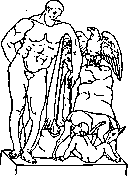
Figure 1.
us with the methods of artificial feeding among the Egyptians, Greeks, Romans and other peoples. The results of artificial feeding of a child were, of course, always and everywhere poor, but literary data on this question is very scarce: obviously, this little interested physicians of former times, since infant life was valued
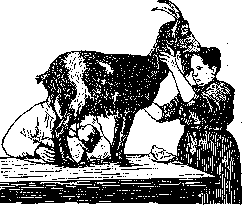
Figure h.
was not high. Only with the identification of the importance of preserving the lives of the rising generation, with the development of statistics, and since the separation of childhood diseases into a special discipline in the second half of the 19th century, the question of the enormous child mortality among artificially fed children immediately arose in its entirety, and the scientific study of the causes of this phenomenon began. The failure of artificial feeding was first seen in the difference in the chemical composition of human and animal milk, with special attention being paid to the milk proteins. The larger amount of protein compared to human milk and its coarse curds when cow's milk clotted were considered the main reason for its difficult digestibility and digestive disorders in early childhood. Therefore, first by Ritter von Rittersheim and then by Biedert, dilutions of cream and milk with water with added sugar were proposed (see Biedert's cream mixtures). The position put forward by Biedert regarding the difficult digestibility of cow's milk casein led to a number of proposals for the preliminary treatment of casein with trypsin, its peptonization, dilution with whey, etc., and a number of preparations appeared under the name of artificial human milk, children's albuminous milk (Voltrner, Backhaus, Loflund, etc.); none of them lived up to expectations and, of course, were not suitable for mass feeding of children. This theory of the poor tolerance of casein from animal milk by the child's organism has been practically refuted by the widespread successful application in recent times of preparations containing large amounts of casein (protein milk, buttermilk, larosan, plasmon, etc.). Czerny and Keller expressed the hypothesis about the harmful influence of the fat in cow's milk, which gives a large amount of lower fatty acids, causing irritation of the intestines and diarrhea. This theory also proved to be untenable. Milk sugar and the salts (whey) of milk were also put forward as the cause of failure in feeding with cow's milk (Finkelstein, Davidson, Keilman, etc.). Despite the enormous number of different mixtures and methods of feeding based on these theoretical premises about the difference in the chemical composition of human and animal milk, no practically useful proposals emerged. Obviously, the matter does not lie only in the chemical difference. Advances in bacterology led to the hypothesis that the harmful effect of animal milk depends on its contamination with bacteria, which cause diseases of the intestinal tract in children. Sterilization and pasteurization of milk appeared, along with appropriate apparatus (Soxlet, Gippius; see Soxlet's apparatus and Gippius's apparatus), but here too hopes were not fulfilled, as these methods did not have a decisive influence on the success of feeding. In the search for the causes of failure in artificial feeding, medical thought turned to the difference in the biological properties of the two types of milk, and work is now proceeding in this direction by studying the heterogeneity of proteins, fats, whey, their correlational relationships, as well as the study of enzymes, the adaptability of the organism to the assimilation of food, conditions depending on the child himself, his living environment, etc. Just as the hypotheses about the significance of the difference in chemical composition and bacterial contamination of cow's milk, so too the biological difference from human milk cannot but be taken into account; work in all these directions has contributed and continues to contribute its share to clarifying the question of the difficulty of artificial feeding, but it is undoubtedly one-sided views on the unsatisfactory nature of artificial feeding that cannot explain the causes—this question is complex and must be considered as a whole, taking into account not only the milk itself but also the peculiarities of the child's organism in all their variety and the surrounding environment; only the study of this complex of conditions will create the possibility of successful artificial feeding. This explains why in a good family environment it has long been possible to raise a child on cow's milk, while in the conditions of former institutions all attempts remained unsuccessful. The last decade has brought enormous practical achievements in this area, and modern institutions for young children, despite the widespread use of artificial feeding in them, no longer show 60-100% mortality, and the latter has fallen below 10%. This success is based on overcoming the so-called hospitalism (see) of closed institutions, on increasing the child's immunity to infections and tolerance to foreign food. This is achieved by establishing certain hygienic living conditions for children (premises, light, air, cleanliness, proper care, etc.), on the one hand, and by eliminating the qualitative and quantitative starvation of the child, which determines the level of his life potential, his ability to assimilate food. Until recently, the significance of starvation for the child's organism was generally given very little consideration, and the teaching about the harm of individual components of cow's milk, about the harmful food residue, and the fear of overfeeding, which were primarily used to explain digestive tract disorders, led to constant underfeeding of the child, undermining his strength, and reducing his vitality. Without denying the harmful effects of overfeeding, it is necessary at the present time to especially emphasize the destructive effects of hunger on the growing organism. The younger the child and the worse his nutrition, the more harmful for him is not only prolonged but even short-term hunger, damaging his intracellular exchange, disrupting the work of the protoplasm of his body's cells, which clinically is expressed by loss of weight, decreased functions of the organism and immunity; the child dies in a state of atrophy from any accidental infection (see Starvation). The amount of calories in food per 1 kg of weight of a normal child (about 100 in the first year of life), established by the work of Geibner and Rubner, must always be taken into account in artificial feeding of a child and should even exceed this figure, especially for children in closed institutions (Gerasimovich). This necessary amount of calories can be covered by different compositions of food, with the predominance of one or another of its components, which is not indifferent to the correctness of the child's development and the success of feeding; therefore, the second basic requirement of artificial feeding is certain correlational relationships between proteins, fats, and carbohydrates. These ratios for children up to 6 months should correspond to those that exist in human milk, i.e., for 1 part of protein there should be 3.5 parts of fat and 7 parts of carbohydrates. It is especially required that for 1 part of fat there should be 2 parts of carbohydrates, and the replacement of fats with carbohydrates by some authors (Pirquet, Groer) at the same caloric value of the mixture will not give the normal pink color of the skin and the turgor of subcutaneous tissue and, finally, the height of immunity that occur only when the child has a sufficient amount of fatty substances in his food. The failure of feeding in the first days and weeks of life with very diluted milk (1:3 and 1:2) stands first and foremost in dependence on the non-fulfillment of these two basic requirements. To cover the necessary amount of calories with the first of the mentioned dilutions, the child would have to suck about 1,000 g of mixture per day, but even then the need for fats would remain unmet. Therefore, most authors from the first days of life give milk diluted with an equal amount of water, with the addition of 4-6% sugar (see dia r. on p. 757-758). One cannot keep a child on such a mixture for long, as it contains little fat; some authors (Finkelstein, Nassau, etc.) recommend adding to it, starting from the 3rd week of life, first 1%, and then 2% fat in the form of butter or cream. One can also successfully add one of the so-called fat mixtures (see Milk mixtures). Thus, as an example of food for feeding a child in the first weeks, the following prescription can be given: cream (10%) 15 g, whole milk 35 g, water 50 g, sugar 5%. The addition of sugar is usually sufficient in the amount of 5%, but an increase to 7% is also possible, with milk sugar, due to its tendency to ferment more readily, being replaced by ordinary beet sugar. The supplementation of cow's milk with carbohydrates is usually limited only to increasing the amount of sugar. Experience shows that the introduction of a second carbohydrate (polysaccharide) has a beneficial effect on both digestion and assimilation of food, which is expressed in a more vigorous gain in weight of the child. The simplest and most suitable way for this is to dilute milk not with water but with a decoction of one or another cereal containing 3-5% dextrins. This is also the basis for adding to the mixture of milk and water one or another children's flour, which usually contains dextrinized starch and maltose (Mellin's food, Nahrmaltose, Soxlet's nutritive sugar, and in our country Maltone). Experience has shown that the tolerance of dextrins and starch is even quite high in small children; therefore, cautious use of decoctions is possible, according to some authors, even from two weeks of age.
The best development of the child when feeding milk with broth apparently depends not only on increasing the caloric value of the mixture by increasing the amount of carbohydrates, since the addition of sugar does not give such results, but on increasing the activity of digestion, due to the stimulating effect of the second carbohydrate on the intestines. Thus, mixtures for children are relatively simple in composition, but for the success of artificial feeding, it should be remembered that they must contain the necessary nutrients for the child's development in the correlational ratios indicated above. Taking the same example as in breast feeding, we can give a 5-month-old child weighing 6,000 g a mixture consisting of 2 parts milk and 1 part broth of flour with the addition of 5% sugar for the entire volume of the mixture, i.e. 530 g of milk (345 calories), 270 g of 3% broth (32 calories) and 40 g of sugar (160 calories), totaling 537 calories. This minimum amount of food can be increased by 10-15% by increasing the volume of food or increasing the amount of sugar to 7%. The use of more complex mixtures containing increased amounts of proteins, fats or carbohydrates, acidic and concentrated mixtures is used in pathological cases, when for various reasons the child does not develop on ordinary mixtures. More often this has to be used in closed institutions, where, as indicated, children require a larger amount of calories for proper development, and the volume of food cannot be increased. The use of such mixtures requires careful individualization of each case, but the general principle is to regulate the processes of fermentation and putrefaction in the intestine by proteins and carbohydrates and not to exceed the limits of tolerance that exist in a given child, when introducing a sufficient amount of water (not less than 150 g per 1 kg of weight).
Finally, the third indication that must be followed in artificial feeding of the child is the addition of vitamins to the mixture; despite the not yet finally established theoretical view of these substances, in practice the addition of vitamins brings great benefit and prevents the development of severe diseases. Animal milk, like human milk, contains various vitamins, the amount of which depends on their content in food, but still the measures applied to animal milk until it reaches the child's mouth (cooling, standing in cans, boiling and especially sterilization) sharply reduce their content in milk. Therefore, the addition of raw vegetable and fruit juices, as well as cod liver oil, to artificially fed urban children, and especially to children in institutions, is necessary, starting from three months, when one can assume that the child is already expending the passive immunity received in the prenatal period. Since animal milk is the main food for an artificially fed child, of course, the strict requirements for so-called 'infant milk' are necessary for the success of artificial feeding (see Milk). The requirements are as follows: 1) the milk must come from completely healthy cows tested with tuberculin reaction, receiving vitamin-rich feed and located in premises meeting hygienic requirements; 2) the personnel serving the farm and coming into direct contact with milk must be healthy and under constant supervision; 3) milk collection, filtration, cooling must be carried out according to the requirements of asepsis and hygiene; 4) the transport of cooled milk in sealed cans must be organized. The milk obtained in this way contains a very small number of bacteria and can be used for feeding children in its raw form.
The question of feeding children with raw milk has been much debated in the medical press (Monrad, Raimondi, Marfan and others). In individual cases, feeding with raw milk gives good results, but for mass application of artificial feeding, short boiling of milk-based mixtures and, if possible, rapid cooling of them is necessary; prolonged or repeated boiling and true sterilization of milk are unacceptable, as they lead to strong denaturation of it and the development of scurvy or at least prescorbutic phenomena in the child. Where it is necessary to use milk from other animals-goats, mares, or jennies-the same rules must be applied for diluting the milk; regarding goat's milk, there are a number of observations showing that children fed with it suffer from anemia, the exact cause of which has not yet been found.
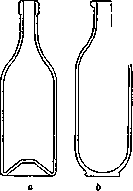
For feeding a child, it is necessary to have good bottles, preferably of a special shape, without any irregularities or sharp corners inside, in which it is difficult to wash out milk residues (see fig. 3). In the technique of preparing mixtures for feeding, besides the correctness of their composition, great importance is attached to pedantic cleanliness of all items in which the mixtures are prepared; therefore, taking into account the difficulty of obtaining good milk and the impossibility of controlling it, as well as in view of a number of technical difficulties in home preparation of mixtures, it is always more desirable to use mixtures obtained from specialized institutions. Figure 3. Bottles for feeding.- a-unsuitable; b-suitable.
from special milk kitchens (see Milk kitchen). The number of feedings in artificial feeding, just as in breastfeeding, should not exceed 6 in the first months and 5 after 3 months. The amount of food by volume per day also corresponds to the amount sucked by the child from the breast and in no case should be more than 1,000 g. The amount of whole milk included in the child's daily food up to 6 months, according to Budin, should be 1/10 of the body weight. The transition from 1:1 milk to 2:1 and from the latter to whole milk depends less on the child's age than on his general condition and development (weight, height, tissue turgor, etc.), with whole milk rarely being given before 5 months. After three months, one can use for diluting milk not a decoction of cereals but a flour decoction containing not only dextrins but also a small amount of starch. By 5-6 months, the child begins to need a larger amount of carbohydrates, and his body is prepared to assimilate them; without supplementary feeding, the child's weight and development lag, although individual deviations occur very often. Starting from the 6th month, a small amount of puree from apples, cauliflower, carrots can be added to the breast or artificial feeding, and at 6 months one of the feedings is replaced by porridge in an amount up to 200 g. By 7 months, another feeding is replaced by jelly (apple, cranberry, etc.), at 9 months the latter can be alternated with broth (see Broth, broth in children's nutrition) sprinkled with cereal or with pureed vegetables, with the addition of cracker. By 10 months, the child's food becomes even more varied. In view of the still significant denaturation of milk even with brief boiling and the destruction of vitamin C, the preventive addition of raw vegetable and fruit juices to the food of an artificially fed child is necessary, starting from the three-month age. The use of fish oil is also desirable, starting from about the same age. An approximate menu for an artificially fed child at 10-12 months may thus be as follows: in the morning at 7 a.m. - milk (200 g) or nutritious coffee with milk (1:1 or more milk), with a cracker, cookie, or not-soft bread with butter; around 10:30 a.m. - porridge on milk; at 1 p.m.: a) broth sprinkled with cereal, vermicelli or noodles, with cracker (150 g), b) potato puree with butter or apple mousse (100 g) or compote; 4:30-5 p.m. - jelly or tea with milk and cookie; raw grape or orange juice (15-30 g); 8-9 p.m. - milk (150 g). In between, thirst can be quenched with water or tea, but in no case with milk. Meat is usually given after a year, but some children who need protein food tolerate finely chopped meat or pureed veal or chicken liver well at 9 months. It is better not to give eggs until 1 year. Thus, a more or less healthy child, without severe constitutional deviations from the norm, can be artificially fed while observing the above nutrition rules, but provided that proper care and hygienic living conditions are maintained. This circumstance plays no less a role in the success of artificial feeding than the nutrition itself. While breastfeeding gives good results and low morbidity, high immunity even in a very unfavorable home environment for the child, artificial feeding proceeds successfully only with proper care and if the external living conditions do not place too great a burden on the child's body.
Related articles
Mentioned in
Cite this page
“Feeding of Young Children.” Soviet Medical Encyclopedia. English translation of Bolshaya Meditsinskaya Entsiklopediya, 1st ed. (Moscow, 1928–1936), ed. N. A. Semashko. https://sovietmedicalencyclopedia.pages.dev/article/feeding-of-young-children/