Sterilization
Historical document, translated for reference. It reflects medical knowledge of the 1920s–30s and is not medical advice.
Summary
This article details various historical methods of sterilization used in surgery, bacteriology, and pharmacy during the early 20th century. It covers physical methods like dry and moist heat, autoclaving, and tyndallization, as well as chemical disinfection techniques.
Encyclopedia article (1928–1936)
STERILIZATION. Sterilization in surgery. For the disinfection of surgical instruments, metal sterilizer-boil
Fig. 1.
Figure 2.
ers are used. The simplest and most convenient for use in field conditions (emergency surgery, in rural practice, e.g., cesarean section or other obstetric procedures, operations on
f.
Figure 3.
Figure 4.
spirit burners (Figs. 1 and 2). Instruments in the sterilizers are placed on special removable nets or perforated metal trays equipped with side hand
.
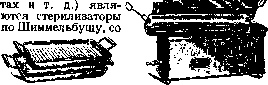
les or hooks (Fig. 3). In large sterilizers, several such trays are placed simultaneously. In large surgical inpatient departments, sterilizer-boilers are heated by gas (Fig. 4), electricity, or by steam coming from a general sterilization unit (see Operating Room). In the be-
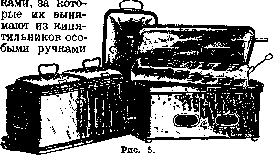
ginning of the aseptic era, sterilizers for the simultaneous disinfection of instruments and dressing material with flowing steam were widely used. For this purpose, a metal box without a bottom was installed over the boiler, into which drums with dressing material were inserted. The prototype of such a combined apparatus is the Schimmelbusch sterilizer (Fig. 5). The Turner sterilizer for dressing material is built on the same principle. With the further development of asepsis, the sterilization of dressing material and surgical linen with flowing steam was replaced by sterilization under pressure in autoclaves (see). The material to be sterilized is placed in special drums (see Sterilization Drums). For the theoretical justifications of sterilization and the methodology of sterilizing surgical silk, catgut, and other materials, see Antiseptics and Asepsis, Operating Room, Dressing Room.
N. Blumenthal. Sterilization (making sterile) in bacteriological practice is the complete killing of microbes in a given object. When studying individual types of microbes, it is necessary not only to free them from extraneous microbes, i.e., to sterilize all objects used for this purpose, but also to subsequently protect the already sterile items from the possibility of new contamination by microbes. For this, all items, materials, and instruments to be sterilized are wrapped in paper, and glassware (flasks, bottles, test tubes, pipettes) are plugged with a cotton stopper, using simple cotton, not absorbent cotton. Sterilization is performed by physical and chemical methods. For each object, it is necessary to individualize the method of sterilization. The basic requirement is the least possible change in the properties of the sterilized object. In view of this, the method of chemical sterilization is in many cases inapplicable. The most common method is sterilization by heating. The applied heating methods are divided into three groups: 1) Sterilization by calcination, 2) dry heat, and 3) moist heat. Sterilization by calcination, despite the fact that this method is the simplest and fastest, can be applied only to a limited number of items, since not all items withstand such a high temperature. Platinum loops, needles, cover slips and slides, glass rods and spatulas, etc., can be calcined. Dry heat is used to sterilize laboratory glassware, cotton, paper, and in some cases metal objects. The glassware is pre-washed with soap, thoroughly rinsed to free it from organic substances, which char during sterilization and spoil the glassware, thoroughly dried, since wet glassware bursts from heating, plugged with cotton stoppers or wrapped in paper, and placed in a sterilization cabinet or Pasteur oven. When loading the apparatus with glassware, one must ensure that the items do not touch the bottom and walls due to the higher temperature of the latter. Sterilization by dry heat is performed at an air temperature inside the oven of 150° for two hours, 160° for one hour, and 180° for half an hour. It is not recommended to bring the heating to higher temperatures, since cotton and paper burn and the resulting resinous substances inhibit the growth and development of microbes. Upon completion of sterilization, the paper and cotton stoppers acquire a slightly brownish tint. In some cases (in the absence of a thermometer), this sign can be used as an indicator of the achieved sterility of the items. Upon completion of sterilization, the oven must cool down, and only then should the glassware be removed. All items remain wrapped in the same paper and are unwrapped only just before use. Sterilization by moist heat does not require such high temperatures as sterilization by dry heat, since the admixture of water vapor enhances the effect of temperature. There are three methods of moist sterilization: 1) under pressure, 2) with steam at 100°, and 3) prolonged sterilization at low temperatures - pasteurization. Steam under pressure, with the increase of which the boiling point of water rises, has the greatest sterilizing capacity. Such sterilization is performed in an autoclave (see) at a temperature of 125-110°. Most culture media, some solutions, thick-walled glass, rubber tubes, metal objects, etc., are sterilized in autoclaves. Some special media change their properties during sterilization under pressure. In such cases, the so-called fractional sterilization at 100° (tyndallization) is used. The essence of this method is based on Tyndall's observation that a single boiling for 15-30 minutes kills only the vegetative forms of microbes, while spores remain viable; a second boiling after 24 hours kills the germinated spores, and finally, the insignificant amount of spores remaining from the second boiling and germinated spores is destroyed by a third boiling. For tyndallization, a Koch apparatus (see) or an autoclave (sterilization without pressure in flowing steam) is used. If it is necessary to obtain some nutrient substrates that change upon boiling in a sterile form, the pasteurization method is used, i.e., heating the objects for one hour for 5-7 days in a row at 56-58-75° (depending on the properties of the substance). Pasteurization is performed in water baths of one design or another. Finally, liquids that cannot withstand any heating are sterilized by filtration through a previously sterilized candle (see Filter). Sterilization with the help of some chemical substances is used as a method of disinfection and is usually the final moment in working with microbial cultures. The most common of these substances are: mercuric chloride in solutions of 1 to 500 and 1 to 1,000, a 3-5% solution of carbolic acid, a 1-2% solution of lysol, a 10-15% solution of formalin, tincture of iodine, alcohol, ether, chloroform, toluene. The sterilizing properties of these substances are related to the time of their exposure: in order to achieve complete sterilization, a certain time at a certain temperature and concentration is required for each of them.
A. Korzhinskaya. Sterilization of medicinal products. According to the Pharmacopoeia VII, the pharmacy is obliged to dispense all medicines intended for injections as sterile, regardless of whether there is a requirement for sterilization on the prescription or not. The pharmacy does not check the dispensed medicines for sterility. The Pharmacopoeia VII teaches the following methods of sterilization: 1) Heating for 2 hours at 160-170°. For this purpose, one can use an autoclave or any iron or copper box or drying cabinet, checking the temperature inside them. This method is suitable for glassware, metal instruments, and such preparations as
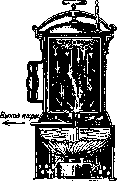
Figure 6. Schematic section through an autoclave for sterilization in flowing steam.
zinc oxide, pure talc, kaolin, etc., which do not change at 170°. Gauze and cotton tolerate this temperature poorly, and their fibers quickly become brittle. - 2) Heating in autoclaves for 15 minutes at a temperature of 115-120°; for dressing materials, in view of the difficulty of heating them for steam to penetrate the entire thickness of the material, heating at a temperature of 115° should be carried out for 30 minutes (see Autoclave). It should be emphasized that this does not imply simple heating from the outside with steam at a temperature of 115-120°, but the penetration of steam of this temperature into the very object being sterilized is necessary. Therefore, dressing materials are sterilized in packaging that allows steam to penetrate the entire thickness of the material. - 3) Heating in flowing steam for 30 minutes (for dressing materials 45 minutes). The 'flowing-steam' apparatus consists of a steam boiler or water bath and the sterilizer itself. Upon boiling of the water in the bath, steam fills the entire space of the sterilizer (Fig. 6) and displaces the air. From this moment, the sterilization time is counted. This is the most common method of sterilization in a pharmacy. Having a steam infusion apparatus, one can use it for sterilization with flowing steam by adapting an infusion vessel with two rows of holes to it (Fig. 7). - 4) Boiling. Water and aqueous solutions can be sterilized by simple boiling for 30 minutes. Glassware and metal instruments can also be sterilized by subjecting them to boiling in water (with soda) for 15 minutes. A convenient device for boiling instruments is boxes with a perforated insert, which is removed together with the instruments placed in the box, with the water draining into the outer box. 5) Solutions that cannot withstand a temperature of 100° without changing their composition are sterilized by^ w

heating for 3 consecutive days, daily for 30 minutes at 60-70° (fractional sterilization). This method of fractional sterilization, "pasteurization" or "tyndallization," is practically not used in pharmacies; it is occasionally used by pharmaceutical factories. The method is based on the denaturation of many proteins at temperatures above 56° and, consequently, the killing of bacteria. However, the spores of many bacteria do not die during this process, and upon cooling of the liquid, at the moment it reaches its optimal temperature, they develop into vegetative forms of bacteria. Since a very low temperature inhibits this growth of spores (which is the basis for the cold preservation of aqueous liquids), the temperature of the solution should be maintained at no lower than 15° in the intervals. Repeated heating to 60-70° kills the germinated spores; for certainty of complete elimination of pathogenic bacteria, this operation is repeated 1 to 3 more times. In case it is impossible to use the previous methods of sterilization or if one wishes to obtain

Figure 7. Infundirka for sterilization in flowing steam.
For a solution that would remain sterile for a longer time despite the opening of the vessel, sterilization is performed by adding disinfecting substances: chloretone, mercuric chloride (which is usually added from 0.05% to 0.1%), phenol and cresols (0.2-0.5%), thymol, benzoic or salicylic acid (0.1%), boric acid or borax (4%), essential oils (up to the saturation of aqueous liquids), chloroform (0.5%). The addition of chemical sterilizing substances is performed only with the consent of the physician, with the name and quantity of the substance used indicated in the prescription. The mere addition of disinfecting substances, especially in small quantities, is not a completely reliable sterilization and often only inhibits the growth of bacteria, which can then begin to develop again under favorable conditions in the organism. Furthermore, the added substances can alter the composition of the solution; for example, alkaloid solutions produce insoluble precipitates with mercuric chloride, phenol with antipyrine produces an oily liquid, etc. Both methods—sterilization by heating and the addition of chemical substances—can also be used in combination; for example, boiling is used with the addition of sterilizing substances or even substances such as soda or other alkalis or acids, which by themselves in a cold state cannot be considered sterilizing. When boiling with acids, and especially with alkalis, sterilization occurs faster due to the hydrolysis of proteins and fats. To sterilize instruments, devices, and utensils coming from patients, this method is often used, employing soda, soap solutions, formalin, milk of lime, lysol, lysoform, and others as the chemical sterilizing agent. For the preparation of sterile solutions of substances that undergo changes from heating, aseptic preparation is used. All necessary devices and vessels, as well as the ingredients of the solution that can withstand sterilization (e.g., water, salts), are preliminarily sterilized by one of the indicated methods. Devices such as scales, horn spoons, etc., are washed with alcohol and ether using sterilized cotton wool. It is especially necessary to emphasize the need for the sterilization of funnels and filter paper. Substances that cannot withstand sterilization are added at the end to the sterilized solution of the remaining ingredients while observing all conditions that exclude the entry of microorganisms. The following preparations are preferred not to be subjected to high temperatures, especially in the presence of alkalis or acids. All these substances should be kept in pharmacies and warehouses in a state of sterility (in particular, shelf bottles should be subjected to sterilization before each filling): Acidum diaethylbarbituricum, Adrenalinum hydrochloricum solutum, Aethylmorphinum hydrochloricum, Albumen ovi, Apomorphinum hydrochloricum, Arecolinum hydrobromicum, Argentum colloidale, Argentum proteinicum, Atropinum sulfuricum, Bismutum subgallicum, Bismutum subgallicum oxyjodatum, Bismutum tribromphenylicum, Calcium glycerophosphoricum, Chininum aethylcarbonicum, Chloralum hydratum, Cocainum hydrochloricum, Cotarninum hydrochloricum, Diacetylmorphinum hydrochloricum, Dijoddithymol, Extractum Secalis cornuti spiss., Extractum Secalis cornuti fluidum, Homatropinum hydrobromicum, Hydrargyrum amid.-bichloratum, Hydrargyrum chloratum, Hydrargyrum cyanatum, Hydrargyrum oxycyanatum, Jodoformium, Natrium bicarbonicum, Natrium kakodylicum, Neosalvarsan, Organotherapeutica, Orthoformium, Pepsinum, Physostigminum salicylicum, Pilocarpinum hydrobromicum, Pituitrinum, Scopolaminum hydrobromicum, Theobrominum natrio-salicylicum. Before subjecting any liquid to sterilization, it is necessary to be sure not only of its correct preparation but also of the absence of foreign substances, in particular dust, including cork dust, cotton fibers, filter paper, etc. Transparent solutions must be most thoroughly filtered through sterilized filter paper. Before each operation for preparing sterile forms, the pharmacist must wash their hands with extreme thoroughness using soap and warm water with the help of a brush; however, one cannot fully rely on their sterility even after such washing. All work should be arranged so that the object being sterilized comes into contact exclusively with freshly and reliably sterilized items. The entry of dust and bacteria from the air into vessels is prevented by plugging all openings of these vessels with cotton plugs, sterilized by passing them through the non-luminous (alcohol or gas) flame of a burner. Instruments and other sterilized items should be retrieved with tweezers (forceps), the ends of which are sterilized before each use by calcination in a flame. Sterilized solutions generally remain sterile only as long as they are protected from the entry of bacteria from the outside. Solutions prescribed in quantities intended for several injections are especially easily contaminated; each opening of the stopper and insertion of the syringe needle into the solution entails the danger of bacterial contamination of the solution. Therefore, the most reliable method of ensuring the sterility of solutions is dispensing in sealed ampoules (see), each of which is used for one injection, after which the remains of the contents are discarded. The removal of bacteria from injection liquids by filtering through porous candles made of unglazed porcelain (Chamberland), infusorial earth (Berkefeld), or unglazed clay (Pukall) is sometimes used in factory preparation of sterilized solutions or in the constant manufacture of large quantities of the same liquid. All devices, including filters, must be preliminarily sterilized before each filtration, and the filtered solutions checked for sterility. This method of sterilization, due to the painstaking preparatory work and the significant retention of liquid in the pores of the filter and in the receiver, is suitable only for the sterilization of large quantities of liquids, and a separate candle should be used for each liquid. This method is mainly applicable for obtaining sterile distilled water or physiological (isotonic) saline solutions. Filtration cannot be considered a completely reliable method of sterilization in view of the possibility of both the growth of bacterial colonies through the filters and the presence of accidental cracks in the filter. In addition to solutions, it is sometimes necessary to sterilize suspensions (e.g., iodoform in glycerin, salicylic-mercury salt in vaseline oil, etc.), powders (dusting powders for wounds, eye powders, etc.), and less often ointments, emulsions, etc. As a rule, the most suitable method should be considered the sterilization of each ingredient separately, the sterilization of all devices (mortars, pestles, spatulas, utensils) in an autoclave, and the aseptic preparation of the complex form. Powders should be sterilized together or each ingredient separately depending on their composition: mineral non-volatile substances (talc, zinc oxide, potassium iodide, potassium bromide, potassium chloride or sodium) allow sterilization at 150°; those that are non-volatile and do not decompose at 100° can be boiled with water or alcohol and the boiling continued on a water bath until the liquid has completely evaporated. Of the ointment bases, lanolin and vaseline withstand prolonged heating in flowing water vapor (not under pressure), the latter also being sterilized at 120°. Fats are sterilized by the fractional method or by the addition of sterilizing disinfecting chemical substances; it should be noted, however, that most bactericidal substances act reliably only in aqueous solution. Eye drops, although there are no legal regulations on this subject, should be prepared under conditions of asepsis. A special place among medicinal agents subject to sterilization is occupied by dressing materials, which come into direct contact with wounds during use. Small packages of these materials are used as an independent dosage form: cotton wool is wrapped in paper or dispensed in boxes of 5, 10, 25 g and more. Boxes for compressed cotton wool deserve attention, as they allow one to take the necessary amount of cotton wool without contaminating the entire supply (Fig. 8). All dressing materials must be sterilized together with the cardboard box or paper wrapping. Rubber items suffer from prolonged heating and become brittle or, conversely, pliable; their sterilization occurs with the least harm by boiling for 15-30 minutes in water or a weak solution (1-2%) of borax, phenol, or cresol.
Related articles
Mentioned in
Cite this page
“Sterilization.” Soviet Medical Encyclopedia. English translation of Bolshaya Meditsinskaya Entsiklopediya, 1st ed. (Moscow, 1928–1936), ed. N. A. Semashko. https://sovietmedicalencyclopedia.pages.dev/article/sterilization/