Berkefeld Candle
Historical document, translated for reference. It reflects medical knowledge of the 1920s–30s and is not medical advice.
Summary
The Berkefeld candle is a filter made from fine-porous diatomaceous earth in the shape of a hollow cylinder. It is used in bacteriological laboratories to separate microbes from liquid media, with pores small enough to trap all microorganisms except filterable viruses.
Encyclopedia article (1928–1936)
BERKEFELD CANDLE (Berkefeld-Filter), a filter made of fine-porous diatomaceous earth, has the shape of a hollow cylinder in the form of a candle, from which it gets its name. The liquid being filtered passes through the walls either from the inner cavity outward, or conversely, from the outside inward. Candles are made in different sizes and with different densities. In bacteriological laboratories, Berkefeld candles are used to separate microbes from the liquid medium in which they are located; the pores of the filter are so small that they retain all ordinary microorganisms, with the exception of the so-called filterable virus. Filtration through Berkefeld candles proceeds very slowly; therefore, to speed up the process, the liquid is passed through the candle under increased pressure or negative pressure is created in the vessel into which the filtrate flows. In Fig. 1, the Maassen apparatus is shown, in which the candle (A) is inserted into a pear-shaped vessel (C), from which air is drawn off through the side tube (B). The liquid to be filtered is poured into the cavity of the candle, passes through its walls, and collects
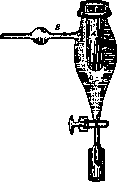
Figure 1. Maassen apparatus.
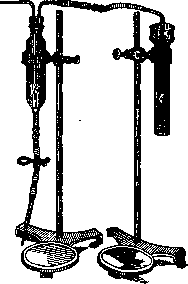
Figure 2. Apparatus for filtration: A - candle; B - vessel for filtrate; C - tube for air suction.
inside the pear-shaped vessel, from where it is poured into ampoules, flasks, etc. Zlatogorov recommends using such devices in which the candle does not enter the vessel receiving the filtrate. Such an apparatus is shown in Fig. 2. During filtration, thorough preliminary sterilization of the apparatus is necessary. In addition, it must be remembered that prolonged operation of the candle, for example, more than a day, can lead to the growth of bacteria in its pores. Therefore, filtration should not be carried out for too long. After use, the candles are sterilized for 15 minutes in an autoclave at 120°, then washed with water, dried, and calcined in special furnaces to burn off all organic substances. For water filtration, Berkefeld candles operating under pressure are used; they are fitted into a special metal case, which is screwed onto the water pipe.
Related articles
Mentioned in
Cite this page
“Berkefeld Candle.” Soviet Medical Encyclopedia. English translation of Bolshaya Meditsinskaya Entsiklopediya, 1st ed. (Moscow, 1928–1936), ed. N. A. Semashko. https://sovietmedicalencyclopedia.pages.dev/article/berkefeld-candle/