Kitasato Filter
Historical document, translated for reference. It reflects medical knowledge of the 1920s–30s and is not medical advice.
Summary
The Kitasato filter is the oldest and simplest porcelain filter that retains microbes. It is a small hollow cylinder used for filtering liquids, particularly for obtaining tetanus toxin in pure form.
Encyclopedia article (1928–1936)
Kitasato filter or candle is the oldest and simplest porcelain filter that retains microbes. In form, it represents a hollow cylinder of very small dimensions (length 160 mm, diameter 8 mm, lumen 2 mm), closed at one end. As experience shows, the K. filter belongs to the most reliable and fine-pored filters. The filter received its name thanks to the work of K., who applied it for obtaining tetanus toxin in pure form. At present, K. filters are German-made products. Filtration with the help of K. filters is usually carried out under reduced pressure, and filtration can be carried out from inside outward or in the reverse direction. In the first case, a rubber stopper is placed on the filter and it is immersed in a flask, hermetically sealing the latter with the same rubber stopper that carries the filter. The flask should have a side branch for evacuating air. The liquid to be filtered is poured into the filter with a pipette. For greater convenience, the open end of the candle can be connected via a stopper to
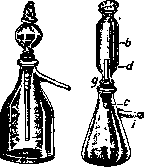
another (double-necked) vessel, into which the liquid is poured, gradually entering the filter as filtration proceeds (fig. 1).- When filtering from outside inward (fig. 2), the candle is mounted in the reverse direction: only its open end enters the flask for air evacuation, and the entire candle, turned bottom-upward, is in the upper vessel, which is connected to the lower one by means of the same stopper through which the candle is passed with its open end. The liquid to be filtered is in the upper vessel and passes through the cavity of the candle into the lower flask. The latter method has the advantage, as it allows for easier cleaning of the candle. All precautions and control are observed, as when filtering through other microbial filters.
Related articles
Mentioned in
Cite this page
“Kitasato Filter.” Soviet Medical Encyclopedia. English translation of Bolshaya Meditsinskaya Entsiklopediya, 1st ed. (Moscow, 1928–1936), ed. N. A. Semashko. https://sovietmedicalencyclopedia.pages.dev/article/kitasato-filter/