Funnel
Historical document, translated for reference. It reflects medical knowledge of the 1920s–30s and is not medical advice.
Summary
This article describes various types of funnels used in laboratory settings for filtering liquids, transferring substances, and collecting precipitates. It details different designs including glass, porcelain, and metal funnels with various angles and features, as well as specialized funnels like Büchner and Hirsch funnels for filtration.
Encyclopedia article (1928–1936)
Funnel (infundibulum), serves for filtering or pouring liquids and for pouring loose substances into vessels with narrow openings. Funnels are made of glass, porcelain, ebonite, wood, papier-mâché, metal. Funnels vary greatly in size and shape; the most common types are: Glass funnels with a 45° angle at the apex (see figure 1), with smooth walls, used primarily for filtering liquids through folded (pleated) filter paper of Gey-Lussac. Glass funnels with a 60° angle at the apex (see figure 2), with smooth walls. Filtration is performed in them through smooth Berzelius filters that fit tightly against the walls of such a funnel; in this case, filtration is much more complete but slower than through folded filters, since for the same size of paper, its filtering surface is smaller here. Glass funnels with a 60° angle at the apex (see figure 8), with ribbed walls. The ribbing of the walls facilitates faster filtration. Gwigner funnel with a 60° angle at the apex for accelerated filtration in analytical work, with a capillary 16 cm long and 2 mm in diameter. The liquid passing through the capillary tube sucks liquid from the upper part of the funnel. Allen funnel (see figure 6) for filtering very volatile liquids or those that may change in air; filtration takes place in a closed space. Büchner funnel is a porcelain funnel with a perforated plate in the form of a sieve, on which filter paper is placed (see figure 3). Büchner funnel is hermetically sealed with a stopper on a bottle, from which air is evacuated with a pump (water-jet); due to the pressure difference, filtration proceeds quickly, and the solution can be removed from the precipitate much more completely than in ordinary filtration. Büchner and Hirsch funnels (see figure 7) are used for collecting, washing, and suction of precipitates. These funnels have the disadvantage that they are difficult to clean. This disadvantage is eliminated in a similar funnel, but disassembled-Lenz. Filtration in such funnels is most often carried out with suction using
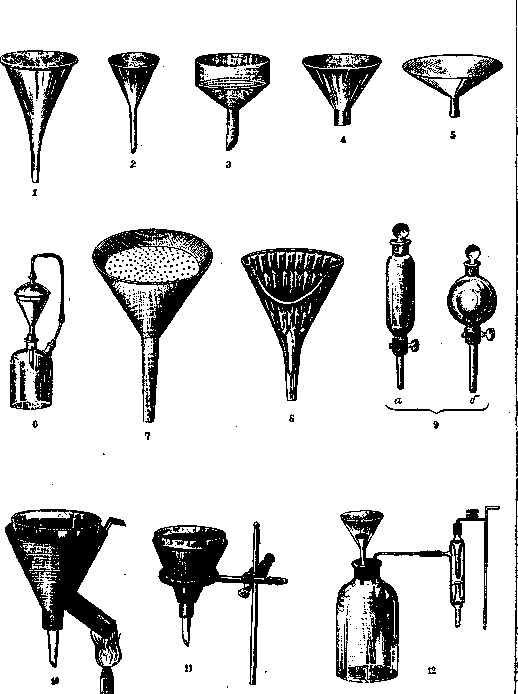
Figure 1. Glass funnel with a 45° angle with smooth walls. Figure 2. Glass funnel with a 60° angle with smooth walls. Figure 3. Büchner funnel. Figure 4 and 5. Funnels for powders. Figure 6. Allen funnel. Figure 7. Hirsch funnel. Figure 8. Glass funnel with ribbed walls. Figure 9. Separatory funnels. Figure 10 and 11. Copper funnels with double walls with glass funnels inserted in them. Figure 12. Setup for filtration with a water-jet pump. 61S with the help of a water-jet pump. Figure 12 shows such a filtration setup. Copper funnels (see figure 10 and 11) for hot filtration, with double walls between which there is water or some other liquid. At the bottom, the funnel (see figure 10) has a hollow side outlet filled with liquid. A glass funnel is inserted into the copper funnel, through which filtration is performed, heating the liquid in the copper funnel to the desired temperature through the outlet, as well as the filtering liquid. Copper funnels are also made without side outlets (see figure 11), and then heating is done with a ring burner with several holes. When it is necessary to filter easily flammable liquids, a copper funnel with two tubes is used—one at the top and one at the bottom—and during filtration, a stream of steam from a boiler is passed through the tube. Separatory funnels—spherical and cylindrical, with ground-in stoppers and taps (see figure 9 a and b), are used for separating immiscible liquids. Funnels for powders (see figure 4 and 5) are used for pouring powders and generally loose substances into vessels with narrow openings.
not in m. rectus abdominis, as is usually done, but to their natural place—in the scrotum, in close proximity to the tunica albuginea. V. approached the problem of rejuvenation simultaneously with Steinach, but independently of him, experimenting on large animals and performing numerous operations on people. In assessing the results obtained in this area, V. is apparently inclined to exaggerate their significance, treating them as true rejuvenation, with which, however, other authors do not agree.
Related articles
Mentioned in
Cite this page
“Funnel.” Soviet Medical Encyclopedia. English translation of Bolshaya Meditsinskaya Entsiklopediya, 1st ed. (Moscow, 1928–1936), ed. N. A. Semashko. https://sovietmedicalencyclopedia.pages.dev/article/funnel/