Butyrometer
Historical document, translated for reference. It reflects medical knowledge of the 1920s–30s and is not medical advice.
Summary
A butyrometer is an instrument for determining the amount of fat in milk. The article describes various types of butyrometers, particularly the Gerber butyrometer, and explains methods for fat determination in milk and dairy products.
Encyclopedia article (1928–1936)
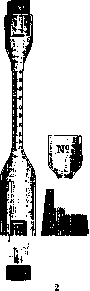
BUTYROMETER (from Latin butyrum - butter and Greek metron - measure), an instrument for determining the amount of fat in milk. Of the various constructions of B., only the Gerber butyrometer and, to some extent, the Marshan lactobutyrometer have found the greatest practical application. - The Gerber B. (see Figure 1, R. B.) is a small glass cylindrical vessel, the upper part of which is drawn out into a long neck ending in a small head, while the lower part has an opening closed with a rubber stopper. A series of small divisions is marked on the neck for reading the amount of fat separated from the milk. Among the modifications of the standard B., the flat B. (see Figure 1, F. B.) deserves attention, whose neck is more convenient for reading the small divisions of the scale. For analyzing skim milk, B.'s are made with a relatively large cylindrical body and a short neck (see Figure 1, S. B.). Gerber B.'s are also used to determine the amount of fat in various dairy products. When examining cream and sour cream, B.'s of two types are used; in one of them, cream or sour cream is poured directly in an amount of 5 g, in the other (see Figure 2), the weighing is done in a special small beaker, which is then, together with the stopper, placed inside the B. A similar device (with a beaker) is also found in B.'s for butter. (The method of using the B. is described in detail in the article Acid-butyrometry.) Besides the usual acid method of determining fat in the B., the Gerber-Wendler-'Sal' method is also very widespread, which consists in pouring 11 cubic cm of a special solution 'Sal', 0.6 cubic cm of isobutyl alcohol, and 10 cubic cm of the milk being tested into the B., plugging the B. with a rubber stopper and shaking it vigorously until the milk proteins are completely dissolved, then placing the butyrometer for 5-10 minutes in a water bath at 45°, after which it is centrifuged in the usual way and the amount of separated fat is read. The accuracy of the 'Sal' method is the same as that of the acidimetric method. The 'Sal' solution is prepared from 150 g of caustic soda, 40 g of Rochelle salt, and 10 g of sodium chloride in 1 liter of water. There are also two methods for determining fat with Gerber butyrometers: the Zihler method - 'Sinacid-butyrometry' and the Wendler method - 'Neosal'. Both of these methods are rarely used and offer no particular advantages over the basic methods described above. - For a description of the Marshan butyrometer, see Lactobutyrometer.
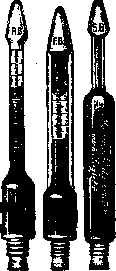
FIG. 1.
FIG
1
body and short neck (see Figure 1, S. B.). Gerber B.'s are also used to determine the amount of fat in various dairy products. When examining cream and sour cream, B.'s of two types are used; in one of them, cream or sour cream is poured directly in an amount of 5 g, in the other (see Figure 2), the weighing is done in a special small beaker, which is then, together with the stopper, placed inside the B. A similar device (with a beaker) is also found in B.'s for butter. (The method of using the B. is described in detail in the article Acid-butyrometry.) Besides the usual acid method of determining fat in the B., the Gerber-Wendler-'Sal' method is also very widespread, which consists in pouring 11 cubic cm of a special solution 'Sal', 0.6 cubic cm of isobutyl alcohol, and 10 cubic cm of the milk being tested into the B., plugging the B. with a rubber stopper and shaking it vigorously until the milk proteins are completely dissolved, then placing the butyrometer for 5-10 minutes in a water bath at 45°, after which it is centrifuged in the usual way and the amount of separated fat is read. The accuracy of the 'Sal' method is the same as that of the acidimetric method. The 'Sal' solution is prepared from 150 g of caustic soda, 40 g of Rochelle salt, and 10 g of sodium chloride in 1 liter of water. There are also two methods for determining fat with Gerber butyrometers: the Zihler method - 'Sinacid-butyrometry' and the Wendler method - 'Neosal'. Both of these methods are rarely used and offer no particular advantages over the basic methods described above. - For a description of the Marshan butyrometer, see Lactobutyrometer.
FIG. 2.
Related articles
Mentioned in
Cite this page
“Butyrometer.” Soviet Medical Encyclopedia. English translation of Bolshaya Meditsinskaya Entsiklopediya, 1st ed. (Moscow, 1928–1936), ed. N. A. Semashko. https://sovietmedicalencyclopedia.pages.dev/article/butyrometer/