Vacuum Apparatus
Historical document, translated for reference. It reflects medical knowledge of the 1920s–30s and is not medical advice.
Summary
This article from the 1928–1936 Soviet Great Medical Encyclopedia explains the design, operation, and applications of vacuum apparatus used for evaporation, distillation, and drying, highlighting their advantages over atmospheric methods.
Encyclopedia article (1928–1936)
VACUUM-APPARATUS, an evaporating or distilling apparatus from which air is pumped out by a vacuum pump; thus, evaporation (or distillation) takes place in a rarefied or almost airless space. The principle of evaporation in airless space, first proposed by Howard in 1813, caused a tremendous revolution in the pharmaceutical and chemical industries at the time. For example, the sugar beet industry owes its development and the reduction in the price of sugar to this method to a significant extent, since when evaporating in open vessels (i.e., at a higher temperature and in contact with air), much sugar was spoiled (inverted). In a vacuum apparatus, evaporation occurs much faster, at a temperature significantly lower than the boiling point of the evaporated liquid under ordinary pressure and almost in the absence of atmospheric oxygen, which makes it possible to obtain a greater yield of product with the least expenditure of time and fuel. Since air is a significant obstacle during sterilization, and high temperature acts destructively on many substances, vacuum apparatus is increasingly gaining recognition in sterilization laboratories. Scientific technique has created vacuum apparatus of various constructions, adapting them to each individual production. Figure 1 shows a vacuum apparatus made of red copper, with a diameter of t 7?! *>, nyy avo) gus, :lv tgv a:
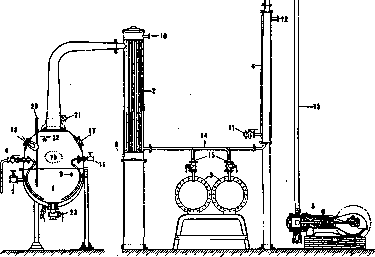
Figure 1. Red-copper evaporating and distilling vacuum apparatus of the State Plant. Boiler apparatus of the Moscow Machine-Building Trust: 1 - body, or kettle; 2 - tubular condenser; 3 - receivers; 4 - reflux condenser; 5 - vacuum pump; 6 - receiving pipe with a dial cock; 7 - valve conducting steam to the jacket; " - jacket vent; 9, 10, 11 and 12 - connections to the water supply; 13 and 14 - connecting pipes; 15 - receiver cocks; 16 - valve conducting live steam into the apparatus; 17 - sight glass; 18 - electric light bulb; 19 - manhole; 20 - thermometer; 21 - vacuum gauge; 22 - kettle vent; 23 - drain cock.
in 800 mm. A vacuum apparatus consists of a spherical kettle (1) with a useful capacity of about 130 liters, a counter-current tubular condenser (2), two receivers (3), a reflux condenser (4), a dry vacuum pump (5), etc. All internal parts of the apparatus are well tinned, and the lower part of the spherical body is plated with a layer of English tin about 0.5 cm thick. For analytical, bacteriological, and small chemical laboratories, vacuum apparatuses are made in smaller sizes. In multi-body vacuum apparatuses, the latent heat of the vapors of the liquid being distilled in the first body is used to heat the liquid in the second body, and so on, as a result of which the consumption of steam is reduced, which significantly reduces the cost of production. The two-body vacuum apparatus shown in Figure 2, with a heating surface of 30 sq. m, is used in the production of lactic acid, glycerin, sugar, and other productions for evaporating aqueous solutions of hygroscopic substances, from which it is finally difficult

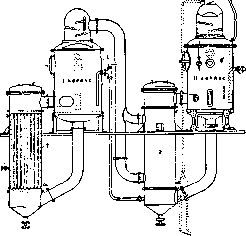
Figure 2. Two-body vacuum apparatus: 1 - cylindrical body; 2 - external heater; 3 - trap.
to evaporate water (for example, in glycerin from 26° B6 to 31° B6 and other solutions); in this apparatus, the first body is heated with live steam, while fresh solution enters the second. The apparatus consists of two cylindrical bodies, or kettles (2), two external heaters (2), a trap (3), a counter-current plate condenser, two receivers for condensation water, a dry vacuum pump, a condensing pot, and the necessary piping (the vacuum pump, condenser, and receivers are not shown in Figure 2, as they are built in various constructions; in particular, they are shown in Figure 1). The vacuum apparatus of the indicated construction makes it possible to easily clean the tubes from scale, establish intensified circulation of liquid in the tubes, and eliminate foaming of the liquid.
A. Mogilsky. A vacuum apparatus for laboratory purposes differs from the above-mentioned ones by its smaller size and simpler construction (see Figure 3). It consists of a metal water bath A, into which a porcelain or other cup B for evaporation is inserted, with well-fitted edges for liquids, on which a glass bell C with a tube in the dome is placed, also with well-fitted edges. A rubber stopper B with three holes is inserted into the tube, through which into the apparatus are conducted: 1) a capillary tube E to the bottom of cup B; 2) thermometer K; and 3) a glass tube for discharging the vapors of the distilling substance M. The latter tube is connected through a safety flask t to a pump for sucking out air. In cases where it is required to collect and distill vapors, a condenser and receiver for the distillate are inserted between the vacuum apparatus and the safety vessel.
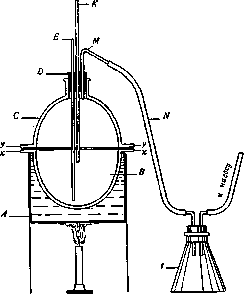
Figure 3. Vacuum apparatus for laboratory purposes.
If it is necessary to know exactly the pressure at which the work is performed, a manometer is introduced into the system. Technique of application: bath A is filled with water, the cup for evaporation is inserted into it, into which the substance to be treated is placed. The cup is covered with the bell, the edges are smeared with lard or special rubber putty and tightly fitted to prevent the ingress of air from outside, after which the whole device is connected to the pump. When collecting the distillate, the receiver is immersed in a vessel with ice or a cooling mixture. To simplify the device, parts B and C in it can be replaced by an ordinary flask.
a. Cheply. Vacuum dryer, a drying apparatus from which air is pumped out by a vacuum pump; thus, the drying process takes place in a rarefied space and therefore many times faster than in an ordinary dryer, although drying is carried out at a relatively low temperature. Substances that change from high temperature and atmospheric oxygen, when treated in a vacuum dryer, usually do not decompose or oxidize; therefore, this method of drying is often applied in the pharmaceutical and chemical industries. The Pharmacopoeia (Ph(UN)) prescribes drying the following extracts in it: Extracta sicca Alkoholi, Belladonnae, Hyoscyami, Liquiritiae and Extracta Opii, Rhei, Strychni.
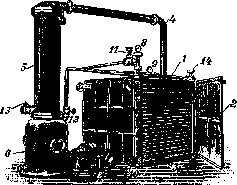
Figure 4. Vacuum dryer: 1 - body; 2 - hinged door; 3 - hollow shelves; 4 - connecting piping; 5 - tubular condenser; 6 - collector for condensation water; 7 - vacuum pump; 8 - manometer; 9 - vacuum gauge; 10 - hinged bolt; 11 and 12 - two steam valves; 13 - dial cock; 14 - vent.
When drying extracts, the dryer (see Figure 4) is first heated by introducing steam through the steam valve, having previously opened the vent to allow air to escape from the body and the system of pipes; then, after closing the steam valve, porcelain plates with thick extract are placed on the shelves; the doors are closed and tightly screwed down with bolts, and the vacuum pump is set in motion; several steam valves are opened, heating steam is admitted, and by opening the dial cock, the appropriate cooling of the condenser is established. Reaching the required temperature in the dryer, the steam valve is closed, and subsequently the drying process is observed through the sight glass. If the extract, swelling, threatens to overflow over the edges of the plates, the vent is opened for a short time and thus the vacuum is reduced. When the extract on the plates stops swelling and takes the form of a stationary cone of light, porous, dry mass, i.e., complete drying of the taken extract has been achieved, the vacuum pump is stopped, the cooling of the condenser is stopped, and the vent is opened; after unscrewing the bolts, the door is opened, the plates are removed, and the dry extract is immediately removed from them.
Related articles
Mentioned in
Cite this page
“Vacuum Apparatus.” Soviet Medical Encyclopedia. English translation of Bolshaya Meditsinskaya Entsiklopediya, 1st ed. (Moscow, 1928–1936), ed. N. A. Semashko. https://sovietmedicalencyclopedia.pages.dev/article/vacuum-apparatus/