Vacuum Cleaner
Historical document, translated for reference. It reflects medical knowledge of the 1920s–30s and is not medical advice.
Summary
A vacuum cleaner is an apparatus for removing dust from surfaces or collecting it for air quality research through aspiration. These devices come in portable, wheeled, and stationary models, operating with either air suction or pressurized air, and are valuable for both cleaning and disinfection purposes.
Encyclopedia article (1928–1936)
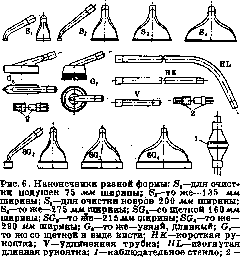
VACUUM CLEANER, an apparatus used for removing dust from surfaces or collecting it for the purpose of studying air pollution through aspiration. Vacuum cleaners come in portable models, those mounted on carts, and stationary models. They operate on different systems, some working with air suction and others with pressurized air. Portable vacuum cleaners are operated either manually or more commonly by electric current. Cart-mounted and stationary vacuum cleaners are powered by electricity, sometimes by heat engines. The main components of a vacuum cleaner are: 1) rubber hoses with a metal nozzle applied to the surface being cleaned of dust, 2) a metal reservoir where air suction or pressure is created by means of a fan, turbine, or bellows, 3) a motor (electric or gas engine), 4) a container for collected or removed dust. Metal nozzles, usually made of aluminum, come in various shapes, most commonly in the form of a shovel blade 7 to 50 cm wide; along the edge applied to the dusty surface, a 1/2 to 1 cm slit is cut to create a strong air current to dislodge dust particles from objects and carry them through the hose to a filter or special container. For fuzzy surfaces, the nozzles are made smooth near the slit, while for smooth surfaces they are equipped around the slit with a brush of varying stiffness and hair length. This brush mechanically facilitates the removal and elimination of dust particles. Sometimes the nozzle has a narrow hollow tube with a longitudinal slit on one side for extracting dust from hard-to-reach places, for example from books on shelves, from spaces above radiators, from clothing hanging in a closet, etc. The nozzle fits hermetically onto a metal hollow handle, with which one can clean floors, walls, ceilings, etc. without bending over or using a ladder. The handle fits tightly to a flexible rubber sleeve, which is sometimes enclosed in a flexible frame of metal rings; the sleeve of varying length connects to the air suction device or to the reservoir for compressed air. The connection of the sleeve to this mechanism can be either direct or in stationary installations through a network of iron pipes laid throughout the building. In the latter case, the machine for creating air suction or compression is located in the basement floor. In portable apparatus, dust on its way to the fan or through bellows first passes through a filter in the form of two bags—one woolen and the other linen. In other systems, dust with air is pushed through water, where it is trapped (fig. 1-6). Since filters become clogged with dust over time and impede air movement, a device for shaking the bags is installed to dump the dust into a lower-lying reservoir, from which it can be removed and burned or washed out of this reservoir with a stream of tap water into the sewer.
Figure 1. Cleaning clothing with a vacuum cleaner.
Stationary vacuum cleaners more often work with compressed air. The design of nozzles in these systems is such that a stream of compressed air enters through a special central tube, branching in the nozzle into two streams; one of these exits through small holes in the mouthpiece and dislodges dust particles from where they are attached, while the other turns back near the slit into the peripheral tube and creates suction in it. In this way, the pressure difference on dust particles increases and the cleaning effect is greater.
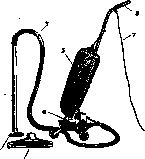
Figure 2. Portable vacuum cleaner: 1-smooth nozzle; 2-flexible metal hose; 3-fan; 4-motor; 5-dust collector; 6-nozzle with brush; 7-cord to plug; 8-handle with switch.
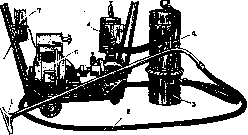
Figure 3. Cart-mounted vacuum cleaner: 1-nozzle; 2-suction hose; 3-vessel for collecting dust; 4-reservoir with filters; 5-suction fan; 6-motor; 7-cord to plug. Suction capacity of the apparatus is 60 m³ per hour. Electric motor of one horsepower. Dimensions of apparatus-90.0x43.5x70.0 cm. Weight-95 kg without accessories.
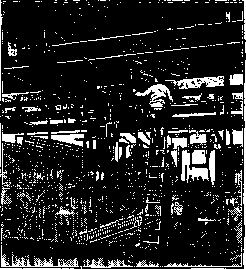
In some systems, there is a central installation that forces air into a compressed air reservoir, from which iron pipes are laid underground to the paths where carts for cleaning are placed. In the Potsdam railway workshops (Germany), in special enclosed rooms, wagons are even mechanically cleaned by vacuum cleaners in no more than 10 minutes. In skyscrapers in the USA, stationary vacuum cleaner installations are almost standard. Many factories and plants in the USA and Germany are equipped with central vacuum cleaners, for example, paint shops, weaving mills, silk-spinning mills, woolen mills, tobacco factories, cement plants, bakeries, etc. (fig. 7). Cleaning libraries, offices, printing houses, hospitals, government offices, etc. is also often done with vacuum cleaners. In the USSR, vacuum cleaners are still quite rare; after the revolution, they began to be installed for the purpose of sanitary protection of labor in printing houses, on railways, etc. Experimental testing of the effectiveness of vacuum cleaners has been carried out repeatedly both abroad and in the USSR. Berghaus indicates that with the help of a vacuum cleaner in a hotel room already cleaned by conventional methods, 393 g of dust was removed in 1.5 hours, and in another room 651 g in 50 minutes. Particularly valuable in vacuum cleaning is that during its operation, dust is not raised into the air and cleaners do not come into contact with it with their hands, as is the case with dry or wet cleaning with rags. Butyagin proved that 1.5 hours after vacuum cleaning, the number of bacteria in the air is half that after ordinary cleaning with brushes and rags, and that the air expelled from the vacuum cleaner contains much fewer bacteria than the air entering it. Vacuum cleaning at the same time serves to some extent as disinfection of the environment, and therefore represents one of the methods of combating infectious diseases. Ickert recommends spending 45 seconds to 1 minute per m² of fabric materials when processing with a vacuum cleaner, when working with a wide attachment. At the same time, up to 98% of dust and all bacteria are removed. Vacuum cleaning, of course, does not exclude other methods of disinfection and floor washing; with wallpaper, it is the best method for cleaning walls. It is possible to recommend vacuum cleaners also as a disinfestation method for removing insects along with dust from walls, items, and clothing (Kishke). Karsten recommends using a vacuum cleaner for removing moths and their larvae, for catching malaria mosquitoes from basement walls where they go to winter; he advises doing this at dusk when insects settle on walls. He also points to the possibility of using a vacuum cleaner for spraying disinfectant solutions, if the hose to the sprayer is attached to the hole expelling air from the vacuum cleaner, which can double the effect of room disinfection.
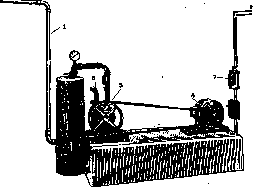
Figure 4. Stationary vacuum cleaner: 1-suction pipe; 2-reservoir for collecting dust; 3-reservoir with filters; 4-motor; 5-fan; 6-pipe expelling air; 7-switch.
Taking into account that beating outer clothing, blankets, soft furniture, carpets in cities presents a difficult problem in terms of finding a suitable place, that soft furniture often cannot be moved even temporarily (for example, in theaters), and considering the great economy of time, the completeness of cleaning all surfaces of the room, and the possibility of more frequent removal of dust from it, it can be assumed that vacuum cleaners will find wide application in the USSR as sanitary installations of primary necessity. At the same time, however, it should be emphasized that as health measures to combat dust in a production environment, vacuum cleaners have only auxiliary significance.
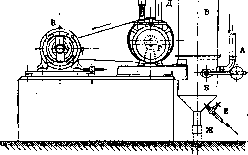
Figure 5. Diagram of a stationary vacuum cleaner: A-suction pipe; B-reservoir for collecting dust; B-reservoir with filters; Г-dust pump; D-pipe expelling air; E-pipe from water supply; Ж-pipe for washing dust into sewer; 3-electric motor.
Figure 6. Nozzle with brush for stationary vacuum cleaner: 1-part for attaching tubes.
Figure 7. Cleaning a ceiling with a vacuum cleaner in a factory.

Related articles
Mentioned in
Cite this page
“Vacuum Cleaner.” Soviet Medical Encyclopedia. English translation of Bolshaya Meditsinskaya Entsiklopediya, 1st ed. (Moscow, 1928–1936), ed. N. A. Semashko. https://sovietmedicalencyclopedia.pages.dev/article/vacuum-cleaner/