Furniture
Historical document, translated for reference. It reflects medical knowledge of the 1920s–30s and is not medical advice.
Summary
This article discusses furniture from a sanitary and hygienic perspective, emphasizing requirements for materials, construction, and placement to ensure cleanliness, safety, and proper ventilation in various settings.
Encyclopedia article (1928–1936)
FURNITURE (from the French meuble), items of daily use, serving for lying, sitting, storage of things, etc. Depending on the purpose, place, method of use, the material and construction of furniture can be very diverse, as diverse are the sanitary-hygienic requirements for furniture. From the point of view of sanitation and hygiene, furniture must satisfy the following requirements: 1) withstand ordinary methods of disinfection and cleaning by wet methods, 2) not hinder cleaning and ventilation of the room, 3) not favor the accumulation of dust and multiplication of parasites, 4) displace as little air as possible and not obstruct daylight through windows, 5) not present a danger of injury or other dangers (for example, in case of fire), 6) correspond in size and weight to the character of the room, 7) correspond in construction to the biological needs of a person: body dimensions, normal posture during work and rest, cleanliness in preparation and storage of food, storage of dishes, clothing, linen, books, etc. These hygienic requirements in application to one or another place can receive different specific, and sometimes directly opposite, expression. For example, from the point of view of danger of injury in residential apartments, light furniture is preferable to heavy furniture, whereas in places of mass gathering of the public, for example in theaters, at railway stations, heavy and especially immovable furniture is preferable to light furniture; for storing books in private apartments, closed cabinets are better than open ones, as they prevent the accumulation of dust on books, conversely, in large bookstores, open cabinets are preferable to closed ones, as they facilitate the removal of dust by vacuum cleaners, etc. School furniture, industrial furniture must satisfy special requirements (see below). The material for furniture is usually wood, preferably of hard varieties, with veneer covering from beautiful varieties of wood. In residential premises, from a sanitary-hygienic point of view, the following wishes can be made regarding furniture. Beds should be individual, single, but have curtains and canopies that hinder access of air to the sleeper. In malarial regions, on the contrary, one has to abandon this hygienic requirement and recommend curtains of tulle for protection from mosquitoes. Children's beds should be equipped with lowering barriers consisting of a mesh stretched on a metal rod. The material for the bed is best served by nickel-plated or enameled or painted iron. Wooden beds are worse from the point of view of ease of cleaning and especially disinsection. The bed should be sufficiently soft. The best are beds with a mesh on which a light hair mattress is placed, or beds with a solid frame on which a spring mattress is placed.-Furniture for s i t t i n g-bent ('Viennese') polished furniture is best. It is convenient for cleaning, light, displaces little air and in construction corresponds to the natural posture when sitting. From the point of view of cleanliness, polished furniture is best, as dust on a polished surface does not linger and sharply strikes the eye. Worse is painted furniture, as the paint is easily damaged, from which cracks, depressions are formed, where dust and dirt accumulate. Unpainted, white furniture is more difficult to clean from dirt than painted furniture, and besides it gives more cases of injury (splinters). From soft furniture, leather is preferable. Of materials for upholstery of furniture, from a hygienic point of view, smooth materials should be preferred to pile materials. Plush soft furniture is anti-hygienic in that it does not lend itself to cleaning and disinfection. Heavy, difficult to move sofas are also bad in that they displace a lot of air and contribute to the accumulation of dust under them.-Tables for dining are preferably round, for writing-rectangular polished (Swedish-American). Chairs should not be too heavy so that they can be moved during cleaning. In new construction, tightly closing niches (cabinets) should be arranged in walls for storing clothing, linen, dishes, etc., which have great advantages both from a purely hygienic point of view and because they facilitate cleaning and ventilation of the room, and most importantly do not take up space in the room, which is especially important. In general, the task of saving space appears to be an especially important moment determining the construction of new types of furniture (sofa-bed, table-cabinet, etc.). Carving on furniture is not hygienic, as it extremely hinders cleaning, and from an aesthetic point of view carving is good only when it is carefully cleaned of dust, in all other cases carved furniture will rather produce an anti-aesthetic impression.-Carpets on the floor or on the walls, heavy draperies, drapes, curtains are not hygienic, as they contribute to the accumulation of dust and hinder cleaning. If for aesthetic reasons or for protection from the sun in hot weather curtains and drapes are necessary, then white washable fabrics and light in weight and easily removable construction should be chosen. In general, direct sun rays are a powerful disinfectant, in some cases completely irreplaceable (t/bc), and their access to the room should be blocked only for real necessity, when for example they interfere with work or sleep. Where possible, one should strive to replace flammable material with non-flammable material-metal, glass (cabinet walls, table tops). This is especially important in kitchens when using kerosene for cooking. Modern technology of mass factory production of furniture offers great possibilities for the use of new materials not used in cottage production of furniture (as for example bent steel), new methods of polishing and coloring, new constructions, coordinated with the requirements of hygiene and based on anthropometric measurements. Particularly extensive work has been developed in creating new standards of furniture in America, where for this purpose special institutes exist. In our country, new standards of furniture are being developed by the All-Union Central Institute of Health Improvement and Labor Organization and other scientific institutes. In general, it must be said that the household equipment of the present time, created on the social order of the bourgeoisie, is little suitable for the new forms of socialist life. The construction of socialist cities requires the development of new types of furniture, fully meeting the needs of the working people in the new forms of their life and work. This task is the next for the near future.
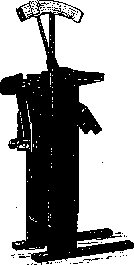
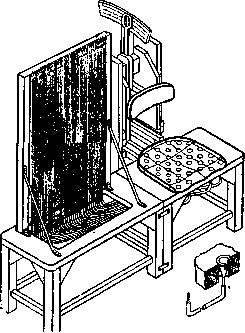
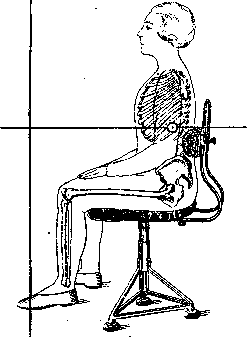
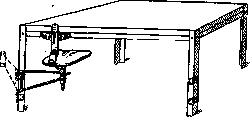
E. Lisitsky, V. Rozanov. M. [Furniture] of industrial production is an extremely important type of M. that serves the working people throughout their work in enterprises. Its significance is determined by its influence on 1) labor productivity, 2) fatigue, and 3) the health of workers. However, the experimental science has so far paid little attention to this question, which is why the development of types of industrial M. has been based exclusively on empirical data. In the USSR, for the first time at the All-Union Central Institute for Health Improvement and Labor Organization (Moscow), a scientific and methodologically substantiated approach to the study of the construction of industrial M. and its physiological and hygienic assessment is being created. The basic requirements for the rational construction of industrial M. consist in combining to the best advantage into one coherent dynamic whole the living working human organism and the surrounding production environment. Therefore, requirements of this kind can be subdivided into 1) biomechanical, 2) technical, 3) physiological, 4) hygienic, 5) economic, 6) aesthetic. Biomechanical requirements for construction follow from 3 basic biomechanical forms of human bodily activity. a) In relation to the statics of the human body, the construction of M. should primarily provide good support, maximally relieving static muscular tensions, and in addition, its form should contribute to the even distribution of forces in the human body, ensuring a correct, least tiring posture. This requirement applies to the construction of various fixed chairs, footrests, armrests, tables, etc. b) In relation to the kinematics of the human body, it is necessary to coordinate the movement of parts of M. (movable armrest, footrest, chair, etc.) with the natural movements of parts of the body, so that the former repeat or at any rate do not hinder the latter. Often, the complete disregard of the rules of biomechanics by the constructor leads to the fact that the construction of M. forces a person to make complex and unnatural movements. c) In relation to the dynamics of the human body, the construction of M. should not only exclude 'superfluous movements' but should also ensure the possibility of such a physiological motor complex in which the achievement of the goal would be accomplished with the least expenditure of energy for the worker. Technical requirements for the construction of M. a) The construction should provide for standardization and unification of types of M. for the purpose of wider dissemination and cheapening of rational M. b) The principle of interchangeability of parts of M. should be applied. c) The construction should be technically as simple as possible (small number of parts) with emphasis on simple and inexpensive methods of manufacturing M. d) All parts should be designed for standard grades of materials. e) The strength of the construction (especially for dangerous professions) should be ensured, calculated for maximum dynamic forces. Physiological requirements consist in the fact that the construction of M. should ensure, as far as possible, normal states of the physiological functions of the human body (gas exchange, blood pressure, angle of vision, etc.) and thereby protect the body from fatigue and disease. Hygienic requirements. a) Parts of furniture that are in constant contact with the body should be made of a poor heat conductor (e.g., wood). b) Good ventilation of the skin should be ensured if the human body is in prolonged (all 8 hours) contact with M. c) Edges and surfaces of M. should be smooth, even, rounded, and easily cleaned of dust, etc. Economic requirements. a) Rational industrial M. should contribute to increasing labor productivity. b) Along with an increase in the quantity of rational M. produced, a reduction in its cost is required. Aesthetic requirements are determined by the fact that the construction should be convenient, not cumbersome, and pleasant in appearance in form and color. Experimental methods for studying industrial M. should provide 1) a basis for the correct construction of M., 2) an evaluation of existing constructions. The first group of methods is essentially at the very beginning of its development and so far amounts to 2 types of biomechanical methods'. Of these, special significance in this case is attached to 1) the 'rotational photography' method (Bernstein), which consists in photographing the pose being studied for 4-5 seconds from 8 different points of view, which makes it possible with great accuracy to compose the so-called pose diagram, i.e., its complete geometric and mechanical plan; 2) the zenith photography method of the pose (Salzgeber); the photography is done with a simple camera, fixed strictly vertically, lens downward, at a height of 2-4 m above the head of the industrial worker, who is at his workplace and dressed in a close-fitting jersey, with white spherical buttons attached to each joint and to identification points of M. and the workplace. Obtaining one horizontal projection is sufficient only for studying the projection of the position of the centers of gravity of the limbs onto a horizontal plane and for calculating the distribution of the resultant static muscular tensions and static moments. To establish the dimensions of the parts of the body and their relative position, to the above type of photography is added side photography (optical axis strictly horizontal), performed simultaneously with the zenith. The resulting photographs are measured at 1/8-1/7 natural size under a projection lantern either by hand or with the help of photomeasurement, and the true values of dimensions, distances, differentials, static moments, and muscular tensions are obtained by simple calculation according to the rules of ordinary projective geometry and theoretical mechanics. Thus, with these methods, the biomechanician physician places in the hands of the engineer a) exact dimensions, b) distances, c) differentials, d) data on the distribution of the centers of gravity of the limbs (necessary for taking into account the position of the centers of supporting surfaces), and e) magnitudes of the resultant muscular efforts in the limbs. As for the form of supporting surfaces—a no less important part of the construction—its form can be obtained in the form of plaster casts from those parts of the body for which they are intended. Thus, for example, the type of chair developed by VTsIOOT has a seat constructed according to the average data of casts of average people (men and women). To the second group of methods, which give an evaluation of already finished constructions, belong the following: 1) Biophysical methods for recording the effectiveness of supporting surfaces. For example, to evaluate the role of the lumbar backrest, a dynamograph (specially constructed by Pavlenko) (fig. 1) can be conveniently used, which allows measurement of pressure on the backrest in a certain position, and if a kymograph is attached to it—also to graphically record changes in pressure on the backrest during work. This instrument can also be easily applied in any production environment if it is placed against the worker's back during work. Another instrument—the polymomanometer (fig. 2), also constructed at VTsIOOT (Salzgeber) on a different principle—allows quantitative assessment of the distribution of the pressure of a sitting person's body on various supporting surfaces. For this, for example, the seat being tested is equipped with several dozen holes, into which glass tubes filled with liquid are inserted, and is attached to a table with a stand for manometric tubes. Each manometric tube is connected to a tube in the seat with a rubber hose, and the open ends of the tubes in the seat are covered with thin rubber (similar to a Marey capsule). 2) Of the physiological methods used as indirect methods evaluating the effectiveness of M., one can name the study of gas exchange. However, it should be borne in mind that it gives only data on the degree of severity of the posture for a person with different M., but does not give direct indications of its connection with the reaction of the supporting surface. Generally speaking, here all methods that serve to characterize the degree of fatigue can be used, including psychotechnical ones. 3) An important factor for evaluation can be the method of accounting for productivity. 4) No less important is the questionnaire survey of the workers themselves. Of course, comparative experiments should be conducted on people equally well accustomed to rational and irrational furniture. The most important emerging types of rational constructions of industrial M. are the following: I. Industrial furniture providing a rational supporting surface. 1) Universal chair (of iron and wood, fig. 3), constructed at VTsIOOT. The features that advantageously distinguish it from chairs of other constructions are the following: a) Extremely simple movement of the seat in height with a light press of the foot on a pedal, b) Correct saddle-shaped form of the seat, having a front-to-back tilt. c) Variability of the rotational ability of the seat, namely: for dangerous work—complete locking; for work with a service area—rotation of 120° and finally complete rotation. d) Possibility of attaching various armrests and footrests, e) Interchangeability
2) Specialized chairs for different types of work. For example, for work requiring precision and stability, chairs with fixed seats and backrests are used. For work that requires mobility, chairs with casters and swivel seats are preferred. 3) Adjustable workbenches that can be modified to suit different tasks and workers of different heights. 4) Ergonomic computer stations that monitor the user's posture and adjust the furniture accordingly. 5) Standing desks with anti-fatigue mats to promote better circulation and reduce the risk of sedentary-related health issues. 6) Collaborative furniture designed to facilitate teamwork, such as modular tables and whiteboards. 7) Storage solutions that are easily accessible and reduce the need for excessive bending or stretching. 8) Lighting integrated into furniture to reduce eye strain and improve visibility. 9) Acoustic panels and partitions to create a more focused and less noisy work environment. 10) Furniture made from sustainable materials to reduce environmental impact and improve indoor air quality. Each of these types of industrial furniture is designed with the specific needs of the worker in mind, aiming to enhance productivity, reduce fatigue, and promote overall health and well-being in the workplace.
II. Furniture that facilitates proper posture and movement. 1) Chairs with lumbar support to maintain the natural curve of the spine. 2) Desks with adjustable height to allow for both sitting and standing work positions. 3) Footrests to support the feet and reduce pressure on the lower back. 4) Monitor arms to position screens at eye level, reducing neck strain. 5) Keyboard trays to allow for proper wrist alignment and reduce the risk of repetitive strain injuries. 6) Document holders to keep materials at eye level and reduce neck movement. 7) Chairs with breathable materials to prevent overheating during long work periods. 8) Furniture with rounded edges to prevent injuries and provide a more comfortable user experience. 9) Adjustable armrests to support the arms and reduce shoulder strain. 10) Furniture with built-in exercise features, such as balance boards or pedal exercisers, to promote movement during sedentary work. These types of furniture are specifically designed to support the human body's natural movements and reduce the physical stress associated with prolonged work periods.
III. Furniture that enhances productivity and efficiency. 1) Workstations with integrated cable management systems to reduce clutter and improve organization. 2) Modular furniture systems that can be easily reconfigured to suit changing work needs. 3) Furniture with built-in power outlets and USB ports to facilitate easy device charging. 4) Whiteboards and other collaborative surfaces integrated into furniture to support brainstorming and planning. 5) Furniture with built-in storage solutions to keep work areas tidy and reduce time spent searching for items. 6) Ergonomic chairs that adjust to the user's body to provide optimal comfort and support. 7) Desks with non-reflective surfaces to reduce glare and improve visibility. 8) Furniture with sound-dampening materials to create a quieter work environment. 9) Adjustable lighting integrated into furniture to reduce eye strain and improve focus. 10) Furniture with built-in timers and reminders to help workers manage their time effectively. These types of furniture are designed to create an optimal work environment that supports productivity, efficiency, and comfort, helping workers to perform at their best.
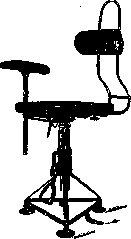
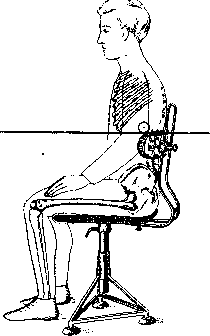
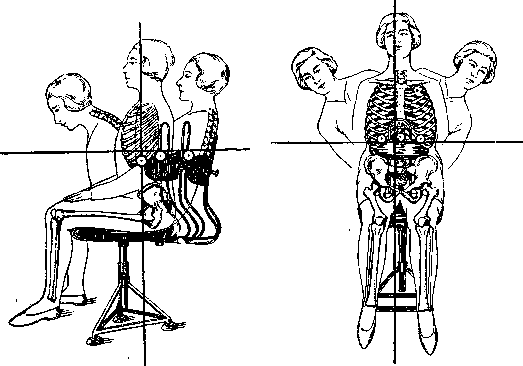
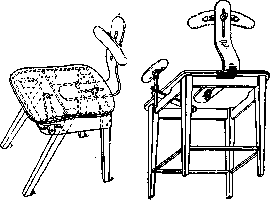
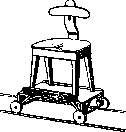
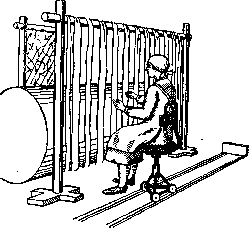
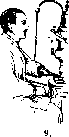
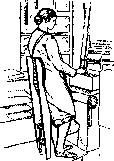
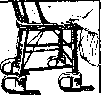
Figure 2. The relationship of various parts of the chair, e) Variability of backrest movements (not only vertically but also horizontally). Figure 4 clearly demonstrates the necessity of such backrest displacements in connection with the displacement of the center of gravity of the upper half of the body in different postures and different body lengths. - 2) The universal chair of the VCIOT type, simplified and made cheaper (wood), basically has the same properties as the first chair. This design is extremely convenient because, despite its universality, it completely lacks metal parts, which is important given the large raw material base of forest materials in our country. Instead of steel springs, a bent springy birch board is used. The cost of this chair is also significantly lower. -3) The seat of the chair (fig. 5) represents an even greater simplification due to the fact that it cannot be changed in height. These chairs are ordered by number. The height of different numbers differs by 3 cm from each other. -4) The principles of designing universal chairs also provide guidance for various palliative measures in the rationalization of old furniture. Figure 6 illustrates the rationalization of a simple stool, to which a backrest and armrest are attached. -5) For servicing long workstations, 'mobile work chairs of two types are planned (fig. 7 and 7a): a) mobile on casters, b) mobile on rollers at the seat itself. -6). For professions that work sitting and then standing, folding chairs are made (fig. 8). -7) For work at inclined workstations, corresponding inclined chairs are created. -8) In Germany, where the labor of disabled people was widely used after the war and during it, special suspended armrests for stumps were attached to the machine (fig. 9). - 9) For moving tense hands of professions such as weaver-mistresses, punch operators, etc., mobile armrests mounted on a well-stretching spring and repeating natural movements are recommended. - 10) Workers who, by the nature of their profession, cannot work sitting down are given the opportunity to rest during breaks between work on special folding chairs that do not take up space in the aisle (collapsible). -11) For some standing work, special supports (project by N. Haeberle) are made to unload the back muscles when standing (fig. 10). -12) For work where there are large movements of one leg, as well as for disabled people, chairs with cutouts in the seat for that leg are suitable. -13) In working conditions where there is floor vibration, it is advisable to use springy pads (rubber) under the chair legs, as indicated in fig. 11 (project by Gilbreth), as well as to use a spring. -14) For rest rooms located next to the workshop, convenient and cheap folding seats made of wood and canvas that can change the degree of their inclination as desired are suitable. Other types of rational industrial furniture: 1) It should be noted the rationalization of furniture produced by the pharmacy administration in Moscow pharmacies, which was generally quite successful, except for the too low location of the lower drawers and shelves in the cabinets. 2) A project for a sorting table for sorting letters (Rudnik) deserves attention. 3) VCIOT is working on the issue of revising the design of the upper surface of the work table. With increasing clarity, the expediency of providing a slight tilt of the table surface for certain professions is emerging, which makes it possible to sit more upright at the table and work with a normal viewing angle. 4.) It is also necessary to mention furniture for locker rooms: a) rational cabinets for clothing (Germany) and b) about box-stools for cleaning shoes, installed in dusty and dirty workshop locker rooms. It should be noted that the first steps in introducing rational furniture into our industry have already yielded results. At present, 3 works have been completed that prove the economic efficiency of rational chairs of the VCIOT design. A large number of positive reviews from workers and production personnel about the first samples of work furniture, which was tested by the Institute in a number of factories and plants, have been collected. Drawings of work tables and chairs with all reviews have been transferred to VKS for standardization on an all-Union scale. - The success of introducing rationalization of industrial furniture requires, of course, a great deal of cultural and educational work and special training of workers in the correct use of the proposed design.
Figure 3.
FIG. 4.
measures in the field of rationalization of old furniture. Figure 6 gives an illustration of the rationalization of a simple stool, to which a backrest and armrest are attached. -5) For servicing long workstations, 'mobile work chairs of two types are planned (fig. 7 and 7a): a) mobile on casters, b) mobile on rollers at the seat itself. -6). For professions that work sitting and then standing, folding chairs are made (fig. 8). -7) For work at inclined workstations, corresponding inclined chairs are created. -8) In Germany, where after the war and during it the labor of disabled people was widely used,
Figure 5.
Figure 6.
Figure 7.
special suspended armrests for stumps were attached to the machine (fig. 9). - 9) For moving tense hands of professions such as weaver-mistresses, punch operators, etc., mobile armrests mounted on a well-stretching spring and repeating natural movements are recommended. - 10) Workers who, by the nature of their profession, cannot work sitting down are given the opportunity to rest during breaks between work on special folding chairs that do not take up space in the aisle (collapsible). -11) For some standing work, special supports (project by N. Haeberle) are made to unload the back muscles when standing (fig. 10). -12) For work where there are large movements of one leg, as well as for disabled people, chairs with cutouts in the seat for that leg are suitable. -13) In working conditions where there is floor vibration, it is advisable to use springy pads (rubber) under the chair legs, as indicated in fig. 11 (project by Gilbreth), as well as to use a spring. -14) For rest rooms located next to the workshop, convenient and cheap folding seats made of wood and canvas that can change the degree of their inclination as desired are suitable. Other types of rational industrial furniture: 1) It should be noted the rationalization of furniture produced by the pharmacy administration in Moscow pharmacies, which was generally quite successful, except for the too low location of the lower drawers and shelves in the cabinets. 2) A project for a sorting table for sorting letters (Rudnik) deserves attention. 3) VCIOT is working on the issue of revising the design of the upper surface of the work table. With increasing clarity, the expediency of providing a slight tilt of the table surface for certain professions is emerging, which makes it possible to sit more upright at the table and work with a normal viewing angle. 4.) It is also necessary to mention furniture for locker rooms: a) rational cabinets for clothing (Germany) and b) about box-stools for cleaning shoes, installed in dusty and dirty workshop locker rooms. It should be noted that the first steps in introducing rational furniture into our industry have already yielded results. At present, 3 works have been completed that prove the economic efficiency of rational chairs of the VCIOT design. A large number of positive reviews from workers and production personnel about the first samples of work furniture, which was tested by the Institute in a number of factories and plants, have been collected. Drawings of work tables and chairs with all reviews have been transferred to VKS for standardization on an all-Union scale. - The success of introducing rationalization of industrial furniture requires, of course, a great deal of cultural and educational work and special training of workers in the correct use of the proposed design.
Figure 8.
Figure 10.
Figure 11.
o. Zaitzgeber. Furniture for children's institutions should also be designed on the basis of physiological requirements for the correct position of the body during work, without violating the functions of breathing, blood circulation, vision and the musculoskeletal apparatus. The correct position
Figure.
of the body during work is achieved by the active work of muscle groups supporting the torso in a position of stable equilibrium. Fatigue of muscle groups that occurs under unfavorable working conditions, for example, with excessive duration of work, insufficient lighting, with irrationally arranged furniture, leads to a weakening of muscle tone and displacement of the body's center of gravity
Figure 10.
and its individual segments, which results in incorrect, harmful to health postures. As a result of prolonged incorrect body position, persistent changes develop in the body - stoop, scoliosis, weakening of vision, etc.; the body's overall resistance decreases, anemia develops, etc. - Special importance is attached to children, who are in the process of growth and development, maintaining the correct position of the body and developing corresponding skills related to the use of furniture. External support points, provided in properly designed work furniture, contribute to a significant reduction in muscular efforts; thus, a properly designed backrest provides support in the lumbar and lower thoracic parts of the spine, the correct height of the chair facilitates support of the foot on the floor or a stand, etc. The requirements for proper furniture here are that the dimensions and relationships of the table and seat must correspond to the proportions of the child's body. Body length, which determines the basic dimensions of furniture, is in a direct correlational relationship with height, and therefore height serves as an indicator when determining the dimensions of furniture for different age groups of the population. When determining
Figure 11.
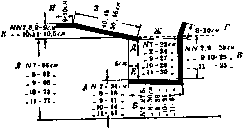
of experiments and anthropometric. The method of observations and measurements was first applied in America by Bernard (1838) to determine the dimensions of children's furniture. Then a number of authors developed tables of dimensions for school furniture, which were adopted as laws in different countries. In Russia, the first table of furniture dimensions for schoolchildren was developed by Erisman based on data from measurements and long-term observations of students in St. Petersburg gymnasiums (1871 - 1905). In 1927/28, at the State Institute of Social Hygiene in Moscow, this question was again studied using a special methodology for anthropometric measurements of children who took the correct body position on a special measuring chair by Stefani, followed by variation-statistical processing of the materials. Similar work was carried out in 1931 by the Institute for the Protection of Motherhood and Infancy of the People's Commissariat of Health on nursery-age children using a somewhat modified methodology. As a result of a mass survey of children from nurseries, kindergartens, and schools in Moscow, a table of furniture dimensions for children and adolescents from 1 year to 19 years was developed (Table 1). Data from anthropometric measurements of children show large variations in individual body dimensions, on which the main dimensions of furniture are based, and therefore precisely fitted furniture should be individual or vary in its main dimensions, mainly in the height of the table, seat, and backrest. The correctness of sitting position depends mainly on correctly set dimensions of the difference, i.e., the distance from the edge of the table facing the seated person to the edge of the seat; of the backrest distance, i.e., the distance from the edge of the table to the seat (horizontally), and of the seat distance, i.e., the ratio of the front edge of the seat to the difference (Figs. 12 and 13). The designs of school desks vary depending on their purpose: in addition to satisfying the general requirements for furniture, they should facilitate the implementation of the principle of individual isolation; for this purpose, individual desks are most desirable; two-seater desks are also acceptable. Access to the work desk should be possible from at least two sides. One-seater and two-seater desks are portable and can be used for various groupings during work; the same desks can be adapted for different types of work. Desks with an inclined board, which best satisfy the requirements of visual hygiene when reading and writing, can be converted into desks with a horizontal board, which is more convenient for other work. Individual folding desks are especially desirable due to the possibility of using them for outdoor work. For the purpose of saving space and for easy and quick cleaning of the room, drop-leaf tables are also used, e.g., for dining. Special workbenches should be adapted for children of different heights and satisfy all the requirements of the work process when working sitting and standing. Tables in school laboratories—chemical, physical, and biological—vary in the design of special boxes for storing materials and teaching aids; they require the connection of electricity, gas, water, etc. The most rational seating from a hygienic point of view are chairs or benches with lumbar and dorsal-lumbar backrests; backrests in the form of separate horizontal or curved slats are also quite satisfactory. Such backrests, the height of which is determined based on data on the height of the lumbar curve and the height of the lower corner of the shoulder blades above the seat, fully support the spine. An essential condition for the correct design of these backrests is the absence of longitudinal crossbars between the slats that interfere with proper sitting. Solid backrests should correspond to the curves of the spine. For laboratories, the chair developed by the Central Institute of Labor Protection (see above) is most acceptable. An essential condition for the correct supply of working furniture to children's institutions is the correct selection of tables and chairs according to the sizes of the corresponding furniture numbers and their proper distribution to children's groups. For this purpose, tables and chairs with stamps of certain numbers should be put on sale. The percentage distribution of children from different children's institutions by height should serve as a guide when ordering furniture for them (Fig. 14). Auxiliary furniture in children's institutions consists of cabinets of various purposes—for books and teaching aids, for individual and collective work, special display cabinets, cabinets for clothing, etc. Cabinets should not displace much air and should not contribute to the accumulation of dirt and dust. In height, cabinets should correspond to the height of children and have a small width for convenient access to things and easy cleaning. Cabinets should either stand on legs 15-20 cm high or be portable, easily movable from their place, on a solid frame tightly fitting to the floor. Individual closed cabinets for clothing with shelves for hats should have ventilation devices. In their absence, cabinets with an open front wall are preferable. For the purpose of unloading the room, it is advisable to install wall cabinets in both work and utility rooms of children's institutions. In addition, children's institutions have special drying cabinets (for linen and clothing) with the supply of warm air. Children's furniture in the home environment of the child should meet the same hygienic requirements. The development of sanitary-hygienic requirements and standards for furniture for children and adolescents is carried out in the institutes for the protection of mother and infant and for the protection of the health of children and adolescents of the People's Commissariat of Health, and the development of samples of polytechnical equipment is carried out in the Institute of Polytechnical Education of the People's Commissariat of Education. At the Institute of Social Hygiene (1929), the question of the dimensions of a table and chair for workers of mental labor was studied based on special measurements of students of the Higher Technical School in Moscow (Table 2).
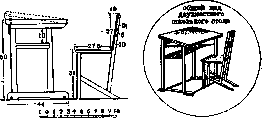
Figure 12. Schematic cross-section of a desk: A-height of seat; B-width of bench or depth of chair; C-height of lumbar backrest; D-additional value for dorsal-lumbar backrest; E-difference; F-seat distance; G-backrest distance; H-width of the inclined part of the board; I-width of the horizontal part of the desk/board; J-desk lid lift; K-height of the desk edge facing the seated person.
at least from two sides. One-seater and two-seater desks are portable and can be used for various groupings during work; the same desks can be adapted for different types of work. Desks with an inclined board, which best satisfy the requirements of visual hygiene when reading and writing, can be converted into desks with a horizontal board, which is more convenient for other work. Individual folding desks are especially desirable due to the possibility of using them for outdoor work. For the purpose of saving space and for easy and quick cleaning of the room, drop-leaf tables are also used, e.g., for dining. Special workbenches should be adapted for children of different heights and satisfy all the requirements of the work process when working sitting and standing. Tables in school laboratories—chemical, physical, and biological—vary in the design of special boxes for storing materials and teaching aids; they require the connection of electricity, gas, water, etc. The most rational seating from a hygienic point of view are chairs or benches with lumbar and dorsal-lumbar backrests; backrests in the form of separate horizontal or curved slats are also quite satisfactory. Such backrests, the height of which is determined based on data on the height of the lumbar curve and the height of the lower corner of the shoulder blades above the seat, fully support the spine. An essential condition for the correct design of these backrests is the absence of longitudinal crossbars between the slats that interfere with proper sitting. Solid backrests should correspond to the curves of the spine. For laboratories, the chair developed by the Central Institute of Labor Protection (see above) is most acceptable. An essential condition for the correct supply of working furniture to children's institutions is the correct selection of tables and chairs according to the sizes of the corresponding furniture numbers and their proper distribution to children's groups. For this purpose, tables and chairs with stamps of certain numbers should be put on sale. The percentage distribution of children from different children's institutions by height should serve as a guide when ordering furniture for them (Fig. 14). Auxiliary furniture in children's institutions consists of cabinets of various purposes—for books and teaching aids, for individual and collective work, special display cabinets, cabinets for clothing, etc. Cabinets should not displace much air and should not contribute to the accumulation of dirt and dust. In height, cabinets should correspond to the height of children and have a small width for convenient access to things and easy cleaning. Cabinets should either stand on legs 15-20 cm high or be portable, easily movable from their place, on a solid frame tightly fitting to the floor. Individual closed cabinets for clothing with shelves for hats should have ventilation devices. In their absence, cabinets with an open front wall are preferable. For the purpose of unloading the room, it is advisable to install wall cabinets in both work and utility rooms of children's institutions. In addition, children's institutions have special drying cabinets (for linen and clothing) with the supply of warm air. Children's furniture in the home environment of the child should meet the same hygienic requirements. The development of sanitary-hygienic requirements and standards for furniture for children and adolescents is carried out in the institutes for the protection of mother and infant and for the protection of the health of children and adolescents of the People's Commissariat of Health, and the development of samples of polytechnical equipment is carried out in the Institute of Polytechnical Education of the People's Commissariat of Education. At the Institute of Social Hygiene (1929), the question of the dimensions of a table and chair for workers of mental labor was studied based on special measurements of students of the Higher Technical School in Moscow (Table 2).
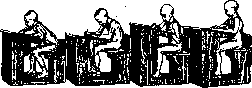
Figure 13. Correct and incorrect sitting positions at school desks (from left to right): at a low table with positive seat distance; at a low table with a low bench; at a high table and at a table of appropriate dimensions.
backrests; backrests in the form of separate horizontal or curved slats are also quite satisfactory. Such backrests, the height of which is determined based on data on the height of the lumbar curve and the height of the lower corner of the shoulder blades above the seat, fully support the spine. An essential condition for the correct design of these backrests is the absence of longitudinal crossbars between the slats that interfere with proper sitting. Solid backrests should correspond to the curves of the spine. For laboratories, the chair developed by the Central Institute of Labor Protection (see above) is most acceptable. An essential condition for the correct supply of working furniture to children's institutions is the correct selection of tables and chairs according to the sizes of the corresponding furniture numbers and their proper distribution to children's groups. For this purpose, tables and chairs with stamps of certain numbers should be put on sale. The percentage distribution of children from different children's institutions by height should serve as a guide when ordering furniture for them (Fig. 14). Auxiliary furniture in children's institutions consists of cabinets of various purposes—for books and teaching aids, for individual and collective work, special display cabinets, cabinets for clothing, etc. Cabinets should not displace much air and should not contribute to the accumulation of dirt and dust. In height, cabinets should correspond to the height of children and have a small width for convenient access to things and easy cleaning. Cabinets should either stand on legs 15-20 cm high or be portable, easily movable from their place, on a solid frame tightly fitting to the floor. Individual closed cabinets for clothing with shelves for hats should have ventilation devices. In their absence, cabinets with an open front wall are preferable. For the purpose of unloading the room, it is advisable to install wall cabinets in both work and utility rooms of children's institutions. In addition, children's institutions have special drying cabinets (for linen and clothing) with the supply of warm air. Children's furniture in the home environment of the child should meet the same hygienic requirements. The development of sanitary-hygienic requirements and standards for furniture for children and adolescents is carried out in the institutes for the protection of mother and infant and for the protection of the health of children and adolescents of the People's Commissariat of Health, and the development of samples of polytechnical equipment is carried out in the Institute of Polytechnical Education of the People's Commissariat of Education. At the Institute of Social Hygiene (1929), the question of the dimensions of a table and chair for workers of mental labor was studied based on special measurements of students of the Higher Technical School in Moscow (Table 2).
Length of desk-100 cm
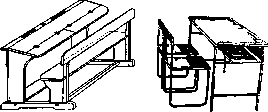
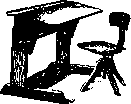
Figure 14. Types of school desks: 1-Erisman's desk; 2-Schütte's desk; 3-Ivanovsky's desk; 4-universal desk.
of the corresponding furniture numbers and their proper distribution to children's groups. For this purpose, tables and chairs with stamps of certain numbers should be put on sale. The percentage distribution of children from different children's institutions by height should serve as a guide when ordering furniture for them (Fig. 14). Auxiliary furniture in children's institutions consists of cabinets of various purposes—for books and teaching aids, for individual and collective work, special display cabinets, cabinets for clothing, etc. Cabinets should not displace much air and should not contribute to the accumulation of dirt and dust. In height, cabinets should correspond to the height of children and have a small width for convenient access to things and easy cleaning. Cabinets should either stand on legs 15-20 cm high or be portable, easily movable from their place, on a solid frame tightly fitting to the floor. Individual closed cabinets for clothing with shelves for hats should have ventilation devices. In their absence, cabinets with an open front wall are preferable. For the purpose of unloading the room, it is advisable to install wall cabinets in both work and utility rooms of children's institutions. In addition, children's institutions have special drying cabinets (for linen and clothing) with the supply of warm air. Children's furniture in the home environment of the child should meet the same hygienic requirements. The development of sanitary-hygienic requirements and standards for furniture for children and adolescents is carried out in the institutes for the protection of mother and infant and for the protection of the health of children and adolescents of the People's Commissariat of Health, and the development of samples of polytechnical equipment is carried out in the Institute of Polytechnical Education of the People's Commissariat of Education. At the Institute of Social Hygiene (1929), the question of the dimensions of a table and chair for workers of mental labor was studied based on special measurements of students of the Higher Technical School in Moscow (Table 2).
Table 2. Table of average furniture dimensions for workers of mental labor (in cm). For groups with height from 155 to 165 cm from 165 to 175 cm from 175 to 185 cm 1 Desk dimensions Width (front-rear dimension) . . Length of work space at a common desk . . . Length of individual desk..... Chair dimensions Height of seat . . . Depth (front-rear dimension) . . Height of upper edge of backrest above seat 120 30 47,5 38 40 81 60 120 31 40 43
The percentage distribution of furniture according to the height groups indicated in the table was 16% for size 1, 62% for size 2, and 22% for size 3. The furniture available on the market in the USSR is designed according to average "standard" dimensions and thus can be correctly applicable to only about 62% of the male population. Taking into account that the average height of women is lower than that of men, the correct use of this furniture is even less. With mass production and supply of furniture with fixed dimensions to public institutions, the height distribution should be taken into account. The problem of furniture in our country has only just been posed; for its correct solution, it is necessary to develop types, dimensions, and designs and to establish varieties and quality of building materials corresponding to the hygienic requirements of cultural housing, and to organize standard production of basic furniture items. The problem of furniture should be developed in connection with the reorganization of labor and living conditions and in close contact with the new socialist housing construction. Hospital furniture—see Hospital, hospital equipment.
M. Koresunvap.
Related articles
Cite this page
“Furniture.” Soviet Medical Encyclopedia. English translation of Bolshaya Meditsinskaya Entsiklopediya, 1st ed. (Moscow, 1928–1936), ed. N. A. Semashko. https://sovietmedicalencyclopedia.pages.dev/article/furniture/