Disinfection Apparatus
Historical document, translated for reference. It reflects medical knowledge of the 1920s–30s and is not medical advice.
Summary
This article from the 1928-1936 Soviet Medical Encyclopedia details various disinfection apparatus and instruments, focusing on devices for the wet method such as hydropumps and sprayers.
Encyclopedia article (1928–1936)
DISINFECTION APPARATUS and instruments are intended for spraying, sprinkling, and boiling disinfecting liquids, as well as for converting these liquids or solid substances into a gaseous state. Disinfection apparatus and instruments are divided according to the methodology into groups: for the wet method, the gas method, and disinsection.
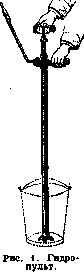
Instruments for the wet method. 1. Hydropump (see figure 1). This device can be considered as a hand-operated water pump adapted for sprinkling and spraying disinfecting liquids. The essential parts of the hydropump are: a cylinder-barrel serving as a reservoir for the liquid; a leather piston fixed at the lower end of a hollow cylindrical rod inserted into the hydropump barrel; two valves—lower and upper, both in the form of well-polished copper balls; a nozzle made of massive iron, giving direction to the liquid jet; the nozzle is attached to the upper part of the hydropump barrel by means of a special thread, bent at a right angle and rotating around a horizontal axis; a brass tip is screwed onto its free end. The dimensions of the individual parts of the hydropump should be: barrel length—75 cm, its diameter—3 cm, piston rod diameter—2 cm, barrel and piston rod wall thickness—1.5–2 mm, length of the nozzle together with the brass tip—40 cm. The best material for manufacturing the hydropump barrel and piston rod is red copper, brass is less expedient, and other materials are even less suitable (ebonite is fragile, iron is heavy). The hydropump of the described design in most cases satisfies practical purposes—there is not even any special need for such devices as a spray-tip: the liquid jet delivered by the hydropump is regulated and broken down to the desired limit, down to the finest dust, by means of the disinfectants operator's finger; the ability to control the jet is a test of the practical experience of the disinfection worker. In practice, there are deviations from the typical design of the hydropump (fixing the device immovably to a bucket, attaching rubber hoses, etc.). Cheap market and garden hydropumps made of thin sheet brass with leather valves are unsuitable for disinfection practice (they wear out extremely rapidly, whereas properly designed devices usually serve for several years). 2. Sprayers. In most cases, the hydropump can serve as a universal device for sprinkling and atomizing liquids, but sometimes, for example when it is necessary to spray liquids in a limited volume, the use of special sprayers is useful; a number of devices have been proposed for this purpose, of which the following best satisfy practical tasks: a) The six-jet (multijet) sprayer (see figure 2) is an air pump connected by means of a rubber tube to a glass bottle for liquid. The pump consists of two iron cylinders inserted one into the other with a leather piston and two valves; the excess atmospheric pressure resulting from the pump's operation is transmitted through the rubber tube to the glass bottle with the liquid, which is thereby sprayed using a special device adapted to the bottle with several (usually six) spray tips. b) English-Figure 2. Six-jet sprayer:
b) English-Figure 2. Six-jet sprayer:
b) English-Figure 2. Six-jet sprayer:
((spore) consists of an anti-pneumatic L i R (expanded; basic! co; small bottle for two engaging liquids in a case; at right angles, the-v-spraying device of slender iron tubes, of which the vertical one of small caliber is inserted into the reservoir with liquid, and the horizontal one of large caliber but narrowed at the end houses a leather piston on a rod with a handle; when the piston operates, atmospheric pressure is rarefied above the upper end of the vertical tube, thanks to which liquid rushes here from the reservoir, spraying under the influence of the air jet supplied by the piston during its methodical operation. b) The portable sprayer consists of a brass reservoir with a nozzle-sprayer and a pneumatic pump; when the latter operates, excessive atmospheric pressure is created in the reservoir, under the influence of which the liquid poured into the reservoir rushes into the nozzle-sprayer and is thus pulverized. The device is borrowed from horticultural practice, is not particularly practical, since it frequently requires repair. c) The automatic sprinkler (Holder, Pomona, Automax, etc.) is a copper reservoir of larger or smaller size, equipped with a pneumatic pump, a pressure gauge, and a hose with a nozzle-sprayer at its free end. The liquid poured into the reservoir is automatically sprayed under the influence of the high pressure created by the operation of the pump. The device is put on the disinfector's back and is convenient for spraying extensive surfaces, for example, during the petrolization of water bodies in connection with antimalarial measures. The disadvantages of the apparatus include the complexity of its design. d) The Swedish blowtorch—kerosene and gasoline. It serves for thermal disinsection—burning out insects with a flame in the cracks of walls, beds, furniture, etc. e) The bedbug-killer kettle with a long spout serves for the same purposes as the previous apparatus (thermal disinsection), operating with a jet of steam. Apparatus for formalinization. Devices serving for disinfection with formalin must: a) evaporate formalin in the proper quantity and rapidly, b) prevent the conversion of formaldehyde into inactive polymers, c) be fire-safe, d) economically consume alcohol for heating; moreover, they must be durable, portable, and accessible for cleaning. All the variety of devices proposed for formalinization purposes can be reduced to four main systems: 1) apparatus for boiling formalin, 2) apparatus extracting formaldehyde from formalin by means of boiling water vapors, 3) apparatus pulverizing formalin also by means of boiling water vapors, and 4) apparatus designed for evaporating solid polymers of formalin, usually in the form of formalin tablets. According to the type of boilers (first group), the following apparatuses are arranged: 1. Flügge's apparatus (see Figure 3). The apparatus consists of three parts: a tripod, an open alcohol burner, and a nickel-plated copper reservoir with two openings in the lid (formalin and water are poured through one opening, and the other serves for the exit of vapors). The apparatus is adapted for installation both inside the fumigated room and outside it; in the latter case, the vapors of formalin and water formed in the apparatus are led into the room by means of a rubber tube with a thin metal nozzle advanced through the keyhole. The following table has been proposed for filling Flügge's apparatus. When calculating for a 7-hour period of formaldehyde action (2.5 g per 1 m3 of space) When calculating for a 31/2-hour period of formaldehyde action (5 g per 1 m3 of space) [Table data omitted for brevity] The table is not absolutely invariable: depending on the presence and properties of the objects being fumigated, the amount of formalin (and proportionally also alcohol and water) can be changed in one direction or another, especially towards an increase when the room is significantly loaded with things. For the purpose of rapid and uniform distribution of formalin in the space, the apparatuses must be placed so that no more than 150 m3 of the fumigated volume falls to each of them. Flügge's apparatus is simple in design and evaporates formalin quickly. The use of formalin is possible almost up to the limit norm, as a result of which the apparatus should be recognized as fully satisfying practical purposes; its disadvantages include the design of the reservoir, which makes its cleaning difficult.-2. Krupin's apparatus. The reservoir of the apparatus has a removable lid screwed on with a rubber gasket, which ensures the possibility of its thorough cleaning. A water gauge glass adapted to the apparatus makes it possible to observe the liquid level as it evaporates; in order to prevent excessive pressure during the boiling of the liquid and to eliminate the danger of explosion resulting therefrom, a glass tube reaching almost to the bottom is inserted into the reservoir through the lid of the apparatus. A kerosene priming stove serves to heat the apparatus, as a result of which its installation is possible only outside the fumigated space. Vapors of formalin and water are led into the fumigated room through the keyhole according to the method indicated for Flügge's apparatus.-3. Torrens' apparatus. Consists of the same parts as Flügge's apparatus. The reservoir is accessible for cleaning and solidly constructed; the nozzle adapted to the lid of the apparatus and serving for the exit of formalin and water vapors is equipped with four lateral
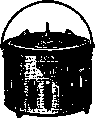
Figure 3. Flügge's apparatus.
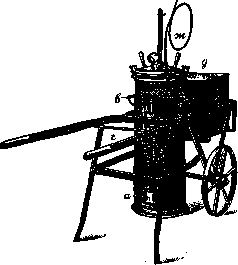
Figure 4. Hoton's apparatus (general view): a—kerosene priming stove; b—tripod; c—cart; e—box for a set of disinfection agents; zh—hose guide openings, ensuring a rapid and uniform distribution of formalin in the space. In order to prevent an explosion, a safety valve is adapted to the apparatus. The alcohol lamp is hermetically arranged, but gives an insufficiently energetic flame, due to which the rapidity of formalin evaporation is not ensured, which should be attributed to the disadvantages of the apparatus.-4. Hoton's apparatus (see Figures 4 and 4a) is very widespread abroad (France). It is an open iron boiler holding 16 l of liquid, tightly covered with a lid on a rubber gasket. A glass tube in a brass frame equipped with a graduated scale is attached to the middle of the lid. The consumption of formalin as it boils in the boiler is noted on the scale by means of an iron pin entering the glass tube from the boiler and fixed on a float swimming on the surface of the formalin. The apparatus is equipped with a kerosene burner and a copper tube conducting formalin vapors into the room through the keyhole. The device makes it possible to precisely dose the amount of evaporated formalin, the vapors of which rush into the room with a certain expression thanks to a certain excess pressure in the boiler, which contributes to the rapid and uniform distribution of gas in the room. The apparatus, together with a box for a set of disinfection agents, is mounted on a hand cart and can be moved by the disinfector over a distance.-5. The apparatuses of Zagorovsky, Roepke, Magnus Elb, Zausaylov, Trillat, and others, from among those arranged according to the type of boilers, have only historical interest, since they have not found wide practical application. An essential accessory of the devices of the second group of formalin apparatuses are two, usually cylindrical, reservoirs made of copper or brass. One of the reservoirs is a formalin tank, and the other is a water boiler, with the former being inserted into the latter. Vapors of boiling water penetrate from the boiler into the formalin tank, extract formaldehyde from the formalin, and together with the latter rush into the external environment. This group includes: 1. Zarevich's apparatus (see Figure 5). The apparatus is equipped with a tripod, an alcohol lamp, and a tightly screwed lid having the shape of a cylinder open at the bottom, immersed in the formalin reservoir. Water vapors penetrate from the boiler into the formalin tank through openings located at the upper edge of the latter
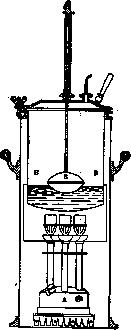
Figure 4a. Hoton's apparatus in cross-section: A—kerosene priming stove; B—formalin tank; E—float.
go. For the exit of vapors, the lid has an opening with a nozzle. 2. Berolin's apparatus. Differs from Zarevich's apparatus only in that water vapors from the boiler are conducted into the formalin tank by a coil. 3. Ehrenburg's apparatus. The formalin tank is soldered into the boiler, vapors
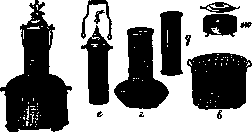
Figure 5. Zarevich's apparatus: a—general view; b—in cross-section; c—tripod; d—water tank; e—formalin tank; f—covering cylinder; g—alcohol lamp.
Water from the latter penetrates into the first by means of two connecting tubes. A special alcohol burner is not provided, as a result of which one has to use a random heat source for heating. To charge the apparatus of the extracting group, the following table proposed by Zarevich is usually employed. Volume of disinfection in m³ | 40% formalin (g) | Water (g) | Denatured alcohol (g) [The OCR table values follow: 62.5, 250.0, 62.5; 125.0, 500.0, 125.0; 187.5, 750.0, 187.5; 250.0, 1,000.0, 250.0; 312.0, 1,250.0, 312.5; 375.0, 1,500.0, 375.0; 437.0, 1,750.0, 437.0; 500.0, 2,000.0, 500.0; 562.5, 2,250.0, 562.0; 625.0, 2,500.0, 625.0]. Regarding the Zarevich and Berolin apparatuses, the table is applied conditionally: first, 1 liter of water is poured into the boiler and 100 g of denatured alcohol into the alcohol burner, regardless of the volume of the spaces to be fumigated,
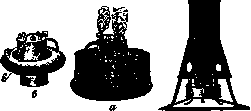
Figure 6.
Figure 7. Figure 6. Lingner apparatus: a—stand; b—formalin tank; c—water tank. Figure 7. Simple Aesculap.
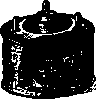
and only then is the calculation made according to the table. Apparatus for the pulverization of formalin in rooms to be disinfected [Lingner (see figure 6), Solonia, Prausnitz, etc.] are rarely used in practice. For burning solid polymers of formaldehyde (formalin tablets made of trioxymethylene), the following devices have been proposed: 1. The simple Aesculap lamp (see figure 7). It consists of a support plate, a closed alcohol burner with several wicks, an iron housing in the form of a truncated cone, and an iron mesh crucible for tablets. The crucible is installed on the housing above the alcohol burner; it holds up to 250 tablets, which evaporate under the influence of the alcohol flame, during which the dissociation of the trioxymethylene molecule into the formaldehyde molecule takes place. The device is not equipped with a device for humidifying the environment being disinfected, and therefore moisture is introduced artificially by one way or another (by means of a hydraulic pump, atomizer, etc.). 2) The combined Aesculap (see figure 8). It is arranged in the same way as the simple Aesculap, but with the addition of a steam generator and an alcohol burner for the purpose of humidifying the environment. Disinfection with formaldehyde polymers can also be carried out by means of apparatus designed for liquid formalin. For this purpose, the reservoir of the apparatus is filled with trioxymethylene and water in a ratio of 1:17. Only apparatus with sufficiently open reservoirs (e.g., Torrens, Zarevich) are suitable for this method. Under the influence of boiling water, dissociation of the polymer particle occurs with the release of formaldehyde and water vapors into the atmosphere. As the water boils with this method, the concentration of formaldehyde increases, favoring new polymerization, as a result of which trioxymethylene has to be taken 1.5–2 times more than the normal norm, which must be attributed to the disadvantages of the method. For the evaporation of NH3 for the purpose of deodorization after disinfection with formalin, an
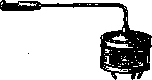
Figure 9. Ammonia evaporator.
At 2.5 g of formaldehyde per 1 m³ | At 5 g of formaldehyde per 1 m³ [OCR garbled table headers and text].
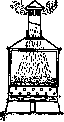
potassium permanganate, burnt lime, barium peroxide).
Apparatus for sulfurization. These apparatuses must satisfy the main condition of correct sulfurization—to burn sulfur without residue and as quickly as possible; in addition, these apparatuses must be portable and fire-safe. Of the apparatuses proposed for sulfurization purposes, the most popular is the Zaysailov and Telichenko apparatus (see figure 10), which is two iron cylinders nested one inside the other with a lid equipped with an exhaust pipe. The inner cylinder, which is the sulfur receiver (holds up to 8 kg of product), has many holes in the bottom; the outer cylinder serves as a case for the previous one, at its lower edge there are two rows of holes designed for the flow of air to the burning sulfur. Before starting disinsection, 40-50 cm³ of alcohol is poured into the bottom of the outer cylinder; after lighting it, the inner cylinder filled with sulfur is inserted, and the apparatus is closed with a lid. The alcohol flame melts the sulfur, which flows to the bottom of the outer cylinder and burns there. Under certain conditions, molten sulfur can flow onto the floor through holes in the outer cylinder, which is why, to prevent fire hazard, the apparatus must be placed on a floor strewn with sand, or on a stand (baking sheets, etc.). Fire hazard is eliminated in the apparatus for burning sulfur proposed by Borisovsky and Myasnikov: these apparatuses are equipped with sulfur receivers that prevent the molten product from leaking out of the apparatus. For deratization (see) on ships, a number of special devices for burning sulfur have been proposed: Clayton, Blanc, Marat, etc. In addition to the described special apparatus and tools, in disinfection practice, accessories of subsidiary significance are also necessary: buckets, funnels, measuring cups, tape measures for measuring, special clothing, gas masks, brushes, mops, paste brushes, and some other auxiliary items. Lit.: see lit. to art. Disinfection. G. Chistyakov.
Related articles
Mentioned in
Cite this page
“Disinfection Apparatus.” Soviet Medical Encyclopedia. English translation of Bolshaya Meditsinskaya Entsiklopediya, 1st ed. (Moscow, 1928–1936), ed. N. A. Semashko. https://sovietmedicalencyclopedia.pages.dev/article/disinfection-apparatus/