Vectors
Historical document, translated for reference. It reflects medical knowledge of the 1920s–30s and is not medical advice.
Summary
Vectors are living intermediaries in the spread of infections and invasions. This article explains the different types of vectors, mechanical and specific transmission methods, and provides detailed tables of various vectors and the diseases they carry.
Encyclopedia article (1928–1936)
VECTORS, living intermediaries in the spread of infections and invasions. The spread of causative agents of invasions and infections in the majority of cases occurs with the direct or indirect mediation of animals. The latter receive the causative agent from its place of habitation and transmit it to other animals or humans, who as a result may contract the corresponding infectious or invasive disease. The concept of 'vector' must be distinguished from the concept of 'intermediate host.' Vectors can repeatedly spread the causative agents contained in them (or on them) while maintaining their own life; intermediate hosts infect the definitive host with the corresponding parasite in most cases when they are consumed by the definitive host. Often a vector is at the same time also an intermediate or definitive host of the causative agent being spread. The objects of transfer are mainly various fungi, bacteria, protozoa, and unidentified viruses (for example the virus of papatachi fever); similarly, certain worms (microfilariae and mosquitoes of the genus Mansonia, Chrysops, etc.) are transmitted to definitive hosts; there are cases of transfer of relatively large objects, for example feather mites by blood-sucking flies, pseudoscorpions by house flies, etc., but as a rule the objects of transfer are extremely small compared to the vector. Humans, domestic and wild animals can be objects of infection by vectors, and the latter can also be reservoirs of the corresponding virus. Transfer of causative agents can be mechanical and specific. In the first case, there are no biological relationships between the transmitted causative agent and the vector, i.e., the vector is not a host of the organism it transmits; in the second, the object of transfer multiplies in the vector or passes through a certain part of its life cycle. In mechanical transfer, transmission of invasion is possible at any moment during the period of the causative agent's stay in or on the vector, and this period can be very short. Specific transfer is not possible before the causative agent reaches its invasive stage of development in its life cycle and occupies in the vector's body a place from which it has an exit to the outside. In some cases, the transfer is associated with the procedure of blood-sucking, and the causative agent is injected with the vector's saliva into the organism or is introduced by its own mouthparts; this method of transfer is called inoculative (inoculation). In other cases, the vector contaminates the coverings or mucous membranes of the host with its excrement, which contain the causative agents of invasion or infection; such contamination (pollution) is completed when the transmitted causative agents passively or actively penetrate the organism (Figure 1). Contamination and inoculation can each be mechanical and specific. Horseflies (Tabanidae) and the stable fly can inoculate anthrax with their mouthparts by contaminating them while sucking the ulcer of a diseased animal; Stomoxys nigra transmits the causative agent of surra—Trypanosoma Evansi—not later than 10 minutes after its own infection on the animal. Trypanosoma gambiense, when the tsetse fly sucks blood, enters its stomach, where Trypanosoma gambiense multiplies, passes through the proventriculus and proboscis,
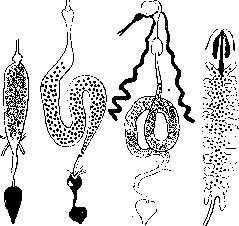
Figure 1. Diagram of development cycles of trypanosomes in the intestinal canal of intermediate host-vectors: A and B—development with contaminative, C and D—with inoculative methods of infection; A—Tg. Lewisi in the rat flea; B—Tg. melophagium in the sheep ked; C—Tg. gambiense and brucei in the tsetse fly; D—Tg. rotatorium in the leech. Solid black indicates areas of development of infectious stages (metacyclic trypanosomes); black dots—areas with predominance of the crithidial stage; white circles—areas with trypanosome-type stages; unshaded parts do not contain developmental stages.
enters the lumen of the salivary glands, where the second stage of multiplication occurs with the formation of invasive trypanosomes, which are injected into human blood with the saliva when the tsetse fly sucks its blood (specific inoculation) (Figure 2). 31: Table of vectors of causative agents of infections and invasions. Vector Transferred organism Disease which the vector spreads Method of transfer of causative agent Ticks 1. Argasidae Argas persicus Argas reflexus Ornithodorus moubata Spirochaeta gallinarum and others. Staphylococcus pyogenes Treponema Duttoni Trypanosoma Cruzi under experimental conditions Ornithodorus papillipes Ornithodorus moubata Ornithodorus normandi Spirochaeta sogdianum Spirochaeta hispanicum Spirochaeta normandi Ornithodorus venezuelensis Spirochaeta venezuelensis Ornithodorus turicata Ornithodorus talaje Spirochaeta neotropicalis Fowl spirillosis and other birds Furunculosis Specific transfer; inoculation Mechanical transfer Tick relapsing fever Agent of Central Asian tick relapsing fever (Shakhriab virus) Specific transfer; inoculation (contamination) With saliva during blood-sucking Tick relapsing fever of Spain, Morocco and Tunisia Tick relapsing fever of America Specific transfer Tick relapsing fever of America 2. Ixodidae Ixodes ricinus Ixodes autumnalis Babesiella bovis Piroplasma canis Boophilus annulatus Boophilus decoloratus Pestis 'Bloody urine' of cattle of northern and central Europe Piroplasmosis of dogs Plague (?) Piroplasma (Babesia) bigeminum Theileria annulata Anaplasma marginale Spirochaeta Theileri Texas fever of cattle, 'tick fever', hemoglobinuria of the Caucasus, Crimea, Central Asia 'Tropical piroplasmosis', Caucasian theileriosis of cattle Anaplasmosis of cattle in South Africa Specific transfer; inoculation; in the tick the piroplasma multiplies Spirochaetosis of cattle Piroplasma ovis Rhipicephalus bursa Rhipicephalus sanguineus Theileria parva (?) Piroplasmosis of sheep and goats (Crimea, Caucasus) Theileriosis (North Caucasus) (?)
ch Nuttallia equi Nuttalliosis of horses Haemogregarina canis Piroplasma canis Nuttallia equi Piroplasmosis of dogs Nuttalliosis of horses Vector Transferred organism Disease which the vector spreads Method of transfer Rhipicephalus sanguineus Rhipicephalus Evertsi Rhipicephalus appendicularis Nuttallia Cruzi (under experimental conditions)
Chagas disease Piroplasma bigeminum Piroplasmosis of cattle Gonderia mutans Gonderiosis of cattle Theileria parva Theileriosis of cattle Nuttallia equi Gonderia mutans Theileria parva Piroplasma bigeminum Theileria parva Rhipicephalus simus Dermacentor reticulatus Dermacentor Andersoni Dermacentor albipictus Gonderia mutans Anaplasma marginale Piroplasma caballi Piroplasmosis of horses (southern) Gonderiosis of cattle Theileriosis of cattle Piroplasmosis of cattle Theileriosis of cattle Gonderiosis of cattle Anaplasmosis of cattle Northern piroplasmosis of horses Piroplasma canis Dermacentroxenus Rickettsi Piroplasmosis of dogs Rocky Mountain spotted fever Bact. tularense Agent (?) of tick paralysis Haemaphysalis leachi Haemaphysalis cinnabarina punctata Haemaphysalis leporis palustris Piroplasma canis Tularemia Tick paralysis Piroplasmosis of dogs Piroplasma bigeminum (?) Bact. tularense 3. Trombidiidae Trombicula (Leptus) akamushi Tularemia Filterable virus
Japanese river fever 'kedani' Specific transfer; inoculation 4. Parasitidae Laelaps echidninus Hepatozoon muris Anemia of rats 5. Demodecidae Demodex folliculorum Bacillus necrophorus Acne Mechanical transfer Vector Transferred organism Disease which the vector spreads Method of transfer of causative agent Insecta (insects) 6. Orthoptera (cockroaches) Bact. anthracis Blatta orientalis Bact. cholerae gallinarum Bact. coli Anthrax Fowl cholera Mechanical transfer Staphylococcus aureus Spirillum Metchnikovi Bact. 'pseudo-edema maligno' Eggs of various helminths Cysts of parasitic Protozoa Vibrio cholerae Periplaneta americana
I
A
BCD
Рисунок 1. Схема циклов развития трипаносом и кишечном канале промежуточных хозяев-переносчиков: A ж B-развитие c контаминатив-ным, C и D- c инокулятивным способами заражения; A-Тг. Lewisi в крысиной блохе; B-Тг. melopliagium в овечьей кровососке; C-Тг. gam-biense и brucei в мухе тсе-тсе; D-Тг. rotatorium в пьявке. Сплошным черным обозначены области развития заразных стадиев (метацик-лических трипаносом); черными точками-области c преобладанием критидиального стадия: белыми кружками-области co стадиями трипа-носомного типа; незатушеванные части не содержат стадиев развития. загрязненными при сосании язвы б-ного животного; Stpmoxys nigra передает возбудителя сурры-Trypanosoma Evansi--не позднее, как через 10 минут после собственного заражения на животном. Trypanosoma gambiense при сосании крови мухой тсе-тсе-попадает в ee желудок, здесь Trypanosoma gambiense размножается, через преджелудок и хоботок пере
Рисунок 2. Trypanosoma gambiense в мухе тсе-тсе: 1-хоботок, которым муха заражает человека; 2-трипаносомы в слюнных железах. ходит в просвет слюнных желез, где протекает второй этап размножения c образованием инвазирующих трипаносом, которые ce C слюной впрыскиваются в кровь человека, когда его кровь будет сосать муха тсе-тсе (специфическая инокуляция) (рисунок . 2). 31: Таблица переносчиков возбудителей инфекций и и н в аз и и. Переносчик Переносимый организм Болезнь, к-рую переносчик распространяет Способ переноса возбудителя Клещи 1. Argasidae Argas persicus Argas reflexus Omitliodorus moubata Spirochaeta gallinarum и ДР. Staphylococcus pyogenes Treponema Duttoni Trypanosoma Cruzi в условиях эксперимента Ornithodorus papillipes Ornithodorus amrocanus Omitliodorus normar.di Spirochaeta sogdianum Spirochaeta hispanicum Spirochaeta normandi Ornithodorus venezue-lensis __] Spirochaeta venezuelense Ornithodorus turicata Ornithodorus talaje Spirochaeta neotropical is Спирохетоз кур и др. птиц Фурункулез Специфический перенос; инокуляция Механический перенос Клещевой рекурренс -\- Возбудитель клещевого рекур- ренса Cp. Азии (вирус Шах- ризябс) Специфический перенос; инокуляция (контаминация) Co слюной при сосании крови Клещевой рекурренс Испании, Марокко и Туниса Клещевой рекурренс 10. Америки Специфический перенос Клещевой рекурренс Америки 2. Ixodidae Ixodes ricinus Ixodes autumnalis \ Babesiella bovis Piroplasma canis Boophilus annulatus Boophilu* decoloratus Bac. pestis «Кровавая моча» крупного рогатого скота северной и средней Европы Пироплазмоз собак Чума (?) Piroplasma (Babesia) bigemi-num Theileria annulata Anaplasma marginale Spirochaeta Theileri Техасская лихорадка крупного рогатого скота,«чихарь», гемоглобинурия C. Кавказа, Крыма, Cp. Азии «Тропический пироплазмоз», закавказский тейлериоз крупного рогатого скота Анацлазмоз крупного рогатого скота в Ю. Африке Специфический перенос; инокуляция; в клеще пироплазма размножается Спирохетоз скота Piroplasma ovis Rhipiceplialus bursa Rliipicephalus sangui-neus Theileria parva (?) r Пироплазмоз овец и коз (Крым, Кавказ) Тейлериоз (Сев. Кавказ) (?) ч Nuttallia ecrui Нутталиоз лошадей Haemogregarina canis Piroplasma canis Nuttallia equi Пироплазмоз собак Нутталиоз лошадей Переносчик Переносимый организм ' Болезнь, к-рую переносчик ! Способ переноса распространает
I
возбудителя Rliipicephalus sangui-neus Rhipicephalus Evertsi Rliipicephalus appendi-cularis Nuttallia Cruzi (в условиях j
Болезнь Щагаса эксперимента)
j Piroplasma bigeminum Пироплазмоз скота Gonderia mutans Гондериоз скота Theileria parva Теилериоз крупного рогатого Nuttallia equi Gonderia mutans Theileria parva Piroplasma bigeminum Theileria parva Rhipicephalus simus Dermacentor reticulatus Dermacentor Andersoni Dermacentor albipictus Gonderia mutans Anaplasma marginale Piroplasma caballi Пироплазмоз лошадей (южный) Гондериоз крупного рогатого скота Теилериоз крупного рогатого скота Специфический перенос; инокуляция; в клеще пироплазма размножается Пироплазмоз крупного рогатого скота Теилериоз крупного рогатого скота Гондериоз крупного рогатого скота Анаплазмоз крупного рогатого скота Северный пироплазмоз лошадей Piroplasma canis Dermacentroxenus Rickettsi Пироплазмоз собак Лихорадка скалистых гор Bact. tularense Возбудитель (?) клещевого паралича Haemaphysalis Leachi Haemaphysalis cinna-barina punctata Haemaphysalis leporis palustris Piroplasma canis Туляремия Клещевой паралич Пироплазмоз собак Piroplasma bigeminum (?) Bact. tularense 3. Trombidiidae Trombicula (Leptus) akamusbi Туляремия Фильтрующийся вирус
Японская речная лихорадка I
«кедани» Специфический перенос; инокуляция 4. Parasitidae Laelaps echidninus Hepatozoon muris Анемия крыс 5. Demodecidae Demodex folliculorum Bacillus necrophorus Угри Механический перенос' Переносчик Переносимый организм Болезнь, к-рую переносчик распространяет Способ переноса возбудителя Insecta (насекомые) 6. Orthoptera (прямокрылые) Bac. anthracis I Blatta orientalis Bact. cholerae gallinarum Bact. coli Сибирская язва Куриная холера Механический: перенос Staphylococcus aureus Spirillum Metchnikovi Bac. «pseudo-edema maligno» Яйца различных глист Цисты паразитических Protozoa Vibrio cholerae Periplaneta americana !
Staphylococcus albus Streptococcus aureus Chicken diarrhea Contamination through faeces Cholera Mechanical transfer 7. Parasita Virus of typhus Typhus Specific transmission by injection Spirochaeta Obermeieri Relapsing fever (cosmopolitan) Rickettsia quintana Pediculus capitis, Pediculus vestimenti Various bacteria Achorion Schunleini Staphylococcus pyogenes Diplococcus pemphigi contagiosi Trench fever, Volhynian fever Phlyctenular conjunctivitis Transmission by crushing lice on the skin during scratching By injection Favus Impetigo contagiosa Mechanical transfer Impetigo (tropics) 8. Rynchota (beaked) Triatoma megista and other species, Rhodnius prolixus Trypanosoma Cruzi Chagas disease in Brazil Specific transfer; contamination 9. Diptera (two-winged) Anopheles algeriensisN Malarial plasmodium Larvae of Wuchereria Bancrofti Larvae of Dirofilaria immitis Malaria Elephantias (?) Specific transfer with saliva by injection and blood sucking Intermediate host Dog filariasis Vector Organism transmitted Disease transmitted by the vector Method of transfer of the pathogen Anopheles bifurcatus Anopheles maculipennis Malarial plasmodium Malaria Specific transfer Anopheles plumbeus Anopheles pulcherriimis Anopheles superpictus Anopheles hyrcanus Culex pipiens Mansonioides imiformis Larvae of Dirofilaria immitis Malarial plasmodium Larvae of Dirofilaria immitis Malarial plasmodium Larvae of Dirofilaria immitis Malarial plasmodium Leucocytozoon Danilewskyi Intermediate host Malaria Specific transfer Intermediate host Malaria Specific transfer ! Intermediate host, Does not transmit tropical malaria Specific transfer Bird anemia Plasmodium Danilewskyi Larvae of Dirofilaria immitis Aedes silvestris Aedes vexans Larvae of Wuchereria Bancrofti Larvae of Wuchereria Bancrofti Bac. anthracis Larvae of Dirofilaria immitis Bird malaria Specific transfer with saliva Dog filariasis Elephantias (?) Elephantias (?) Siberian plague Filterable virus Dengue Intermediate host Mechanical transfer Intermediate host Bird malaria Plasmodium Danilewskyi Specific transfer by injection Aedes argenteus Leptospira icteroides Yellow fever Larvae of Wuchereria Bancrofti Elephantias (?) Intermediate host Phlebotomus pappatasi Pathogen of pappatachi fever Pappatachi fever Leishmania tropica Delhi boil Specific transfer Phlebotomus argentipes Leishmania Donovani Kala-azar v Simulium damnosum Larvae of Onchocerca volvulus Human onchocerciasis Culicoides Austeni Larvae of Acanthocheilonema perstans Intermediate host Culicoides «Grahami Vector Organism transmitted Disease transmitted by the vector Method of transfer of the pathogen Tabanus (various species) Bac. anthracis Siberian plague Mechanical transfer Tabanus tropicus, Tabanus striatus, Tabanus lineola Trypanosoma Evansi Cyppa j Tabanus glaucopis Trypanosoma Theileri Non-pathogenic, trypanosomiasis of cattle Probably by contamination Tabanus trigeminus Filterable virus Horse anemia Inoculation Haematopota pluvialis Bac. anthracis Larvae of Loa loa Siberian plague Mechanical transfer Chrysops silaceus, Chrysops dimidiatus Calabar swellings Intermediate host Chrysops caecutiens j Various bacteria Septicemia i Bac. anthracis Siberian plague Tularemia Mechanical transfer Chrysops discalis Bact. tularense Chrysops japonicus Filterable virus Infectious anemia of horses Inoculation Streptococcus faecalis ch Streptococcus pyogenes Erysipelas, suppurations, septicemia Streptococcus salivarius Usually non-pathogenic Diplococcus gonorrhoeae Gonorrhea Diplococcus intracellularis me-ningitidis Cerebral meningitis ' Staphylococcus pyogenes Septicemia Staphylococcus albus Abscesses Musca domestica Staphylococcus aureus Mechanical , Staphylococcus citreus transfer Sarcina aurantiaca Bac. Koch-Weeks Acute infect. conjunctivitis Bact. Morgani Infant diarrhea Bac. £.cidi lactici Bac. aerogenes capsulatus Gangrene Bac. anthracis Siberian plague ! Bac. cuniculicidus Septicemia Bac. diphtheriae f Diphtheria Vector Organism transmitted Disease transmitted by the vector Method of transfer of the pathogen Musca domestica Bac. paratyphi B Bac. pestis Bac. pyocyaneus Bac. tuberculosis Bac. act. tularense Bac. typhi Vibrio cholerae Virus of trachoma Bac. dysenteriae Bacillary dysentery Bact. enteritidis Food intoxications Bac. mallei Glanders Bac. paratyphi A Paratyphus Plague Suppuration of wounds Tuberculosis Tularemia (?) Typhoid fever Cholera Trachoma Mechanical transfer Glossina palpalis Glossina morsitans Stomoxys calcitrans Pathogen of chicken cholera Chicken cholera Cysts Entamoeba histolytica Entamoeba coil Giardia intestinalis Treponema pertenue Amebic dysentery Lambliosis Eggs of helminths Trypanosoma gambiense Trypanosoma rhodesiense Trypanosoma cazalboui Trypanosoma dimorphori Trypanosoma Yivax Trypanosoma brucei «Yaws» Sleeping sickness Disease «souma» Trypanosomiasis of animals Trypanosoma cazalboui' Filterable virus Filterable virus Trypanosoma equinum Trypanosoma Evansi Nagana Horse anemia Specific transfer; inoculation with saliva Swine cholera Mechanical transfer «Mai de Caderas» Surra Mechanical inoculation Organism transmitted Disease transmitted by the vector Method of transfer of the pathogen Stomoxys calcitrans Trypanosoma soudanense «El-debab» Trypanosomiasis of camels Streptococcus Septicemia Mechanical inoculation Lyperosia irritans Bac. anthracis Siberian plague Borborus punctipennis Eggs of ascarids Ascariasis Bac. anthracis Siberian plague Lucilia caesar Bac. coli Staphylococcus pyogenes Septicemia Bac. anthracis Siberian plague Sarcophaga carnaria Bact. coli Mechanical contamination Staphylococcus pyogenes Septicemia Callipbora erythroce-phala Calliphora vomitoria Vibrio cholerae Cholera Bact. coli Colitis Bac. anthracis Siberian plague Staphylococcus pyogenes Septicemia Eristalis tenax Vibrio cholerae Cholera Mechanical Melophagus ovinus Trypanosoma melophagium Non-pathogenic trypanosomiasis transfer 10. Coleoptera (beetles) Anthrenus museorum - Bac. anthracis (spores) ! Siberian plague Attagenus pellio Mechanical contamination through faeces Ptinus sp. Dermestes vulpinus 11. Hymenophtera (Hymenoptera) Ants Bac. typhi abd. Typhoid fever Monomorium pharaoni3 (house ant) and | other species Bac. pestis Plague contami-nation Bac. anthracis (?) Siberian plague 12. Aphaniptera (fleas) Dermatophilus pene- trans Bac. tetani Tetanus Mechanical transfer Vector Organism transmitted Disease transmitted by the vector Method of transfer of the pathogen Xenopsylla cheopis Bac. pestis i Plague ; Ceratophyllus fasciatus Mechanical contamination Ctenocephalus canis Trypanosoma Lewisi Trypanosomiasis of rats Ceratophyllus tesquorum Bac. pestis Plague Oropsylla Silantiewi | Pulex irritans Trypanosoma Lewisi Trypanosomiasis of rats 1 i 13. Vermes (worms) Leeches Hemiclepsis marginata Trypanosoma rotatorium Trypanosomiasis of fish and amphibians Specific inoculation Between these two extreme forms of transmission there are a number of transitions. The pathogen of malaria undergoes a different cycle of development and a different path in the body of the vector (Fig. 3). Its sexual reproduction occurs in the stomach of Anopheles, and the parasite then passes from the stomach into the body cavity of the mosquito and further into the salivary glands, from which it exits to the outside. It is very probable that piroplasmas also pass from the stomach into the body cavity of the tick and then into its salivary glands. That piroplasmas penetrate into the eggs of the tick is indisputable, since the offspring of an infected female tick itself infects animals at its first feeding on them (for example Boophilus, Rhi-picephalus; see Ticks). And these cases of transfer of invasions also belong to the specific type of inoculation, as well as the transmission of the yellow fever pathogen by the mosquito Stego-myia fasciata. In relation to the spirochetes of relapsing fever, spread by ticks of the genus Ornithodo-rus, two methods of their transmission can be established: with saliva during blood sucking (specific inoculation) and with the coxal fluid flowing into the skin wound
[
pathogen Anopheles bifurcatus Anopheles maculipennis Malarial plasmodium Malaria Specific transfer Anopheles plumbeus Anopheles pulcherriimis Anopheles superpictus Anopheles hyrcanus Culex pipiens Mansonioides imiformis Larvae of Dirofilaria immitis Malarial plasmodium Larvae of Dirofilaria immitis Malarial plasmodium Larvae of Dirofilaria immitis Malarial plasmodium Leucocytozoon Danilewskyi Intermediate host Malaria Specific transfer Intermediate host Malaria Specific transfer ! Intermediate host, Does not transmit tropical malaria Specific transfer Bird anemia Plasmodium Danilewskyi Larvae of Dirofilaria immitis Aedes silvestris Aedes vexans Larvae of Wuchereria Bancrofti Larvae of Wuchereria Bancrofti Bac. anthracis Larvae of Dirofilaria immitis Bird malaria Specific transfer with saliva Dog filariasis Elephantias (?) Elephantias (?) Siberian plague Filterable virus Dengue Intermediate host Mechanical transfer Intermediate host Bird malaria Plasmodium Danilewskyi Specific transfer by injection Aedes argenteus Leptospira icteroides Yellow fever Larvae of Wuchereria Bancrofti Elephantias (?) Intermediate host Phlebotomus pappatasi Pathogen of pappatachi fever Pappatachi fever Leishmania tropica Delhi boil Specific transfer Phlebotomus argentipes Leishmania Donovani Kala-azar v Simulium damnosum Larvae of Onchocerca volvulus Human onchocerciasis Culicoides Austeni Larvae of Acanthocheilonema perstans Intermediate host Culicoides «Grahami Vector Organism transmitted Disease transmitted by the vector Method of transfer of the pathogen Tabanus (various species) Bac. anthracis Siberian plague Mechanical transfer Tabanus tropicus, Tabanus striatus, Tabanus lineola Trypanosoma Evansi Cyppa j Tabanus glaucopis Trypanosoma Theileri Non-pathogenic, trypanosomiasis of cattle Probably by contamination Tabanus trigeminus Filterable virus Horse anemia Inoculation Haematopota pluvialis Bac. anthracis Larvae of Loa loa Siberian plague Mechanical transfer Chrysops silaceus, Chrysops dimidiatus Calabar swellings Intermediate host Chrysops caecutiens j Various bacteria Septicemia i Bac. anthracis Siberian plague Tularemia Mechanical transfer Chrysops discalis Bact. tularense Chrysops japonicus Filterable virus Infectious anemia of horses Inoculation Streptococcus faecalis ch Streptococcus pyogenes Erysipelas, suppurations, septicemia Streptococcus salivarius Usually non-pathogenic Diplococcus gonorrhoeae Gonorrhea Diplococcus intracellularis me-ningitidis Cerebral meningitis ' Staphylococcus pyogenes Septicemia Staphylococcus albus Abscesses Musca domestica Staphylococcus aureus Mechanical , Staphylococcus citreus transfer Sarcina aurantiaca Bac. Koch-Weeks Acute infect. conjunctivitis Bact. Morgani Infant diarrhea Bac. £.cidi lactici Bac. aerogenes capsulatus Gangrene Bac. anthracis Siberian plague ! Bac. cuniculicidus Septicemia Bac. diphtheriae f Diphtheria Vector Organism transmitted Disease transmitted by the vector Method of transfer of the pathogen Musca domestica Bac. paratyphi B Bac. pestis Bac. pyocyaneus Bac. tuberculosis Bac. act. tularense Bac. typhi Vibrio cholerae Virus of trachoma Bac. dysenteriae Bacillary dysentery Bact. enteritidis Food intoxications Bac. mallei Glanders Bac. paratyphi A Paratyphus Plague Suppuration of wounds Tuberculosis Tularemia (?) Typhoid fever Cholera Trachoma Mechanical transfer Glossina palpalis Glossina morsitans Stomoxys calcitrans Pathogen of chicken cholera Chicken cholera Cysts Entamoeba histolytica Entamoeba coil Giardia intestinalis Treponema pertenue Amebic dysentery Lambliosis Eggs of helminths Trypanosoma gambiense Trypanosoma rhodesiense Trypanosoma cazalboui Trypanosoma dimorphori Trypanosoma Yivax Trypanosoma brucei «Yaws» Sleeping sickness Disease «souma» Trypanosomiasis of animals Trypanosoma cazalboui' Filterable virus Filterable virus Trypanosoma equinum Trypanosoma Evansi Nagana Horse anemia Specific transfer; inoculation with saliva Swine cholera Mechanical transfer «Mai de Caderas» Surra Mechanical inoculation Organism transmitted Disease transmitted by the vector Method of transfer of the pathogen Stomoxys calcitrans Trypanosoma soudanense «El-debab» Trypanosomiasis of camels Streptococcus Septicemia Mechanical inoculation Lyperosia irritans Bac. anthracis Siberian plague Borborus punctipennis Eggs of ascarids Ascariasis Bac. anthracis Siberian plague Lucilia caesar Bac. coli Staphylococcus pyogenes Septicemia Bac. anthracis Siberian plague Sarcophaga carnaria Bact. coli Mechanical contamination Staphylococcus pyogenes Septicemia Callipbora erythroce-phala Calliphora vomitoria Vibrio cholerae Cholera Bact. coli Colitis Bac. anthracis Siberian plague Staphylococcus pyogenes Septicemia Eristalis tenax Vibrio cholerae Cholera Mechanical Melophagus ovinus Trypanosoma melophagium Non-pathogenic trypanosomiasis transfer 10. Coleoptera (beetles) Anthrenus museorum - Bac. anthracis (spores) ! Siberian plague Attagenus pellio Mechanical contamination through faeces Ptinus sp. Dermestes vulpinus 11. Hymenophtera (Hymenoptera) Ants Bac. typhi abd. Typhoid fever Monomorium pharaoni3 (house ant) and | other species Bac. pestis Plague contami-nation Bac. anthracis (?) Siberian plague 12. Aphaniptera (fleas) Dermatophilus pene- trans Bac. tetani Tetanus Mechanical transfer Vector Organism transmitted Disease transmitted by the vector Method of transfer of the pathogen Xenopsylla cheopis Bac. pestis i Plague ; Ceratophyllus fasciatus Mechanical contamination Ctenocephalus canis Trypanosoma Lewisi Trypanosomiasis of rats Ceratophyllus tesquorum Bac. pestis Plague Oropsylla Silantiewi | Pulex irritans Trypanosoma Lewisi Trypanosomiasis of rats 1 i 13. Vermes (worms) Leeches Hemiclepsis marginata Trypanosoma rotatorium Trypanosomiasis of fish and amphibians Specific inoculation Between these two extreme forms of transmission there are a number of transitions. The pathogen of malaria undergoes a different cycle of development and a different path in the body of the vector (Fig. 3). Its sexual reproduction occurs in the stomach of Anopheles, and the parasite then passes from the stomach into the body cavity of the mosquito and further into the salivary glands, from which it exits to the outside. It is very probable that piroplasmas also pass from the stomach into the body cavity of the tick and then into its salivary glands. That piroplasmas penetrate into the eggs of the tick is indisputable, since the offspring of an infected female tick itself infects animals at its first feeding on them (for example Boophilus, Rhi-picephalus; see Ticks). And these cases of transfer of invasions also belong to the specific type of inoculation, as well as the transmission of the yellow fever pathogen by the mosquito Stego-myia fasciata. In relation to the spirochetes of relapsing fever, spread by ticks of the genus Ornithodo-rus, two methods of their transmission can be established: with saliva during blood sucking (specific inoculation) and with the coxal fluid flowing into the skin wound
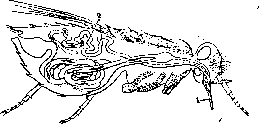
Figure 3. Development of the malarial plasmodium in Anopheles: 1-development of the plasmodium in the stomach cavity; 2-development on the surface of the stomach; 3-transition of sporozoites into the body cavity and penetration into the salivary glands.
Рисунок 3. Развитие малярийного плазмодия в Anopheles: 1-развитие плазмодия в полости желудка; 2-развитие на поверхности желудка; з-переход спорозоитов в полость тела и внедрение в слюнные железы.
ticks, containing spirochetes (contamination). The causative agent of Chagas disease (Chagas)-Trypanosoma Cruzi is transmitted by kissing bugs (fig. 4). Trypanosomes are sucked up by the bug with human blood and transform into crithidia (in the midgut); the latter divide and produce metacyclic trypanosomes, accumulating in the hindgut of the bug. With its excrement, they are expelled out and contaminate human skin. Through scratches on the skin or through intact mucous membranes, trypanosomes penetrate the body and infect a person (specific contamination). The transmission of the rat trypanosome (Trypanosoma Lewisi) through fleas (fig. 5) also occurs due to the exit of metacyclic invasive forms with feces onto the rat's skin. Infection occurs either when rats accidentally lick up trypanosomes or (more often) when they eat infected fleas with trypanosomes that have reached the infective stage. The contaminative transfer of spirochetes of cosmopolitan recurrent fever has that characteristic feature that this transfer is carried out by crushing infected lice on the human body, since only when the chitinous coverings of the lice are ruptured do the spirochetes get an exit to the outside (fig. 6). Purely mechanical contamination is carried out, for example, by the housefly, which becomes contaminated with pyogenic bacteria when crawling on suppurating ulcers of animals, and subsequently lands on healthy animals or humans (for example, transmission of the trachoma virus by flies). Beetles can play a similar role. The role of vectors in epidemiology and epizootology is extremely significant, since specific vectors are currently the only agents for the spread of certain diseases (Anopheles and malaria, sandflies and papatachi fever, ticks and piroplasmoses, lice and typhus, etc.). But non-specific vectors can also play a very substantial auxiliary role in the spread of invasions and infections.
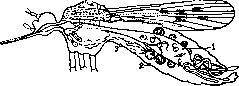
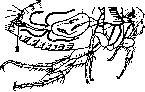
Fig. A. Development cycle of Trypanosoma Cruzi in the bug Triatoma: 1-metacyclic trypanosomes in rectum, expelled with bug feces onto human skin; 2-trypanosomes in the stomach.
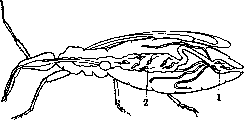
Fig. 5. Development cycle of Trypanosoma Lewisi in the flea: 1-trypanosomes in the stomach; 2-metacyclic trypanosomes in rectum.
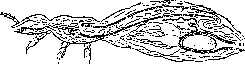
The spread of spirochetes of recurrent fever in the body of the louse. Spirochetes can exit the body cavity only when the legs, antennae are broken or when the coverings are ruptured. (housefly and typhoid fever, etc.). Therefore, the fight against V., in whatever special forms it may be expressed, is fully elevated to the level of prevention of the diseases they spread (fighting mosquitoes and prevention of malaria, fighting Ornithodorus and prevention of tick-borne relapsing fever, fighting lice and parasitic typhus, etc.). It should be noted that in the USSR, measures to combat V. are increasingly becoming common practice in preventive work (see Disinsection). Lit.- see literature for the articles Insects, Parasitology, Protozoology, Entomology and Epidemiology.
Related articles
Mentioned in
Cite this page
“Vectors.” Soviet Medical Encyclopedia. English translation of Bolshaya Meditsinskaya Entsiklopediya, 1st ed. (Moscow, 1928–1936), ed. N. A. Semashko. https://sovietmedicalencyclopedia.pages.dev/article/vectors/